Custody and co-parenting blog
Field notes, statistics and practical advice for parents keeping records through separation, mediation and court.
- 42 articles
- Free to read
- US terms

How to document a missed handover factually
Document a missed handover with factual wording, evidence labels, a realistic annotated entry, and a chronology that preserves context.
ReadWhat to record in a custody journal
A practical custody-journal contents checklist with inclusion rules, realistic entries, evidence references and a monthly chronology method.
ReadHow to prepare custody records for your lawyer or solicitor
Prepare a focused custody-record review pack with an issue list, chronology, question sheet, evidence index and transparent gaps for a lawyer or solicitor.
ReadCustody journal vs notes app: when notes stop being enough
Plenty of parents start custody documentation in Apple Notes or Google Docs. Here's what a notes app does fine, where it breaks down, and when a dedicated custody journal earns its keep.
ReadHow to document co-parenting: the complete method
A complete co-parenting documentation method with a two-minute record template, factual rewrites, evidence rules, and a chronology workflow.
ReadCustody journal examples: five entries done right
Five worked custody journal examples, from a late pickup to a money dispute and a neutral day, with every wording choice explained.
ReadHow to organize custody evidence
Organize custody evidence with an issue map, master index, chronology, source files and a review workflow that keeps relevant material easy to find.
ReadHow to organize text messages for custody evidence
Preserve custody-related text messages with sender, date, surrounding context, originals, issue tags and chronology references instead of isolated screenshots.
ReadHow to prove parenting time
How to prove parenting time actually exercised: the scheduled-vs-actual log, third-party corroboration from schools and activities, and how overnights get counted.
ReadDocumenting high-conflict co-parenting without becoming part of it
A field guide to high-conflict co-parenting documentation: brief factual replies, parallel parenting, logging provocation without absorbing it, and keeping the record clean.
ReadHow to document parental alienation
How to document suspected parental alienation credibly: record specific dated behaviors rather than the label, involve professionals early, and avoid the mistakes that discredit real concerns.
ReadHow to prepare records for custody mediation
Prepare a custody mediation working pack with issues, child-focused interests, options, practical facts, proposals and an agreement log rather than an evidence dump.
ReadHow to prepare records for a guardian ad litem
Prepare child-focused records for a guardian ad litem or Children's Guardian with a role check, routine map, selective chronology and transparent source index.
ReadCustody terms, translated into plain English
Plain-English definitions of the custody terms parents actually encounter: legal vs physical custody, parenting time, right of first refusal, guardian ad litem, ex parte, and more.
ReadHow to document late or missed child support payments
How to document late, missed or partial child support payments with due dates, amounts, proof and a running payment history.
ReadHow to log denied or withheld visitation
Log denied or withheld visitation with the schedule source, proof made at the time, cancelled visits, make-up time and neutral wording for withholding.
ReadHow to document custody order violations
Document custody order violations by linking the order term, actual event, evidence, response, impact and professional-review question.
ReadHow to record verbal co-parenting agreements
Turn a spoken co-parenting arrangement into a clear written confirmation with a copyable message, version history and disagreement workflow.
ReadHow to track shared child expenses after divorce
A simple way to track shared child expenses after divorce with receipts, reimbursement status, messages and a clear running record.
ReadHow to write a factual co-parenting incident report
Write a useful co-parenting incident report with a copyable template, event-versus-interpretation test and annotated factual rewrite.
ReadHow to keep a useful co-parenting communication log
Build a communication log that tracks requests, responses, decisions and originals without turning every message into an incident.
ReadHow to document parenting time exchanges
Record parenting time exchanges with scheduled time, actual time, place, messages and issues so patterns are clear without emotional wording.
ReadWhat counts as evidence in a child custody case?
Learn which records may matter in a US child custody case, what each can and cannot show, and how to preserve texts, photos, schedules, school records, medical records and expenses.
ReadWhat do judges look for in US child custody cases?
Understand common US child-custody factors and see how California, New York, Texas and Florida use different laws, terms and starting points.
ReadRight of first refusal in child custody: meaning, examples and what to record
Learn what a right-of-first-refusal childcare clause may mean, what details control it, common examples, and how to keep a clear factual record.
ReadHow to keep useful records in high-conflict co-parenting
A selective high-conflict co-parenting record system focused on child impact, patterns, boundaries, safety and an organised chronology.
ReadCustody documentation mistakes to avoid
Ten custody-documentation mistakes with practical fixes, factual rewrites and a pre-save checklist for stronger co-parenting records.
ReadA practical co-parenting boundaries checklist
A plain co-parenting boundaries checklist for communication, schedule changes, expenses and child-focused records.
ReadWhat to look for in a custody exchange tracking app
How to choose a custody exchange tracking app that records scheduled time, actual time, messages, evidence and clean exports.
ReadHow to keep a contact log for family court
A practical contact log for family court: planned contact, actual contact, missed time, communication, evidence and review-ready exports.
ReadCustody evidence checklist: collect, verify and organize
A custody evidence checklist that separates collection, verification, indexing, chronology and professional review instead of producing an evidence dump.
ReadHow to organize records for a custody modification
Organize custody modification records around the existing order, dated change, child-related impact, attempted response and supporting sources.
ReadHow to organize photo and video evidence in custody cases
Preserve photo and video evidence with originals, dates, context, metadata notes, event links and professional-review limits.
ReadCall logs, voicemail and recording law in US custody cases
Federal law sets a one-party floor, about a dozen states go past it, and two different suppression rules apply. What that means for a call log in a custody case in the US.
ReadHow to organize school records in custody cases
Organize school records for custody preparation: attendance, lateness, teacher emails, pickup records, activities, source context and review packs.
ReadHow to organize medical records in custody cases
Organize medical records for custody preparation: appointments, instructions, medication, communication, expenses, privacy and review-ready exports.
ReadWhat Stops Successful Co-Parenting? US Statistics on Conflict and Cooperation
US co-parenting statistics show how separate households, support arrangements and conflict complicate cooperation—and how private records can help.
ReadHow Much Does Co-Parenting Cost? US Statistics on Expenses Across Two Homes
US co-parenting expense statistics show the child-support gap, duplicated costs and why shared parenting has no single national price.
ReadHow Long Does a Child Custody Case Take? US Court Data Explained
US child custody case timelines vary by state. Learn what courts measure, why there is no national average and how to maintain an ongoing case record.
ReadCo-parent harassment: examples and how to document them
Examples of co-parent harassment, which details belong in a written record, and how to log repeated contact, threats and pressure factually.
ReadWhen a co-parent makes false accusations
How to answer false accusations in a custody case with dated records: capture the exact claim, gather material created at the time, keep your reply factual.
ReadWhat happens when a parent misses visitation
What to do when the other parent doesn't show up for their parenting time: how to record no-shows, track the pattern, and keep the effect on your child factual.
ReadQuestions parents ask
Do I need an attorney to use these?
No. Many parents handle custody matters pro se, and most family courts run self-help centers. Organized, dated records help you present what happened clearly, whether you hire counsel or represent yourself.
What does a custody evaluator look at?
Evaluators and guardians ad litem look at routines, each parent's involvement and how the child is doing. They read quickly, so one factual entry per event, with the date and source, beats pages of narrative.
Is mediation required before a custody hearing?
It depends on the state and county. California, for example, requires custody mediation before a hearing, while other courts order it case by case. Domestic violence often changes the rules, so check with your local court.
Why does my state use different words?
Custody law is state law. Some states say legal and physical custody with visitation; others say parenting time and decision-making. Match your records to the wording in your own order or parenting plan.
Keep the whole record in one place
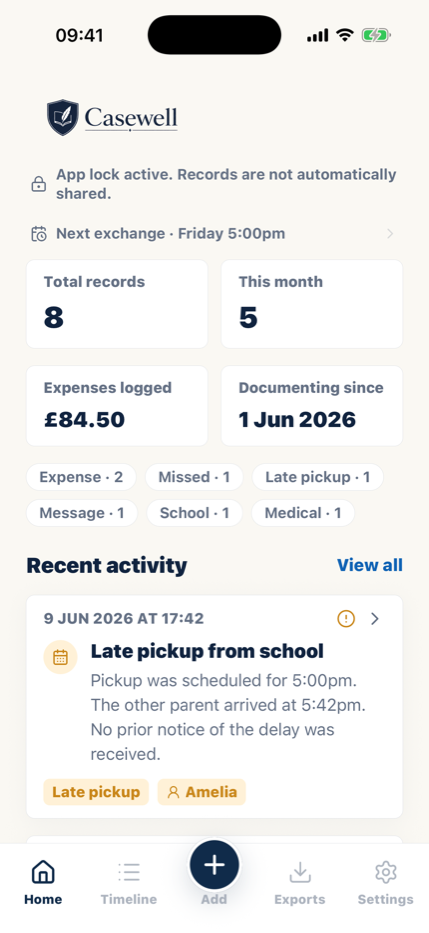
Casewell does it on your phone: dated notes, proof attached, your court dates in view, and one clear PDF for your family-law attorney.


14 days free · Private by design