
How to read this in the United States
Custody questions rarely have one US-wide answer. State law differs, and county rules differ inside a single state. Start with the order or parenting plan that actually applies to you.
Record each event with the date it happened and the date you wrote it down. Keep the whole message thread, bill or calendar item rather than a crop of it. A screenshot should never be your only copy.
A reader should be able to see what happened, when you recorded it and what changed afterwards. Take the legal questions to a family-law attorney licensed in your state.
State-and-county checklist for a US review
Put the state, county, and court on the cover sheet. Quote the custody order or parenting plan. Keep court notices and portal files in their first form. Flag a move, school line, or issue between states for legal review. Do not guess which state rule controls.
Use the camera-and-recorder rule
Write what a camera could show and a recorder could capture. Movements, times, visible condition, exact words and sequence. “Aggressive” is a conclusion; “stood within a metre, pointed a finger and shouted ‘You are not taking her’” is an account a reader can evaluate. “Neglected” is a conclusion; “the prescribed inhaler was not in the bag at collection” is an observation.
You can record a genuine concern, but label it: “I was concerned because…” followed by the observable basis. That keeps event and interpretation distinct.
Build the report in six passes
- Anchor the date, time, place and people present.
- State the expected arrangement or relevant background in one sentence.
- Describe events in order, using direct observation first.
- Put exact spoken words in quotation marks only when you remember them accurately.
- State the practical effect on the child or arrangement without exaggeration.
- Record action taken, expert contact and evidence references.
If a fact came from a message, another adult or a child, say so. Hearsay rules differ, but source labelling is useful everywhere.
Copyable incident report template
INCIDENT DATE/TIME:
RECORDED DATE/TIME:
LOCATION:
PEOPLE PRESENT:
EXPECTED ARRANGEMENT / RELEVANT CONTEXT:
DIRECT OBSERVATIONS IN TIME ORDER:
EXACT WORDS (only if accurately recalled):
INFORMATION FROM OTHERS + WHO SAID IT:
PRACTICAL IMPACT ON CHILD/ARRANGEMENT:
ACTION TAKEN / EXPERT CONTACT:
EVIDENCE REFERENCES:
FOLLOW-UP OR LATER ADDENDUM:
Before and after: emotional versus factual
Before: “He had another terrifying meltdown at handover and traumatised the children while everyone watched.”
After: “At 18:03 outside the library, J raised his voice and said, ‘They are staying with me.’ He stood in front of the rear passenger door for about two minutes. An and M remained in the car. A covered her ears and began crying. Library staff member R Patel came outside at 18:05. J moved away from the door at 18:06 and I drove away. I emailed my solicitor at 19:12. Evidence: car-park receipt IR04-A. Email IR04-B.”
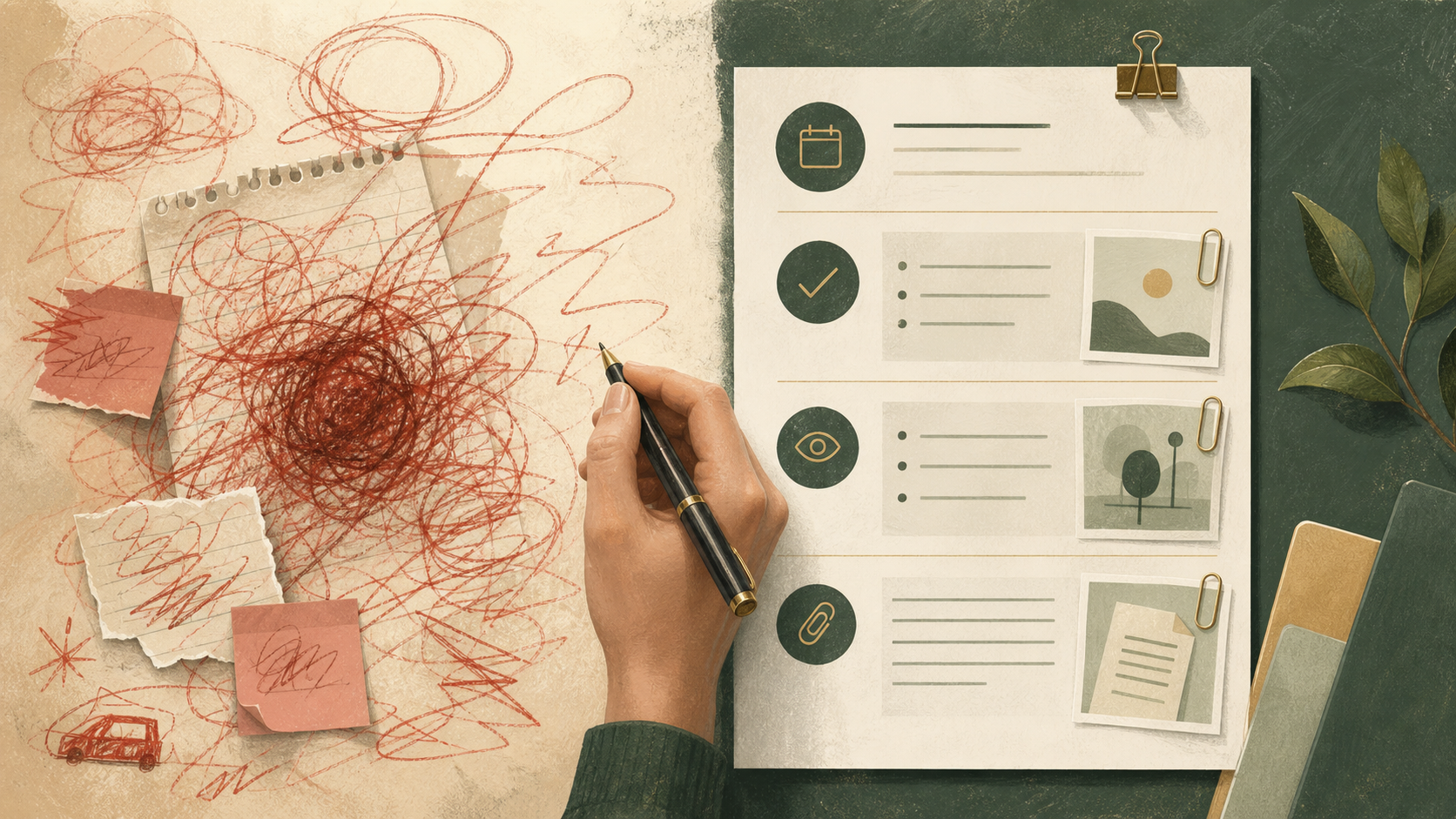
The factual version preserves serious conduct and impact. It removes loaded labels, supplies sequence, identifies a witness and cross-references the material.
Know when one report should become several
Use one report for one continuous incident. Split the record when events occur on different days, different evidence applies, or a later consequence needs its own follow-up. Link related reports with a shared tag. Don't rewrite the original to add a new development. Add a dated addendum: “On 21 May, school confirmed…”
This prevents hindsight from leaking into the first account and makes the timeline honest about when each fact became known.
Safety comes before documentation
An article cannot tell you whether an event is an emergency. If someone faces immediate danger, contact local emergency services. For child-safety, medical or domestic-abuse concerns, use the appropriate local expert or specialist service. Don't delay help to gather a better record, and don't confront someone merely to create evidence.
After immediate needs are addressed, record who was contacted, when, any reference number, and what you directly observed. Avoid declaring that a crime, breach or diagnosis occurred unless a qualified authority has established it.
A US review note
Write a useful co-parenting incident report with a copyable template, event-versus-interpretation test and annotated factual rewrite. Sharing any of it in the United States takes a few more steps.
Take one question at a time. Attach the current order, a short timeline and the source files that carry the point. Keep the rest of the record safe in case it is needed later.
Check local rules before you file or send anything. Ask a family-law attorney licensed in your state or use the court's own help pages. Rules for hidden details, proof, exhibits, and due dates vary.
Put the state and county on the review note. Use the terms from the local order. A rule or label from one state may not apply in another.
What a coherent US record looks like
Casewell keeps the dated entry, its source file and any later addition together in one private timeline. When a review is needed, select only the records that answer the question in front of you and share those with a family-law attorney licensed in your state.
Try for freeHow long should an incident report be?
Long enough to keep the material facts and short enough that each sentence does a job. A clear one-page report is often more useful than a repetitive narrative.
What if I cannot remember the exact words?
Do not use quotation marks. Write that you recall words to a particular effect, identify any uncertainty and keep any original message or recording lawfully available.
Should I include my own reaction?
Include actions relevant to the sequence, safety or child impact. Avoid defending every choice. State what you did and let the timeline show the context.
Does this apply in every state?
No. Custody law, court process and terms differ by state and often by county. Use the page as a records method and confirm legal questions locally.
Sources
Custody law, court process and terms differ by state and often by county. The official source gives orientation only. This page is a records guide, not legal advice.