 Casewell
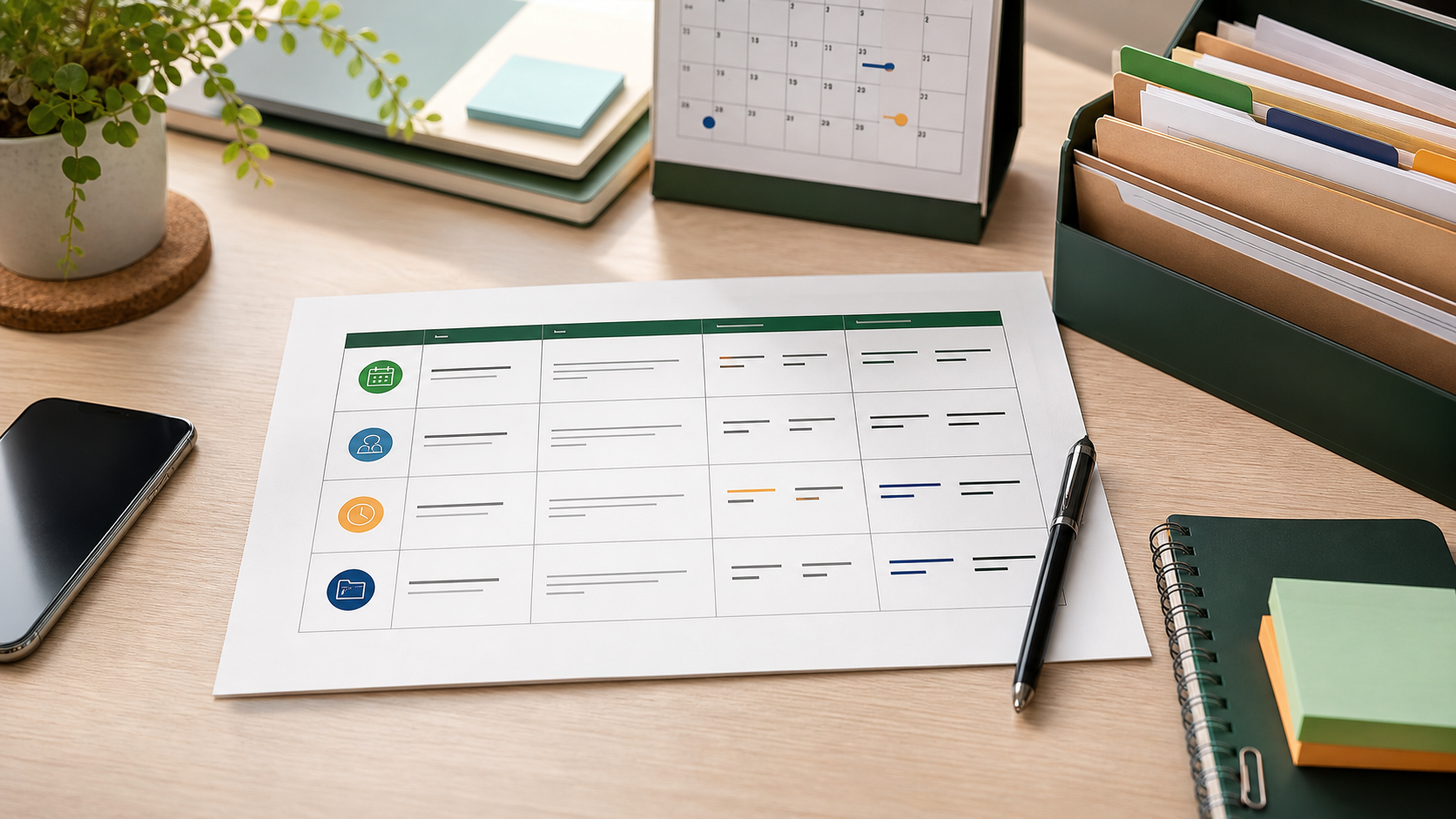
Start with the planned contact
Record the source of the plan first. The order, written agreement, calendar entry or confirmed message. Add the date, scheduled start and end, exchange place and who was expected to attend. This prevents the log from becoming a memory of disappointment rather than a comparison between plan and outcome.
Record what actually happened
Use separate fields for actual start, actual end, whether contact went ahead, and whether the contact was changed by agreement. If the reason was given in a message, summarize it and attach the full thread. If the reason is unknown, write that it was not known at the time.
Include ordinary contact too
A contact log that only records problems can look selective. Include completed contact, agreed changes and make-up time. Everyday entries give the reviewer a baseline and make repeated missed or late contact easier to count.
Connect every entry to evidence
Attach or reference the message, call log, calendar record, travel receipt, school note or witness observation that supports the entry. Do not force weak evidence into the log. A blank evidence field is better than implying proof exists when it does not.
A clearer way to prepare
Come to court ready, not stressed.
Turn messages, receipts and everyday notes into a clear attorney-ready record.
New record
Late pickup
Pickup was scheduled for 5:00 pm. The other parent arrived at 5:42 pm.
Report ready
Your report is ready
Ready for your attorney to review.
Prepare the log for professional review
Before sharing the log, filter it by date range and issue. Add a short cover note naming the question for review, such as missed weekend contact or repeated late returns. Keep originals separately and ask a qualified expert what should be included.
Use one reference for each source
Give every order, message thread, call log and file a stable ID, then use that ID in the contact row. This lets a reviewer verify an entry quickly and makes later corrections less confusing.
Contact log checklist
Use this checklist for each contact period.
Copyable contact log row
Paste this into a spreadsheet or use it as the structure for a Casewell entry.
DATE:
SCHEDULE SOURCE:
PLANNED CONTACT:
ACTUAL CONTACT:
EXCHANGE LOCATION:
WHO WAS PRESENT:
COMMUNICATION SUMMARY:
EVIDENCE REFERENCES:
CHILD-RELATED EFFECT:
FOLLOW-UP OR MAKE-UP TIME:
KNOWN GAPS:- Useful wording
Scheduled contact was 10:00-16:00 under ORD-03. Contact began at 11:12. Message at 09:48 said traffic. Screenshot MSG-044 attached.
- Weak wording
Late again and clearly does not care about the order.
Example: reviewable contact entry
The strongest entry gives the reviewer facts and limits.
- Planned
Saturday 10:00 to 16:00, exchange at library car park, source ORD-03.
- Actual
Exchange completed at 11:12. Contact ended at 16:02.
- Communication
Message at 09:48 stated traffic. No earlier notice in the thread.
- Evidence
MSG-044 screenshot and complete thread export kept.
- Limit
Reason for delay not on its own verified.
Using this guide in the US
The steps in this guide work in every state. A few things work differently here.
- Each state makes its own custody law, and court rules can change from county to county. Put your state and county at the top of your notes.
- If you or the other parent has moved to another state, the case usually stays with the state that made the first order. Ask an attorney before you file anywhere else.
- Use the words in your own custody order or parenting plan. If it says "parenting time", write that, not "visitation".
- Keep the whole message thread, bill or calendar entry, not a cropped screenshot. Note the date something happened and the date you wrote it down.
Before you share your record
Everything above is about keeping your own record. Before you show any of it to someone else, a few extra steps help.
Deal with one question at a time. Share the current order, a short timeline and the files that prove the point. Keep everything else safe in case it is needed later.
Court rules on redacting details, exhibits and deadlines vary from place to place. Check with a family-law attorney licensed in your state or your court's self-help pages before you file or send anything.
Keep a dated copy of everything you file or send. If your court uses an e-filing portal, save the confirmation for each filing with the record it belongs to.
Court timeline
Turn your screenshots into a court timeline
Have the messages and receipts as screenshots? Casewell reads them, puts them in date order and turns them into a neutral court chronology with an exhibit pack. Try it free, and pay once if you download the documents.
Or keep a dated record as things happen in the Casewell app.
Should a contact log include successful contact?
Yes. Successful and everyday contact creates the baseline that lets an expert understand whether later missed or delayed contact is part of a pattern.
Is a contact log legal evidence?
A contact log can support planning, but a court or expert decides relevance, court process and weight. Keep the source material behind each entry.
How detailed should each entry be?
Use enough detail to reconstruct the plan, actual outcome, evidence and follow-up. A short complete entry is usually better than a long emotional narrative.
Does this apply in every state?
No. Custody law, court process and terms differ by state and often by county. Use this page to keep your own record in order, and check legal questions with an attorney in your state.
Sources
Custody law, court process and terms differ by state and often by county. The official source gives orientation only. This page is a documentation guide, not legal advice.