

How to read this in the United States
Custody questions rarely have one US-wide answer. State law differs, and county rules differ inside a single state. Start with the order or parenting plan that actually applies to you.
Record each event with the date it happened and the date you wrote it down. Keep the whole message thread, bill or calendar item rather than a crop of it. A screenshot should never be your only copy.
A reader should be able to see what happened, when you recorded it and what changed afterwards. Take the legal questions to a family-law attorney licensed in your state.
Why is there no national custody-case timeline?
Each state controls its own family-court court process, terms and case management. Some systems report domestic-relations cases together. Others separate divorce, parentage, support and custody filings. A number from one state may so describe a different population from a number published elsewhere.
The National Center for State Courts keeps a comparison of state processing-time standards. It warns that standards vary by legal area and case type. A standard is a court-management goal, not the observed time for every case and not a promise to either parent.
Federal courts generally do not decide everyday custody disputes. National federal court statistics so cannot supply the missing average.
- State law and court rules
- County calendars and services
- Case type and requested orders
- Temporary order versus final disposition
Source: National Center for State Courts, case processing time standards by state — State standards differ and should not be treated as observed national custody durations
What does “time to disposition” mean?
Time to disposition runs from filing to the recorded resolution of a case. Resolution may be a final order, settlement, dismissal or another closing event. It is different from the date of the first hearing or the date an emergency request is considered.
An interim order is temporary. It can address parenting time or decision-making while the larger case continues. A parent may so receive an important ruling without the case appearing as finally disposed in court statistics.
When reading a court dashboard, check whether it counts cases, motions or hearings. Also check whether inactive periods are excluded. Those choices can materially change the reported duration.
What can state court data tell us?
State data can show local workload and how courts define completion. California reported 318,729 family-law filings and 276,903 dispositions in fiscal year 2023–24. Those figures include marital, parentage, domestic-violence, child-support and other petitions. They are not a custody-only waiting-time estimate.
The gap between filings and dispositions in one year is not a count of overdue cases. Some filings are resolved in a later reporting year, while some dispositions close cases filed earlier. It is a measure of annual court activity.
The useful question is local: what does your state and county court publish for your exact filing type? Court clerks and official self-help information can explain court process. But they cannot give legal advice.
Source: Judicial Council of California, 2025 Court Statistics Report — All reported family-law categories; annual activity, not a custody waiting-time measure
Which stages can happen before a final order?
A case may involve service of papers, a response deadline, temporary-order requests, mediation or child-custody recommending counseling, discovery, status conferences and a trial. States use different names, and not every case uses every stage.
Emergency or expedited requests follow separate standards. Receiving an early temporary ruling does not mean the entire custody case has finished. Conversely, an agreed parenting plan may avoid a contested trial if the court approves it.
Use a local attorney or official court guide to identify the next procedural event. Generic online timelines can’t account for judicial assignment, local calendars, service problems or allegations requiring more review.
Why do some custody cases take longer?
Duration can increase when parents dispute several issues, factual allegations need evidence, a custody evaluation is ordered, records must be got or a hearing is continued. A continuance moves a scheduled event to a later date. It does not by itself prove misconduct.
Court capacity matters as well. A state may have broad time standards while a person county manages vacancies, heavy calendars or limited evaluator availability. These are system conditions, not findings about the strength of either parent's position.
Complexity and conflict are related but not identical. A legally complex relocation question may take time even when messages is restrained. A high-conflict case can also resolve without trial.
What changes should you record while the case is open?
School schedules, medical appointments, exchanges, expenses and parenting-time changes continue after filing. Keep new events separate from the facts already alleged. Record the event date, when you made the entry and the source that supports it.
Do not assume every disagreement belongs in a court filing. An attorney can distinguish a material development from routine friction. For immediate safety concerns, use appropriate emergency and expert channels rather than relying on a private journal.
Keep complete source material. If a screenshot is used for quick review, keep the original conversation and enough context to identify the sender, date and sequence.

Worked fictional custody timeline entry
This example records a development without deciding whether it violates an order.
- Event and record dates
Exchange scheduled September 14, 2026 at 5:00 p.m. Entry created at 7:20 p.m.
- Expected arrangement
Temporary order, paragraph 6: Parent B collects Child A from school reception.
- Observed event
Reception closed at 5:30 p.m. Parent B had not arrived. Child A remained with Parent A.
- Supporting material
School sign-out email and complete message thread attached as EVT-041-An and EVT-041-B.
- Follow-up
Parent B reported a canceled train and proposed collection the following morning.
- Status
Alternative exchange agreed for September 15 at 8:00 a.m. No conclusion recorded about intent or violation.
How do you build a useful custody chronology?
Create one event per meaningful development. State what the current order or plan needed, what was observed and what happened next. Attach the relevant document instead of copying a long argument into the note.
Use stable references such as EVT-041 for the event and EVT-041-A for its first file. Related later events can point back to the original without changing its timestamp. This creates an audit trail when a proposed resolution, payment or make-up visit occurs later.
Factual language improves review. “Pickup scheduled for 5:00 p.m.. Message received at 5:18 p.m.” is clearer than a conclusion about intent.
How can Casewell support an ongoing custody case?
Casewell gives a private timeline that one parent can keep without requiring the other parent to join. It can connect parenting-time events, messages, receipts and supporting files to the dates they explain.
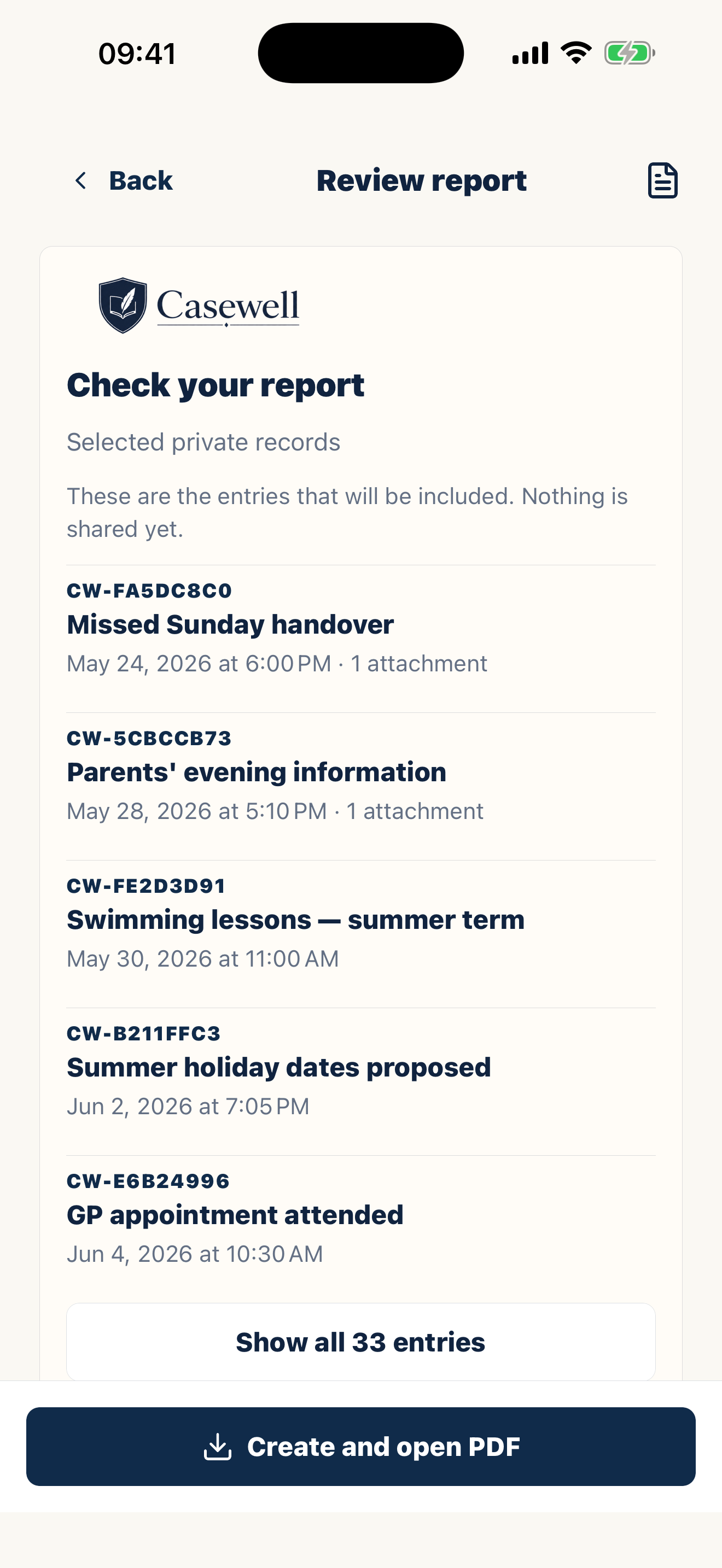
Filters help narrow the record to a relevant child, issue or date range. Selected entries can be clear into a PDF for an attorney, mediator, evaluator or court-related review. The complete working history stays private until the parent chooses what to share.
“Court-ready” means clear, dated, factual and prepared for review. Courts and experts decide relevance, admissibility and outcomes.
What do US court statistics leave out?
Administrative data count filings, hearings and dispositions. They rarely measure the hours a parent spends arranging childcare for court, locating old records, rescheduling work or managing day-to-day changes while orders remain temporary.
The absence of one national duration is itself important. It prevents a state-exact process from being presented as universal. A responsible article should state the legal area, reporting period, case type and endpoint beside every number.
Parents should also separate procedural speed from fairness or outcome. A short case is not necessarily simple, and a long case is not proof that either side caused delay.
What should you ask your attorney or court?
Ask what the next event is called, what must be filed before it and whether any current order remains in force. Confirm the deadline using the actual notice or rule rather than a generic checklist.
Ask which new events are legally material and how your court expects exhibits or declarations to be presented. A private timeline can help prepare the conversation. But it is not a substitute for needed forms, authentication or procedural rules.
If you are self-represented, use your state court's official self-help service. Court staff can usually explain forms and process while remaining neutral.
What is the practical conclusion?
There is no sound national answer to how long an US custody case takes. The useful evidence is state and county exact, and even local statistics may measure final disposition rather than the first meaningful order.
Follow the official schedule for your case and keep new developments as separate dated records. Keep the governing order, event, source and outcome connected. Ask an attorney what needs formal action.
Casewell supports that private working history and focused review by a lawyer or other expert. Keep a private, court-ready timeline while your custody case is ongoing.
State-and-county checklist for a US review
Put the state, county, and court on the cover sheet. Quote the custody order or parenting plan. Keep court notices and portal files in their first form. Flag a move, school line, or issue between states for legal review. Do not guess which state rule controls.
A US review note
US child custody case timelines vary by state. Learn what courts measure, why there is no national average and how to keep an ongoing case record. Sharing any of it in the United States takes a few more steps.
Take one question at a time. Attach the current order, a short timeline and the source files that carry the point. Keep the rest of the record safe in case it is needed later.
Check local rules before you file or send anything. Ask a family-law attorney licensed in your state or use the court's own help pages. Rules for hidden details, proof, exhibits, and due dates vary.
Put the state and county on the review note. Use the terms from the local order. A rule or label from one state may not apply in another.
Keep new events connected to your custody chronology
Casewell keeps dated developments and source files in one private timeline, with filtered PDF exports for attorney, mediator or court-related review.
Try for freeIs there an average length for a US custody case?
There is no reliable national average. State and county court steps, case types and measurement methods differ.
Is a temporary custody order a final disposition?
No. A temporary order can govern arrangements while the underlying case continues.
Should I document events after filing?
Keep a factual private timeline and ask an attorney which developments need formal action.
Does the other parent need Casewell?
No. One parent can keep a private Casewell timeline without a shared account.
What does court-ready mean?
Clear, dated and factual for expert or court-related review, without a promise of admissibility or outcome.
Does this apply in every state?
No. Custody law, court process and terms differ by state and often by county. Use the page as a records method and confirm legal questions locally.
Sources
US custody cases are handled mainly by state courts. The National Center for State Courts documents different state processing standards but does not publish one observed national custody duration. California figures used here illustrate one state system and include broader family-law types.