


How to read this in the United States
Custody questions rarely have one US-wide answer. State law differs, and county rules differ inside a single state. Start with the order or parenting plan that actually applies to you.
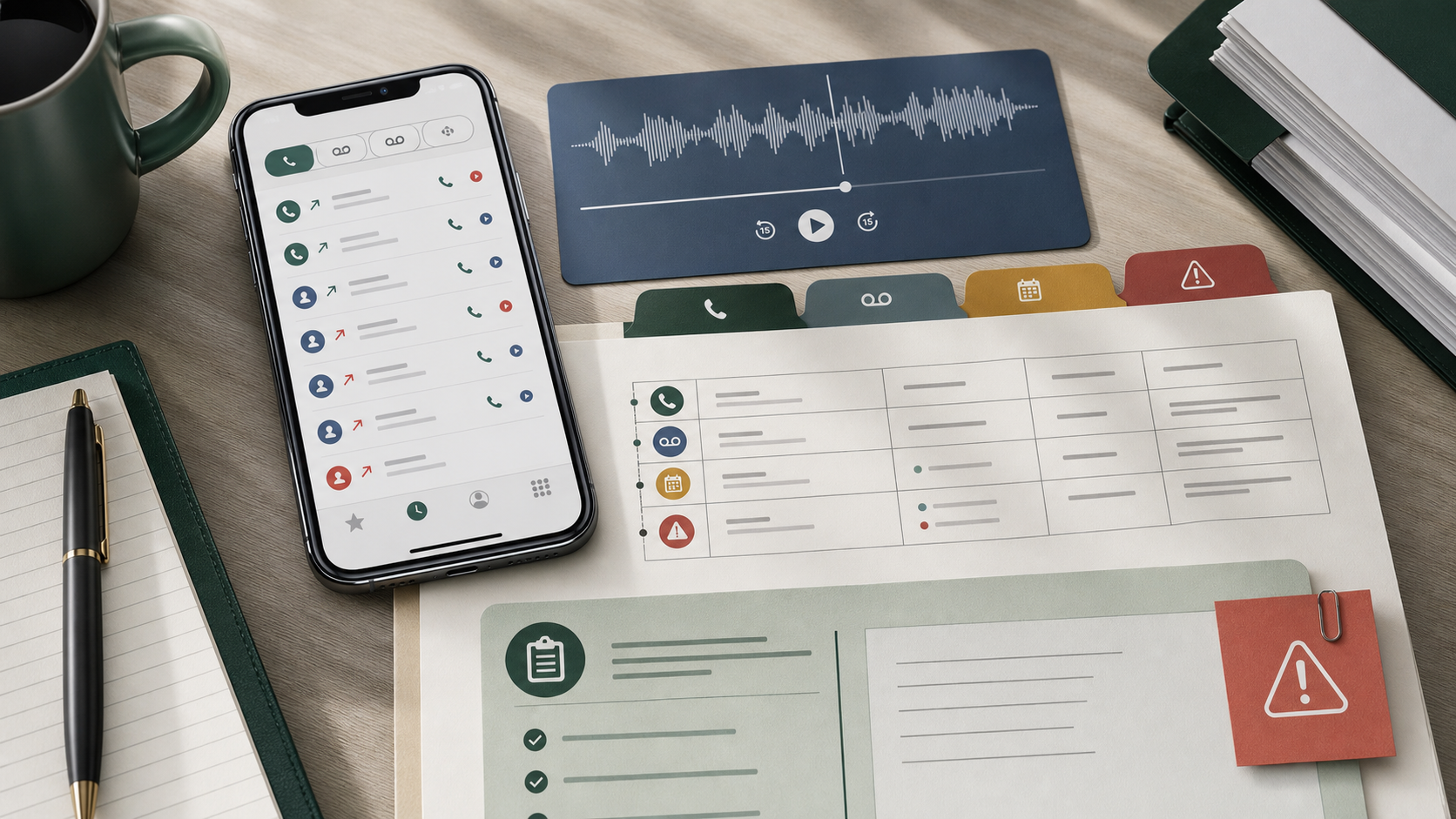
Record each event with the date it happened and the date you wrote it down. Keep the whole message thread, bill or calendar item rather than a crop of it. A screenshot should never be your only copy.
A reader should be able to see what happened, when you recorded it and what changed afterwards. Take the legal questions to a family-law attorney licensed in your state.
The federal floor, and the states that sit above it
Federal law is the part everyone quotes. Under 18 U.S.C. 2511(2)(d) it is not unlawful for a person not acting under color of law to intercept a wire, oral, or electronic communication where that person is a party to it, or where one party has given prior consent. The exception falls away if the recording is made to commit a criminal or tortious act. A violation carries up to five years under section 2511(4).
That is a floor and nothing more. States are free to demand more, and about a dozen of them do, requiring every party to a call to agree before anyone can record it.
California is the largest of those states. Penal Code 632(a) makes it a crime to intentionally record a confidential communication without the consent of all parties, with a fine of up to 2,500 dollars per violation and up to a year in county jail. Section 632(c) defines the term by expectation rather than content. A conversation counts as confidential where the circumstances reasonably show that a party wanted it kept between the people on it.
The trap is the state line. When you are in a one-party state and the other parent is in an all-party state, two statutes are in play and courts do not agree on which one controls. Long-distance co-parenting is exactly the situation where this comes up. Treat the stricter of the two rules as the one that governs. Check it before you press record.
There are two suppression rules, and they are not the same rule
People compress this into one question. Was it legal? The court is answering two.
18 U.S.C. 2515 says that where a wire or oral communication has been intercepted in breach of the federal chapter, no part of its contents and no evidence derived from it may be received in evidence in any trial, hearing or other proceeding. That is a hard bar, and it is a bar on federal violations.
A recording that broke your state statute rather than the federal one is not reached by section 2515 at all. It is reached by whatever your state wrote. California Penal Code 632(d) says evidence gathered in breach of the section is not admissible in any judicial, administrative, legislative or other proceeding.
So the useful question has three parts. Which statute would this recording break? Does that statute carry its own bar on using the material? And is a judge going to hold the making of it against me in a case about my child?
That third part has no citation and decides more cases than the first two.
Recording your child's call with the other parent
This is the question parents actually arrive with, and it has the least settled answer on the page.
In Pollock v. Pollock, 154 F.3d 601, the Sixth Circuit adopted what is called vicarious consent. A parent may consent on behalf of a minor child to the recording of the child's calls where the parent holds a "good faith, objectively reasonable basis" for believing that the recording is needed and in the child's best interest.
Courts have split on it since. Washington's Supreme Court declined to adopt the doctrine in State v. Christensen, reasoning that its all-party statute gives its residents more protection than the federal rule does.
So whether the same act is lawful, a state crime, or a federal one depends on where you are standing. It also depends on the honesty of the belief. A court examines that after the fact, with the recording in front of it.
The answer is not to work it out from a page like this one. If you think a call with your child needs recording for the child's safety, that is a conversation to have with an attorney licensed in your state before you record, not after.
You cannot subpoena the contents from the phone company
This surprises people every time. The Stored Communications Act, at 18 U.S.C. 2702(a), says a provider of an electronic communication service to the public shall not knowingly divulge the contents of a communication it holds. Section 2702(b) then lists the exceptions, and civil discovery is not among them.
A subpoena to the carrier in a custody case will not produce the text of the messages or the audio of the voicemail. The copy on the handset is the copy that exists. Save it off the phone.
What you can get is your own account. Customer proprietary network information under 47 U.S.C. 222 covers the numbers you called and the frequency, duration and timing of the calls. Carriers have to password-protect access to it. This is why the process feels slower than it should.
It reaches your account and not the other parent's. Getting someone else's records by pretending to be them is a federal crime in its own right under the Telephone Records and Privacy Protection Act of 2006. People talk themselves into this one. Do not.
When the other parent blocks the calls, using California as the worked example
There is no national form here. Enforcement is state law and often county practice on top of it. California is the largest example and shows the shape of the problem.
Family Code 3028 lets a court order financial compensation where a parent has been thwarted while attempting to exercise custody or visitation rights. Those rights can come from an order or, notably, from a written or oral agreement between the parents.
The filing threshold is why a call log earns its keep. Under 3028(c) the motion has to allege, under penalty of perjury, one of three things. At least 100 dollars of expenses. Or at least three occurrences of failure to exercise custody or visitation rights. Or at least three occurrences of thwarting, within the six months before filing.
Three occurrences inside a six-month window is a counting problem. It is won or lost by whether somebody wrote each one down on the day it happened. Compensation is limited to reasonable expenses. This can include the value of caretaker services rather than only what a third party charged.
Contempt is the other route, and a heavier one. California uses form FL-410 with form FL-412 for custody and visitation violations. The state's own self-help guide warns that contempt is criminal in nature and can carry jail. It tells people to get a lawyer for it.
If the order was made in another state, expect to register it in the enforcing state first. Every state has its own version of the UCCJEA article that governs that step.
What travels across all fifty states
Almost nothing on this page is national. The recording rule, the suppression rule, the compensation statute and the contempt forms all change at the state line, and the vicarious consent question changes with them.
The habit travels. Date, scheduled time, each attempt with its own time, the outcome, the reason the other parent gave, and whether the call was ever made up. Written the day it happened, in words you would be content to read aloud.
That record is what lets an attorney licensed in your state tell you quickly which of these routes is even open to you. Without it, the first month of the case is spent reconstructing what you already knew.
State-and-county checklist for a US review
Put the state, county, and court on the cover sheet. Quote the custody order or parenting plan. Keep court notices and portal files in their first form. Flag a move, school line, or issue between states for legal review. Do not guess which state rule controls.
A US review note
Federal law sets a one-party floor, about a dozen states go past it, and two different suppression rules apply. What that means for a call log in a custody case in the US. Sharing any of it in the United States takes a few more steps.
Take one question at a time. Attach the current order, a short timeline and the source files that carry the point. Keep the rest of the record safe in case it is needed later.
Check local rules before you file or send anything. Ask a family-law attorney licensed in your state or use the court's own help pages. Rules for hidden details, proof, exhibits, and due dates vary.
Put the state and county on the review note. Use the terms from the local order. A rule or label from one state may not apply in another.
Copyable record for a blocked or missed call
One entry per scheduled call, with the occurrence count that compensation statutes ask for.
ORDER OR AGREEMENT PARAGRAPH:
CHILD:
SCHEDULED CALL (DATE AND TIME):
NUMBER OR APP USED:
ATTEMPTS (TIME OF EACH):
OUTCOME:
REASON GIVEN BY THE OTHER PARENT:
MESSAGE SENT AT THE TIME:
MAKE-UP TIME OFFERED OR TAKEN:
EXPENSES INCURRED (IF ANY):
OCCURRENCE NUMBER IN THIS SIX-MONTH WINDOW:
SOURCE FILE (SCREENSHOT OR VOICEMAIL):- Useful entry
Order paragraph 7, Tuesday 7pm video call with Mia. Called 19:00 and 19:13, no answer. Text sent 19:15. No reply. Not made up. Occurrence 3 since March 4.
- Avoid
A recording of the other parent made from an all-party state without checking which statute applies.
Before a recording becomes part of your case
Work through these before you record, and again before you file.
Which US route is this?
Four things get called call evidence here. They go four different ways.
Is it your phone's own call history?
Screenshot it the same week and number each occurrence. Nobody's consent is needed to keep your own log.
Is it a voicemail somebody left you?
Save the audio off the handset. A subpoena to the carrier will not produce it later.
Is it a recording of a call you were on?
Check your state and the other party's state before anything else, then ask whether it adds what a log cannot.
Is it scheduled time the other parent is blocking?
That is an enforcement question. Count the occurrences and the window, then look at your state's compensation and contempt routes.
Turning a call log into a counted, dated pattern
Casewell lets you attach source material to the exact event it explains, keep a private evidence timeline, and export selected records as a court-ready PDF for review by an attorney licensed in your state, mediation or a court hearing.
Try for freeIs it legal to record a phone call with my ex?
Federally, yes if you are on the call. 18 U.S.C. 2511(2)(d) exempts a private person who is a party to the call, or who has one party's prior consent, unless the recording is made to commit a criminal or tortious act. Your state can be stricter, and about a dozen insist that every party consents. California Penal Code 632 is one of them. If you and the other parent are in different states, two rules apply at once and courts disagree about which controls. So treat the stricter one as governing.
Can I record my child's call with the other parent?
That depends on a doctrine courts have split on. In Pollock v. Pollock, 154 F.3d 601, the Sixth Circuit allowed a parent to consent on a minor child's behalf where the parent held a good faith, objectively reasonable basis for believing it was needed for the child's best interest. Washington's Supreme Court declined to adopt the doctrine in State v. Christensen. This is the question on the page with the widest spread of answers. So take it to an attorney licensed in your state before you record.
Will a judge let me use a recording that broke the law?
It depends which law. 18 U.S.C. 2515 bars the contents of a communication intercepted in breach of the federal chapter, along with anything derived from it, in any trial or hearing. That covers federal violations only. States write their own bar, and California Penal Code 632(d) makes material gathered in breach inadmissible in any judicial or administrative proceeding. Separately, the judge is forming a view about the person who made the recording.
Can I subpoena my ex's texts or voicemails from the phone company?
No. The Stored Communications Act at 18 U.S.C. 2702(a) stops a provider divulging the contents of a communication, and the exceptions in 2702(b) do not include civil discovery. A carrier subpoena will not produce message text or voicemail audio in a custody case. The copy on the handset is the copy that exists. This is why saving voicemail audio off the phone matters so much.
My ex keeps blocking the scheduled calls. What can I do?
It is state law, so the route differs. California is a useful illustration. Family Code 3028 allows financial compensation where a parent was thwarted while attempting to exercise custody or visitation rights under an order or even a written or oral agreement. The motion must allege under penalty of perjury either 100 dollars of expenses, or three occurrences of failure, or three occurrences of thwarting, in the six months before filing. Contempt is the heavier route, using forms FL-410 and FL-412 in California. The state warns that it is criminal in nature.
How do I get my own phone records?
Ask your own carrier. Customer proprietary network information under 47 U.S.C. 222 covers the numbers you called and the frequency, duration and timing of your calls, and carriers must password-protect access to it. It reaches your account only. Obtaining another person's records by pretending to be them is a federal crime under the Telephone Records and Privacy Protection Act of 2006. Your handset log is still usually the only record of incoming calls. So save it while it exists.
Does this apply in every state?
No. Custody law, court process and terms differ by state and often by county. Use the page as a records method and confirm legal questions locally.
Sources
Federal statutes apply nationwide. Recording rules, suppression rules, compensation statutes and contempt forms are state law, and California is used here as a worked example. This is a records guide, not legal advice.
- 18 U.S.C. 2511: interception and disclosure, including the party consent exception
- 18 U.S.C. 2515: prohibition of use as evidence of intercepted communications
- 18 U.S.C. 2702: Stored Communications Act, voluntary disclosure by providers
- California Penal Code 632: recording a confidential communication
- California Family Code 3028: compensation for thwarted custody or visitation time
- California Courts Self Help: enforce a custody order
- Justia: recording phone calls and conversations 50-state survey
- California Courts: Child custody and parenting time