

How to read this in the United States
Custody questions rarely have one US-wide answer. State law differs, and county rules differ inside a single state. Start with the order or parenting plan that actually applies to you.
Record each event with the date it happened and the date you wrote it down. Keep the whole message thread, bill or calendar item rather than a crop of it. A screenshot should never be your only copy.
A reader should be able to see what happened, when you recorded it and what changed afterwards. Take the legal questions to a family-law attorney licensed in your state.
Source: US Census Bureau, Custodial Parents and Their Child Support: 2022 — 22.2 million children; residence definition, not legal custody
The national picture behind co-parenting
The Census Bureau counted 13.9 million custodial parents living with 22.2 million children while the child's other parent lived elsewhere. That was 27.1% of all under-21s living in families. “Custodial” here is a survey definition based on residence, not a ruling about legal custody.
Less than half of custodial parents—41%—reported either a court order or an informal agreement for financial support. Among parents who were supposed to receive support, about three in four received at least something. The remaining 24.5%, around 1.1 million parents, received none.
Money is only one strand of co-parenting. But it exposes a recurring problem. An arrangement can exist on paper while daily follow-through remains uncertain. The same gap can appear in schedule changes, medical information and shared expenses. When national data struggle to observe those interactions, families still have to manage them.
What the US statistics cannot tell us
A household survey sees one address at a time. It may not fully represent children who divide time between homes. Also, it does not tell us whether parents communicate well, make decisions jointly or feel safe. Child-support eligibility is not a score for parental involvement. Also, a missed payment does not by itself explain why it was missed.
Research on high-conflict divorce often uses court-involved or voluntary samples. This are not interchangeable with all separated parents. Program evaluations can show whether a particular intervention improved measured behavior among participants, not what every American family should do.
The defensible conclusion is so modest. Separate-household parenting is common. Formal arrangements are not universal. And even an obligation does not guarantee performance. Working together is a pattern of behavior—reliable information, decisions and follow-through—not a label supplied by a custody schedule.
Source: US Census Bureau, Current Population Survey Child Support Supplement — survey estimates subject to sampling variation
Where ordinary cooperation breaks down
Co-parenting creates dependencies between households. Someone must communicate a school closure, confirm a pickup, approve treatment, return equipment and account for costs. Under low conflict, these tasks are routine. Under strain, each task can become another disagreement about timing, wording or responsibility.
Distance, work schedules, housing, transportation and unequal income can make a theoretically simple plan difficult. The emotional history matters too. A request about the child may be heard through years of mistrust. New partners and different household rules add more decision-makers without adding more shared context.
This is why a shared calendar is not a complete solution. A tool can display a date, but it cannot create willingness, safety or accurate follow-through. Some parents benefit from shared systems. Others find that the system becomes another place to argue. The process must fit the relationship that actually exists.
What this says about American family life
The United States asks former partners to become long-term operational partners while support is fragmented across state courts, child-support agencies, schools, health systems and private services. Families often have to translate between those systems themselves.
Official statistics naturally count orders, households and dollars. They rarely count the mental load of keeping two homes aligned. Who remembers the form, keeps the prescription, reschedules the appointment and notices that an agreed payment never arrived? That work remains invisible until it fails.
Resources shape the appearance of successful co-parenting. Two suitable homes near the same school and flexible jobs make shared routines easier. Long travel, expensive childcare and unstable housing add friction. The numbers should not be read as proof of moral decline. They show how private relationships are expected to carry substantial administrative work, often with uneven institutional support.
How parents are reducing conflict
Cooperative parents can use a shared calendar, written decisions and regular reviews. The goal is a dependable operating rhythm, not constant contact. Confirm who will do what and by when, especially for expenses, travel and medical decisions.
When messages is strained, make it narrower. Use one appropriate channel, keep messages child-focused and address one decision at a time. State the requested response and deadline. Mediation, parenting coordination or another qualified local service may be useful depending on the state and the family's circumstances.
Some high-conflict families use more parallel structures with clearer boundaries and less discretionary contact. That approach must remain consistent with orders and expert advice. Violence, coercive control and immediate safety concerns are not everyday messages problems. Use emergency, safeguarding or specialist resources rather than waiting for a records workflow to solve them.
The value of an independent factual record
A private record cannot enforce an agreement. But it can keep what was expected and what occurred. Record the local date and time, the source of the arrangement, observable facts, the child-related effect and the next action. Keep complete messages and original receipts where possible.
Avoid loaded conclusions. “Pickup occurred at 6:24 p.m.. Scheduled time was 6:00 p.m.” is more useful than a claim about motive. Record resolved items and normal exchanges as well as problems. Add later notes as new entries so the timeline remains transparent.
Do not collect irrelevant private information or question a child for evidence. Records should reduce uncertainty, not become surveillance. If litigation is expected, ask a lawyer about preservation, disclosure and what belongs in a review pack. State rules and court practices vary.
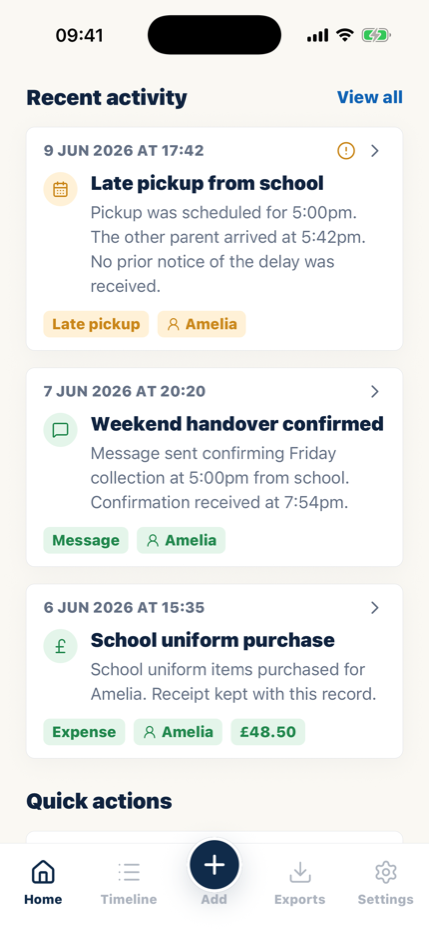
How Casewell creates a court-ready timeline
Casewell gives one parent a private system that does not need the other parent to join. Create a dated record for parenting time, an exchange, messages, an expense or a wellbeing observation. Attach screenshots and receipts to the relevant event, then search or filter the timeline later.
The optional neutral rewrite helps turn an emotional draft into factual language while leaving approval with you. Filtered PDF exports organize selected entries for attorney review, mediation or court-related planning.
“Court-ready” means calm, dated, structured and easier for an expert to review. It is not a promise that every entry is admissible or that a court will accept a particular conclusion. Casewell helps with collection and organization. Legal relevance remains an expert decision.
A five-minute record that remains useful later
A useful entry can be short. Identify the child or private reference, scheduled arrangement, event time, recorded time and source. State what happened and the practical follow-up. Attach the complete source and avoid repeating one event across several notes.
This structure matters because conflict distorts recall. Months later, a precise record is easier to test than a long narrative written from memory. The goal is not volume. It is a consistent timeline in which dates, sources and corrections remain visible.
Cooperation takes two; documentation does not
The American statistics reveal both scale and uncertainty. More than one in four children in the measured population had a parent living elsewhere, while fewer than half of custodial parents reported a support arrangement. Families are coordinating far more than a single data table can see.
Use shared tools when they work. When they become another source of conflict, keep messages appropriate and keep a clear record on your side. The purpose is not to build a case out of every irritation. It is to stop important dates, decisions, payments and outcomes from dissolving into disputed memory. Review the timeline periodically so resolved matters are marked as resolved and later notes remain attached to the original event.
Build your private, court-ready co-parenting timeline with Casewell.
State-and-county checklist for a US review
Put the state, county, and court on the cover sheet. Quote the custody order or parenting plan. Keep court notices and portal files in their first form. Flag a move, school line, or issue between states for legal review. Do not guess which state rule controls.
A US review note
US co-parenting statistics show how separate households, support arrangements and conflict complicate working together—and how private records can help. Sharing any of it in the United States takes a few more steps.
Take one question at a time. Attach the current order, a short timeline and the source files that carry the point. Keep the rest of the record safe in case it is needed later.
Check local rules before you file or send anything. Ask a family-law attorney licensed in your state or use the court's own help pages. Rules for hidden details, proof, exhibits, and due dates vary.
Put the state and county on the review note. Use the terms from the local order. A rule or label from one state may not apply in another.
Organize the facts even when cooperation is uneven
Casewell keeps parenting-time events, expenses, messages and files in one private, searchable and court-ready timeline, with filtered PDF exports for review by a lawyer or other expert.
Try for freeWhat percentage of US children live with one parent while the other lives elsewhere?
The Census Bureau estimated 27.1% of under-21s living in families in 2022, using a residence-based child-support definition.
Does a child-support statistic measure co-parenting quality?
No. It measures financial arrangements or payments, not messages, safety, parenting quality or joint decisions.
Does my co-parent need Casewell?
No. Casewell is private and works without a shared account.
What does court-ready mean?
It means factual, dated and clear for attorney or court-related review, without guaranteeing admissibility or an outcome.
What can I export?
Selected notes, dates, types, expenses, parenting-time events and files can be clear into PDF reports.
Does this apply in every state?
No. Custody law, court process and terms differ by state and often by county. Use the page as a records method and confirm legal questions locally.
Sources
The Census child-support survey describes where children lived and support reported by custodial parents. It does not measure legal custody or every shared-care household. Program studies describe selected participants and should not be generalized to all separated families.