

How to read this in the United States
Custody questions rarely have one US-wide answer. State law differs, and county rules differ inside a single state. Start with the order or parenting plan that actually applies to you.
Record each event with the date it happened and the date you wrote it down. Keep the whole message thread, bill or calendar item rather than a crop of it. A screenshot should never be your only copy.
A reader should be able to see what happened, when you recorded it and what changed afterwards. Take the legal questions to a family-law attorney licensed in your state.
What counts as a co-parenting expense?
Co-parenting expenses include several different money flows. A parent may pay child support, buy daily necessities during parenting time and contribute to agreed school or medical costs. Two homes may also need separate furniture, utilities and supplies.
Child support is a regular payment set through an order or agreement. A shared expense is a particular purchase that parents may divide. Repayment happens after one parent pays first and asks for the other parent's contribution.
These types should not be combined without checking the governing documents. A monthly support amount may cover everyday clothing in one family but sit beside separate expense rules in another. State law and the wording of an order or agreement matter.
What do the national figures show?
The Census Bureau estimated that 13.9 million custodial parents lived with 22.2 million children under 21 in 2022 while the other parent lived elsewhere. Only 41% of those parents reported a formal or informal child-support arrangement.
About 4.7 million parents were supposed to receive support. The average amount due was $6,390 for the year, or about $533 per month. The median was lower at $4,816, which means large obligations pulled the average upward.
The report uses “custodial” as a residence-based survey term. It does not measure legal custody, and it may not represent every equal-time arrangement. The figures describe support reported by one household rather than the full cost of raising a child across both.
Source: US Census Bureau, Custodial Parents and Their Child Support: 2022 — Current Population Survey Child Support Supplement; reported 2022 amounts
How large was the child-support gap?
Custodial parents were due a total of $29.9 billion in 2022. They reported receiving $19.2 billion. The report also found that 24.5%, or about 1.1 million parents due support, received no payment at all.
Receiving something did not necessarily mean receiving the full amount. The Census type “any payment” includes both full and partial payment. A parent who received one payment belongs in a different group from a parent who received nothing, even if a large balance remained.
The gap shows why an order and a payment history are separate records. It does not explain why money was missing. Income changes, enforcement, informal adjustments and reporting differences can all affect the result.
Why can two homes cost more than one?
Food and local activities usually follow the child's time. Housing and basic readiness do not. A bedroom, reliable internet, heat and storage may be needed throughout the month even when the child is staying elsewhere.
Parents may duplicate clothes, toiletries, chargers, medicine, sports equipment and school supplies. Some duplication prevents constant packing and reduces the chance that an essential item is unavailable. It also creates spending that is difficult to see in child-support totals.
Travel can be another fixed burden. Long-distance parenting may involve gas, flights, hotels and missed work. A support order may address some costs. But families should not assume that every direct expense is automatically credited.
Does equal parenting time create an equal split?
A 50/50 schedule describes time, not purchasing power. One parent may have a much higher income, carry health insurance or pay childcare directly. The homes may also face different rent, transport and school-access costs.
States use different child-support formulas and shared-parenting adjustments. An equal schedule may change the calculation. But it does not automatically reduce support to zero. A local attorney or agency can explain the rule that applies to a particular case.
Parents still need a method for costs outside the regular amount. The practical questions are whether approval was needed, what share was agreed and how payment will be documented.
Source: US Census Bureau, Current Population Survey Child Support Supplement — survey estimates; any payment includes full and partial payment
Which child expenses are easiest to misunderstand?
School fees, medical bills, childcare, activities, clothing and travel often sit between routine and exceptional spending. A receipt shows the amount and provider. It does not show whether the cost was needed, approved or already covered by support.
Health costs can arrive in stages. A parent may pay a copay, receive an insurer adjustment and later get another bill. Recording only the first amount can leave the final responsibility unclear.
Activities create similar issues. Registration, equipment, uniforms and travel may be separate charges. A useful record connects each payment to the same decision while keeping the charges distinct.
Worked fictional expense record
This example separates the purchase, agreement, request and payment. It does not decide whether the contribution is legally owed.
- Expense
September 12, 2026 · Child A · school trip deposit · $240 paid to Northfield Middle School.
- Purpose and source
Deposit needed to reserve the child's place. Full school invoice attached as EXP-024-A.
- Agreement context
Parenting order states that agreed school trips are divided 60/40. September 4 approval message attached as EXP-024-B.
- Contribution requested
$96 requested on September 12 with the invoice and receipt.
- Response
Other parent confirmed $70 and disputed $26. Complete message thread kept.
- Payment and balance
$70 received September 18. Recorded balance: $26 disputed, not described as an established debt.
What should an expense record contain?
Record the purchase date, child reference, provider, type, purpose and total. Attach the complete receipt, invoice or benefits statement. A bank transaction alone may not identify the service or the child.
Add the order, agreement or message that explains the expected split. Record the amount requested and the date sent. Keep the reply, even when it disputes the request or offers a different amount.
Keep the original expense unchanged when money arrives. Add the payment date and amount, then calculate the remaining balance. Use factual labels such as requested, part-paid, paid or disputed.
How can parents manage the record manually?
A spreadsheet works when every expense follows the same fields. Store supporting files with matching IDs and avoid putting several unrelated purchases into one row. The expense checklist and child-expense tracker give a starting structure.
Keep regular child support separate from itemized expenses unless the order or agreement says otherwise. This reduces double counting and helps an attorney identify which issue a payment relates to.
Review unresolved rows on a regular schedule. Add later payments and notes as dated updates. A complete record should also show costs that were paid without disagreement.
How does Casewell organize co-parenting expenses?
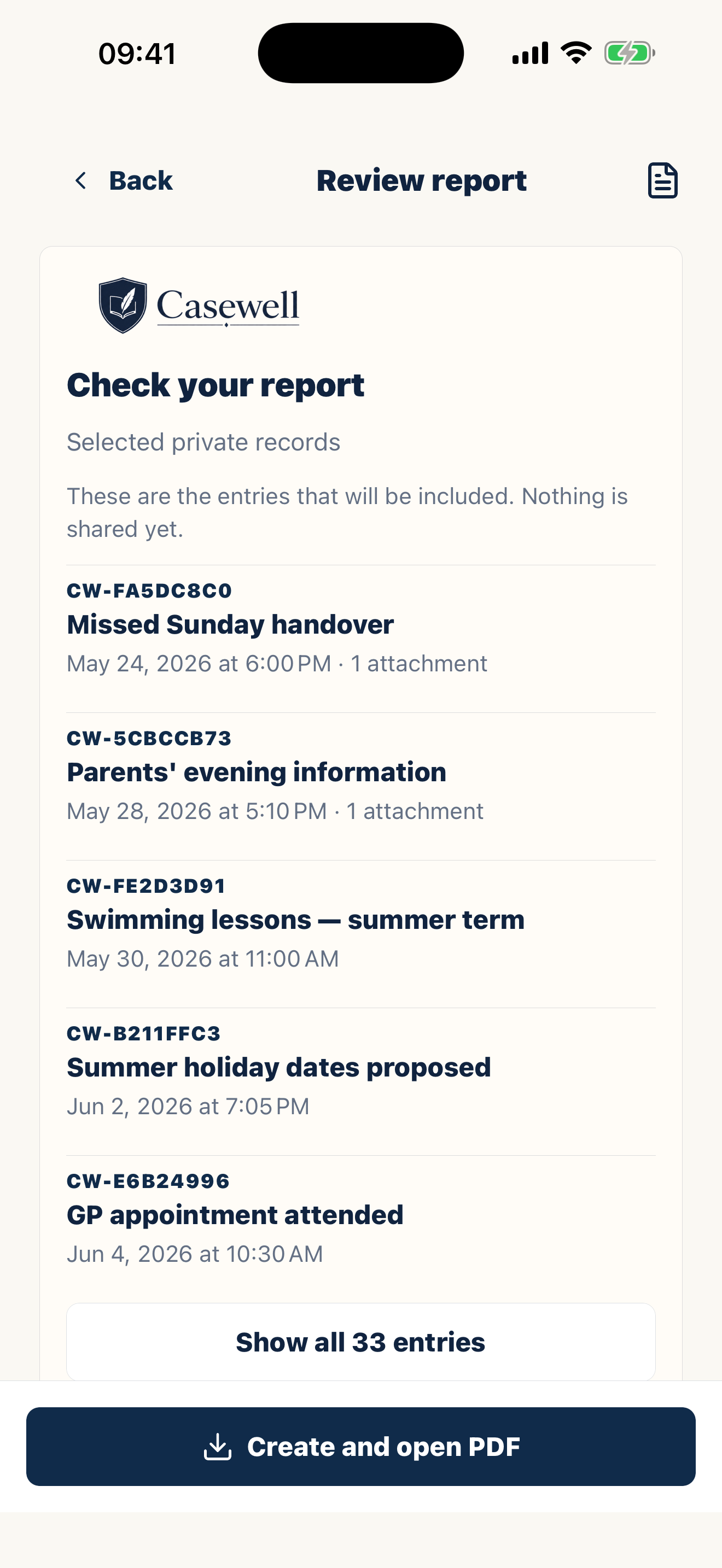
Casewell gives one parent a private timeline that does not need a shared account. Create an expense entry, add the amount and type, then attach the receipt and relevant messages to the same event.
Filters can narrow the timeline by period or topic before review by a lawyer or other expert. Selected entries can be clear into a PDF for an attorney, mediator, adviser or court-related planning. The parent decides what to include.
“Court-ready” means clear, dated, factual and prepared for review. It does not decide repayment or admissibility. An attorney or court decides what the order needs and which material is relevant.
What do the US statistics leave out?
The Census totals follow support reported by custodial parents. They do not create a combined ledger for both homes. Direct purchases, travel during parenting time and costs covered without repayment may never enter the support total.
That blind spot matters for household planning. A national payment gap can show the scale of unpaid support. But it cannot price a second bedroom or decide whether an exact school fee belongs inside an existing order. Parents need both the official calculation and an item-level history.
How should you review an outstanding expense?
Start with the document that governs the cost. Check the order, agreement or written discussion before calculating a contribution. Then compare the original receipt with any insurance payment, refund or later adjustment.
Keep the amount requested separate from the amount received. If a bank transfer does not identify the expense, record that uncertainty instead of assigning it by guesswork. This protects the accuracy of every other balance.
Use a regular review date. Add part-payments, questions and revised proposals as dated updates. Do not erase the first request when circumstances change.
Finish with a factual status such as requested, part-paid, paid, disputed or withdrawn. Include everyday resolved costs as well as disagreements. That gives an attorney, mediator or adviser a more representative history.
What is the practical conclusion?
US statistics reveal a substantial difference between support due and support received. They do not calculate the price of keeping two child-ready homes. Direct purchases, travel and duplicated equipment remain largely outside the national total.
Parents can reduce confusion by separating support, person purchases, requests and payments. Each row should answer what was bought, which source governs the cost and what happened after the request.
Casewell keeps that history with its supporting files in a private timeline. Track co-parenting expenses in a private, court-ready timeline with Casewell.
State-and-county checklist for a US review
Put the state, county, and court on the cover sheet. Quote the custody order or parenting plan. Keep court notices and portal files in their first form. Flag a move, school line, or issue between states for legal review. Do not guess which state rule controls.
A US review note
US co-parenting expense statistics show the child-support gap, duplicated costs and why shared parenting has no single national price. Sharing any of it in the United States takes a few more steps.
Take one question at a time. Attach the current order, a short timeline and the source files that carry the point. Keep the rest of the record safe in case it is needed later.
Check local rules before you file or send anything. Ask a family-law attorney licensed in your state or use the court's own help pages. Rules for hidden details, proof, exhibits, and due dates vary.
Put the state and county on the review note. Use the terms from the local order. A rule or label from one state may not apply in another.
Keep the cost, request and payment history together
Casewell connects each amount to its receipt, messages and later payments in a private timeline, with filtered PDF exports for attorney or court-related review.
Try for freeDoes co-parenting always cost more?
There is no fixed national percentage. Housing, distance, care time, income and the child's needs decide which costs move, repeat or remain fixed.
Does a 50/50 schedule eliminate child support?
Not automatically. State formulas, income differences, insurance and other costs may still produce an obligation. Get advice about the applicable rule.
Should child support and shared expenses be tracked together?
Keep them distinct unless the order or agreement combines them. Separate records make it easier to identify the purpose of each payment.
What expense information can Casewell store?
An entry can keep the date, amount, type, receipt, notes, related messages and later payment history together.
What does court-ready mean?
It means clear, dated and factual for expert or court-related review. It does not promise repayment, admissibility or an outcome.
Does this apply in every state?
No. Custody law, court process and terms differ by state and often by county. Use the page as a records method and confirm legal questions locally.
Sources
The Census survey defines a custodial parent by where a child lived, not by legal custody. It does not fully measure equal-time households or prove why a payment was missed. Support transfers, household spending and shared expenses answer different questions.