
How to read this in the United States
Custody questions rarely have one US-wide answer. State law differs, and county rules differ inside a single state. Start with the order or parenting plan that actually applies to you.
Record each event with the date it happened and the date you wrote it down. Keep the whole message thread, bill or calendar item rather than a crop of it. A screenshot should never be your only copy.
A reader should be able to see what happened, when you recorded it and what changed afterwards. Take the legal questions to a family-law attorney licensed in your state.
State-and-county checklist for a US review
Put the state, county, and court on the cover sheet. Quote the custody order or parenting plan. Keep court notices and portal files in their first form. Flag a move, school line, or issue between states for legal review. Do not guess which state rule controls.
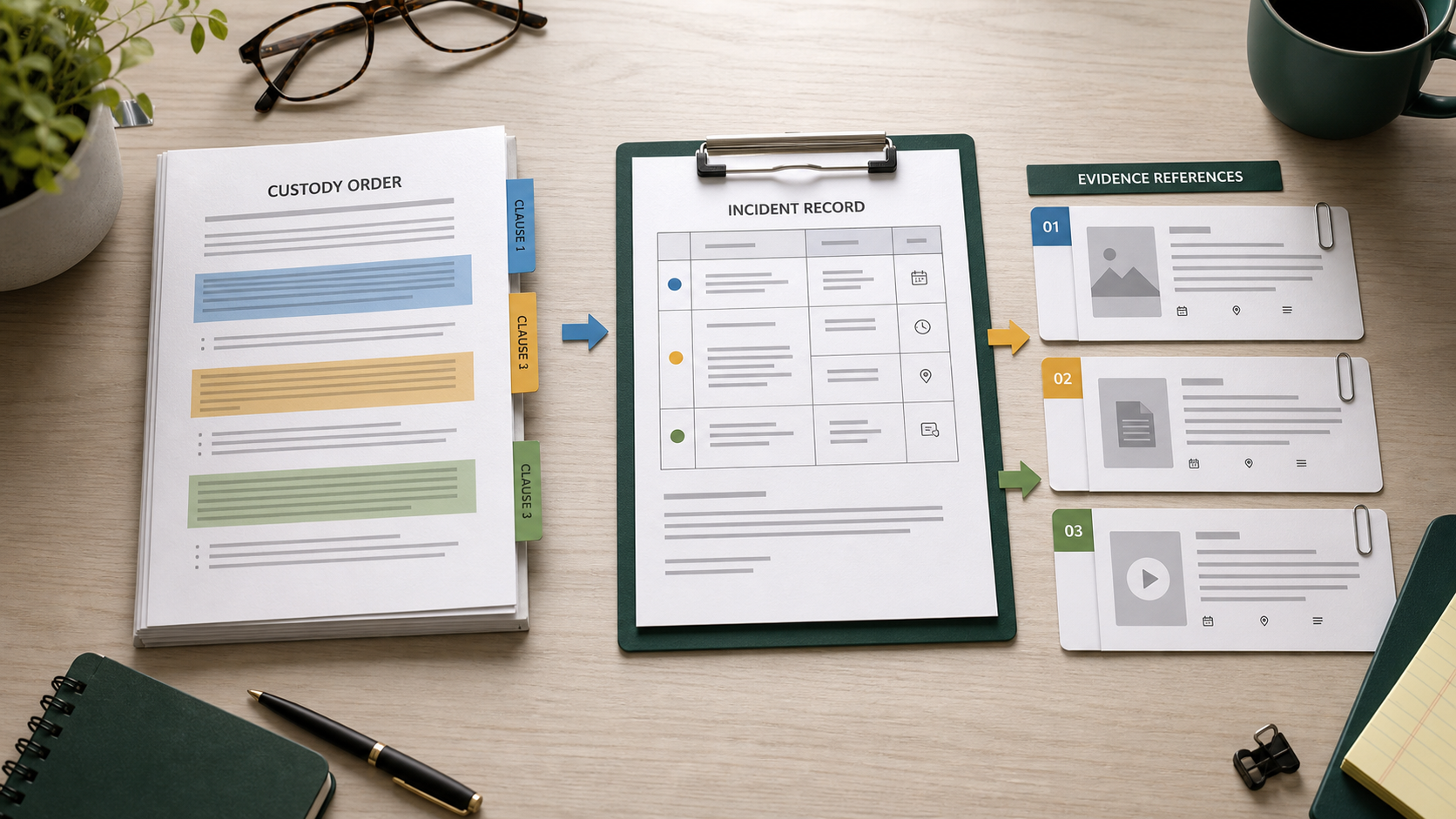
Quote the relevant term
Use the exact clause or paragraph reference from the order. Do not paraphrase from memory. A reviewer needs to see the expected duty before deciding whether the event may matter.
Describe the event separately
Record the date, time, place, people present and observable facts. Keep the event separate from the legal label. The court or expert decides whether the facts amount to a violation.
Attach the source material
Messages, calendars, school records, receipts and call logs should be linked to the event. Keep the original and use a working copy for notes. If no source exists, label the entry as direct observation.
Record your response
Your response can matter. Note whether you asked for clarification, offered an alternative, followed the needed process, attended as planned or sought advice. Avoid retaliation or unilateral changes without advice.
Turn incidents into an issue map
Group entries by order term: exchange time, holiday schedule, information sharing, expenses, phone contact or travel notice. A pattern clear by term is easier to review than a long list of frustrations.
A US review note
Document custody order violations by linking the order term, actual event, evidence, response, impact and expert-review question. Sharing any of it in the United States takes a few more steps.
Take one question at a time. Attach the current order, a short timeline and the source files that carry the point. Keep the rest of the record safe in case it is needed later.
Check local rules before you file or send anything. Ask a family-law attorney licensed in your state or use the court's own help pages. Rules for hidden details, proof, exhibits, and due dates vary.
Put the state and county on the review note. Use the terms from the local order. A rule or label from one state may not apply in another.
Clause-to-event example
Tie each event to the order term and evidence.
- Order term
ORD-04 paragraph 8: Friday exchange at 17:30.
- Expected action
Child available for exchange at school car park.
- Actual event
No exchange occurred by 18:10.
- Evidence
Messages MSG-052 to MSG-055. Arrival note in parenting-time log.
- Response
Message sent at 18:12 asking to reschedule. No reply that evening.
- Limit
Reason for non-attendance not known from the record.
Copyable custody order violation record
Use this for one possible order-related event.
ORDER REFERENCE:
RELEVANT TERM:
EXPECTED ACTION:
EVENT DATE AND TIME:
WHAT HAPPENED:
WHO WAS PRESENT:
MESSAGES:
EVIDENCE REFERENCES:
CHILD-RELATED EFFECT:
YOUR RESPONSE:
STATUS OR FOLLOW-UP:
CONTRARY OR LIMITING FACTS:- Keep separate
The event record describes what happened. The legal assessment belongs with a qualified expert.
- Include limits
Unknown facts, agreed changes and later resolutions should stay visible.
Before review by a lawyer or other expert
Check the record before you export or share it.
What a coherent US record looks like
Casewell keeps the dated entry, its source file and any later addition together in one private timeline. When a review is needed, select only the records that answer the question in front of you and share those with a family-law attorney licensed in your state.
Try for freeWhat counts as a custody order violation?
That depends on the order wording, local law and facts. Your record should show the term, the event and the source material so an expert can assess it.
Should I document every small breach?
Record recurring or meaningful events consistently, including everyday compliance. A pattern is easier to review when the records are complete and dated.
Can Casewell enforce an order?
No. Casewell helps organize records and exports. Enforcement, modification and urgent remedies need local expert advice.
Does this apply in every state?
No. Custody law, court process and terms differ by state and often by county. Use the page as a records method and confirm legal questions locally.
Sources
Custody law, court process and terms differ by state and often by county. The official source gives orientation only. This page is a records guide, not legal advice.