 Casewell
co-parentingdocumentation guides
Step-by-step guides to documenting co-parenting: what to record, how to word it, and how to get it ready for a professional.

every guidepractical, step by step and free to read
what to record in a custody journal
A practical custody-journal contents checklist with inclusion rules, realistic entries, evidence references and a monthly chronology method.
Read guide 02Getting ready for courthow to prepare custody records for your lawyer or solicitor
Prepare a focused custody-record review pack with an issue list, chronology, question sheet, evidence index and transparent gaps for a lawyer or solicitor.
Read guide 03Keeping a recordhow to document co-parenting: the complete method
A complete co-parenting documentation method with a two-minute record template, factual rewrites, evidence rules, and a chronology workflow.
Read guide 04Getting ready for courthow to organize custody evidence
Organize custody evidence with an issue map, master index, chronology, source files and a review workflow that keeps relevant material easy to find.
Read guide 05Getting ready for courthow to organize text messages for custody evidence
Preserve custody-related text messages with sender, date, surrounding context, originals, issue tags and chronology references instead of isolated screenshots.
Read guide 06Getting ready for courthow to prepare for family mediation in England and Wales
Prepare for family mediation in England and Wales with a pack covering the MIAM, shuttle or joint sessions, Our Child's Plan, legal aid and the £500 voucher.
Read guide 07Getting ready for courthow to prepare records for a guardian ad litem
Prepare child-focused records for a guardian ad litem or Children's Guardian with a role check, routine map, selective chronology and transparent source index.
Read guide 08Specific situationshow to document late or missed child support payments
How to document late, missed or partial child support payments with due dates, amounts, proof and a running payment history.
Read guide 09Specific situationshow to log denied or withheld visitation
Log denied or withheld visitation with the schedule source, proof made at the time, cancelled visits, make-up time and neutral wording for withholding.
Read guide 10Specific situationshow to document custody order violations
Document custody order violations by linking the order term, actual event, evidence, response, impact and professional-review question.
Read guide 11Keeping a recordhow to record verbal co-parenting agreements
Turn a spoken co-parenting arrangement into a clear written confirmation with a copyable message, version history and disagreement workflow.
Read guide 12Specific situationshow to track shared child expenses after divorce
A simple way to track shared child expenses after divorce with receipts, reimbursement status, messages and a clear running record.
Read guide 13Keeping a recordhow to write a factual co-parenting incident report
Write a useful co-parenting incident report with a copyable template, event-versus-interpretation test and annotated factual rewrite.
Read guide 14Keeping a recordhow to keep a useful co-parenting communication log
Build a communication log that tracks requests, responses, decisions and originals without turning every message into an incident.
Read guide 15Specific situationshow to document parenting time exchanges
Record parenting time exchanges with scheduled time, actual time, place, messages and issues so patterns are clear without emotional wording.
Read guide 16Kinds of evidencewhat counts as evidence in a child arrangements case?
Learn which records may matter in a child arrangements case, what each can and cannot show, and how to preserve messages, photos, schedules, school records, medical records and expenses.
Read guide 17How courts decidewhat do family courts look for in child arrangements cases?
Understand the welfare checklist used in England and Wales for child arrangements, including wishes and feelings, needs, harm, change and each parent's capability.
Read guide 18Keeping a recordhow to keep useful records in high-conflict co-parenting
A selective high-conflict co-parenting record system focused on child impact, patterns, boundaries, safety and an organised chronology.
Read guide 19Keeping a recordcustody documentation mistakes to avoid
Ten custody-documentation mistakes with practical fixes, factual rewrites and a pre-save checklist for stronger co-parenting records.
Read guide 20Keeping a recorda practical co-parenting boundaries checklist
A plain co-parenting boundaries checklist for communication, schedule changes, expenses and child-focused records.
Read guide 21Specific situationswhat to look for in a custody exchange tracking app
How to choose a custody exchange tracking app that records scheduled time, actual time, messages, evidence and clean exports.
Read guide 22Kinds of evidencehow to keep a contact log for family court
A practical contact log for family court: planned contact, actual contact, missed time, communication, evidence and review-ready exports.
Read guide 23Getting ready for courtcustody evidence checklist: collect, verify and organize
A custody evidence checklist that separates collection, verification, indexing, chronology and professional review instead of producing an evidence dump.
Read guide 24Getting ready for courthow to organize records for a custody modification
Organize custody modification records around the existing order, dated change, child-related impact, attempted response and supporting sources.
Read guide 25Kinds of evidencehow to organize photo and video evidence in custody cases
Preserve photo and video evidence with originals, dates, context, metadata notes, event links and professional-review limits.
Read guide 26Kinds of evidencecall logs, voicemail and recordings in UK family court
Covert recordings, voicemails and call logs in UK family court, covering the Family Justice Council guidance, PD27A bundle limits and Form C79 enforcement.
Read guide 27Kinds of evidencehow to organize school records in custody cases
Organize school records for custody preparation: attendance, lateness, teacher emails, pickup records, activities, source context and review packs.
Read guide 28Kinds of evidencehow to organize medical records in custody cases
Organize medical records for custody preparation: appointments, instructions, medication, communication, expenses, privacy and review-ready exports.
Read guide 29Keeping a recordco-parent harassment: examples and how to document them
Examples of co-parent harassment, which details belong in a written record, and how to log repeated contact, threats and pressure factually.
Read guide 30Keeping a recordwhen a co-parent makes false accusations
How to answer false accusations in a custody case with dated records: capture the exact claim, gather material created at the time, keep your reply factual.
Read guide 31Specific situationswhat happens when a parent misses visitation
What to do when the other parent doesn't show up for their parenting time: how to record no-shows, track the pattern, and keep the effect on your child factual.
Read guide 32Getting ready for courthow to print text messages for court
Print text messages for court from an iPhone or Android: what each page must show, four ways to print, how to make a PDF and how to label the pages.
Read guide 33Getting ready for courthow to export a WhatsApp chat for court
Export a WhatsApp chat for court on iPhone or Android, what the file includes, why export can be switched off and how to print it with screenshots.
Read guidequestions parents ask
Do I need a solicitor to use these?
No. Plenty of parents in England and Wales go to the family court without a solicitor. Dated records let you explain events in your own words, with a solicitor, a McKenzie friend or on your own.
What will a mediator or Cafcass ask about?
Cafcass officers and mediators want to understand day-to-day life and how it affects your child. A short, factual entry for each event is easier to talk through than a long letter. Choose the few that matter most beforehand.
Do I have to go to mediation first?
Usually. In England and Wales you normally attend a MIAM before applying for a child arrangements order. Exemptions exist, including for domestic abuse. Keeping records helps whichever route you take.
Do these work in Scotland or Northern Ireland?
Yes. A dated record works the same way anywhere. Scottish orders talk about residence and contact, and Northern Ireland has its own courts and forms, so copy the wording from your own order.
keep the whole recordin one place
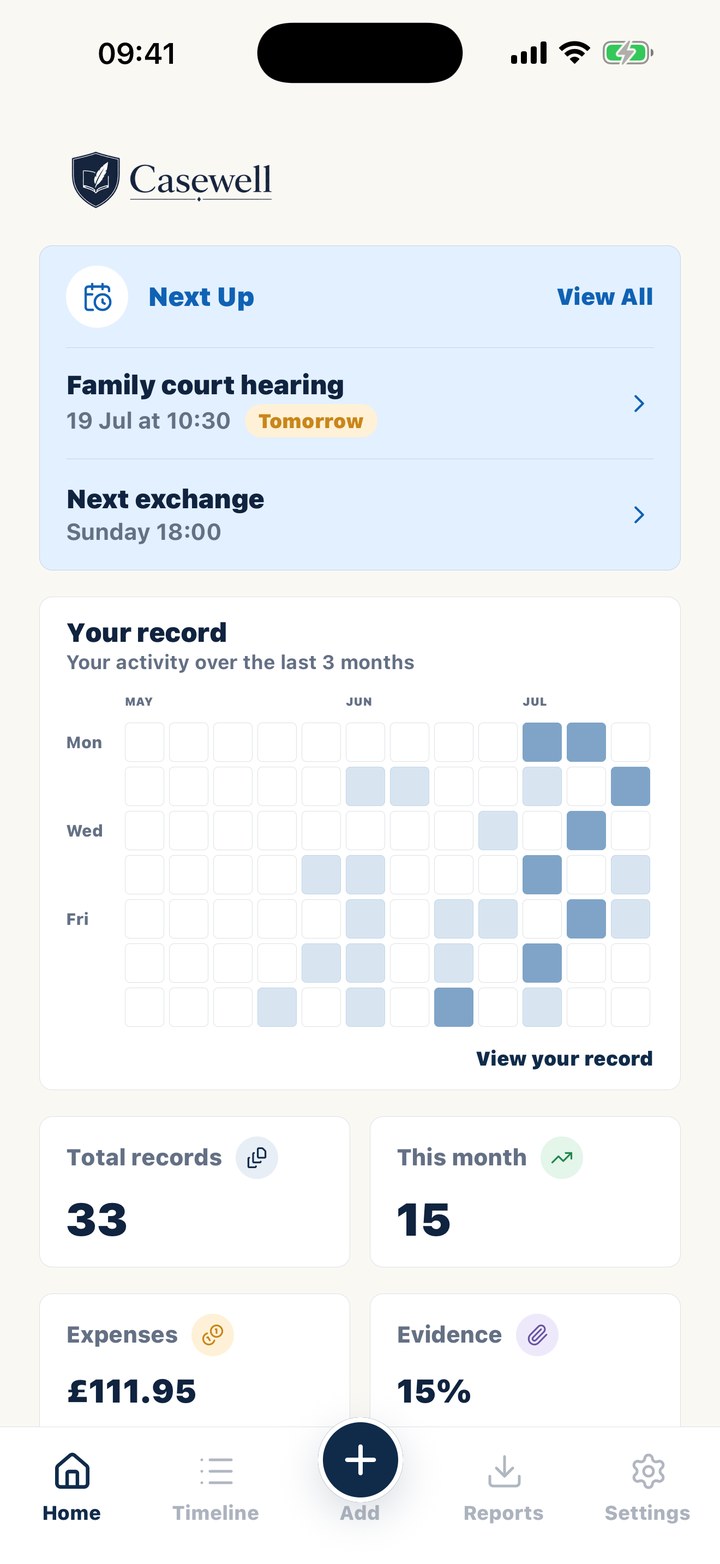
Casewell does it on your phone: dated notes, evidence attached, your court dates in view, and one clear PDF for your family solicitor.
Start free trial14 days free · Private by design