
How to read this in the UK
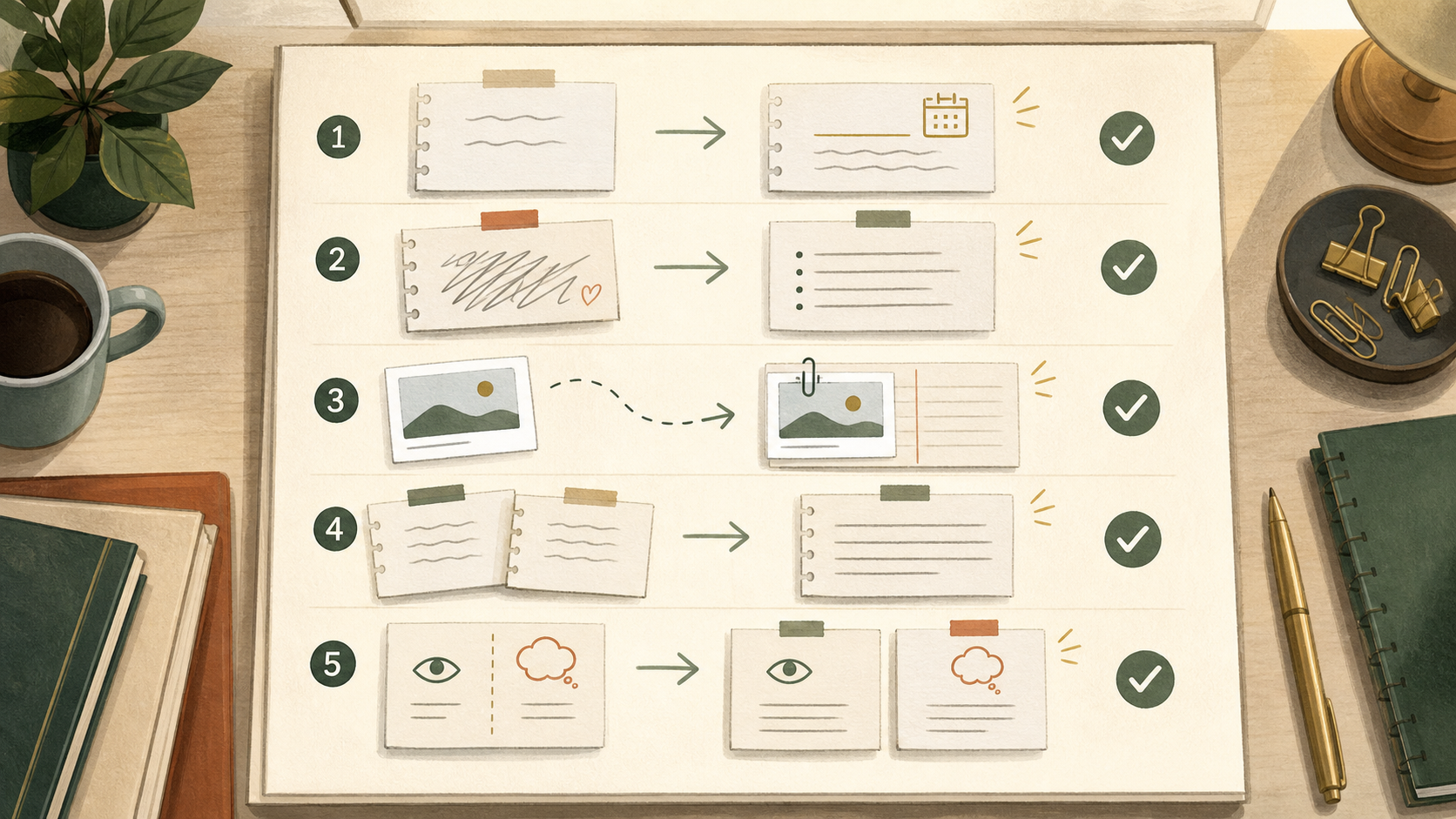
Three things need to stay separate in a record. What the arrangement says, what actually happened, and the file that shows it. Blur them together and a reader has to take your word for it. Keep them apart and the record speaks for itself.
The UK is not one family-law system. England and Wales, Scotland and Northern Ireland each have their own rules, forms and vocabulary. Use the words that appear in your own order or agreement rather than a term borrowed from somewhere else.
Keep the complete source file, not a crop of it. Write events in the order they happened, and say plainly where something is missing or unclear. A family solicitor can work with a record like that. They cannot work with a reconstruction.
Locality checklist for a UK review
Name the UK nation and court. Copy the key words from the current order or plan. Add places only when they help explain the event. Remove home or school addresses if the reader does not need them. Check the right court rules before you use a private timeline as a formal record.
Mistakes 1–3: delay, certainty and motive
- Writing weeks later as if it were immediate. Fix: show both event date and recorded date. Label reconstructed entries.
- Guessing an exact time. Fix: write “about 17:30” and state the anchor, such as a 17:26 call log.
- Presenting motive as fact. Fix: replace “did it to upset me” with the action, messages and practical consequence.
Before: “She intentionally made us miss the appointment.”
After: “The 09:00 appointment details were sent on 4 May. At 08:42 on 8 May, I received a message saying transport was unavailable. The clinic recorded the appointment as missed at 09:17.”
Mistakes 4–6: screenshots, context and editing
- Saving a cropped screenshot without context. Fix: keep date, participants and enough surrounding conversation to show meaning.
- Putting evidence in a separate camera-roll pile. Fix: attach it to the event and assign a stable reference.
- Silently rewriting an old entry. Fix: correct transparently or add a dated addendum.
A file reference such as COM-2026-05-08-A should stay the same in the journal, timeline and export. If a corrected file is created, give it a new suffix instead of replacing the original.
Mistakes 7–8: too much and too little
- Documenting every annoyance. Fix: use the relevance test—child, time, care, decision, safety, agreement, needed messages or cost.
- Recording only negative events. Fix: include material working together, resolved issues and occasional routine exchanges.
A grievance-only file can hide the baseline. If ten exchanges occurred and two were late, the eight routine outcomes help a reader understand frequency. That doesn't need essays: “Exchange at 17:00 as scheduled. No issue” is enough when a baseline matters.
Mistakes 9–10: the child and the courtroom
- Questioning a child to create entries. Fix: record direct observations and exact words volunteered without prompting. Seek appropriate expert help for welfare concerns.
- Assuming a journal is automatically admissible or ready to file. Fix: keep information first, then let a qualified local expert decide relevance, court process, redaction and evidence format.
Official court guidance commonly distinguishes factual evidence and supporting documents from the filing process. Your clear record helps planning. It does not decide the rules.
The 30-second pre-save checklist
- Have I separated event, interpretation and evidence?
- Are the event date and recorded date both clear?
- Did I identify how I know each material fact?
- Did I use exact words only when accurately recalled?
- Is the child-related impact concrete rather than assumed?
- Is the original supporting material attached with context?
- Does this need its own entry rather than an existing thread update?
- Would a neutral reader understand the sequence?
- Have I avoided unnecessary private information?
- Is any urgent action more important than finishing the note?
Repairing an existing messy record
Don't delete the past and pretend it was always tidy. Keep the original, then improve forward. Create an index mapping old filenames to events, label reconstructed dates, attach missing originals where available and add a clear note explaining the clean-up date.
Build a one-line timeline from the most relevant events first. That exercise will reveal gaps faster than rewriting every old paragraph. From today onward, use one template and one evidence-reference system.
A UK review note
Ten custody-records mistakes with practical fixes, factual rewrites and a pre-save checklist for stronger co-parenting records. Sharing any of it in the UK takes a few more steps.
Before you share any of this, work from a copy. Remove private details the reader does not need, and leave the original file untouched.
Check each key sentence. Can you link it to a date or source? If not, change the summary. Do not fill the gap with a guess.
Name the UK nation and court on the review copy. Keep the words used in the order. Ask a family solicitor about court rules and what you may need to share.
What a coherent UK record looks like
Casewell keeps the dated entry, its source file and any later addition together in one private timeline. When a review is needed, select only the records that answer the question in front of you and share those with a family solicitor.
Try for freeIs emotional wording fatal to a journal?
No. Keep the original if integrity matters, then add a factual summary or dated clarification. The strongest improvement is a consistent neutral method from now on.
Should I delete duplicate screenshots?
Keep one verified original and remove working duplicates only if your storage process is reliable. Never lose the only copy while reorganising.
Can I use AI to rewrite entries?
A rewrite can help separate observations from conclusions. But you must verify every fact, keep meaning and avoid adding details. You remain responsible for the record.
Does this cover Scotland and Northern Ireland too?
No. England and Wales, Scotland and Northern Ireland have separate family-law systems, forms and terms. Use the page to organise a working record and get advice for the relevant legal system.
Sources
England and Wales, Scotland and Northern Ireland have separate family-law systems, forms and terms. The official source gives orientation only. This page is a records guide, not legal advice.