


How to read this in the UK
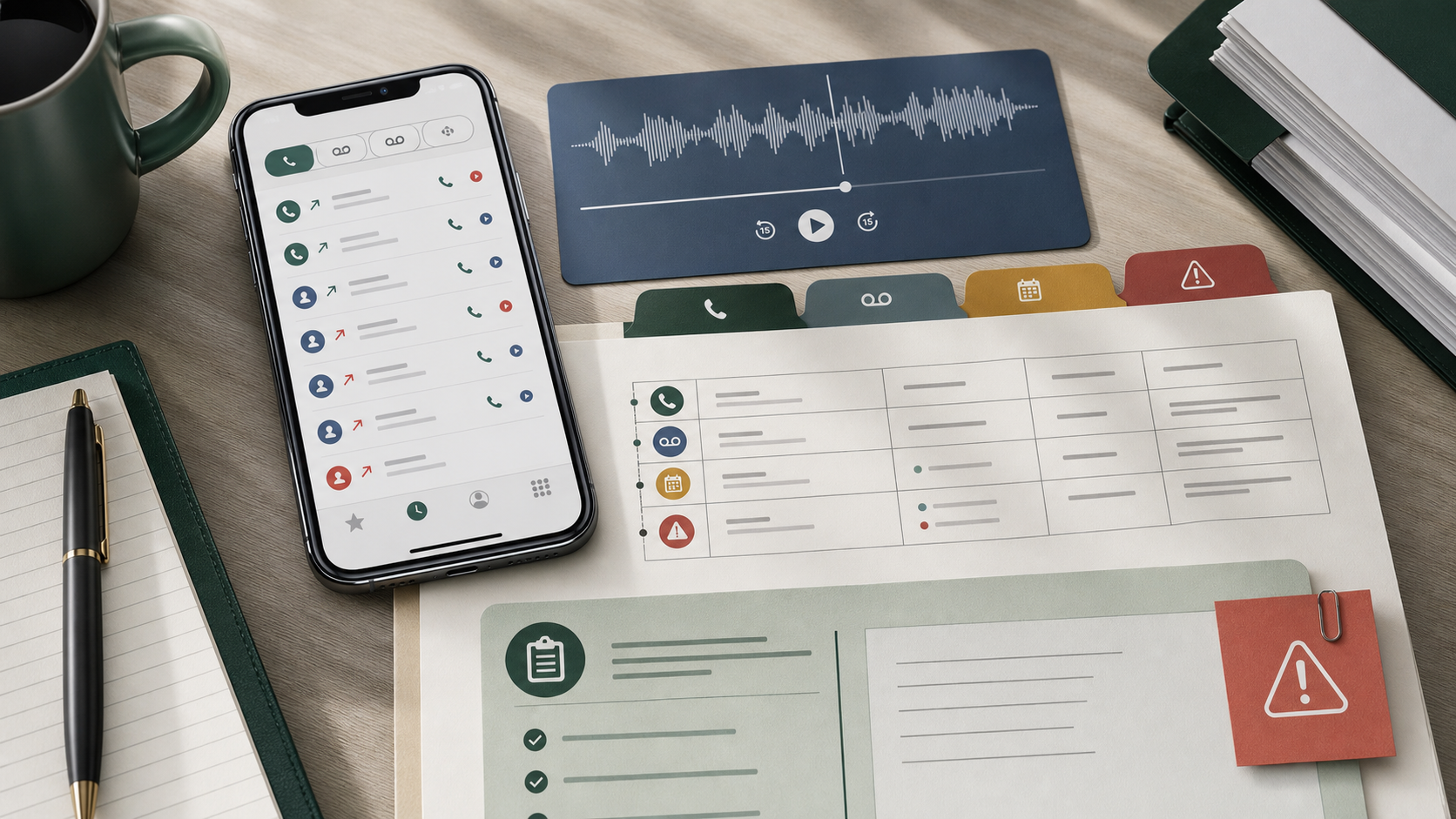
Three things need to stay separate in a record. What the arrangement says, what actually happened, and the file that shows it. Blur them together and a reader has to take your word for it. Keep them apart and the record speaks for itself.
The UK is not one family-law system. England and Wales, Scotland and Northern Ireland each have their own rules, forms and vocabulary. Use the words that appear in your own order or agreement rather than a term borrowed from somewhere else.
Keep the complete source file, not a crop of it. Write events in the order they happened, and say plainly where something is missing or unclear. A family solicitor can work with a record like that. They cannot work with a reconstruction.
What the court does with a recording, and what it does with a log
A phone's own call history and a recording of a call are treated very differently. The log is a record you keep. The recording is evidence you are asking a judge to admit, and there is a published route for that.
The Family Justice Council published guidance on covert recordings in family law proceedings concerning children in May 2025. Covert there means made without the knowledge or permission of the person recorded, whether that person is the other parent, a child or a social worker.
The guidance sets out what to do if you want a recording considered. Tell the court as early in the case as you can. Say who and what the recording is of and why it matters to the issues being decided. Be ready to hand an unedited copy to the court and to every other party if you are ordered to. The court may ask you to apply on Form C2 for permission to use it.
Expect the point to cost time. There may be a separate hearing just to decide whether the recording can be used. A written transcript may need to be prepared. Where someone brings a large number of recordings, the court weighs whether they are useful enough to justify the delay and expense.
One rule has no grey area. Recording a court hearing, including a remote hearing, is a contempt of court and can be a criminal offence.
The other parent, your child, and a social worker are three different questions
Recording the other parent is the riskiest of the three. Unless there is a very good reason why it was needed, a court may treat the recording as an invasion of that parent's privacy. The guidance goes further and says a court may decide it amounts to harassment or is wrong for another reason. That finding then feeds into what the court decides about the child's welfare. This is the part most parents do not see coming.
Recording your child sits worse still. Courts generally do not approve of it. Young people told the Family Justice Council that being recorded in secret is an invasion of their privacy and can make them feel an adult has broken their trust. A judge will weigh the effect on the child, whether the child has to be told about the recording and whether the child would have to give evidence about what is on it.
Recording a Cafcass officer or social worker is different again. Ask first, and ask to see the organisation's own policy. Cafcass says its social workers should always be open and transparent in their work. It also says there is no legal reason why a parent or carer should not record their own interview. Permission to record still does not mean a court will accept the recording into evidence.
What actually reaches the judge in England and Wales
Practice Direction 27A governs court bundles in the family court and the Family Division. Two of its rules decide what happens to a folder full of call-log screenshots.
Paragraph 5.2 lists classes of document that must not go in the bundle unless the court directs otherwise. Text messages, WhatsApp messages and any form of social media message are on that list. So are voice notes and other recordings. Paragraph 7.3(c) adds that statements go in without exhibiting or duplicating those documents.
Paragraph 11.2(b) caps an electronic bundle at 350 pages, and that limit can only be exceeded with the court's permission. A paper bundle is held to one A4 file of 175 sheets and 350 sides of text.
So the thing that carries your call history is not the screenshots. It is the agreed chronology, capped at 10 pages by paragraph 8.1, each entry limited to one sentence and cross-referenced to the page in the bundle where the document sits. Your own witness statement is capped at 25 pages excluding exhibits.
That gives you a practical test for every call you record. Can this become one dated sentence, with a named source file you can produce if the court asks for it? Keep the full archive privately. Bring the sentence.
Getting the call records you did not keep yourself
Your handset's own call log is usually the only record of incoming calls you will ever hold. UK networks do not hand those out.
O2 publishes its position plainly. A data request gets you the last 12 months of calls and texts you made. It will not give you the dates, times or numbers of calls made to you without a court order. Other UK networks draw the line in similar places, and itemised billing is not backdated. Turning it on today does nothing for last spring.
You have a right of access to your own data under UK data protection law. The request is normally free and the answer is normally due within a month. This can be extended where the request is complex. It goes to your own network about your own account. It cannot reach the other parent's records.
The consequence is simple. Screenshot the call log in the same week, not the same year. Save the voicemail audio itself rather than only a note about it. A voicemail sitting in a mailbox is deleted on the network's schedule, not yours.
When the other parent stops the calls in England and Wales
Phone and video contact is usually written into a child arrangements order as indirect contact, or set out in a parenting plan. Which of those you hold decides what you can do next.
If there is no order at all, there is nothing to enforce. Leaflet CB5 says so directly. A privately agreed arrangement cannot be enforced, and the route is an application for a child arrangements order on Form C100, normally after a MIAM unless an exemption applies.
If your order was made before 8 December 2008 it may carry no warning notice. You apply on Form C78 to attach one first. The court cannot refuse that application, and attaching a notice does not mean the court has decided anything about the past.
If there is an order with a warning notice, Form C79 is the enforcement route. Two thresholds matter more than the paperwork. The court must be satisfied beyond reasonable doubt that the person failed to keep to the order. It cannot make an enforcement order if it is satisfied that the person had a reasonable excuse.
That second threshold is where a call log earns its place. Reasonable excuse is argued case by case. So the record that helps is the one made at the time. Note the paragraph of the order that set the call, the scheduled time, each attempt you made, the outcome, the reason the other parent gave and whether the call was made up later.
An enforcement order means 40 to 200 hours of unpaid work, monitored by the probation service. Compensation is available for money actually lost, such as a forfeited holiday cost. CB5 is explicit that you cannot claim for hurt feelings or inconvenience.
One missed call is rarely worth an application. The same entry, made the same way every week over months, is a different document.
Scotland and Northern Ireland run on different statutes
Every form named above is England and Wales. The other two UK nations have their own law and their own courts.
In Scotland, contact is dealt with under section 11 of the Children (Scotland) Act 1995. There is no C79 and no unpaid work order. Where a section 11 order is not being obeyed, the route is back to the sheriff court, either to vary the order or to ask the court to hold the other person in contempt. The standard of proof for contempt is beyond reasonable doubt.
Northern Ireland runs on the Children (Northern Ireland) Order 1995, with its own courts, forms and terms.
The way you keep the record travels across all three. The forms do not. Copy the wording from your own order and ask a solicitor in the right nation which route applies to you.
Locality checklist for a UK review
Name the UK nation and court. Copy the key words from the current order or plan. Add places only when they help explain the event. Remove home or school addresses if the reader does not need them. Check the right court rules before you use a private timeline as a formal record.
A UK review note
Covert recordings, voicemails and call logs in UK family court, covering the Family Justice Council guidance, PD27A bundle limits and Form C79 enforcement. Sharing any of it in the UK takes a few more steps.
Before you share any of this, work from a copy. Remove private details the reader does not need, and leave the original file untouched.
Check each key sentence. Can you link it to a date or source? If not, change the summary. Do not fill the gap with a guess.
Name the UK nation and court on the review copy. Keep the words used in the order. Ask a family solicitor about court rules and what you may need to share.
Copyable record for a blocked or missed call
One entry per scheduled call. The fields match what a court is actually asked to decide.
ORDER OR PLAN CLAUSE:
CHILD:
SCHEDULED CALL (DATE AND TIME):
NUMBER OR APP USED:
ATTEMPTS (TIME OF EACH):
OUTCOME:
REASON GIVEN BY THE OTHER PARENT:
MESSAGE SENT AT THE TIME:
CALL MADE UP LATER (WHEN):
SOURCE FILE (SCREENSHOT OR VOICEMAIL):
AGREED CHRONOLOGY LINE (ONE SENTENCE):- Useful entry
Order clause 4(b), Tuesday 6pm video call with Sam. Called 18:00 and 18:14, both rang out. Message sent 18:16. No reply that evening. Call not made up.
- Avoid
A recording of the other parent made without telling them and held back until the final hearing.
Before you rely on a recording in England and Wales
Work through these before a recording becomes part of your case.
Which UK route is this?
Four different things get called call evidence. They go four different ways.
Is it your phone's own call history?
Screenshot it the same week and turn each event into one dated sentence. Nobody's permission is needed to keep it.
Is it a voicemail somebody left you?
Save the audio off the handset. Paragraph 5.2 keeps recordings out of the bundle unless the court directs otherwise.
Is it a recording you made without telling the other person?
Tell the court early, be ready for a Form C2 application and expect to be asked why the recording was needed.
Is it scheduled contact the other parent is blocking?
That is an enforcement question rather than an evidence question. Check whether your order carries a warning notice, then look at Form C79.
Turning a call log into one line a court can read
Casewell lets you attach source material to the exact event it explains, keep a private evidence timeline, and export selected records as a court-ready PDF for solicitor review, mediation or family court planning.
Try for freeCan I record phone calls with my ex to use in the family court?
Making the recording and being allowed to use it are two separate questions. Family Justice Council guidance says to tell the court as early as you can and to explain who and what the recording is of and why it matters. Be ready to hand an unedited copy to the court and to every other party. The court may ask you to apply on Form C2 for permission. It may also decide that recording the other parent without a very good reason invaded their privacy. That view can then affect the welfare decision about your child.
Can I record my child's phone or video call with the other parent?
Courts generally do not approve of covert recordings of children. Young people told the Family Justice Council that being recorded in secret invades their privacy and can break their trust in the adult. A judge will weigh the effect on the child, whether the child has to be told about the recording and whether the child would have to give evidence about what is on it. Take the question to a family solicitor before you record rather than after.
Can I record a Cafcass officer or social worker?
Ask first, and ask to see the organisation's policy on recording. Cafcass says its social workers should always be open and transparent in their work. It also says there is no legal reason why a parent or carer should not record their own interview. Permission to record is not the same as the court accepting the recording into evidence.
Can I put call log screenshots in the court bundle?
Not by default. Practice Direction 27A paragraph 5.2 says text messages, social media messages, voice notes and other recordings must not be included unless the court directs otherwise. Paragraph 7.3(c) says statements go in without exhibiting or duplicating them. An electronic bundle is capped at 350 pages. What carries the history instead is the agreed chronology, capped at 10 pages, with one sentence per entry.
My ex is blocking phone contact with my child. What can I do in England and Wales?
If phone or video contact sits in a child arrangements order carrying a warning notice, Form C79 asks the court to enforce it. The court must be satisfied beyond reasonable doubt that the order was broken. It cannot make an enforcement order if the person had a reasonable excuse. An enforcement order means 40 to 200 hours of unpaid work monitored by the probation service. If there is no order at all, there is nothing to enforce yet. The route is then Form C100.
How far back can I get my phone records?
Less far than most people expect. O2 says a data request gets you the last 12 months of calls and texts you made. It will not give you the numbers that called you without a court order. Itemised billing is not backdated either. Your own handset log is usually the only record of incoming calls. So save it while it still exists.
Does this cover Scotland and Northern Ireland too?
No. England and Wales, Scotland and Northern Ireland have separate family-law systems, forms and terms. Use the page to organise a working record and get advice for the relevant legal system.
Sources
The forms and rules named on this page are England and Wales. Scotland and Northern Ireland have separate family-law systems. This is a records guide, not legal advice.
- Family Justice Council: covert recordings in family law proceedings concerning children
- Family Procedure Rules Practice Direction 27A: court bundles
- HMCTS leaflet CB5: applications related to enforcement of a child arrangements order
- GOV.UK: Form C79, apply to the court to enforce a child arrangements order
- Children Act 1989 section 11J: enforcement orders
- Children (Scotland) Act 1995 section 11: court orders about parental responsibilities
- O2: requesting your personal data
- GOV.UK: Making child arrangements