

How to read this in the UK
Three things need to stay separate in a record. What the arrangement says, what actually happened, and the file that shows it. Blur them together and a reader has to take your word for it. Keep them apart and the record speaks for itself.
The UK is not one family-law system. England and Wales, Scotland and Northern Ireland each have their own rules, forms and vocabulary. Use the words that appear in your own order or agreement rather than a term borrowed from somewhere else.
Keep the complete source file, not a crop of it. Write events in the order they happened, and say plainly where something is missing or unclear. A family solicitor can work with a record like that. They cannot work with a reconstruction.
Source: Department for Work and Pensions, Survey of Separated Parents — published 2022; contact-parent survey
Locality checklist for a UK review
Name the UK nation and court. Copy the key words from the current order or plan. Add places only when they help explain the event. Remove home or school addresses if the reader does not need them. Check the right court rules before you use a private timeline as a formal record.
The headline UK statistics
The Department for Work and Pensions asked separated parents what prevented successful co-parenting. Conflict or a poor parental relationship was the most common answer, selected by 30%. A lack of support from the other parent followed at 25%. Only 15% said there were no barriers.
Those answers matter because they are not abstract attitudes. Conflict was linked to a large difference in everyday decision-making. Fifty-three per cent of parents classified as low conflict said important decisions were made jointly. Among high-conflict parents, only 16% said the same. Nearly half of high-conflict parents—47%—had used a lawyer or solicitor, while 32% had used the family court.
The survey does not say that every disagreement becomes a legal dispute. It does show that working together is not merely a pleasant extra. It affects how decisions are made, how arrangements are kept and how much outside help families need. When parents cannot rely on one another to communicate or follow through, even everyday tasks such as confirming a school trip or reimbursing a prescription can acquire a disputed history.
Source: Department for Work and Pensions, Survey of Separated Parents — conflict groups are survey classifications
What these figures do—and do not—measure
The DWP survey used a conflict classification based on parents' answers. Its findings describe the contact parents who responded. They are not a census of every separated family and they do not on its own verify each parent's account. Several barriers could be selected, so 30%, 25% and 15% should not be added together as if they were parts of a single total.
Co-parenting is also wider than a residence schedule. A child may spend similar time in two homes while parents struggle over information, costs or decisions. Another family may use a primary-home arrangement while both parents communicate reliably and support the child's relationship with the other. Parenting time, legal responsibility, financial maintenance and practical working together overlap. But none is a substitute for the others.
Correlation needs care too. Low conflict may make shared decisions easier. Shared routines may also prevent some conflicts. Income, housing, distance, work patterns, safety concerns and the history of the relationship may affect both. The responsible conclusion is not that one arrangement causes harmony. It is that working together depends on conditions that statistics about a court order or registered address rarely capture.
Why conflict changes ordinary parenting work
After separation, the intimate relationship ends but the administrative relationship often expands. Two homes may need to coordinate school information, medical appointments, activities, travel, clothing, expenses and changes to parenting time. Each task creates a small dependency. One person needs accurate information or timely action from the other.
In a cooperative relationship, those dependencies are barely visible. A message is answered, a receipt is reimbursed and a change is confirmed. Under strain, the same tasks create repeated uncertainty. Was the change agreed? When was the school letter sent? Was the expense discussed? What happened after the missed collection? The conflict is often carried by accumulated ambiguity rather than one dramatic incident.
A lack of support can be practical, emotional or financial. It may mean one parent carries the planning load, that agreed actions are not completed, or that every exception needs a fresh negotiation. New partners, long journeys, insecure housing and inflexible work can add pressure. None of these automatically proves bad parenting. Together, but, they can make working together fragile.
What the numbers say about modern family life
There is a social contradiction at the centre of co-parenting. People are expected to separate emotionally while continuing to operate a small, high-stakes organisation together. They may have ended the relationship because trust and messages failed. Yet the post-separation system asks them to exchange accurate information, share costs and make child-focused decisions for years.
Public data measure what institutions can see. Court applications, maintenance arrangements, addresses and orders. They are less able to count the invisible labour of remembering non-uniform day, finding the missing PE kit, moving an appointment or prompting another reply. That work is real even when it never reaches a solicitor's file.
Resources also shape what looks like successful working together. Two suitable homes near the same school, flexible employment and access to mediation make coordination easier. Families without those advantages face more friction even when both parents have good intentions. The statistics so describe more than person temperament. They expose how relationship history, money, time and public support meet inside everyday parenting.
How separated parents are dealing with conflict
There is no single correct messages system for every separated family. Where working together is strong, a shared calendar, concise written agreements and regular reviews may reduce mental load. The aim is not constant contact. It is dependable information and decisions that can be understood later.
Where messages is strained, narrower channels can help. Keep messages about the child, deal with one question at a time and state dates, times and requested responses clearly. Confirm a variation in writing instead of relying on memory. Family mediation or another qualified local service may help where it is safe and both parents can take part meaningfully.
When direct collaboration repeatedly creates conflict, some families use a more parallel approach. Clearer boundaries, fewer discretionary exchanges and less unnecessary contact. That does not override a court order or parenting agreement. A local expert can explain what is appropriate. If there is coercive control, abuse or an immediate safety concern, everyday co-parenting advice may be unsuitable. Use the relevant safeguarding, emergency or specialist route.
A practical record when cooperation is limited
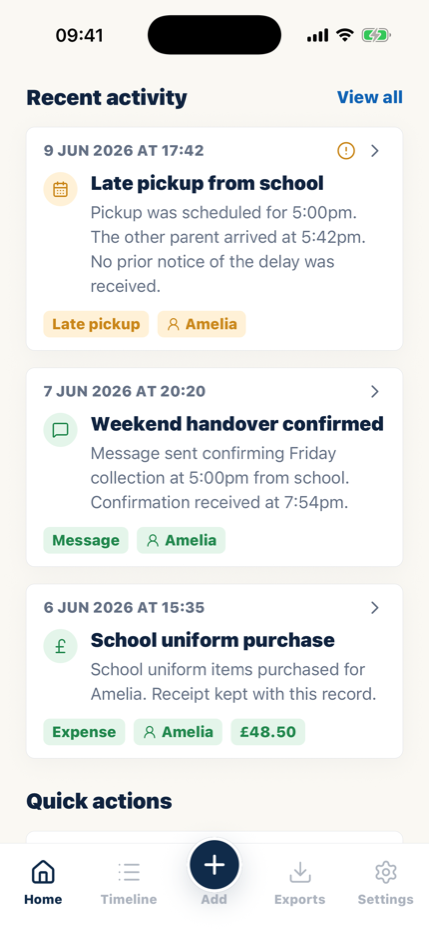
A record cannot make another person cooperate. But it can reduce your dependence on disputed memory. Record the expected arrangement, what happened, the local date and time, the source of your information, any child-related effect and what happened next. Attach the complete message thread, receipt or document where it adds context.
Neutral language is important. Write “collection was scheduled for 18:00 and occurred at 18:24” rather than “late again because they do not care”. Keep successful handovers and resolved expenses as well as problems. So totals have a fair denominator. Add later notes as dated follow-ups instead of rewriting the first entry.
Do not turn a child into an investigator or collect irrelevant information about the other household. A useful record is selective, focused and child-focused. It should help you remember, identify a pattern and prepare a focused conversation—not intensify the conflict. If sharing may have legal consequences, ask a qualified expert what is relevant and how it should be provided.
How Casewell turns scattered details into a court-ready timeline
Casewell is designed for the point where working together may need two people. But records cannot. The other parent does not need to install the app, approve an entry or take part in a shared account. You keep your own private timeline and decide what, if anything, to share.
Create one dated record for an exchange, messages issue, expense, parenting-time change or wellbeing observation. Add screenshots, photographs and receipts to the relevant event instead of leaving them scattered across messages, camera rolls and email. Search and filter the timeline when you need to reconstruct what happened.
Casewell's optional neutral rewrite can turn an emotional draft into calmer factual wording. You approve every line. Filtered PDF exports organise selected records for a solicitor, lawyer, mediator, adviser or court-related planning. “Court-ready” means dated, factual, structured and easier for an expert to review. It does not mean every entry will be admissible or accepted. This is because that decision belongs to the relevant expert or court.
The useful conclusion behind the statistics
The most revealing finding is not simply that 30% report conflict. It is the fall from 53% joint decision-making in low-conflict relationships to 16% in high-conflict ones. Working together changes what families can reliably decide together.
That does not mean every strained family is destined for court, or that records should become a campaign against the other parent. Many conflicts reduce with time, clearer boundaries or support. The practical lesson is to build systems that match the relationship you actually have, not the relationship an ideal co-parenting checklist assumes.
If shared tools work, use them well. If they become another surface for disagreement, keep messages appropriate while keeping an independent record on your side. Casewell gives that record a private, searchable and court-ready structure.
Build your private, court-ready co-parenting timeline with Casewell.
A UK review note
UK co-parenting statistics reveal how conflict, lack of support and unequal decision-making obstruct working together—and what separated parents can do next. Sharing any of it in the UK takes a few more steps.
Before you share any of this, work from a copy. Remove private details the reader does not need, and leave the original file untouched.
Check each key sentence. Can you link it to a date or source? If not, change the summary. Do not fill the gap with a guess.
Name the UK nation and court on the review copy. Keep the words used in the order. Ask a family solicitor about court rules and what you may need to share.
What a coherent UK record looks like
Casewell keeps the dated entry, its source file and any later addition together in one private timeline. When a review is needed, select only the records that answer the question in front of you and share those with a family solicitor.
Try for freeWhat is the biggest reported barrier to successful co-parenting?
In the UK DWP survey, conflict or a poor parental relationship was the most commonly reported barrier at 30%, followed by lack of support from the other parent at 25%.
Does equal parenting time prove successful co-parenting?
No. Parenting time measures where a child stays, while working together includes reliable messages, support and decision-making. The two are related but not interchangeable.
Does my co-parent need to use Casewell?
No. Casewell is a private custody and co-parenting records app. The other parent does not need an account or access to your records.
What does court-ready mean?
Court-ready means records are calm, factual, dated, clear and easier to review in court-related planning. A lawyer, expert or court still decides what is relevant, admissible or accepted.
What can I include in a Casewell export?
You can create filtered PDF reports from selected notes, dates, types, parenting-time events, expenses and files for your own planning or review by a lawyer or other expert.
Does this cover Scotland and Northern Ireland too?
No. England and Wales, Scotland and Northern Ireland have separate family-law systems, forms and terms. Use the page to organise a working record and get advice for the relevant legal system.
Sources
England and Wales, Scotland and Northern Ireland have separate family-law systems, forms and terms. The official source gives orientation only. This page is a records guide, not legal advice.