

How to read this in Australia
A record earns its weight by staying factual. Note what was planned, note what took place, and attach the file or message that supports the note.
Start from the parenting order, plan or written agreement now in force. Most family law here is federal, though Western Australia follows a different court path in some cases. Use the words that appear in your own papers.
Keep everyday days in the private record alongside the difficult ones. When a review is needed, select only the entries that answer the question in front of you. That is what lets an Australian family lawyer find the key facts quickly.
Source: Australian Institute of Family Studies, Relationships within the family — weighted subgroup n=370; more negative than earlier AIFS samples
Australia's conflict and cooperation picture
In the 2021 Families in Australia survey subgroup, 14% described the other-parent relationship as friendly and 20% as cooperative. Twenty-six per cent called it distant, 32% reported lots of conflict and 9% described it as fearful. AIFS warns that this subgroup was more negative than earlier separated-family studies and may reflect its participants and context.
Earlier nationally oriented AIFS work found that about 60–64% of separated parents continued to describe their relationship as friendly or cooperative across multiple waves. Roughly one in five experienced lots of conflict or fear around 15 months after separation.
The useful point is not to choose one percentage as the definitive national rate. It is to recognise a spectrum. A majority may set up workable routines, while a smaller group faces persistent conflict, safety concerns and disproportionate reliance on services.
Care time is not a cooperation score
AIFS's 2026 analysis of Child Support Program data found about one in seven payers and payees in shared care, defined as 35–65% of nights with each parent. Almost three in five were in arrangements where the mother had 87–100% of nights, with another one in five at 66–86%.
These are administrative types used in child-support calculations. They do not show whether an arrangement is flexible, child-focused or experienced similarly by both parents. The dataset also excludes separated parents outside the program and may lag real changes.
Shared care may be more common among parents who already have lower conflict, adequate housing and workable distance. That selection matters. An association between shared care and working together does not prove that imposing a shared schedule will create working together.
Source: AIFS, Care time arrangements after parental separation — Child Support Program participants; categories are not all mutually exclusive at parent level
Why ordinary arrangements become difficult
Post-separation parenting is a chain of small dependencies. School notices, medical consent, sport, travel, uniforms, costs and handovers. A shared schedule needs more than nights on a calendar. It needs timely information and enough trust to act on it.
One AIFS participant described the relationship as cooperative but fluctuating, saying they tried to get on with things “for the sake of the kids”. That short account captures a common reality. Working together can be deliberate work rather than evidence that hurt has disappeared.
Distance, shift work, housing costs and new relationships add pressure. When messages is already strained, each practical variation can reopen the original conflict. A system that assumes constant collaboration may then create more contact than the relationship can safely sustain.
What the evidence says about Australian society
Australia's family-law framework expects parents to remain child-focused after separation. But the data show very different capacities to do so. Most parents do not use court as their main pathway. AIFS estimated about 3%, although 16% used family dispute resolution services or lawyers in the referenced study.
That pattern is encouraging and incomplete. The small court-involved group is more likely to include violence, safety concerns and complex issues. Counting court use so understates conflict outside court and overrepresents complexity inside it.
Official systems can count nights and cases. They cannot easily count who carries the mental load across two homes. Income, suitable housing, proximity and flexible work affect whether shared care is practical. Successful co-parenting is partly relational and partly infrastructural.
How parents are responding
Where trust is adequate, parents can reduce friction with written arrangements, a shared calendar and predictable reviews. Flexibility works best when the baseline is clear. So an exception does not erase the original plan.
When messages is strained, use a defined channel, concise child-focused messages and fewer open-ended negotiations. Family dispute resolution or another qualified service may help where participation is safe and meaningful. A more parallel structure can reduce unnecessary contact. But it must remain consistent with orders and local advice.
Family violence and coercive control are not everyday co-parenting disagreements. Safety must come before a collaborative ideal. Use emergency, specialist and legal support appropriate to the situation.
Keep an independent, factual record
A record is useful when it preserves what the arrangement needed and what happened next. Note the local date and time, expected event, direct observations, source documents, child-related impact and follow-up. Keep complete messages and original receipts rather than isolated fragments.
Use neutral wording and include successful outcomes. If a note arrives later, add it as a new dated entry. Do not question children for evidence or collect unrelated information about another household.
A record cannot decide a parenting dispute. It can make expert advice more efficient by replacing “always” and “never” with a timeline that can be checked.
How Casewell helps
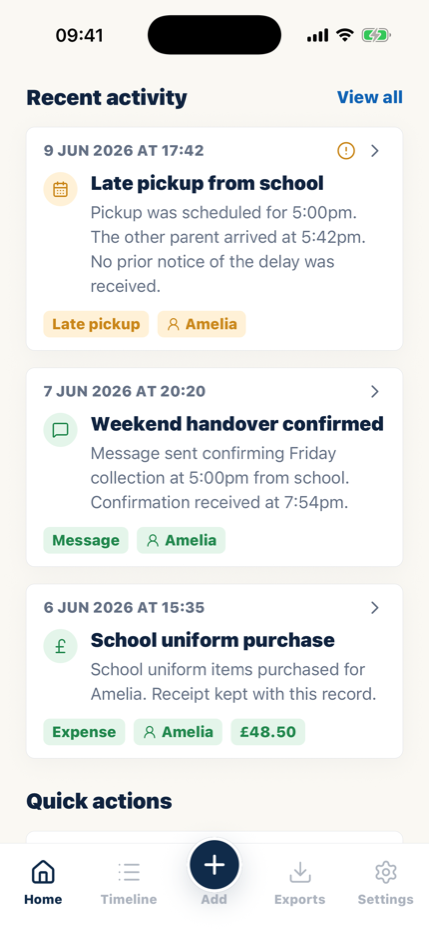
Casewell is a private custody and co-parenting journal. The other parent does not need to join. Record handovers, parenting-time changes, messages, expenses and wellbeing observations, then attach the relevant screenshot or receipt.
The optional neutral rewrite helps convert an emotional draft into calmer factual language while you approve the final wording. Search and filter the timeline, then create clear PDF exports for a solicitor, lawyer, mediator, adviser or court-related planning.
Court-ready means dated, structured and easier to review. It does not guarantee that a court will accept an item or reach a particular outcome.
A practical audit before a record is shared
Decision-making deserves its own trail. For a school, health, travel or activity decision, record the question, information provided, requested response, deadline and outcome. Keep the expert recommendation rather than paraphrasing it from memory. An unanswered request is a fact. The reason may remain unknown.
Expenses need similar context. Record the purchase date, child, type, amount, agreement, receipt, repayment request, reply and final payment. An outstanding amount does not automatically prove deliberate refusal. The request may be incomplete or disputed.
Show the denominator when describing a pattern. If two exchanges failed, record how many were scheduled and how many occurred normally. Correct mistakes visibly and label information reconstructed later.
Keep the complete private archive, but give an expert only the relevant period and types. Ask how sensitive child, school or health information should be transferred. A focused export supports review. It does not replace original sources.
What should stay out of the record
Do not catalogue everyday irritation, unrelated private life or a theory about the other parent's personality. Avoid legal labels and diagnoses unless quoting a qualified source. Record a child's spontaneous words only when materially relevant, with context and without investigative questioning.
Privacy matters even in a private app. Keep only information connected to care, time, decisions, expenses or safety. Protect account numbers and third-party details. A restrained record is easier to defend and less likely to keep the writer emotionally inside every disagreement.
Before a professional review
Define the question and date range first. Give the current order or agreement, a short timeline and an index pointing to original sources. Identify disputed facts, missing material and later corrections. Ask the expert what else is relevant and how sensitive files should be shared. This planning keeps the meeting focused on decisions instead of forcing someone to search an entire phone archive.
The practical conclusion
Australian evidence resists a simple slogan. Shared care is increasing, but it is not a substitute for trust, safety or practical capacity. Conflict is experienced by a meaningful minority and is concentrated among families needing the most help.
Use collaborative systems when collaboration works. When it does not, keep messages appropriate and protect the factual history on its own. Working together needs two willing participants. A disciplined record does not.
Build your private, court-ready co-parenting timeline with Casewell.
State, territory and pathway checklist
Name the state or territory and the court registry. Say if the plan is an order, parenting plan, or written deal. Use the words from that paper. Flag any Western Australian court path for legal review. Keep court papers, dispute help records, and daily notes in separate groups.
An Australian review note
Australian evidence shows how conflict, fear, care time and service use shape post-separation parenting—and where private records help. Sharing any of it in Australia takes a few more steps.
Work from a copy when someone needs to review the record. Include the current order or plan, a short timeline and a small set of named source files.
Check current court orders and rules before you send the pack. An Australian family lawyer can say what belongs in an affidavit, annexure, or private file.
Name the state, territory, and court path. Take extra care in Western Australia. A national guide cannot set the right court step for every case.
A private record across two homes
Casewell organises dated events, receipts, messages and parenting-time changes in a private court-ready timeline, with PDF exports for review by a lawyer or other expert.
Try for freeHow common is high-conflict co-parenting in Australia?
Rates depend on the sample. In one 2021 AIFS subgroup, 32% reported lots of conflict and 9% fear. Earlier broader studies were less negative.
How common is shared care?
In AIFS's 2026 analysis, about one in seven Child Support Program payers or payees were in shared care.
Does shared care mean cooperation is successful?
No. It measures nights, not messages, safety or decision-making.
Does the other parent need Casewell?
No. Casewell is private.
Is Casewell court-ready?
It is built for calm, dated, clear records and review by a lawyer or other expert, without guaranteeing acceptance or an outcome.
Is this a court form or affidavit?
No. It is a method for keeping a private factual record. Current court rules and expert advice decide how material is prepared or used in a proceeding.
Sources
AIFS sources use different populations. The 2021 Families in Australia subgroup had 370 respondents and was more negative than earlier separated-parent studies. The 2026 care-time figures cover Child Support Program participants, not all separated families.