

How to read this in Canada
Keep the record in layers: what the plan says, the dated event and its source, then what happened next. A fact stops being useful the moment it is written up as a legal conclusion.
Canadian rules can come from federal, provincial or territorial law. Start with the order or plan that applies to you, and keep its exact terms, such as parenting time or decision-making responsibility.
If you need to correct an error, add a dated note rather than editing the original. Keep routine events near the disputed ones so a family lawyer in your province or territory can judge which facts actually matter.
Source: Justice Canada, Parent-reported parenting arrangements after separation or divorce — weighted survey; n=913 separated or divorced parents
Canada's changing parenting arrangements
Justice Canada's July 2026 analysis of 2017 General Social Survey data found that 25% of parents reported shared parenting time, defined as the child living 40–60% of the time with each parent. That was up from 9.4% in 2011.
At the same time, 44.2% reported exclusive residence with one parent. Another 30.7% described a majority-time arrangement rather than an equal split. Mothers and fathers reported arrangements differently, a reminder that one respondent's account may not represent both perspectives.
The increase in shared time is socially major. It shows changing expectations about involvement after separation. It does not tell us whether decisions are joint, whether messages is safe or whether the schedule remains workable over time.
The child's experience is broader than the schedule
Statistics Canada estimated that 18% of children aged 1–17—about 1.19 million—had experienced parental separation or divorce by 2019. Among them, 21% spent equal time with the other parent, 36% had regular visits, 17% irregular visits, 8% remote-only contact and 19% no contact.
These types describe frequency, not relationship quality. Regular contact can coexist with conflict. Limited contact may reflect distance, a child's needs or safety. The survey also found that 61% of affected children had moved at least twice and 37% had a sibling in another home, showing the wider complexity around household change.
Successful co-parenting so cannot be reduced to a percentage of nights. It involves stability, information, support and decisions that serve the child.
Source: Statistics Canada, Canadian Health Survey on Children and Youth 2019 — reported from the surveyed household
Where cooperation becomes difficult
The practical work crosses provincial systems, schools, health care, activities and two household budgets. A parent may need consent, information or repayment from someone with whom trust has broken down. Shared decision-making can need negotiation even when the parenting schedule is clear.
Justice Canada interviews found that extracurricular activities and more expenses could intensify tension for parents already struggling with shared decisions. The qualitative sample was small and concentrated geographically. But the mechanism is recognisable. Every new cost can become both a financial and relational decision.
Distance, housing, new partners and different routines add pressure. An app can display a schedule, but it cannot create agreement. Families need a workflow suited to their actual level of working together.
What this says about Canadian family life
Canadian policy increasingly uses parenting-time and decision-making language that separates children's arrangements from ownership-like ideas of custody. The data still show how difficult it is to measure the relationship behind those arrangements.
Administrative systems can count court orders and support. Surveys can count nights and contact. They rarely capture the mental load of moving school information, clothing, medication and deadlines between homes. That invisible work becomes visible mainly when it fails.
Geography and resources matter across a large country. Long travel, remote communities, housing costs and provincial service differences affect what is practical. Rising shared time may reflect stronger involvement. But it may also be easier for families with proximity, income and flexible work.
How parents can reduce uncertainty
Where working together works, use a shared calendar, written decisions and planned reviews. Clarify who will act, the deadline and how a cost will be handled. Keep the baseline arrangement visible when agreeing to a one-off change.
Under strain, narrow messages to the child and the decision at hand. Use one appropriate channel and avoid reopening unrelated history. Mediation, parenting education or local expert support may help where participation is safe.
A parallel approach with firmer boundaries may suit some high-conflict situations, subject to orders and local advice. Family violence or coercive control needs specialist safety planning, not pressure to collaborate.
Build an independent factual chronology
Record the expected event, source, local date and time, what directly occurred, the child's practical impact and the follow-up. Attach complete messages and original receipts. Label reconstructed information and correct mistakes transparently.
Use neutral descriptions rather than diagnoses or motive. Include successful exchanges and resolved payments so the record does not hide the denominator. Never ask a child to investigate the other home.
A timeline does not decide a legal outcome. It makes memory testable and can help a lawyer, mediator or adviser understand a pattern without sorting through disconnected screenshots.
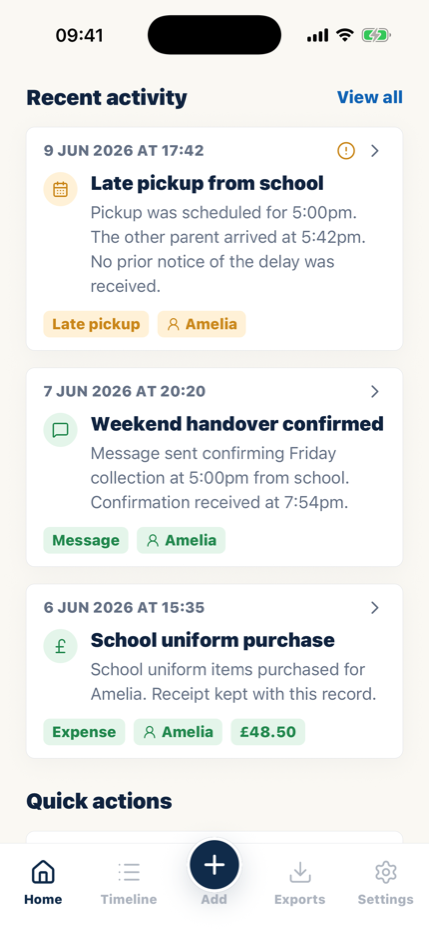
How Casewell helps
Casewell works privately: the other parent does not need an account. Add dated parenting-time events, messages, expenses and wellbeing observations, then keep files with the relevant record.
The optional neutral rewrite helps make wording calmer while you approve every line. Search and filter the timeline, then create clear PDF exports for expert or court-related review.
Court-ready means factual, dated and structured. It does not guarantee relevance, admissibility or acceptance under federal, provincial or territorial rules.
Audit decisions, expenses and outcomes separately
A parenting-time percentage does not show who gathers information and moves decisions forward. For school, health, travel or activities, record the question, material provided, response requested, deadline and final result. Keep expert advice in its original form. An absent response should remain an observation, not a conclusion about intent.
Expenses form a second working together chain. Record the date, child, type, amount, governing agreement, receipt, request, reply and payment. Separate amounts still outstanding from those paid later. An unpaid request can be incomplete, disputed or misunderstood. Keep both sides of the exchange.
A credible pattern shows its denominator. If two exchanges were missed, identify how many were scheduled and how many occurred normally. Correct errors transparently and label information reconstructed from a calendar or statement.
Preservation and sharing are different. Keep complete sources privately, then select only the period and types relevant to expert advice. Ask about secure transfer of medical, school and third-party information. A PDF index aids review but does not replace an original file.
What a restrained record leaves out
Do not catalogue everyday irritation, unrelated private life or theories about the other parent's character. Avoid diagnoses and legal labels unless accurately quoting a qualified source. If a child says something spontaneously, record exact words and context only when materially relevant. Never question the child to strengthen a position.
Privacy matters even in a private system. Keep information linked to care, time, decisions, expenses or safety. Protect account numbers, addresses and third-party details. A focused record is easier for an expert to navigate and less likely to make records itself part of the conflict.
Prepare a focused professional review
Begin with the question and date range. Include the current arrangement, a short timeline, an evidence index and the exact decisions that need advice. Mark unknown or disputed points openly. Keep bulky source files separate until the lawyer, mediator or adviser confirms a secure transfer method.
A summary should point back to original records rather than replace them. This planning helps an expert test the account, identify missing context and spend meeting time on next steps instead of searching a phone archive.
The conclusion behind the numbers
Canadian shared parenting time has risen markedly. But the statistic measures an arrangement, not the working together needed to sustain it. Contact patterns are diverse, and family circumstances cannot be ranked by one schedule.
Use shared tools where they genuinely reduce work. Where working together is limited, keep appropriate messages and keep your own accurate history. Working together needs two participants. Records does not. A periodic review also lets you mark resolved questions clearly and connect later notes with the event that prompted them.
Build your private, court-ready co-parenting timeline with Casewell.
Province-or-territory checklist for a Canadian review
Name the province or territory and the court. Add the law or order tied to the parenting plan. Keep its own terms for parenting time, major decisions, contact, and support. Use local forms and due dates. If two legal areas may be involved, flag that point for a lawyer.
A Canadian review note
Canadian statistics on shared parenting, residence and contact reveal what working together data miss—and how separated parents can stay clear. Sharing any of it in Canada takes a few more steps.
Keep a review pack short: the current order or plan, a factual timeline and the source files that matter. Say plainly where something is missing.
Ask a family lawyer in your province or territory before you file or share records. Privacy, court, and evidence rules can differ across Canada. One PDF does not make those rules the same.
Name the province or territory. Note whether federal divorce law or another family law applies. Keep the terms used in the order itself.
Keep a clear record across changing arrangements
Casewell gives one parent a private, searchable and court-ready timeline with files, expenses and PDF exports for review by a lawyer or other expert.
Try for freeHow common is shared parenting time in Canada?
Justice Canada reported 25% in the 2017 survey, using a 40–60% definition.
How many Canadian children have experienced parental separation?
Statistics Canada estimated 18% of children aged 1–17 in 2019.
Does shared time prove cooperation?
No. It does not measure messages, safety or decision quality.
Does my co-parent need Casewell?
No. Casewell is private.
What does court-ready mean in Canada?
Clear for expert or court-related review. Applicable rules and acceptance remain local.
Does this replace provincial or territorial guidance?
No. Federal, provincial and territorial family-law rules can interact, and court process differs across provinces and territories. Check the current order or plan and current official guidance for the relevant legal area.
Sources
The 2017 General Social Survey analysis used 913 separated or divorced parents and weighted results. Some estimates have small-sample cautions. The 2019 child survey reports from the responding household and may not capture both parents' perspectives.