
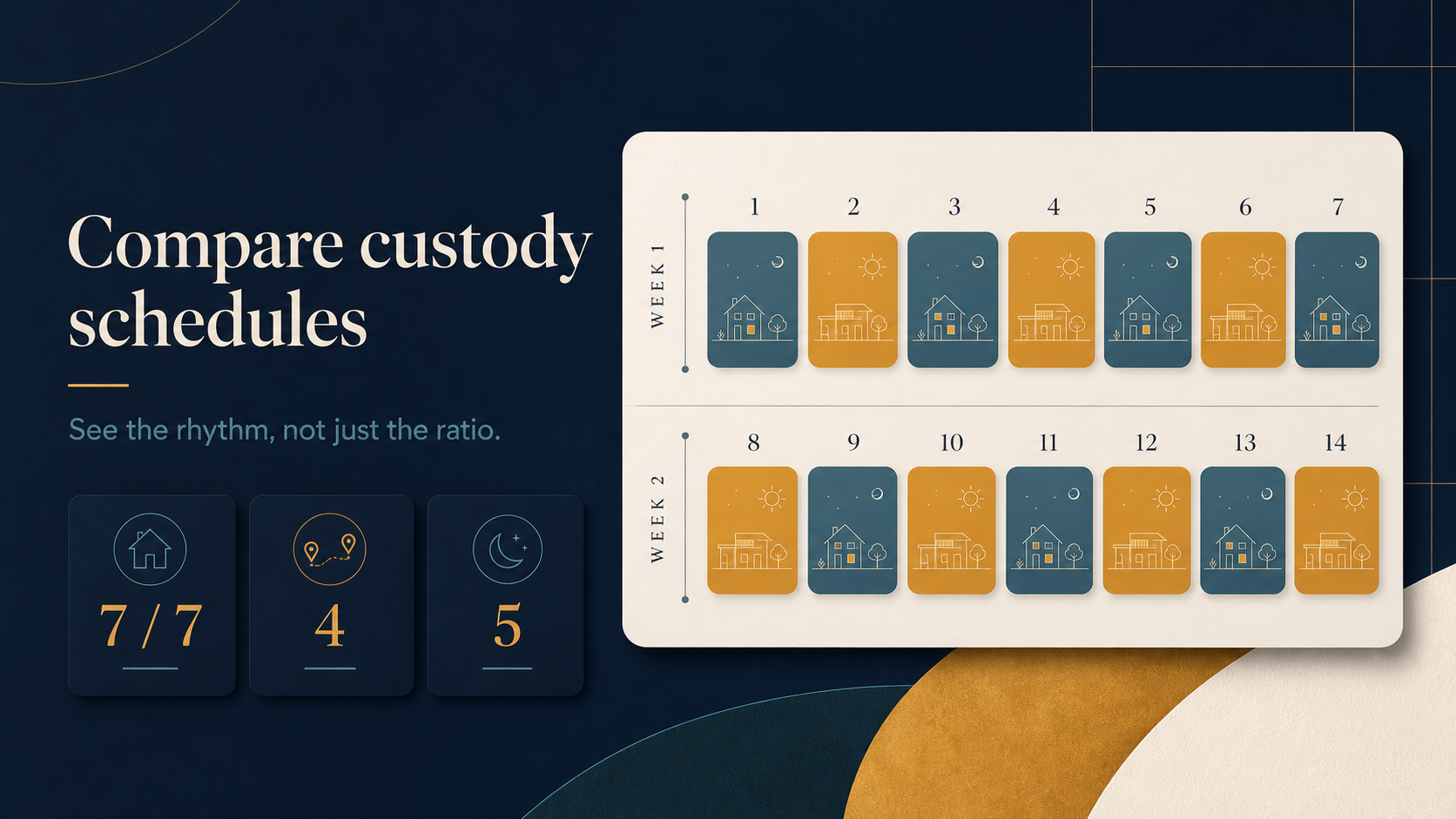
Two-week pattern studio
Compare five common parenting patterns
Choose a pattern or filter by a practical feature. Every view uses the same repeating fourteen-night frame so the trade-offs remain comparable.
2–2–3 schedule
What the pattern changesFrequent handovers keep stretches short, but the weekday pattern rotates between homes.
This compares schedule mechanics only. It does not recommend what is best for a child or interpret an order, agreement, support calculation or local law.
How to read the comparison
Start with the two-week rhythm rather than the percentage alone. The overnight split shows allocation. Handovers show how many transitions the repeating cycle creates. Longest stretch shows the most consecutive nights at either home. Weekday rhythm identifies whether the same parent usually has the same school nights. Together, those measures describe the pattern without deciding whether it suits a particular family.
Equal time can have very different mechanics
The 2–2–3, 2–2–5–5, alternating-week and 3–4–4–3 examples each divide fourteen overnights equally. But their transitions differ. A 2–2–3 pattern creates short stretches and more handovers. Alternating weeks create long stretches and fewer handovers. The other patterns sit between those two ends. Equal arithmetic is not the same as an identical routine.
Use the filters as discussion prompts
The filters surface patterns with equal overnights, fewer handovers, stretches of four nights or less, or fixed weekdays. They are mechanical filters, not recommendations. A practical discussion may also need to consider school and childcare, travel time, work patterns, messages, siblings, activities, the child’s needs and the terms of any current order or agreement.
A repeating example is not a complete parenting plan
A real plan may need exact exchange times and locations, school-day rules, holidays, birthdays, travel, notice for changes, transport responsibility and a process for resolving clashes. Local law and expert advice can affect what should be written. Treat the visual pattern as one layer of a broader agreement.
The schedule is the plan; actual events are the record
Once a pattern is agreed, real life can diverge from it. A handover may move, a weekend may be missed, make-up time may be offered, or a temporary variation may be agreed in messages. Keep the planned arrangement separate from a dated account of what actually occurred. Casewell’s parenting-time log is designed for that second job.
Which custody schedule is best for a child?
This tool cannot answer that. A workable arrangement depends on the individual child, family circumstances, travel, care needs, existing documents and local requirements. Use the comparison to identify practical questions for discussion with an appropriate expert.
Does a 50/50 schedule always mean seven overnights each?
In this fourteen-night visual, equal patterns show seven overnights at each home. Other systems or calculations may use different periods, count hours, or apply their own definitions. So check the method relevant to your situation.
Does Casewell replace a parenting schedule?
No. The comparison helps you understand a proposed routine. Casewell keeps private, dated records of what was planned, what actually happened and the supporting material you choose to attach.
Is my schedule selection sent to Casewell?
No. The comparison runs in your browser and your selection is not transferred into Casewell. If you later use Casewell, you decide what to record there.