Custody schedules

2-2-3 custody schedule: how it works, with a calendar

In a 2-2-3 schedule, the children spend two nights with one parent, two with the other, then three back with the first. The next week flips. It is a 50/50 schedule with short gaps between parents.

  • 50/50 split
  • 6 handovers in 2 weeks
  • Longest time apart: 3 nights
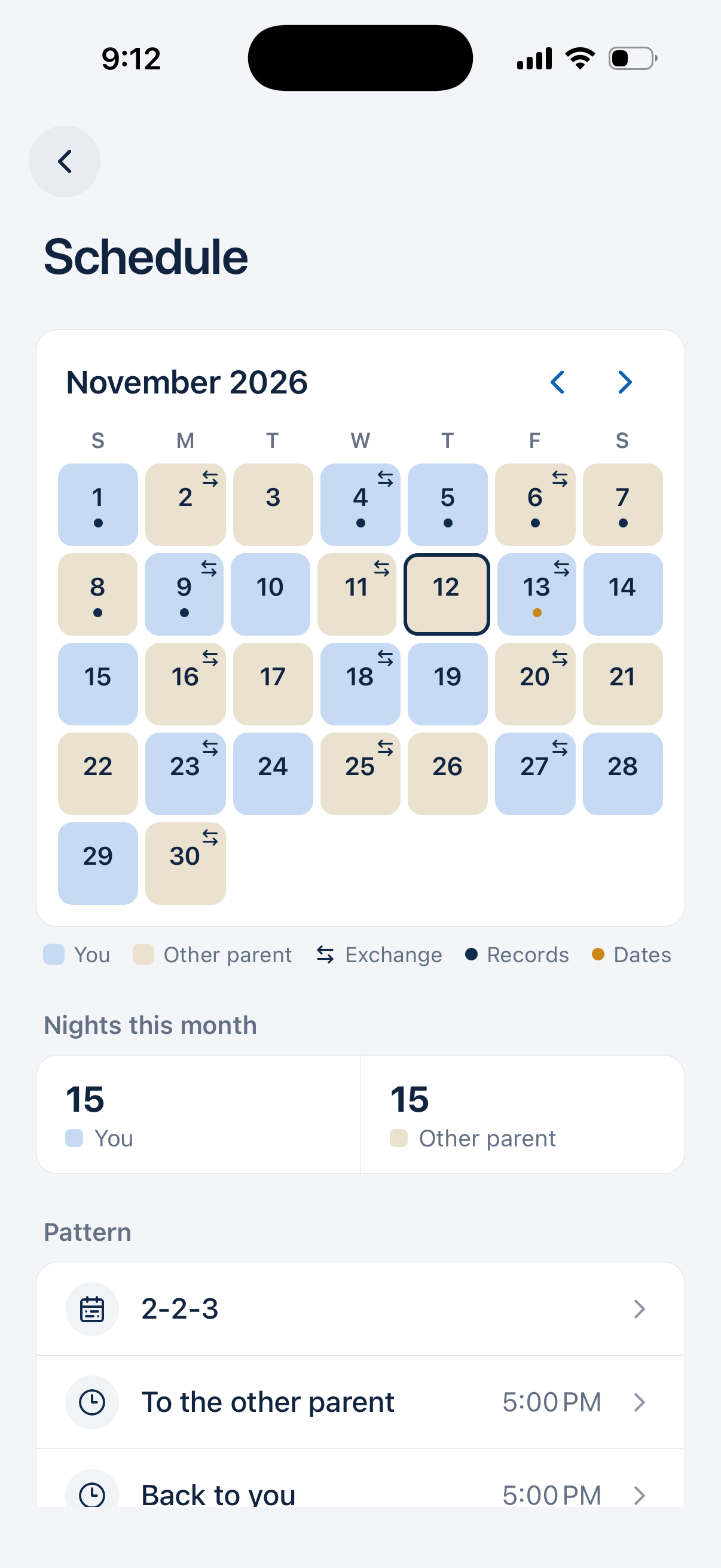
Casewell's custody calendar for November 2026 on a 2-2-3 schedule, with nights counted for each parent

How a 2-2-3 schedule works

A 2-2-3 custody schedule splits time evenly over two weeks. Each parent has seven nights in every 14. No one goes more than three nights without seeing the children.

The name gives the order. Two nights with Parent A, two nights with Parent B, then three nights with Parent A over the weekend. The following week starts with Parent B, so the weekends alternate.

Also called 2/2/3, 223 or the 2-2-3 rotation.

Two weeks, then it repeats

SunMonTueWedThuFriSat
Week 1BAABBAA
Week 2ABBAABB

Parent A Parent B

Here is one common way to run it, starting on a Monday:

  • Week 1: Parent A has Monday and Tuesday. Parent B has Wednesday and Thursday. Parent A has Friday, Saturday and Sunday.
  • Week 2: Parent B has Monday and Tuesday. Parent A has Wednesday and Thursday. Parent B has Friday, Saturday and Sunday.

Then the two weeks repeat. That makes six handovers in every two weeks. Many families hand over at school or daycare, so the children go from one parent's care to the other without a doorstep exchange.

Pros and cons

What works, and what to plan for

What works

  • Short gaps. Children see each parent every two or three days. That suits young children who find long breaks hard.
  • Even time. Each parent has seven nights in every 14, and every second weekend.
  • Both parents stay involved. Each parent does school runs, homework and bedtimes on ordinary weeknights.

What to plan for

  • Lots of handovers. Six exchanges in two weeks means more travel and more contact between parents.
  • Weekdays move around. Monday is with a different parent each week, so weekly clubs and lessons need planning.
  • Two homes, close together. It works best when both homes are near school and the children's things are easy to move or duplicate.

Who a 2-2-3 schedule suits

Family professionals often suggest a 2-2-3 for babies, toddlers and young school children, because the gaps are short. Older children and teens sometimes find the constant moving tiring and ask for longer blocks, such as a 2-2-5-5 or week on, week off.

It also asks a lot of the adults. Parents need to live close together and keep handovers smooth, because they happen every two or three days.

Common variations

Fixed handover days

Some families hand over on the same days each week, such as Monday, Wednesday and Friday. The nights still alternate, but the exchange days stay predictable.

Hand over at school

One parent drops the children at school and the other collects them. This keeps exchanges short and neutral.

Move to 2-2-5-5 later

When children are older, many families switch to a 2-2-5-5. It keeps the same weekdays with each parent and halves the handovers.

Making it work day to day

  • Agree on a handover time and place, and keep it the same each time.
  • Keep a shared list of what moves between homes: school bag, medicine, sports kit.
  • Write down any swap the day it is agreed, with the reason. Over months, small swaps change the real split.
  • If an exchange is late or missed, note the time and what was said while it is fresh.

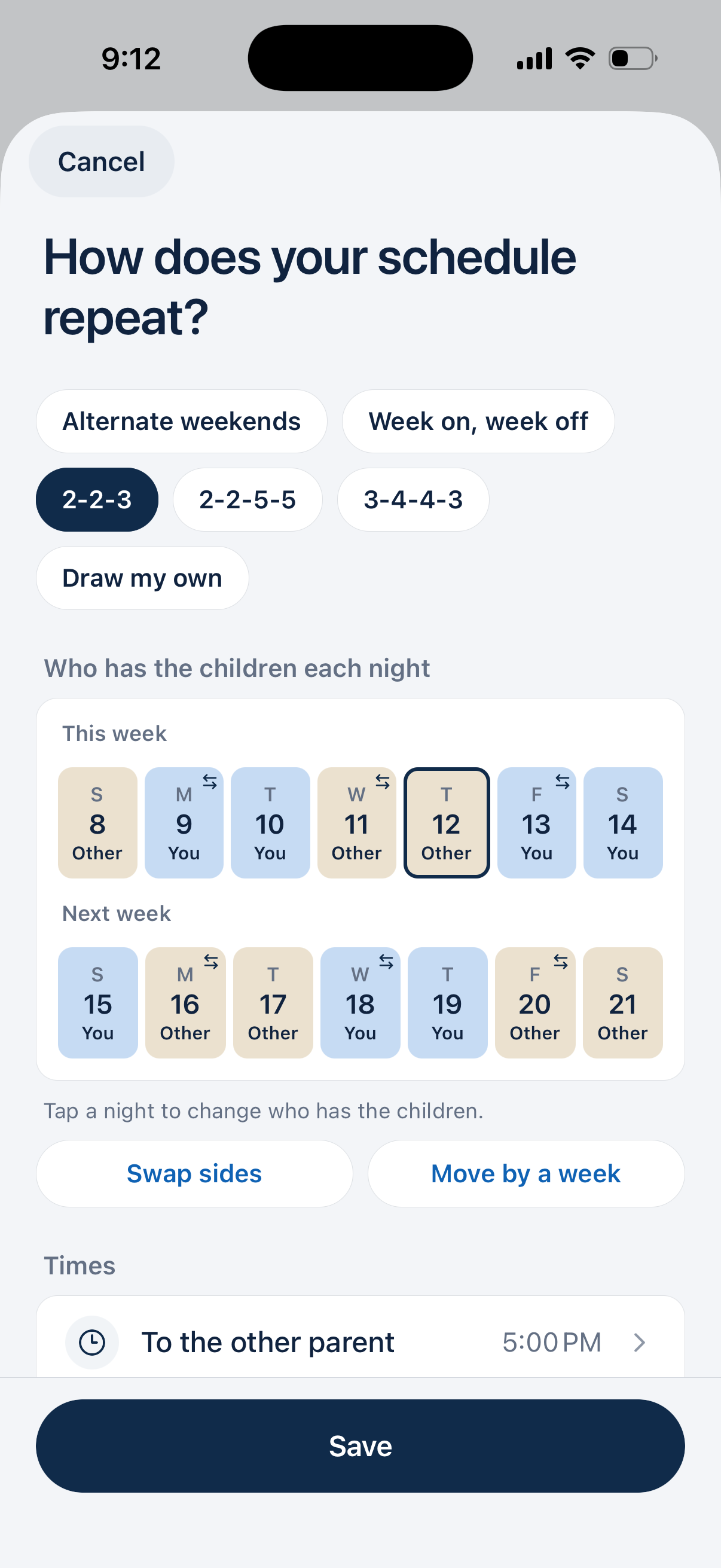
Casewell's pattern screen with 2-2-3 selected, showing who has the children each night this week and next

Track it in Casewell

Set up a 2-2-3 schedule in a minute

  1. Choose 2-2-3

    Pick it from the patterns. Casewell fills in who has the children each night, this week and next.

  2. Match it to your plan

    Use Swap sides or Move by a week until the nights match your order or agreement, then set the handover times.

  3. Record what really happens

    When a night changes, record it. The calendar counts the nights with each parent, and your PDF can include the schedule.

More about the custody calendar

Compare

Common custody schedules side by side

ScheduleSplitHandovers in 2 weeksLongest time apartWeekends
2-2-350/5063 nightsAlternate, Friday to Sunday
2-2-5-550/5045 nightsAlternate, Friday to Sunday
3-4-4-350/5044 nightsSplit: Saturday alternates
Week on, week off50/5027 nightsAlternate, as part of each week
Every other weekend86/14212 nightsEvery other weekend with Parent B

Counted over two weeks with the handover times the app uses by default. Try the patterns side by side with the custody schedule comparison tool.

Common questions

Questions about the 2-2-3 schedule

Casewell helps you keep track of a schedule. It does not give legal advice or decide what a court will order.

What does a 2-2-3 schedule mean for custody?

The children spend two nights with one parent, two nights with the other, then three nights with the first. The next week the order flips. Over two weeks each parent has seven nights, so it is a 50/50 schedule.

Is a 2-2-3 schedule good for toddlers?

It is often suggested for young children because they see each parent every two or three days. Every child is different, though, and the right schedule depends on the child, the distance between homes and how well handovers go.

Is 2-2-3 better than week on, week off?

It depends on the child's age. A 2-2-3 has short gaps and many handovers, which suits young children. Week on, week off has long gaps and only one handover a week, which often suits teenagers.

How many handovers does a 2-2-3 have?

Six in every two weeks, or about three a week. Handing over at school or daycare keeps most of them short.

How do I keep track of a 2-2-3 schedule?

A custody calendar shows whose night it is at a glance. In Casewell you choose 2-2-3, and the calendar fills in. You can record any change and see the nights with each parent each month.

See every night
on one calendar.

Set up your 2-2-3 schedule, record changes, and count the nights with each parent.

start your free trial

14 days free on iPhone and Android, then $2.99 a week or $49.99 a year.

Download on the App Store Get it on Google Play

Cancel anytime in your store settings.