
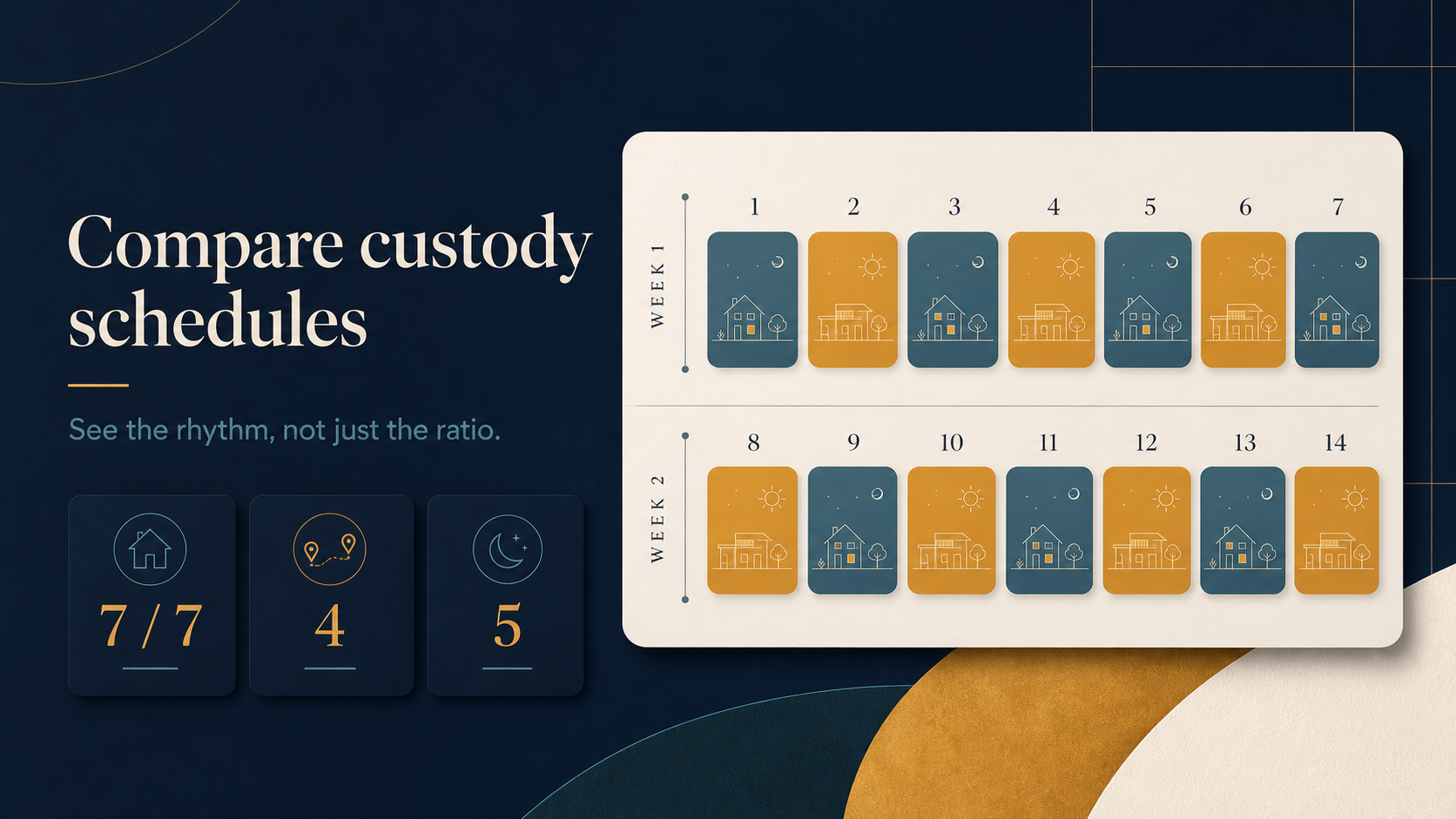
Two-week pattern studio
Compare five common parenting patterns
Choose a pattern or filter by a practical feature. Every view uses the same repeating fourteen-night frame so the trade-offs remain comparable.
2–2–3 schedule
What the pattern changesFrequent handovers keep stretches short, but the weekday pattern rotates between homes.
This compares schedule mechanics only. It does not recommend what is best for a child or interpret an order, agreement, support calculation or local law.
How to read the comparison
A 50/50 label tells you how the nights add up. It does not tell you what the two weeks feels like for a child. The tool shows four things for each pattern.
- Overnight split. How many of the 14 nights are spent at each home.
- Exchanges. How many times the child moves between homes in two weeks.
- Longest stretch. The most nights in a row at either home.
- Weekday rhythm. Whether the same parent usually has the same school nights.
Look at all four together. Two schedules can share the same split and still ask very different things of a child.
Equal time can feel very different
The 2–2–3, 2–2–5–5, alternating weeks and 3–4–4–3 patterns all split the 14 nights evenly. The way they get there is not the same.
A 2–2–3 pattern keeps stretches short, with no more than three nights away from either parent. The cost is six exchanges every two weeks, and weekdays swap each week.
Alternating weeks sit at the other end. There are only two exchanges in the two weeks. The child also spends seven nights in a row away from each home.
The other two patterns fall in between. A younger child who struggles with long gaps and an older child with a busy school week may need very different answers.
There is no national custody schedule
The United States has no single rule for how parenting time is split. Each state sets its own custody law, and courts decide based on the child's best interests.
Some states encourage frequent contact with both parents. Others spell out the factors a judge must weigh. Local courts often publish sample schedules too.
So a pattern that is common in one county may be unusual in another. Check your state court's self-help pages, and ask a family law attorney licensed in your state before you agree to anything.
How overnights can affect child support
In many states, the time each parent has with the child feeds into child support. California is a clear example.
Under California Family Code section 4055, the guideline formula includes the approximate percentage of time the higher earner has primary physical responsibility for the children. That number is called the timeshare.
The every other weekend pattern in this tool gives three nights in every 14. That is about 21% of overnights. The equal patterns give 50%.
Other states use their own formulas and thresholds, and they do not all count time the same way. Check your state's child support calculator or ask an attorney how time is counted where you live.
What the pattern leaves out
A two-week pattern is only one part of a parenting plan. A workable plan usually also covers:
- exact times and places for each handover
- school breaks, summer vacation and holidays like Thanksgiving
- birthdays, special days and travel
- who does the driving
- how much notice to give for a change
- what happens when plans clash
Use the filters as a starting point for that conversation, not as an answer. They sort patterns by what they do, not by what suits your child.
The schedule is the plan. What happens is the record
Once a pattern is agreed, real life drifts from it. An exchange runs late. A weekend gets swapped. Make-up time is offered by text and never happens.
Keep the agreed schedule separate from a dated note of what actually happened. If the arrangement is ever questioned, that second record is the one people will ask for. Casewell's parenting-time log is built for that job.
Which custody schedule is best for my child?
This tool cannot tell you that. The right pattern depends on your child's age and needs, the distance between homes, school and work, and any order or agreement already in place. Use the comparison to work out what to ask, then talk it through with the other parent or an adviser.
Is 50/50 custody the default in the US?
There is no national default. Each state has its own custody law, and judges decide based on the child's best interests. Some states favor frequent contact with both parents. That is not the same as requiring equal time. Ask a family law attorney in your state.
Does the custody schedule affect child support?
It can. In California, the guideline formula in Family Code section 4055 uses a timeshare. That is roughly the share of time the higher earner has primary physical responsibility for the children. Other states use different formulas. Check how your state counts time.
How many overnights is every other weekend?
In this tool, every other weekend gives the second home three nights in every 14, or about 21%. Over a year that is roughly 78 nights. Many real schedules add a midweek visit or holiday time. That changes the count.
Is my schedule selection sent to Casewell?
No. The comparison runs in your browser and nothing you select is uploaded. If you later use Casewell, you decide what to record there.
Sources
California is used as the worked example for child support. Each state sets its own custody and support rules. This tool is a planning aid, not legal advice.