

How to read this in the UK
Three things need to stay separate in a record. What the arrangement says, what actually happened, and the file that shows it. Blur them together and a reader has to take your word for it. Keep them apart and the record speaks for itself.
The UK is not one family-law system. England and Wales, Scotland and Northern Ireland each have their own rules, forms and vocabulary. Use the words that appear in your own order or agreement rather than a term borrowed from somewhere else.
Keep the complete source file, not a crop of it. Write events in the order they happened, and say plainly where something is missing or unclear. A family solicitor can work with a record like that. They cannot work with a reconstruction.
What does the 35-week figure actually measure?
The Ministry of Justice measures the time from the start of a private-law application until the court records the case as disposed. In everyday language, that means the case has reached a recorded conclusion. It does not mean every disputed issue waited 35 weeks for attention.
A court may make directions or an interim order much earlier. An interim order is a temporary arrangement that applies while the case continues. Some applications finish by agreement, withdrawal or another administrative outcome rather than a contested final hearing.
The published figure is a mean average. A small group of unusually long cases can pull a mean upwards. It should be used to understand the court system, not to calculate a personal hearing date.
Source: Ministry of Justice, Family Court Statistics Quarterly — England and Wales; private-law Children Act cases disposed January to March 2026
What do the latest family court statistics show?
During January to March 2026, the mean time to dispose of a private-law Children Act case was 35 weeks. This was about five weeks shorter than the equivalent quarter in 2025. Fifty-two per cent of completed cases were disposed of within 26 weeks.
The same publication reported a 16% year-on-year increase in private-law case starts during the quarter. Across 2025, the Ministry of Justice recorded 55,321 private-law Children Act cases starting. These figures describe workload and completed cases, not the likelihood that one application will be contested.
The method also changed in the latest release. That is another reason to avoid treating a single quarter as a precise forecast or casually joining old and new series.
Is a first hearing the same as a final order?
No. A First Hearing Dispute Resolution Appointment, usually shortened to FHDRA, is generally an early hearing used to identify issues, consider safeguarding information and explore whether agreement is possible. It may produce directions or an agreed order. But many cases continue.
A final order records the court's concluded decision on the application. A case can also end through consent, withdrawal or another form of disposal. The MoJ timeliness measure follows the case to disposal rather than measuring only the wait for the FHDRA.
When comparing websites or statistics, check which milestone they mean. “Time to first hearing,” “time to first decision” and “time to final order” answer different questions.
Source: Ministry of Justice, Family Court Statistics Quarterly — England and Wales; disposal is the recorded conclusion, not the first hearing
Why do some child arrangements cases take longer?
The court needs enough reliable information to make decisions about a child's welfare. A case may take longer when there are several disputed issues, safeguarding concerns, allegations requiring findings, expert or Cafcass work, difficulties serving papers, or unavailable hearing dates.
Adjournment means a hearing is moved to a later date. It may happen because needed evidence is missing, someone needs time to respond or the court cannot safely decide the issue that day. An adjournment is not proof that either parent has done something wrong.
Cases also differ in their destination. A focused application resolved by consent is not comparable with proceedings involving fact-finding, multiple children, international issues or an appeal.
Can mediation make the process shorter?
Mediation can help suitable families define issues and reach proposals without asking a judge to decide everything. If agreement is reached, parents may still need advice about whether and how to record it. Mediation is not suitable for every family or every safety situation.
The statistics do not prove that mediation causes a particular case to finish faster. Families who reach agreement may differ from families needing a contested hearing. Court workload and the timing of safeguarding information also remain relevant.
Where domestic abuse, coercive control or immediate risk is present, everyday negotiation advice may be inappropriate. Use specialist support and get legal advice about urgent or protective steps.
What can change while a family case is ongoing?
A court application does not pause school terms, medical needs, handovers or everyday parenting decisions. New events may occur while the original issues are being considered. Some will be routine. Others may materially change the practical position.
Keep new information separate from the allegations or evidence already filed. Record what happened, when it happened and what source supports it. Do not rewrite an old note so that it appears to include information learned later.
A solicitor can help decide whether a development should be raised formally. A private timeline supports that conversation. But it does not decide relevance or replace the court's filing rules.

Worked fictional timeline entry
This example shows how to record a development during proceedings without turning it into a legal conclusion.
- Event and record dates
Handover scheduled for 14 September 2026 at 17:00. Entry created that evening at 19:20.
- Expected arrangement
Current interim order, paragraph 6: collection from school reception by Parent B.
- Observed event
School reception closed at 17:30. Parent B had not arrived. Child remained with Parent A.
- Supporting material
School sign-out email and complete 16:42–18:05 message thread attached as EVT-041-An and EVT-041-B.
- Follow-up
Parent B wrote at 18:05 that a train cancellation caused the delay and proposed collection the following morning.
- Status
Alternative collection agreed for 15 September at 08:00. No conclusion recorded about breach or motive.
How should you keep a chronology during proceedings?
Use one dated entry for each meaningful event. Include the event date, the date recorded, what was expected, what actually happened and the source you relied on. Attach the complete message, letter, receipt or school notice where it adds context.
Give related records a stable reference. For example, a missed handover, the follow-up message and a later make-up arrangement can share one event reference while retaining their own dates. This makes the sequence easier to review.
Keep observations separate from conclusions. “Collection was scheduled for 17:00. No one arrived by 17:30” is more useful than a label about motive. Record everyday resolved events as well as disputes.
What should you avoid adding to the record?
Avoid diagnosing the other parent, predicting what the judge will think or copying every hostile message into a running argument. A useful record helps a future reader find the event, source and outcome without reconstructing the conflict from scratch.
Do not edit screenshots to remove inconvenient context. Keep the original thread and create a working copy only when an expert needs a focused extract. Keep source files in their original format where practical.
A long case can generate a large archive. Volume is not the same as value. Periodic review helps identify duplicates, missing files and entries that are opinion rather than observable fact.
How does Casewell help during a long-running case?
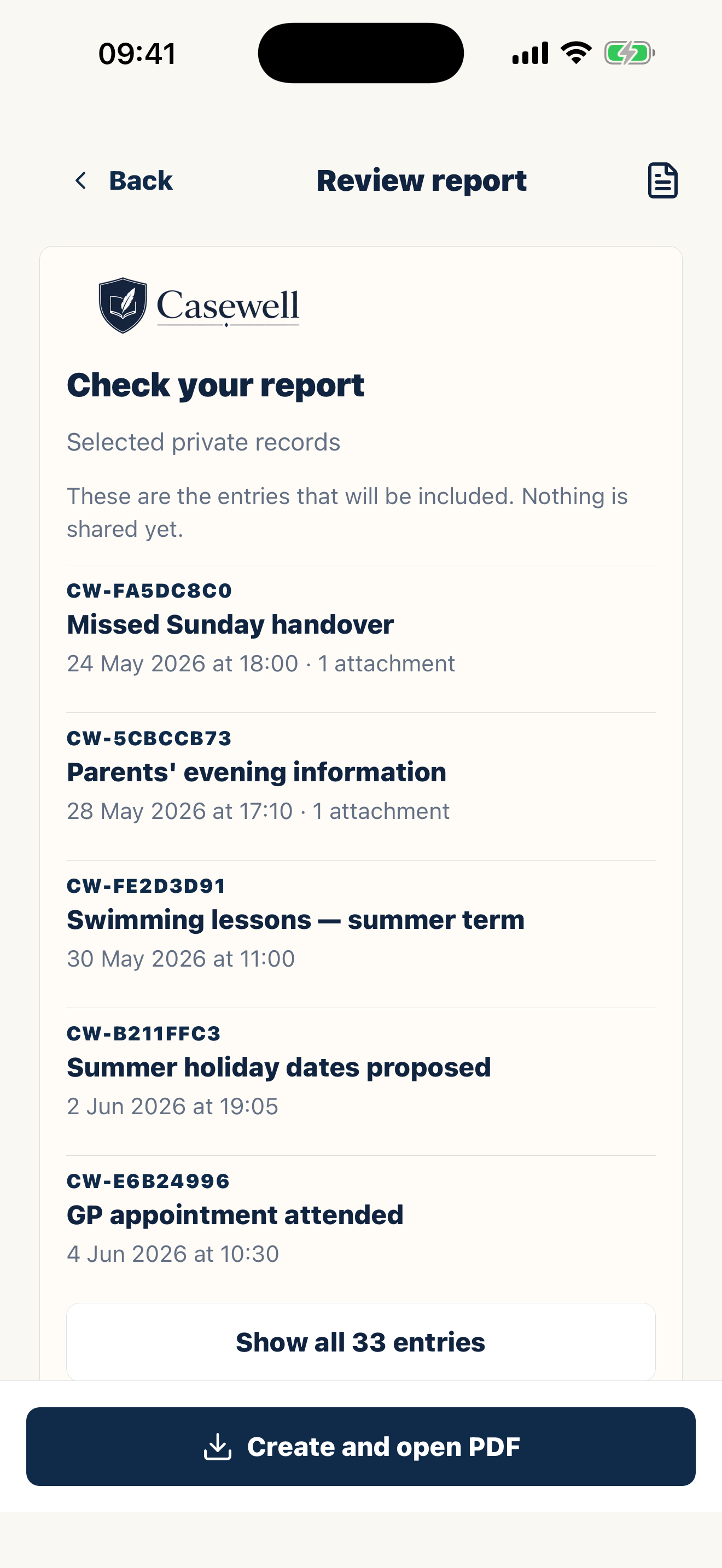
Casewell gives one parent a private timeline without requiring the other parent to join. Parenting-time events, expenses, messages, handovers and supporting files can remain connected to the dates they explain.
Search and filters help narrow the record to a relevant period or subject before speaking with a solicitor, mediator or adviser. Selected entries can be clear into a PDF for expert or court-related review while the complete private timeline remains under the parent's control.
“Court-ready” means clear, dated, factual and prepared for review. Courts and experts decide what is relevant, admissible or persuasive and decide the outcome.
What do waiting-time statistics say about the family justice system?
Court statistics count applications, orders and elapsed weeks more readily than the work families do between hearings. They do not measure every rearranged school collection, expert appointment, missed workday or hour spent finding an old message.
The figures also show why a court case should not be treated as one continuous final hearing. Much of the process involves safeguarding checks, directions, information gathering, negotiation and interim decisions. Those steps can be needed even when waiting is difficult.
Resources matter. Legal advice, flexible work, reliable childcare and the ability to organise records can affect how manageable the process feels. That does not decide the merits of the case.
What is the practical conclusion?
The latest England and Wales figure is 35 weeks on average, with just over half of completed private-law cases finishing within 26 weeks. Neither number is a personal deadline. The next meaningful event may be an early hearing, an interim order, agreement or a later final disposal.
While proceedings continue, keep the developing facts separate, dated and connected to their sources. Ask a solicitor which changes matter legally and follow the court's directions for anything that must be filed.
Casewell helps keep that private working history and prepare selected records for review. Keep a private, court-ready timeline while your family case is ongoing.
Locality checklist for a UK review
Name the UK nation and court. Copy the key words from the current order or plan. Add places only when they help explain the event. Remove home or school addresses if the reader does not need them. Check the right court rules before you use a private timeline as a formal record.
A UK review note
England and Wales family court statistics for early 2026. See what the 35-week average really measures, why it is not a waiting time and how to keep a usable record while a case runs. Sharing any of it in the UK takes a few more steps.
Before you share any of this, work from a copy. Remove private details the reader does not need, and leave the original file untouched.
Check each key sentence. Can you link it to a date or source? If not, change the summary. Do not fill the gap with a guess.
Name the UK nation and court on the review copy. Keep the words used in the order. Ask a family solicitor about court rules and what you may need to share.
Keep new events connected to the case chronology
Casewell keeps dated developments, supporting files and later outcomes in one private timeline, with filtered PDF exports for solicitor, mediator or court-related review.
Try for freeHow long does a child arrangements case usually take?
Cases disposed in January to March 2026 took 35 weeks on average. That system-wide mean is not a deadline, and agreed, urgent and contested cases can take very different amounts of time.
Is the first family court hearing the end of the case?
Not necessarily. A first hearing may identify issues, consider safeguarding information, record agreement or give directions. Some cases need later hearings before final disposal.
Should I keep recording events after proceedings start?
Keep a factual private record of material developments and ask your solicitor what should be raised formally. Do not assume every routine event belongs in evidence.
Does the other parent need to use Casewell?
No. Casewell is designed as a private timeline that one parent can keep without requiring a shared account.
What does court-ready mean during an ongoing case?
It means records are clear, dated, factual and prepared for expert or court-related review. Courts and experts decide relevance, admissibility and outcomes.
Does this cover Scotland and Northern Ireland too?
No. England and Wales, Scotland and Northern Ireland have separate family-law systems, forms and terms. Use the page to organise a working record and get advice for the relevant legal system.
Sources
The figures come from the Ministry of Justice's Family Court Statistics Quarterly and cover completed private-law Children Act cases in England and Wales only. Scotland and Northern Ireland report separately. The measure describes system-wide timeliness rather than a promised wait. Also, a mean can be pulled upwards by a small number of very long cases.