

How to read this in Canada
Keep the record in layers: what the plan says, the dated event and its source, then what happened next. A fact stops being useful the moment it is written up as a legal conclusion.
Canadian rules can come from federal, provincial or territorial law. Start with the order or plan that applies to you, and keep its exact terms, such as parenting time or decision-making responsibility.
If you need to correct an error, add a dated note rather than editing the original. Keep routine events near the disputed ones so a family lawyer in your province or territory can judge which facts actually matter.
What is a first disposition?
A disposition is a recorded court event that resolves at least part of a case. It can include a settlement, stay, dismissal, judgment, expiry of a time limit or transfer. The first disposition may address one issue while parenting or support questions continue.
Statistics Canada so does not describe the 28-day parenting figure as time to final order. It measures the median time to the first disposition. Median means half of the measured cases reached that event sooner and half took longer.
This distinction matters. A temporary parenting arrangement or an early procedural result can be important without ending the broader family case.
Source: Statistics Canada, Civil Court Survey — Median to first disposition; not time to final resolution
What do the latest Canadian figures show?
For 2024/25, the median was 28 days for parenting cases and 32 days for parenting-and-contact cases. Parenting-and-support cases had a 46-day median. All active family-law cases combined reached a first disposition in a median of 48 days.
These case types identify issues recorded in the Civil Court Survey. They do not describe the complexity, safety context or number of children in a person family.
The figures improved or changed differently from 2023/24. Parenting cases fell from 31 to 28 days, while parenting-and-contact cases rose from 31 to 32. A one-year movement should not be treated as a forecast.
Which Canadian terms should parents understand?
Federal family legislation uses “parenting time” and “decision-making responsibility.” Older sources and many provincial searches still use “custody” and “access.”
The applicable court and statute depend on marital status, province or territory and the orders sought. A parenting order can address schedules, decision-making and messages. Contact may refer to time between a child and someone who is not a spouse or parent in the relevant legal framework.
Because court process differs, use the official court guidance for your province or territory. A statistic from the Civil Court Survey cannot replace a local filing timetable.
Source: Statistics Canada, Family law cases in civil courts 2024/25 — Parenting cases; first recorded disposition only
Why can a case continue after the first decision?
One order may deal with an urgent schedule while financial disclosure, assessments or other parenting questions remain unresolved. The court may also set directions, need documents or encourage dispute resolution before a later decision.
Statistics Canada notes that inactivity can complicate measuring the complete lifespan of a family case. Parties may return to the same file when circumstances change. A case can so have several meaningful dispositions.
Do not equate an early median with simplicity. Protection matters can reach a first disposition quickly because they are prioritised, not because the underlying circumstances are minor.
What can make parenting proceedings longer?
The number of disputed issues matters. Parenting-and-support cases had a longer first-disposition median than parenting-only cases in the latest data. That is an association between recorded types, not proof that support caused delay.
Reports, disclosure, service, adjournments and court capacity may also affect the sequence. Provincial family justice services and judicial case management differ.
Family violence or safety concerns can change the appropriate pathway. Use specialised support and legal advice rather than everyday co-parenting negotiation where risk is present.
What should you record while a case continues?
Children's schedules, medical care, school issues, exchanges and expenses continue between court events. Record material developments with the event date, the date written and the source.
Keep new events separate from the facts in an existing affidavit or application. Do not edit an earlier note to include information learned later. An honest timeline shows when each fact became known.
A family lawyer can advise whether a development should be filed, discussed in negotiation or simply kept. A private timeline does not decide relevance.

Worked fictional parenting timeline entry
This example records a later event without deciding its legal significance.
- Event and record dates
Exchange scheduled September 14, 2026 at 5:00 p.m. Entry made at 7:20 p.m.
- Expected arrangement
Interim parenting order, paragraph 6: Parent B collects Child A from school reception.
- Observed event
Reception closed at 5:30 p.m. Parent B had not arrived. Child A remained with Parent A.
- Supporting material
School sign-out email and full message thread attached as EVT-041-An and EVT-041-B.
- Follow-up
Parent B reported a cancelled train and proposed collection the following morning.
- Status
Alternative exchange agreed for September 15 at 8:00 a.m. No legal conclusion recorded.
How should a Canadian parenting chronology be organised?
Start with the current order, agreement or parenting plan. For each event, state what was expected, what occurred and what followed. Attach the complete message, school record or receipt where it supports the entry.
Use neutral terms and stable event references. Link later resolutions, such as make-up parenting time or repayment, without deleting the original issue.
Organising documents does not make them admissible. Provincial evidence rules and court directions govern how information is filed and used.
How does Casewell support an ongoing case?
Casewell gives a private timeline that one parent can keep without inviting the other parent. Parenting-time events, exchanges, messages, expenses and supporting files can remain connected to their dates.
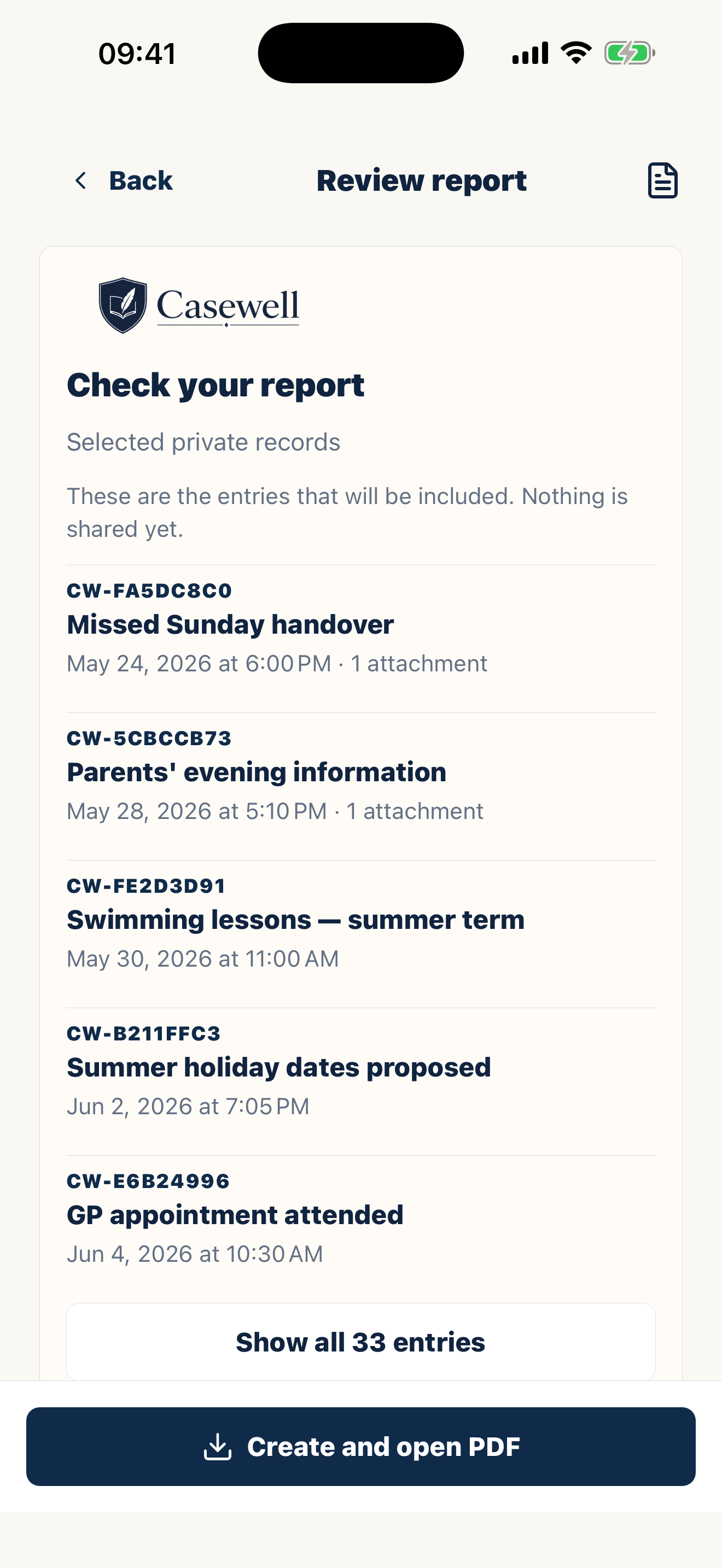
Filters can create a focused view for a family lawyer, mediator or adviser. Selected records can be clear into a PDF for expert or court-related review while the complete timeline stays private.
“Court-ready” means clear, dated, factual and prepared for review. It does not promise admissibility, acceptance or a result.
What do the Canadian statistics leave out?
The Civil Court Survey records court activity. It does not capture every informal agreement, mediation session, work absence or hour spent preparing documents. It also cannot show how a temporary arrangement affected daily life.
Reporting coverage and data definitions matter. A first disposition may resolve one issue. So the 28-day median cannot be presented as the time needed to finish a contested parenting case.
These qualifications increase usefulness rather than weaken it. Parents can understand what the court statistic says and then ask the right local question about the court process.
What should you ask your lawyer or court service?
Ask which court has legal area, what the next event is called and which existing terms remain in force. Confirm deadlines from the actual rules, endorsement or notice.
Ask how new events should be brought forward and what format the court needs. A timeline can help a lawyer identify the relevant period without turning every event into an allegation.
Provincial family justice services may offer information, mediation or other supports. Their role and eligibility differ, so use the current official local source.
What is the practical conclusion?
The latest national survey gives a 28-day median to first disposition for parenting cases. It does not give a national time to final resolution. Parenting, contact and support combinations also show different medians.
Use the figure to understand the measurement, not to predict your order date. Keep developments dated and connected to their sources while the case continues. Also, ask a family lawyer what needs formal action.
Casewell supports that private timeline and focused review. Keep a private, court-ready timeline while your parenting case is ongoing.
Province-or-territory checklist for a Canadian review
Name the province or territory and the court. Add the law or order tied to the parenting plan. Keep its own terms for parenting time, major decisions, contact, and support. Use local forms and due dates. If two legal areas may be involved, flag that point for a lawyer.
A Canadian review note
Canadian family court statistics explain parenting-case timelines, first disposition, ongoing cases and how to keep records during proceedings. Sharing any of it in Canada takes a few more steps.
Keep a review pack short: the current order or plan, a factual timeline and the source files that matter. Say plainly where something is missing.
Ask a family lawyer in your province or territory before you file or share records. Privacy, court, and evidence rules can differ across Canada. One PDF does not make those rules the same.
Name the province or territory. Note whether federal divorce law or another family law applies. Keep the terms used in the order itself.
Keep developments connected to your parenting chronology
Casewell keeps dated events and source files in one private timeline, with filtered PDF exports for lawyer, mediator or court-related review.
Try for freeHow long does a parenting case take in Canada?
Statistics Canada reports 28 median days to first disposition in 2024/25, not to final resolution.
What is a first disposition?
It is the first recorded event resolving at least part of the case, such as a settlement, dismissal or judgment.
Should I record events after filing?
Keep a factual timeline and ask a family lawyer which developments need formal action.
Does the other parent need Casewell?
No. One parent can keep a private Casewell timeline.
What does court-ready mean?
Clear, dated and factual for expert or court-related review. Courts and experts decide relevance, admissibility and outcomes.
Does this replace provincial or territorial guidance?
No. Federal, provincial and territorial family-law rules can interact, and court process differs across provinces and territories. Check the current order or plan and current official guidance for the relevant legal area.
Sources
Statistics Canada’s Civil Court Survey measures the first recorded disposition. This may settle, dismiss or decide one issue without closing the entire case. Reporting coverage and provincial court process vary. The figures are not a national promise of final resolution.