

How to read this in Australia
A record earns its weight by staying factual. Note what was planned, note what took place, and attach the file or message that supports the note.
Start from the parenting order, plan or written agreement now in force. Most family law here is federal, though Western Australia follows a different court path in some cases. Use the words that appear in your own papers.
Keep everyday days in the private record alongside the difficult ones. When a review is needed, select only the entries that answer the question in front of you. That is what lets an Australian family lawyer find the key facts quickly.
What is the court's published timetable, step by step?
The Federal Circuit and Family Court of Australia sets out a national listing pathway in its Central Practice Direction: Family Law Case Management. Unless a matter is urgent or sits in a specialist list, that pathway is the default.
| Stage | When it is listed | What happens |
|---|---|---|
| First court event | Between 1 and 2 months after filing | Directions hearing before a Registrar. Procedural orders are made |
| Interim hearing | After the first court event, if one is needed | Short-notice arrangements decided on limited evidence |
| Dispute resolution | No later than 5 months after filing | Mediation, conciliation conference or family dispute resolution |
| Mention | Within 2 weeks of dispute resolution | Unresolved matters are prepared for the readiness hearing |
| Compliance and Readiness Hearing | As close as possible to 6 months after filing | First appearance before a Judge, who checks the matter is trial-ready |
| Trial management hearing | Only if the trial Judge orders one | Final directions about how the trial will run |
| Final hearing | On a date earlier than 12 months from filing | The contested issues are heard and decided |
| Judgment | Court aims for within 3 months of the trial ending | Final orders are made |
These are listing targets rather than entitlements. The court keeps a discretion to depart from the pathway, and a matter can slip when reports are outstanding, evidence is incomplete or a hearing does not reach a judge on its listed day.
Most published estimates are one practitioner's summary of these steps. The figures above are the court's own. You can check where your matter sits against them at any point.
Source: FCFCOA Central Practice Direction: Family Law Case Management — Paragraphs 5.3 and 6.58; listing targets, not guaranteed dates. Judgment timing runs from the end of the trial, not from filing.
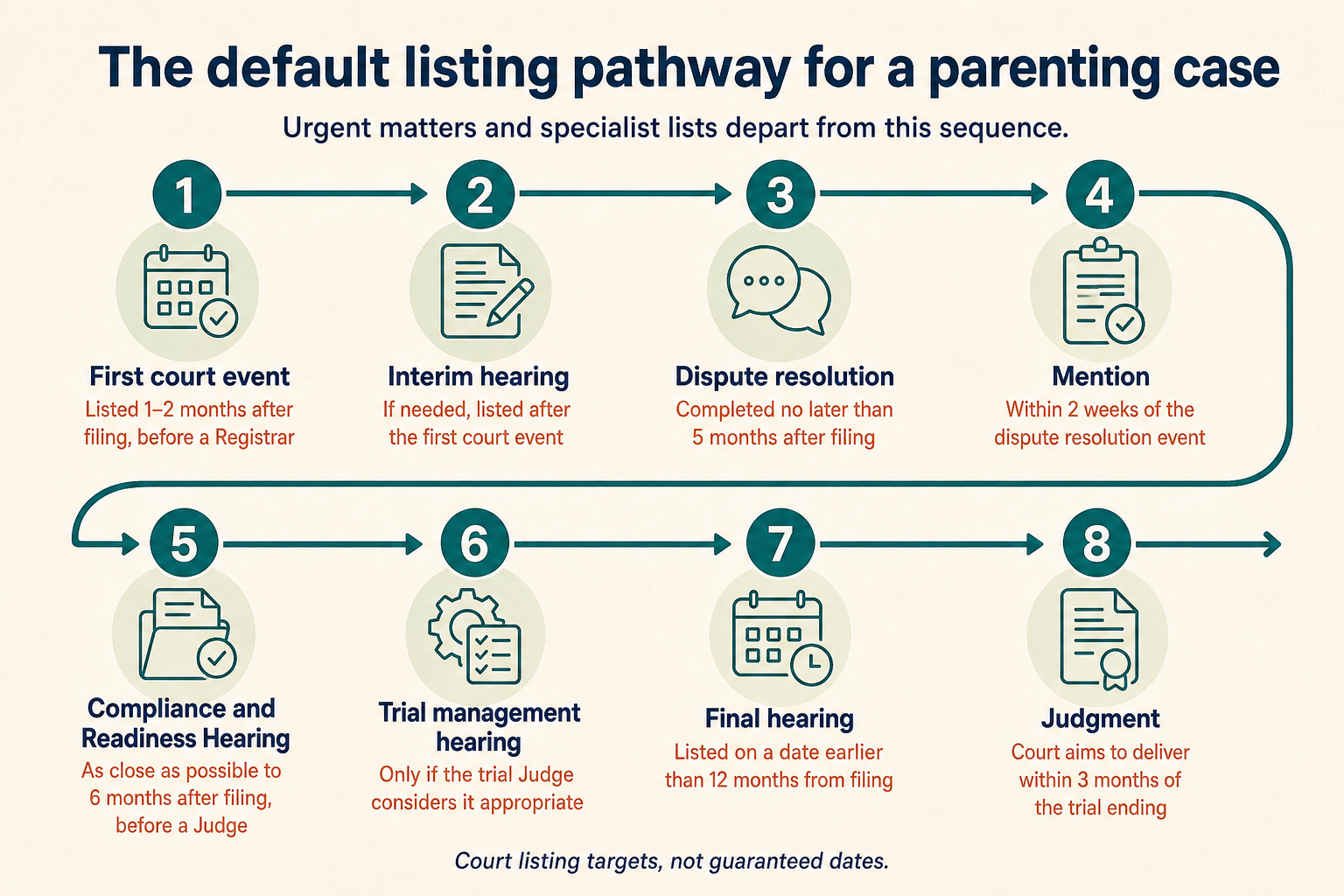
Source: FCFCOA Central Practice Direction: Family Law Case Management — Paragraphs 5.3, 6.1, 6.23, 6.47 and 6.58
What does the 12-month measure mean?
The Federal Court entity annual report states a performance measure for the proportion of final-order family-law applications resolved within 12 months of filing. The planned range for 2024–25 was 80%–90%. But the reported result was 61% for new-pathway final-order applications.
A final-order application asks the court to decide issues on an ongoing basis. It may concern parenting, property or both. The published performance measure cannot be read as a parenting-only average.
Resolution can occur by orders made after agreement, withdrawal or judicial determination. An interim parenting order may address immediate arrangements much earlier while the final-order application remains open.
Source: Federal Court of Australia Listed Entity Annual Report 2024–25 — Planned target was 80–90%; reported 2024–25 result was 61% of new-pathway final-order applications; broader than parenting cases and not a guaranteed deadline
What has to happen before you can file?
Parenting proceedings have a pre-filing stage that most timing estimates ignore. Before filing, parties must comply with the pre-action procedures in Schedule 1 of the Family Law Rules. They must also take genuine steps to resolve the issues, unless it is unsafe or an exemption applies.
An application for parenting orders must be filed with a section 60I certificate from a family dispute resolution practitioner, or an affidavit setting out the basis of an exemption. A certificate is valid for 12 months, and a practitioner cannot issue one if the last dispute resolution session was more than 12 months earlier. Without the certificate or the affidavit, the court must reject the application for filing.
A Genuine Steps Certificate must also be filed, along with a Notice of Child Abuse, Family Violence or Risk, a Parenting Questionnaire and an undertaking as to disclosure. Once served, a respondent has 28 days to file a Response to Initiating Application. Booking dispute resolution and gathering the paperwork happen before filing. After filing, the 28-day response window can affect progress before the first court event.
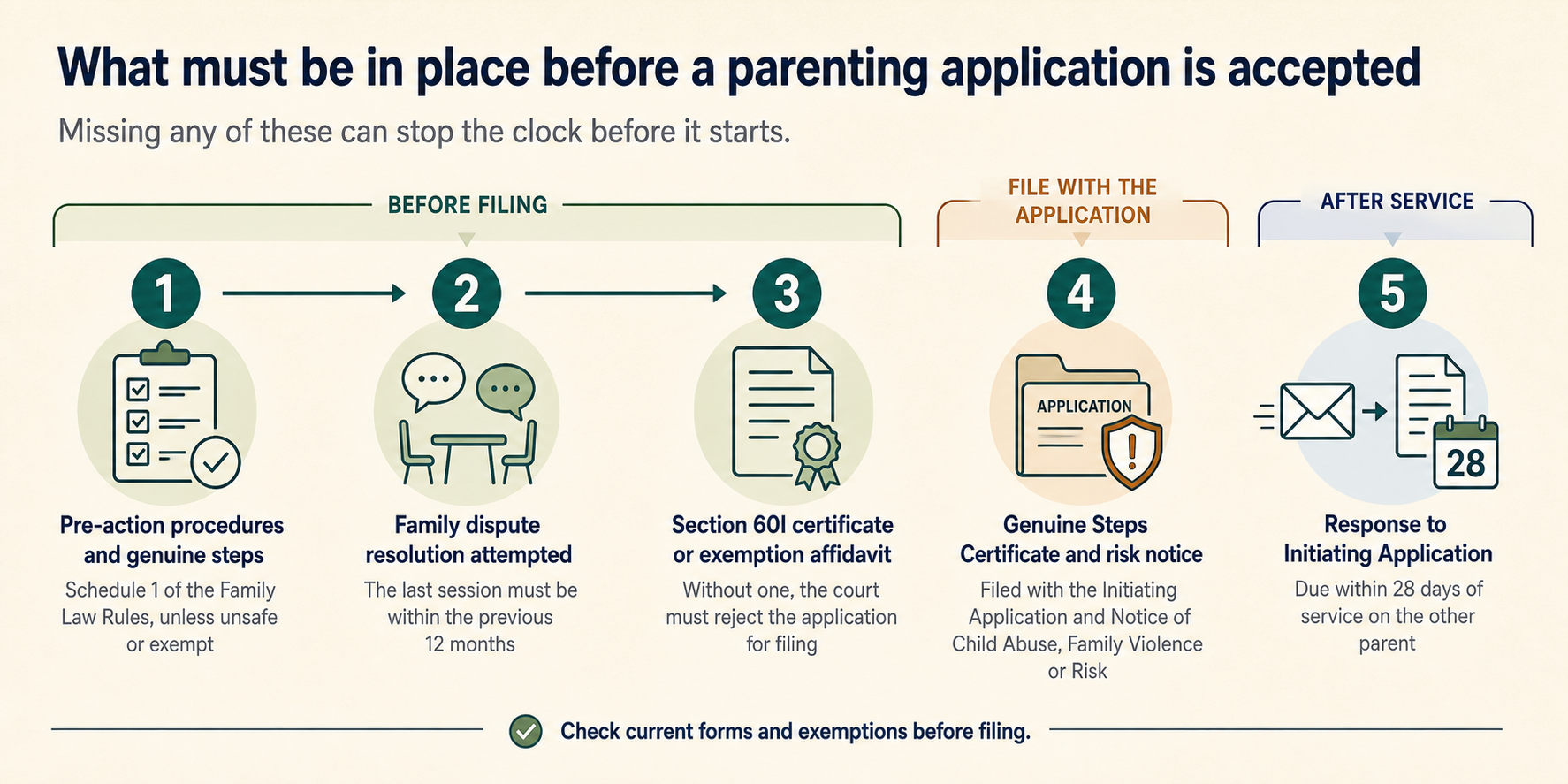
Source: FCFCOA: Compulsory pre-filing Family Dispute Resolution and Practice Direction: Parenting proceedings — Section 60I of the Family Law Act 1975 and paragraphs 2.5, 2.18 and 3.4 of the parenting practice direction
What can happen before final orders?
The court can make interim orders while a matter is continuing. An interim hearing usually relies on limited evidence and does not finally decide every disputed fact. A Child Impact Report, family report or Independent Children's Lawyer may also become part of the process.
Interim hearings carry their own deadlines. Expert reports relied on must be filed and served at least 7 days before the hearing. A minute of the orders sought and a Case Outline are due no less than 7 business days before. Outside urgent risk situations, a party may file only one further application in a proceeding without the court's leave.
When comparing timelines, separate the first court event, an interim decision and resolution of the final-order application. Each is a different endpoint.
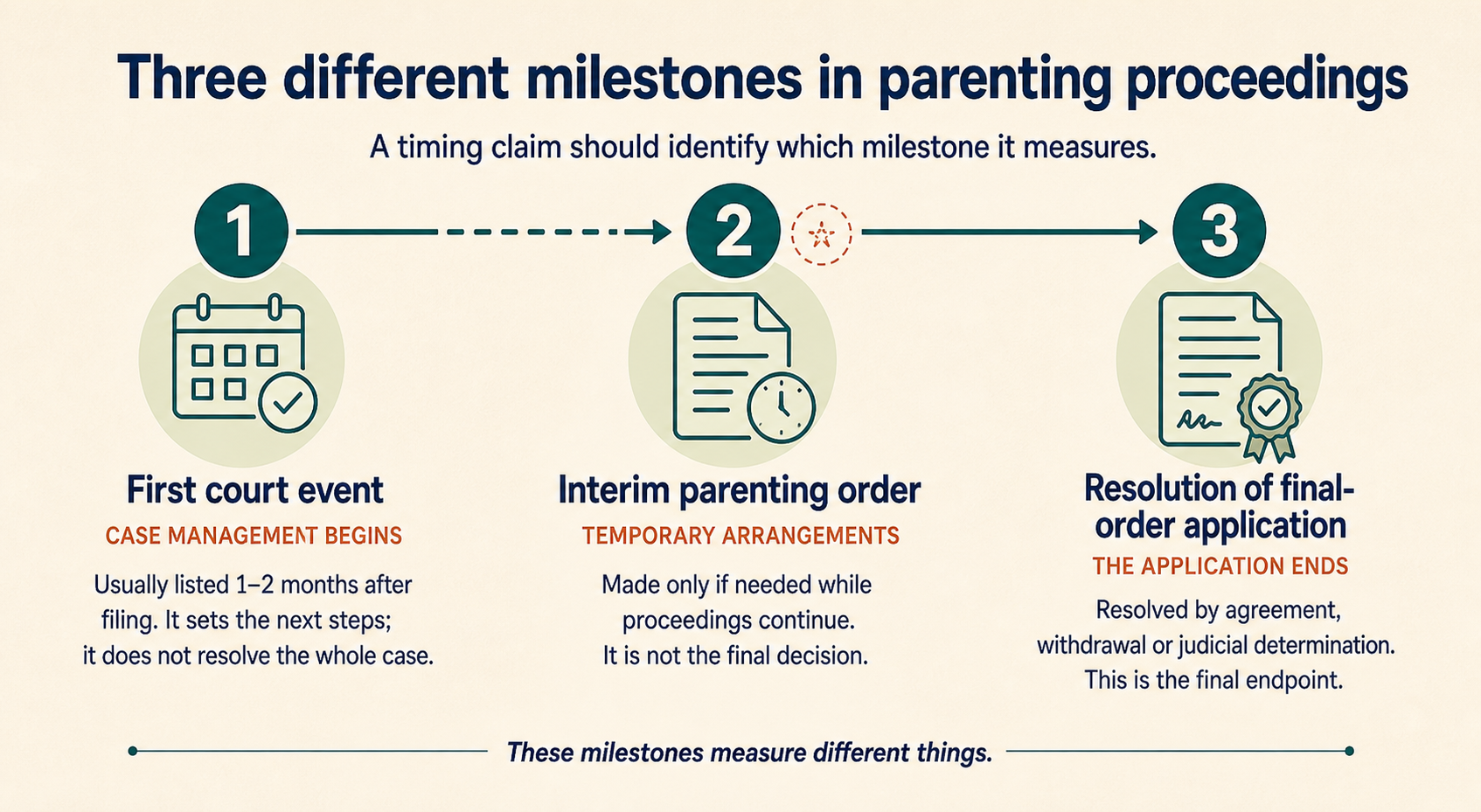
Source: Federal Circuit and Family Court of Australia, applying for orders — Official distinction between interlocutory, consent and final orders
What if your matter is urgent or high-risk?
Urgency changes the route rather than the destination. An urgent application is decided by a Registrar on the papers, supported by an affidavit and a cover letter explaining why an urgent listing is needed. If the matter is accepted as urgent, an interim hearing date is given at the earliest available time, taking account of the extent of the urgency and procedural fairness to the other parent.
Risk is screened separately. After filing, eligible parents are invited to complete the confidential Lighthouse risk screen, and high-risk matters can be referred to a Triage Counsellor and an Evatt List Judicial Registrar. Other specialist lists include Magellan, the National Contravention List and the Critical Incident List, each with its own case management.
If a matter is not accepted as urgent, it returns to the standard pathway. That is why two families filing in the same week can sit on very different timetables from the first month.
What keeps changing while proceedings continue?
School, healthcare, changeovers, travel and everyday expenses continue between court dates. Record major new events separately from the material already filed. Include the event date, the date of the note and the source.
Do not assume every disagreement should be raised with the court. A family lawyer can identify developments that matter to the issues in dispute. Immediate safety matters need the correct urgent channel.
Keep complete messages and documents. A cropped screenshot may help a working discussion. But the original context should remain available.

Worked fictional parenting timeline entry
This example records a changeover development without deciding whether an order was contravened.
- Event and record dates
Changeover scheduled 14 September 2026 at 5:00 pm. Entry created at 7:20 pm.
- Expected arrangement
Interim parenting order, paragraph 6: Parent B collects Child A from school reception.
- Observed event
Reception closed at 5:30 pm. Parent B had not arrived. Child A remained with Parent A.
- Supporting material
School sign-out email and full message thread attached as EVT-041-An and EVT-041-B.
- Follow-up
Parent B reported a cancelled train and proposed collection the following morning.
- Status
Alternative changeover agreed for 15 September at 8:00 am. No legal conclusion recorded.
How should an Australian parenting timeline be organised?
Start with the current parenting order, parenting plan or written arrangement. For each material event, record what was expected, what happened, who was present and what followed. Link the source without adding a conclusion about motive.
Use stable event references so a changeover, later message and make-up time can remain connected. Keep both the event date and the later record date.
It helps to hang your records on the court's own dates. Taking a fictional filing on 2 February 2026, the pathway and the record-keeping line up like this.
| Date in the example | Court event | What is worth recording |
|---|---|---|
| 2 February 2026 | Initiating Application filed | Filing date, sealed copies, certificate and risk notice as filed |
| February 2026 | Service and Lighthouse risk screen | The date service actually happened. The 28-day response window runs from it |
| March to April 2026 | First court event | What each procedural order asks of each parent, with its due date |
| By 2 July 2026 | Dispute resolution completed | Attendance and any interim arrangement agreed for the children |
| Mid July 2026 | Mention | Any change to the arrangements the children are actually living with |
| August 2026 | Compliance and Readiness Hearing | Certificate of Readiness and disclosure undertaking are due 7 days beforehand |
| Before 2 February 2027 | Final hearing | The whole period since filing is what a family report or affidavit will cover |
| Trial plus up to 3 months | Judgment | Interim arrangements usually continue until final orders replace them |
A well-kept timeline is a working aid. It does not become evidence automatically, and it does not replace affidavits, court forms or advice about admissibility.
How does Casewell support an ongoing parenting matter?
Casewell gives a private timeline that one parent can keep on their own. The record is yours, and nobody else has to take part in it. Parenting-time events, changeovers, expenses, messages and files sit beside the dates they explain.
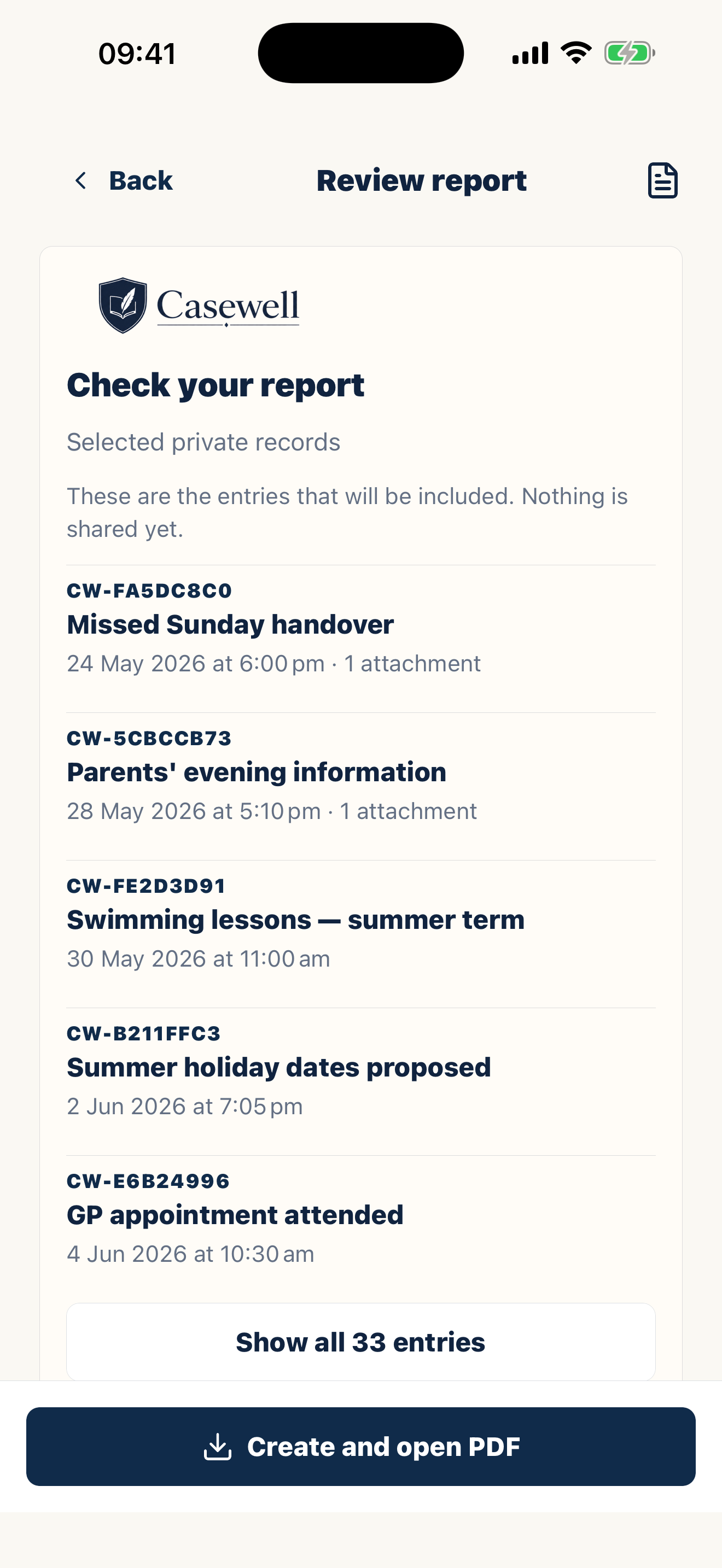
Filters can narrow the timeline before a conference with a family lawyer, mediator or adviser. Selected entries can be gathered into a PDF for expert or court-related review.
“Court-ready” means clear, dated, factual and prepared for review. The court and experts decide relevance, court process and admissibility.
Which court and which division will hear it?
Most parenting proceedings are dealt with by the Federal Circuit and Family Court of Australia, usually called the FCFCOA. It operates as two divisions. Division 2 is the entry point for almost all matters, and Division 1 takes a smaller number of complex or specialist cases, including Magellan matters.
The division question is revisited at the first court event and again at the Compliance and Readiness Hearing, when the court considers where the matter should be finally determined. Complexity, international elements, multiple experts, the likely length of the trial and each court's workload all feed into that decision.
Australian practice uses “parenting orders,” “parenting proceedings,” “decision-making responsibility” and “spend time with.” “Custody” is common in searches but is not the preferred current statutory language.
Which pathway is your matter on?
Four routes run on very different clocks, and most timing arguments are really arguments about which route a family is on.
Agreed matters are the fastest. If parents reach agreement they can record it in a parenting plan, or file an Application for Consent Orders so a registrar can consider it. Parties usually do not have to attend court for consent orders. If a case settles once proceedings are on foot, the proposed orders can be put to the registrar or judge in chambers without another court event.
Contested matters follow the standard pathway above. A narrower dispute may be referred to the Fast Track Hearing List, where the parties agree to affidavits of no more than 20 pages, annexures of no more than 50 pages, short submissions and short-form reasons, and accept 28 days' notice of the hearing date. Specialist and risk lists run their own case management. Ask which route your matter is on before comparing your wait with anyone else's.
Does family dispute resolution make every case faster?
Family dispute resolution can help suitable parents clarify issues and develop proposals. An agreement may reduce what the court must decide. It is not appropriate in every case, and exemptions may apply.
Once proceedings start, dispute resolution is not optional either. Unless exceptional circumstances exist, parties must take part in a dispute resolution event within 5 months of filing, whether privately funded or court-based, and a mention is listed within 2 weeks afterwards. Documents for a court-based event are due 14 days beforehand.
Official performance figures do not prove that dispute resolution produces an exact time saving. Families reaching agreement can differ from those requiring judicial findings. If an agreement is reached, get advice about whether consent orders are appropriate. A private parenting plan and a court order have different legal effects.
Why can parenting proceedings take longer?
Proceedings may take longer when allegations need careful assessment, reports are ordered, several interim applications arise or parties need time for disclosure and evidence. Judicial availability and the length of any final hearing also matter.
Volume is part of the picture. The courts received 101,092 family-law applications in 2024–25, about 3% more than the previous year, while reporting clearance rates around 100% across application types. A busy registry can still mean a matter is not reached on its listed day.
A case can include parenting and financial issues. The 12-month performance measure does not identify how much time each issue contributed. It also does not prove that a party caused delay. Family violence and child-safety concerns need specialist handling. Parents should use expert and emergency support where needed.
How long after the final hearing does judgment take?
The final hearing is not the last date in the timetable. Where a judge reserves judgment, the courts undertake to deliver it within 3 months of the trial finishing. Timely judgment delivery is one of the published core principles.
That means a matter listed for final hearing at, say, month 11 may not produce final orders until month 14 or later. Any timing claim that stops at the hearing date is measuring a different endpoint from one that stops at final orders.
Interim arrangements usually continue until final orders replace them. Keep recording what actually happens during that window. The arrangements in force are the ones the family is living with.
Does Western Australia work differently?
Western Australia runs its own Family Court of Western Australia. The federal case management pathway described here does not apply there in the same way. Western Australian parents should check that court's own listing information and forms.
For de facto couples, property matters in Western Australia are currently governed by the Family Court Act 1997 (WA), rather than the Commonwealth Family Law Act. That is another reason a national timing figure can mislead.
If you are in Western Australia, ask a local family lawyer which court and which forms apply, and which timetable your matter will run to.
What do the court figures leave out?
Court performance data measure filed applications and recorded resolution. They do not capture the work families do between events. Arranging school collection, attending assessments, changing work shifts or finding an old message for a lawyer.
The figures also cover a broad family-law population. They cannot predict a particular parenting proceeding or show whether an interim arrangement was working while the final case remained open.
A responsible estimate should state the court, application type, reporting year and endpoint. Without those details, “12 months” can sound more precise than the evidence allows.
What should you ask your family lawyer?
Ask what the next event is called, what evidence is permitted and which orders currently apply. Confirm deadlines from the actual court direction or notice.
Ask where your matter sits against the published pathway. Useful questions are: has the first court event been listed, when is dispute resolution due, is a Compliance and Readiness Hearing set, and what has to be filed 7 days beforehand. Ask what would move the matter to a specialist list or to Division 1.
Ask how new developments should be communicated and whether they need a formal application, affidavit material or no immediate action. A running timeline makes that conversation more efficient but cannot answer the legal question itself. If you are self-represented, use current FCFCOA guidance and the Commonwealth Courts Portal, where court staff give procedural help rather than legal advice.
What is the practical conclusion?
The Australian answer is a published pathway rather than a single number. First court event at 1–2 months, dispute resolution by 5 months, a readiness hearing near 6 months, a final hearing before 12 months, and judgment within 3 months of the trial. Federal reporting then measures whether final-order applications resolved within 12 months of filing.
Follow the directions in your own matter. Keep new events dated, factual and attached to their sources while proceedings continue. Ask a family lawyer which changes need formal action.
Casewell supports that private timeline and focused review. Keep a private, court-ready timeline while your parenting proceedings are ongoing.
State, territory and pathway checklist
Name the state or territory and the court registry. Say if the plan is an order, parenting plan, or written deal. Use the words from that paper. Flag any Western Australian court path for legal review. Keep court papers, dispute help records, and daily notes in separate groups.
An Australian review note
The FCFCOA lists a first court event 1–2 months after filing, dispute resolution by 5 months and a final hearing before 12 months from filing. Sharing any of it in Australia takes a few more steps.
Work from a copy when someone needs to review the record. Include the current order or plan, a short timeline and a small set of named source files.
Check current court orders and rules before you send the pack. An Australian family lawyer can say what belongs in an affidavit, annexure, or private file.
Name the state, territory, and court path. Take extra care in Western Australia. A national guide cannot set the right court step for every case.
Keep developments connected to your parenting chronology
Casewell keeps dated events and source files in one private timeline, with filtered PDF exports for family-law or court-related review.
Try for freeHow long do parenting proceedings take in Australia?
There is no guaranteed duration. The court's published pathway lists a first court event 1–2 months after filing, dispute resolution within 5 months, a readiness hearing near 6 months and a final hearing before 12 months from filing.
How soon is the first court date after filing?
The Central Practice Direction says a first court event will be listed wherever possible on a date between 1 and 2 months from the start of the proceeding, before a Registrar.
What is a section 60I certificate and how long is it valid?
It is a certificate from a family dispute resolution practitioner showing dispute resolution was attempted. It is valid for 12 months, and a practitioner cannot issue one if the last session was more than 12 months earlier.
How long do I have to respond to a parenting application?
A Response to Initiating Application must be filed and served within 28 days of being served with the application.
Can a parenting matter be heard urgently?
Yes. A Registrar decides an urgent listing request on the papers. If the matter is accepted as urgent, an interim hearing date is given at the earliest available time.
How long after the final hearing is judgment delivered?
The courts undertake to deliver judgment within 3 months of the trial finishing. So final orders can come months after the last hearing day.
Does Western Australia follow the same timetable?
No. Western Australia has its own Family Court with its own listing information. So check that court directly rather than relying on the federal pathway.
Are interim parenting orders final?
No. They operate while proceedings continue unless replaced or otherwise ended.
Should I keep recording changes after filing?
Keep a factual private timeline and ask a family lawyer which developments need formal action.
Does the other parent need Casewell?
No. One parent can keep a private timeline on their own, without a shared Casewell account.
What does court-ready mean?
Clear, dated and factual for expert or court-related review. Courts and experts decide relevance, admissibility and outcomes.
Is this a court form or affidavit?
No. It is a method for keeping a private factual record. Current court rules and expert advice decide how material is prepared or used in a proceeding.
Sources
Stage timings come from the Federal Circuit and Family Court's own Central Practice Direction. This sets the listing pathway rather than a promise about any one case. The federal 12-month performance measure covers final-order family-law applications and is broader than parenting disputes. Western Australia has a separate family court and should be checked separately.
- FCFCOA: Central Practice Direction — Family Law Case Management
- FCFCOA: Family Law Practice Direction — Parenting proceedings
- FCFCOA: Compulsory pre-filing Family Dispute Resolution
- FCFCOA: Applying to the Court for orders
- Federal Court of Australia: Listed Entity Annual Report 2024–25
- FCFCOA: Annual reports
- Attorney-General's Department: Section 60I certificates
- Australian Attorney-General's Department: Parenting arrangements after separation