

How to read this in Australia
A record earns its weight by staying factual. Note what was planned, note what took place, and attach the file or message that supports the note.
Start from the parenting order, plan or written agreement now in force. Most family law here is federal, though Western Australia follows a different court path in some cases. Use the words that appear in your own papers.
Keep everyday days in the private record alongside the difficult ones. When a review is needed, select only the entries that answer the question in front of you. That is what lets an Australian family lawyer find the key facts quickly.
What does a co-parenting cost include?
The cost may be a child-support transfer, a daily purchase or an agreed expense shared between parents. It may also be a fixed cost needed in both homes, such as suitable housing, internet and basic equipment.
Australia's child-support system uses both parents' incomes, the cost of children and each parent's percentage of care. That calculation is different from a receipt for a school camp or an orthodontic payment made outside the regular transfer.
Keep those types distinct when reading statistics or tracking costs. A care percentage can alter liability without showing who paid for uniforms. A payment total cannot reveal what each home already provided directly.
Source: Australian Institute of Family Studies, Care time arrangements after parental separation — Child Support Program payees; categories can overlap across different children
What does current care-time data show?
AIFS analysed administrative data from the Child Support Program through June 2024. Fourteen per cent of payees had children in shared care, defined as 35% to 65% of nights with each parent. Equal time, defined as 48% to 52%, applied to 9%.
The largest type remained mother above-primary care, meaning 87% to 100% of nights with the mother. It applied to 57% of payees. These types are not mutually exclusive when one case includes children with different arrangements.
The figures matter financially because care time is one element of child-support liability. They do not measure all separated parents or the quality of the parenting relationship.
How does care time affect the calculation?
The program assigns a cost percentage to care time. Regular care begins at 14% of nights, while shared care begins at 35%. At equal care, each parent's care-cost percentage is 50% before the broader income calculation is applied.
This does not mean each parent transfers the same amount or that every cost has been settled. The formula also considers both parents' incomes and the estimated costs of children. Family Tax Benefit may also be shared in eligible cases.
Administrative care records can lag behind real changes. If the actual arrangement changes, the financial calculation may not change automatically. Parents should use the official process for reporting care rather than treating a private total as the assessment.
Why can two homes still cost more?
A child's food use moves with care time. But housing does not move as neatly. Each home may need enough space, heating, internet and furniture to support overnight care. Those fixed costs continue between stays.
Parents may also keep clothes, toiletries, medication supplies, chargers and school items in both homes. Children in AIFS research described mothers often paying everyday expenses while fathers sometimes paid larger items. Shared-time children more often described conflict about who paid for what.
That qualitative finding is useful but not a national spending percentage. It shows why a schedule alone does not explain the practical division of money.
Source: Australian Institute of Family Studies, Payee mothers’ interactions with Child Support — parent reports from older longitudinal research; not an audited payment comparison
Why do parents report payments differently?
AIFS payment research found a wide difference between payer and payee reports. Forty-one per cent of payee mothers said payments were made in full and on time. Seventy-three per cent of payer fathers reported the same outcome.
The research does not set up which account was correct in each family. Timing, direct purchases, partial payments and different understandings of the assessed amount may contribute to the gap. Family violence and financial control can also affect payment experiences.
The lesson is not to assume bad faith from one percentage. It is to keep the assessed amount, due date, transfer and any direct payment as separate evidence.
Which expenses need the clearest agreement?
School costs, childcare, healthcare, activities, clothing and travel often fall outside a simple monthly total. Parents may disagree about approval, urgency, choice of provider or whether a regular assessment already accounts for the item.
A receipt establishes the purchase, not the agreed share. Record the message, parenting plan or order that explains how the cost should be handled. If approval was not got, keep that fact rather than rewriting the history.
For medical costs, keep the original invoice, Medicare or insurer adjustment and final amount. For activities, separate registration, equipment and travel so each charge remains understandable.
Worked fictional expense record
This example separates an expense from the assessment and records later payment without deciding legal responsibility.
- Expense
12 September 2026 · Child A · school camp deposit · A$300 paid to Northfield College.
- Purpose and source
Deposit needed to hold the child's place. School invoice attached as EXP-024-A.
- Agreement context
Written agreement says approved school camps are shared equally. Approval message dated 4 September attached.
- Contribution requested
A$150 requested on 12 September with the receipt.
- Response
Other parent agreed to A$100 and disputed A$50. Full message thread kept.
- Payment and balance
A$100 received on 18 September. A$50 remains recorded as disputed, not as an established debt.
What belongs in an expense record?
Record the local date, child reference, type, provider, purpose and total paid. Attach the full invoice or receipt. Add the relevant agreement or message and the amount requested from the other parent.
Keep the response and each later transfer. A partial payment should not replace the original cost. Record what arrived, when it arrived and what balance remains disputed or outstanding.
Use factual status labels and avoid legal conclusions. A clear entry can support discussion or review by a lawyer or other expert. But it does not decide whether a contribution is enforceable.
How can parents track costs without an app?
A consistent spreadsheet and matching receipt folder can work. The expense checklist identifies useful fields. Also, the child-expense tracker gives a reusable layout.
Keep assessed child support separate from itemised expenses unless the assessment, agreement or order treats them together. This avoids counting one transfer against several unrelated costs.
Add later updates instead of editing away the first request. Include paid and resolved items as well as disagreements. A balanced record is easier to review.
How does Casewell keep the history together?
Casewell gives a private timeline that one parent can use without asking the other parent to join. Add an expense entry, attach the receipt and keep related messages with the same dated event.
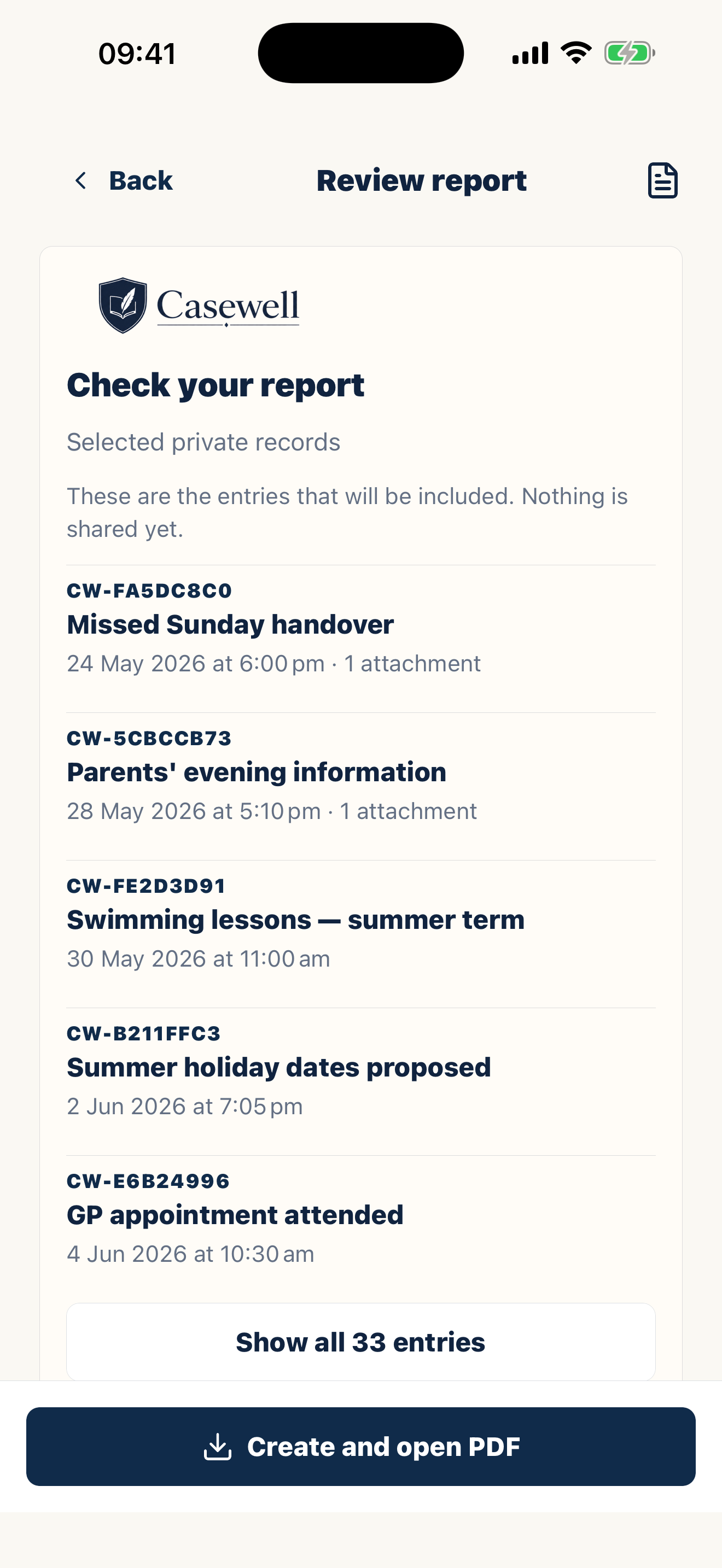
Search and filters can narrow records by date or topic. Selected entries can be clear into a PDF for a lawyer, mediator, adviser or court-related planning. You decide which records leave the private timeline.
“Court-ready” means clear, dated, factual and prepared for review. It does not decide recovery or admissibility. The applicable expert or court decides what matters.
What do Australian statistics leave out?
Child Support Program data are built to administer assessments. They record care bands, incomes and liabilities more consistently than they record every purchase made while a child is present. Direct spending can so remain outside the headline totals.
The data also describe program participants, not every separated family. Private arrangements and families without an assessment may organise money differently. A percentage from the program should not be presented as a national price for shared parenting.
For practical planning, keep the assessment beside a separate list of direct costs. That makes it easier to see what the formula addresses and what still needs an agreement, receipt or repayment process.
What should be agreed before a larger purchase?
For a non-urgent larger cost, write down the item, estimated price, proposed share and response date before paying. If the price later changes, keep the revised quote with the original proposal.
How should an outstanding expense be reviewed?
Begin with the assessment, agreement or order that may govern the item. Check whether prior approval was needed and whether the stated share applies before calculating a balance.
Compare the supplier's invoice with Medicare, private health insurance, a school credit or any refund. Record the net cost only after keeping the documents that explain how it was reached.
Keep the contribution requested separate from the contribution received. An unidentified transfer should be marked for checking, not assigned by guesswork.
Review open items on a predictable date and add later events without replacing the original entry. Use factual labels such as requested, part-paid, paid, disputed or withdrawn. A balanced history should also include costs that were resolved without difficulty.
What is the useful conclusion?
Australian data show that care time changes child-support liability. But they do not price every cost of two homes. Parent reports also show how payment histories can look different from opposite sides of the same arrangement.
Keep the official assessment, direct expenses and repayment history distinct. Record the source, amount, request, response and later payment. This creates a record that can be checked without guessing what a bank transfer meant.
Casewell keeps those details and receipts in one private timeline. Track co-parenting expenses in a private, court-ready timeline with Casewell.
State, territory and pathway checklist
Name the state or territory and the court registry. Say if the plan is an order, parenting plan, or written deal. Use the words from that paper. Flag any Western Australian court path for legal review. Keep court papers, dispute help records, and daily notes in separate groups.
An Australian review note
Australian co-parenting expense statistics explain care-time adjustments, child-support payments and costs shared across two homes. Sharing any of it in Australia takes a few more steps.
Work from a copy when someone needs to review the record. Include the current order or plan, a short timeline and a small set of named source files.
Check current court orders and rules before you send the pack. An Australian family lawyer can say what belongs in an affidavit, annexure, or private file.
Name the state, territory, and court path. Take extra care in Western Australia. A national guide cannot set the right court step for every case.
Keep assessed support and direct expenses distinct
Casewell connects each expense to its receipt, agreement context, request and later payment in a private timeline with filtered PDF exports.
Try for freeDoes shared care always cost more?
There is no fixed Australian percentage. Housing, care time, distance, income and the child's needs decide which costs move or repeat.
Does equal care remove child support?
Not automatically. The formula considers income, care percentages and the estimated costs of children.
Should assessed support and shared expenses be tracked together?
Keep them distinct unless the assessment, agreement or order combines them. This reduces double counting.
What can Casewell record?
An expense entry can keep the date, amount, type, receipt, notes, messages and later payment history together.
What does court-ready mean?
It means clear, dated and factual for expert or court-related review, without promising recovery, admissibility or an outcome.
Is this a court form or affidavit?
No. It is a method for keeping a private factual record. Current court rules and expert advice decide how material is prepared or used in a proceeding.
Sources
The current care-time data cover Child Support Program participants, not every separated family. The payment-compliance figures come from older AIFS research and show different parent reports rather than on its own audited payment histories.