
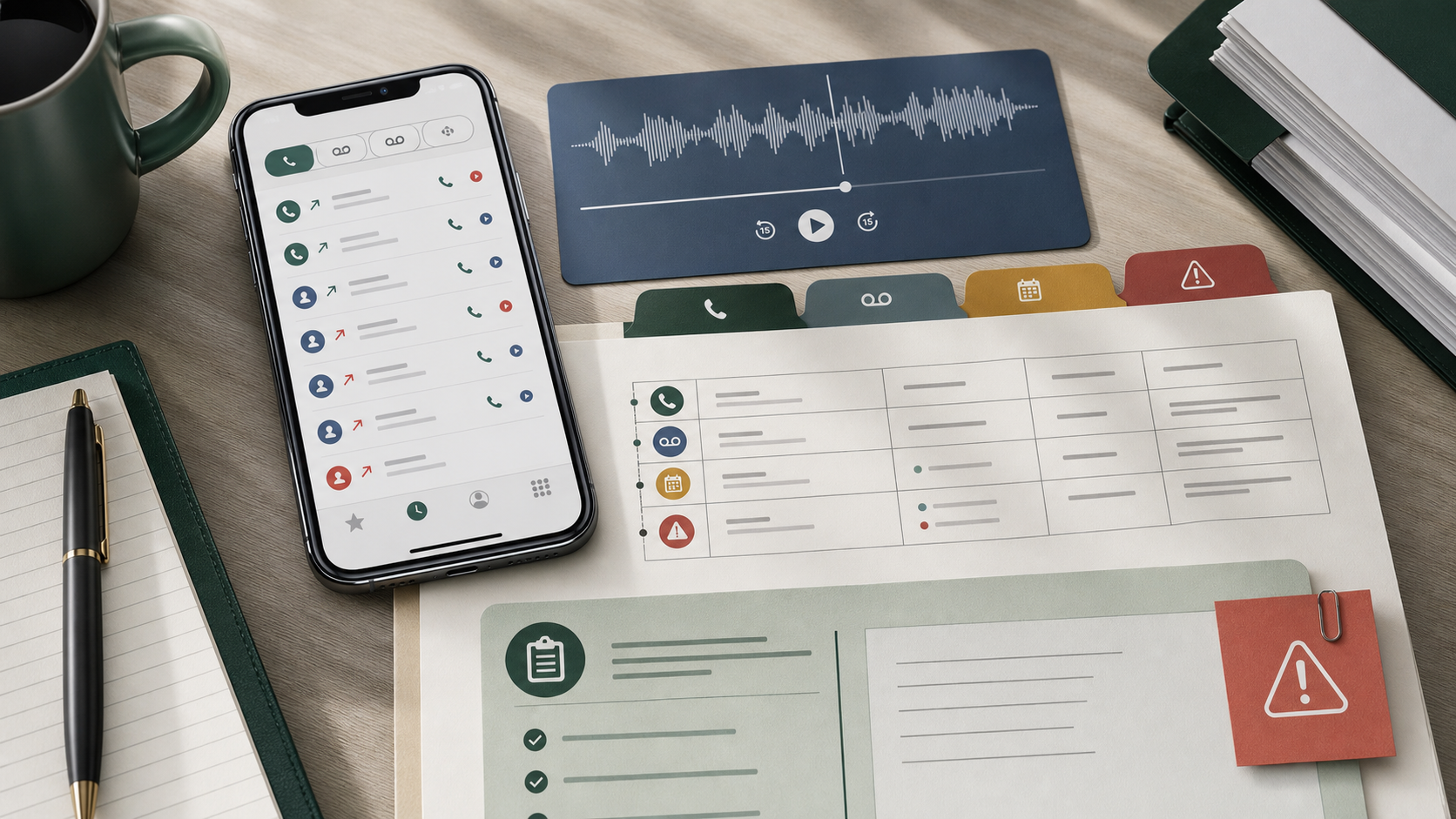


How to read this in Canada
Keep the record in layers: what the plan says, the dated event and its source, then what happened next. A fact stops being useful the moment it is written up as a legal conclusion.
Canadian rules can come from federal, provincial or territorial law. Start with the order or plan that applies to you, and keep its exact terms, such as parenting time or decision-making responsibility.
If you need to correct an error, add a dated note rather than editing the original. Keep routine events near the disputed ones so a family lawyer in your province or territory can judge which facts actually matter.
Recording your own call is not the crime
Section 184 of the Criminal Code makes it an offence to knowingly intercept a private communication, punishable by up to five years.
Section 184(2)(a) then takes out anyone acting with the consent of the person who sent it or the person it was meant for. On a call you are on, you are one of those people. Canada is a one-party consent country, and recording your own conversation is outside the offence.
That settles the criminal question and nothing else. It does not tell you whether the recording helps, whether a judge will want to hear it, or what making it says about you.
A recording of a conversation you are not part of is a different matter entirely. Leaving a phone running in a room you have left, or recording the child's call with the other parent while you are not on it, moves you towards the offence rather than away from it.
What a family judge does with a secret recording
The Ontario decision cited most often here is Hameed v Hameed, 2006 ONCJ 274. The court refused the recordings and held that secret recordings of calls by family law litigants should be strongly discouraged. The reasoning was not about admissibility technicalities. It was that these cases already carry enough mistrust, and the work of the court is to rebuild enough of it that two parents can act together for the child.
The Divorce Act now says something close to that in statutory form. Under section 7.2 a party must, to the best of their ability, protect any child of the marriage from conflict arising from the proceeding. Section 7.3 adds a duty to try a family dispute resolution process where that is appropriate. Section 7.5 says a person subject to an order must comply with it while it is in effect.
Set a secret recording of the other parent against those duties and the picture is not flattering. Recording your child is worse, because the child becomes an instrument in the case.
So the honest test is narrow. Does this go to a safety question that nothing else can show? If yes, take it to a lawyer before you file it. If it goes to tone, the dated log wins and it costs you nothing.
What the motion rules let you file, using Ontario as the worked example
Enforcement and court process are provincial. Ontario is the largest example, and its Family Law Rules show the shape of the problem everywhere.
Rule 14(18) says an affidavit for use on a motion shall, as much as possible, contain only information within the personal knowledge of the person signing it. Rule 14(19) allows what someone else told you only if you name the source and say you believe it is true. On a contempt motion under rule 31, it must also be information that is not likely to be disputed.
Rule 14(20) is the one that catches people. You serve all your evidence with the notice of motion. The other side then serves its answer. You may reply only to new matters they raised. No other evidence may be used.
That means the call log has to be finished before you file, not assembled as the motion goes along. It also has to be dull, because rule 1(8.2) lets the court strike out all or part of any document that is inflammatory, a waste of time, a nuisance or an abuse of the court process.
Getting the call records you did not keep yourself
Your handset log is usually the only record of incoming calls you will ever hold. Carriers hold their own billing data on their own retention schedule. It is thinner than people assume.
You can ask for it. Under federal privacy law an organisation must respond to a request for your own personal information within 30 days, at minimal or no cost. It can take up to 30 more days in limited situations. Even then it has to tell you inside the first 30, and tell you that you can complain to the Privacy Commissioner.
The request reaches your own account only. It does not reach the other parent's records.
So the habit that pays is unglamorous. Screenshot the call log the same week. Save the voicemail audio off the handset rather than trusting the mailbox to keep it. Write the line while you still know which call it was.
When the other parent stops the calls
Get the label right first. Phone and video time between a parent and child is parenting time under section 16.1 of the Divorce Act. A contact order under section 16.5 is for someone who is not a spouse, such as a grandparent. Filing under the wrong heading wastes a hearing.
Enforcement then depends on your province or territory. In Ontario, rule 1(8) of the Family Law Rules says that where a person fails to obey an order the court may make any order it considers necessary for a just determination of the matter. The list is long. Costs. An amount payable to a party or into court as a penalty or fine. Dismissing a claim. Striking out a document. Ruling that a document may not be used. Refusing that party any further order. Postponing a step. A contempt order under rule 31.
A contempt motion is served with a supporting affidavit by special service. If contempt is found, the court may order imprisonment, a fine, an amount payable to a party as a penalty, costs and anything else it decides is appropriate.
One more thing shapes how you build the record. Rule 14(21) lets the court bar a party from bringing further motions without permission where they are making numerous motions without merit. A pattern filed once carries further than a motion every month. A log kept week by week is what makes that pattern filable.
Divorce Act or provincial law, and which province
Two systems can apply. If you are married or divorcing, the Divorce Act governs the parenting order. If you never married, the statute is provincial or territorial, such as the Children's Law Reform Act in Ontario.
The terms and the forms differ, and so does enforcement. The Ontario rules quoted above are an example of the shape, not a national rule.
What travels is the record itself. A dated line per event, the source file kept alongside it, and nothing written that you could not stand behind if it were read out. Copy the terms from your own order, then ask a family lawyer in your province or territory which route is yours.
Province-or-territory checklist for a Canadian review
Name the province or territory and the court. Add the law or order tied to the parenting plan. Keep its own terms for parenting time, major decisions, contact, and support. Use local forms and due dates. If two legal areas may be involved, flag that point for a lawyer.
A Canadian review note
One-party consent makes recording your own call lawful in Canada. Family judges still discourage it. What the motion rules and enforcement routes let you file. Sharing any of it in Canada takes a few more steps.
Keep a review pack short: the current order or plan, a factual timeline and the source files that matter. Say plainly where something is missing.
Ask a family lawyer in your province or territory before you file or share records. Privacy, court, and evidence rules can differ across Canada. One PDF does not make those rules the same.
Name the province or territory. Note whether federal divorce law or another family law applies. Keep the terms used in the order itself.
Copyable record for a blocked or missed call
One entry per scheduled call, written to survive a motion affidavit.
ORDER PARAGRAPH:
CHILD:
SCHEDULED CALL (DATE AND TIME):
NUMBER OR APP USED:
ATTEMPTS (TIME OF EACH):
OUTCOME:
REASON GIVEN BY THE OTHER PARENT:
MESSAGE SENT AT THE TIME:
MAKE-UP TIME OFFERED OR TAKEN:
EXHIBIT REFERENCE:
ONE-LINE AFFIDAVIT ENTRY:- Useful entry
Order paragraph 5, Thursday 7pm video call with Noor. Called 19:00 and 19:11, no answer. Message sent 19:14. No reply. No make-up time offered.
- Avoid
A recording of the child's call with the other parent that you were not part of.
Before a recording goes anywhere near your motion
Run these before the recording becomes part of your case.
Which Canadian route is this?
Four things get called call evidence here. They go four different ways.
Is it your phone's own call history?
Screenshot it the same week and turn each event into one line. No permission needed to keep it.
Is it a voicemail somebody left you?
Save the audio off the handset and exhibit it only where it earns its place.
Is it a recording of a call you were part of?
Lawful under section 184(2)(a), and still discouraged in family court. Get advice before it goes in.
Is it parenting time the other parent is blocking?
That is an enforcement question. Find the paragraph of the order, then look at your province's rules, in Ontario rule 1(8) and rule 31.
Turning a call log into one line a motion can carry
Casewell lets you attach source material to the exact event it explains, keep a private evidence timeline, and export selected records as a court-ready PDF for review by a family lawyer in your province, mediation or a court hearing.
Try for freeIs it legal to record a phone call with my ex in Canada?
Recording a call you are part of is lawful. Section 184 of the Criminal Code makes intercepting a private communication an offence. But section 184(2)(a) exempts a person acting with the consent of the originator or the intended recipient. On your own call you are one of them. Recording a conversation you are not part of is a different question and can put you inside the offence.
Can I record my child's call with the other parent?
Not safely. If you are not on the call, the one-party consent exemption does not cover you. Even where a recording could be made lawfully, section 7.2 of the Divorce Act puts a duty on you to protect the child from conflict arising from the proceeding. Recording a child cuts directly against it. Ask a family lawyer in your province before you do anything of this kind.
Will the judge let me play a recording I made lawfully?
Maybe, and it may cost you more than it earns. In Hameed v Hameed, 2006 ONCJ 274 the court refused the recordings and held that secret recordings by family law litigants should be strongly discouraged. The reason was that the work of the court is to rebuild enough trust for two parents to act together. A recording that goes to a genuine safety question is a different case. One that goes to tone usually is not.
How much of my call log can I put in a motion?
In Ontario, rule 14(18) says an affidavit for use on a motion shall as much as possible contain only what you know personally. Rule 14(20) says you serve all your evidence with the notice of motion, the other side answers, you reply only to new matters, and no other evidence may be used. Rule 1(8.2) lets the court strike out anything inflammatory or abusive. So the log has to be finished, focused and dull before you file.
My ex is blocking parenting time on the phone. What can I do in Ontario?
Start with the paragraph of the order. Rule 1(8) of the Family Law Rules lets the court respond to a failure to obey an order with costs, an amount payable as a penalty or fine, dismissal of a claim, striking a document, refusing the party further orders, postponing a step, or a contempt order under rule 31. A contempt finding can carry imprisonment, a fine, a penalty payable to you and costs. Outside Ontario, ask a lawyer in your own province.
How far back can I get my phone records?
Less far than most people expect. Under federal privacy law your carrier must answer a request for your own personal information within 30 days at minimal or no cost, with a limited extension of up to 30 more days. What it holds is set by its own retention schedule, and it covers your account rather than the other parent's. Your handset log is usually the only record of incoming calls. So save it while it exists.
Does this replace provincial or territorial guidance?
No. Federal, provincial and territorial family-law rules can interact, and court process differs across provinces and territories. Check the current order or plan and current official guidance for the relevant legal area.
Sources
Criminal and divorce law here are federal. Court rules and enforcement are provincial or territorial, and the Ontario rules are used as a worked example. This is a records guide, not legal advice.
- Criminal Code section 184: interception of communications
- Divorce Act section 7.2: protection of children from conflict
- Divorce Act section 16.1: parenting orders
- Ontario Family Law Rules O Reg 114/99, rules 1, 14 and 31
- Divorce Act sections 7.3 and 7.5: duties to try dispute resolution and to comply with orders
- Office of the Privacy Commissioner of Canada: accessing your personal information
- Department of Justice Canada: the Divorce Act changes explained
- Department of Justice Canada: Parenting arrangements after separation or divorce