

The calendar looks tidy. Parent A has the child from Monday through Thursday, Parent B takes over for the rest of the week, and both parents appear to receive equal time. Then the first handover runs late, a school bag stays at the wrong house, or a holiday overlaps with the regular rotation. The disagreement isn't about arithmetic anymore. It's about what the parents agreed to, what happened, and whether anyone recorded it clearly.
A workable 50 50 custody schedule needs more than equal-looking blocks. It needs fixed exchange rules, practical exceptions, holiday instructions, and a neutral record of deviations. The fifteen templates below pair each sample pattern with a logging routine designed to make handovers and changes easier to verify later. Some fit younger children who need frequent contact. Others reduce transitions for older children, distant households, or demanding work schedules.
Definitions also matter. Research uses “shared physical custody” broadly, sometimes covering arrangements where each parent has between 30% and 50% of the child's time, rather than an exact split, as described in this review of shared physical custody research. A schedule can look equal on paper and still fail in daily life if the exchanges, travel, sleep, school routine, or communication system don't work.
1. Alternating Weeks
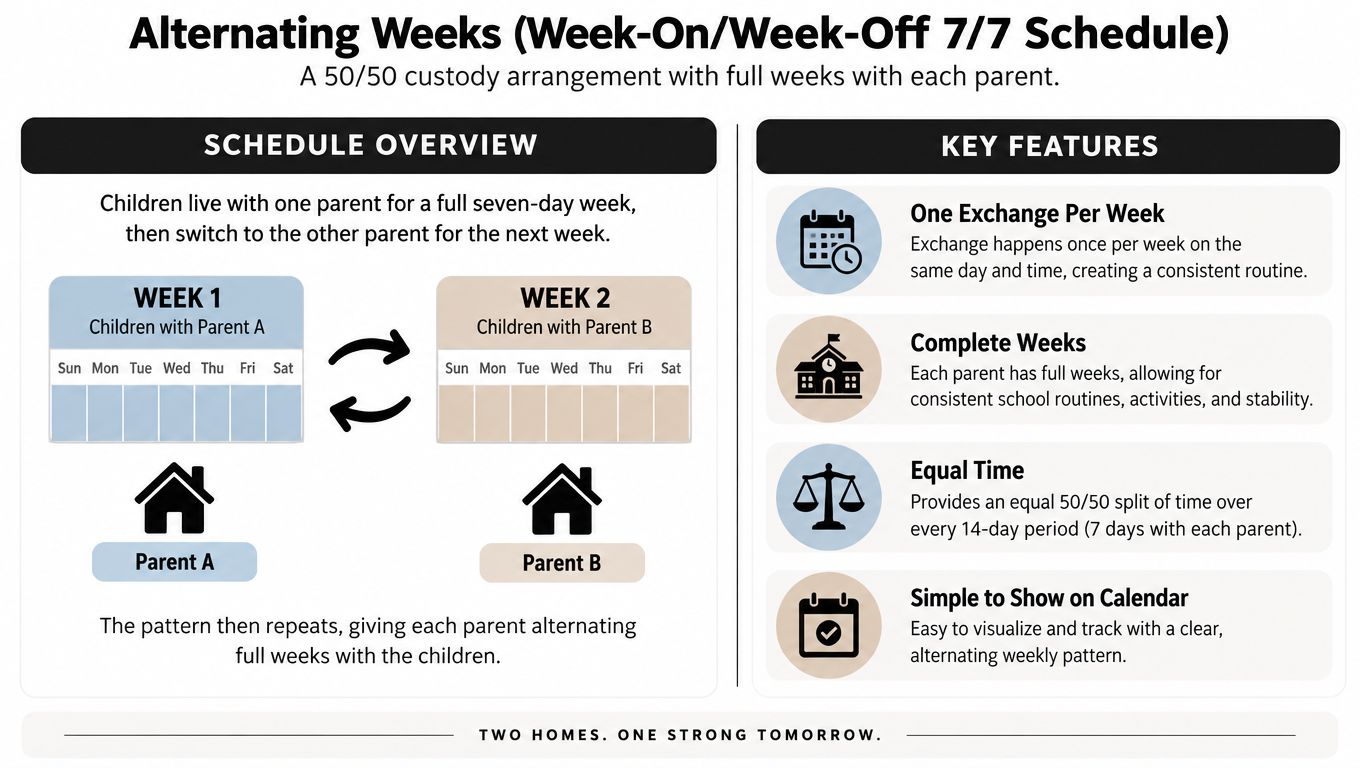
An alternating-week plan gives one parent the child for a full week, then switches homes for the next week. A sample cycle is Parent A from Sunday at 6:00 p.m. through the following Sunday at 6:00 p.m., followed by the same block with Parent B. The calendar is easy to read, but a full week away can feel long for some children.
This pattern suits families who want few exchanges and can reliably support school, activities, and communication across both homes. It may be less comfortable when a child struggles with long separations or when parents live too far from the child's school.
Exchange record: Log the date, agreed time, actual time, location, person completing the handover, and any missing belongings immediately after each switch.
Use this guide to compare 50/50 parenting schedules when mapping the weekly rhythm. Record school notices, medical appointments, activity details, and agreed swaps in the child's journal, linking every change to the original week.
2. 2-2-3 Rotation
The 2-2-3 rotation keeps each parent involved throughout the week. Parent A has Monday and Tuesday, Parent B has Wednesday and Thursday, and Parent A has Friday through Sunday. The following week reverses the weekend block, giving Parent B the longer stretch.
It can work well for children who handle regular transitions and for parents who live close enough to manage several exchanges without disrupting school. It creates more handover points than an alternating-week plan, so vague arrangements quickly become a source of conflict.
Use school or daycare pickup whenever possible. Record the scheduled exchange, the actual pickup, the child's immediate condition, and any essential information about sleep, meals, medication, or activities. A short shared calendar can show the plan, while a private journal should capture what actually occurred.
3. 3-4-4-3 Rotation
The 3-4-4-3 pattern gives Parent A three days, Parent B four days, then reverses the allocation in the next part of the cycle. Across the full rotation, each parent receives equal time, while both parents get meaningful weekday and weekend contact.
This is a useful middle ground when a child needs more continuity than a 2-2-3 provides but neither parent wants a full week apart. The fixed sequence is easier to follow when the written plan names the exact start and end times rather than relying on “after school” or “at the weekend.”
Create a transition chart showing the parent, date, time, and location for every exchange. After each handover, record whether it happened as planned. If a parent accepts a swap, note who proposed it, the agreed replacement time, and whether the change affected school, activities, or transport.
A practical handover checklist should cover:
- Personal items: Note whether school bags, uniforms, medication, and activity equipment moved with the child.
- Routine information: Record relevant sleep, health, homework, and appointment details.
- Exceptions: Link late arrivals, missed exchanges, and replacement time to the original calendar entry.
4. Every Other Weekend Plus One Midweek Visit
Here, one parent handles most school nights while the other has alternating weekends, usually from Friday evening to Sunday evening, plus a regular midweek visit. The midweek contact might be a Wednesday dinner, an overnight, or another clearly defined period.
This arrangement can fit parents who live farther apart or whose work makes equal weekday care impractical. It isn't a 50/50 schedule in the strict equal-time sense, but it can provide a predictable relationship without forcing school-night travel that the family can't sustain.
Set the weekend handover at a specific time and place. Record the child's departure and return, planned activities, homework, medication, and any request to change the next visit. If physical contact isn't possible on a particular day, document an agreed video call without presenting it as a substitute overnight.
Parents comparing this pattern with equal-time alternatives can review the practical differences between alternating weekend schedules.
5. Weekday and Weekend Split
A weekday and weekend split assigns the school week to one parent and the weekend to the other. A typical calendar runs from Monday morning through Friday afternoon with Parent A, then Friday afternoon through Sunday evening with Parent B. The arrangement mirrors many work routines, but it can leave the weekend parent carrying less responsibility for school-day decisions.
Make the written plan specific about Friday pickup, Sunday return, school preparation, and communication about appointments. The weekend parent should receive the information needed to manage homework, medication, activities, and clothing without relying on last-minute messages.
A useful journal entry starts with the scheduled period, then records the actual period. Add missed schoolwork, changed plans, or an agreed exchange adjustment as separate facts. Don't combine observations with conclusions. “Child arrived without prescribed medication” is more useful for later review than a general statement about poor preparation.
6. Every Weekend
An every-weekend arrangement gives one parent the child from Friday evening through Sunday evening, often with an additional weekday evening. It can preserve consistent contact when the parents' weekday work commitments don't align or their homes are too far apart for frequent school exchanges.
The strength is predictability. The weakness is that the weekend parent may have limited involvement in ordinary weekday routines unless the plan includes a midweek period, calls, school participation, or responsibility for specific appointments.
Plan weekend logistics before Friday. Record the scheduled pickup, actual pickup, return condition, school preparation, activities attended, and any expenses paid. If a child misses an activity because of travel or fatigue, note the activity, the planned time, the actual outcome, and the reason as understood, without guessing at motive.
A weekend checklist can include:
- School readiness: Confirm homework, uniforms, projects, and required equipment.
- Health needs: Record medication instructions and appointments.
- Return details: Note the agreed return time and any deviation from it.
7. Bird's Nesting
In a nesting arrangement, the child stays in the family home while each parent moves in and out according to the care calendar. The child avoids repeated packing and maintains one bedroom, one school base, and one household routine. The parents, however, must manage separate residences and strict boundaries.
This can be useful as a temporary transition after separation, especially when the adults can cooperate and the child needs continuity. It often becomes difficult when parents disagree about cleaning, groceries, repairs, visitors, privacy, or who is responsible for household conditions.
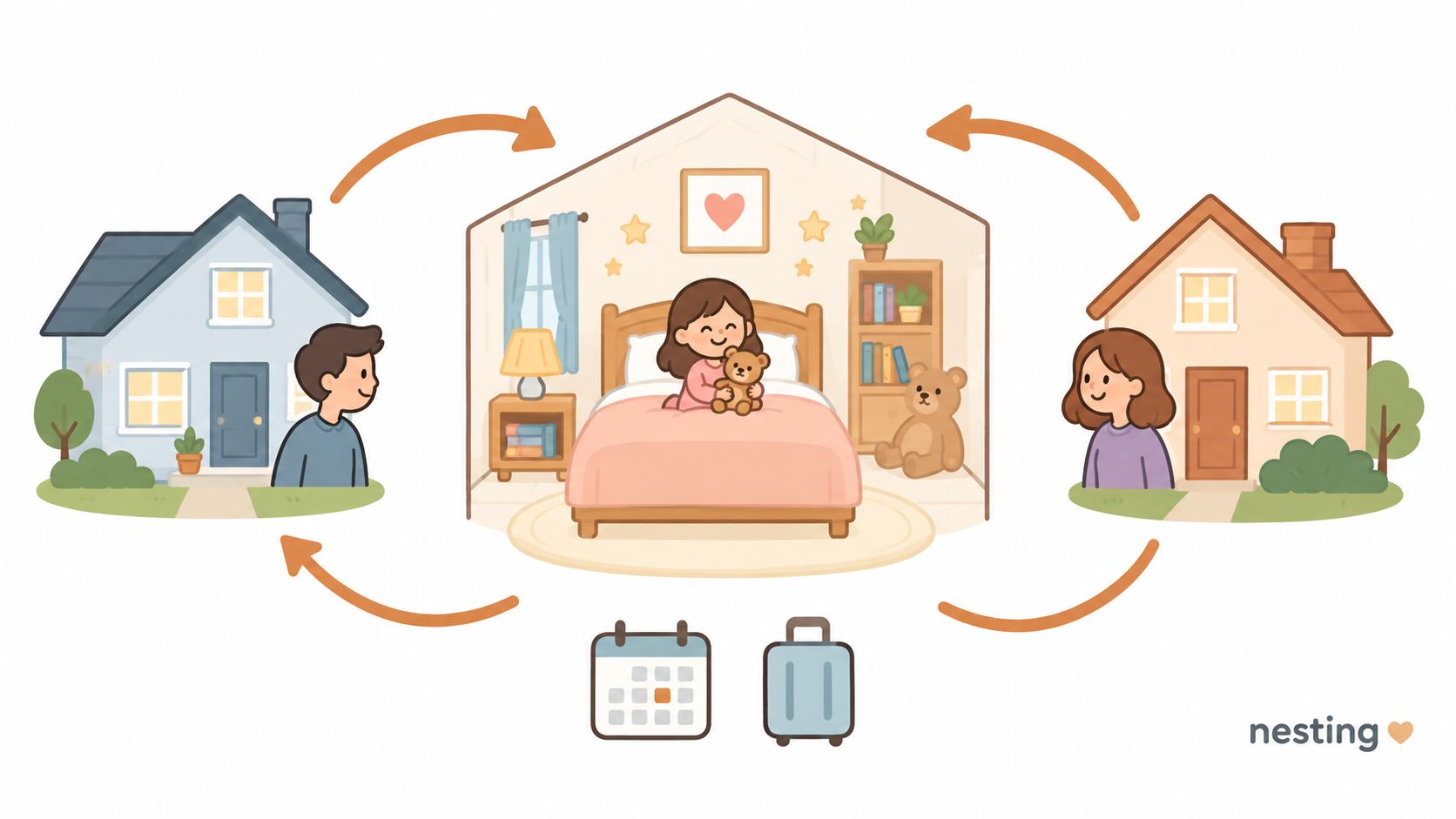
Write a separate household protocol covering entry times, personal property, food, cleaning, repairs, and emergency access. At every changeover, record the time, the condition of the home, outstanding child-related tasks, and any item that needs attention. A private record can support the practical boundaries discussed in this guide to nesting after divorce.
The arrangement should be reviewed regularly. If the parents can't maintain separate spaces and predictable transitions, the child's stable address may be outweighed by adult conflict.
8. Primary Custody with Regular Visitation
The primary and secondary model gives the child one main residence while the other parent has defined parenting time. That time may include dinners, overnights, alternating weekends, school breaks, holidays, and vacation periods. It isn't an equal-time plan, but it may be more workable where distance, housing, work, or the child's needs make equal overnights unrealistic.
The parenting plan should identify exchange locations, decision-making responsibilities, communication methods, notice for changes, and a process for reviewing the schedule as the child grows. “Reasonable visitation” is often too vague to prevent disagreement.
Keep one entry for the scheduled visit and another for what happened if the period changed. Record cancellations, replacement time, late arrivals, and relevant child logistics. Attach receipts, school notices, or written agreements to the relevant event rather than storing them separately with no date or context.
9. Split Custody
Split custody places different children primarily with different parents. It may arise in high-conflict situations or when older children express different residence preferences, but it separates siblings and should not be treated as an easy administrative solution.
The schedule must protect sibling relationships. A sample plan might place one child with Parent A during school nights and another with Parent B, then bring both children together for alternating weekends, holidays, or shared activities. The calendar should identify each child separately and show the periods when siblings are together.
Document sibling contact as carefully as each child's individual residence. Record missed shared meals, activities, celebrations, and agreed replacements. Keep the wording factual, especially when children have different views. A journal should not turn one sibling into a messenger or ask a child to prove a parent's position.
Before agreeing, examine school transport, extracurricular commitments, emotional strain, and whether the arrangement can preserve ordinary sibling time. The apparent convenience for adults may create a complicated family routine.
10. Every Third Weekend or Rotating Long Weekend
A longer but less frequent weekend can suit parents who travel for work or live far from the child's school. The child might leave Friday evening and return Monday morning every third weekend, with a short midweek call or visit between physical periods.
The longer visit gives the parent more time for ordinary routines, not just a quick activity. It also creates a longer gap between in-person contact, so the family needs dependable calls and clear plans for the next visit.
Write the long weekend into the calendar with exact departure and return times, including whether Monday school drop-off is permitted. After each visit, record the exchange, travel conditions, activities, school preparation, and any agreed adjustment. If a visit is lost to illness or travel, document the proposed replacement rather than assuming it will be remembered.
A longer visit only helps if the travel plan, sleep routine, and return arrangements are realistic for the child.
11. Summer and School-Year Split Schedule
The school-year plan can prioritize stable school nights and local activities, while the summer plan allows longer visits, travel, or extended blocks with either parent. The two schedules must be written as separate calendars. Otherwise, a summer change can accidentally override the regular plan without a clear end date.
Set the summer schedule before school finishes. Include start and end times, travel notice, destination details, communication during trips, and which plan resumes afterward. Parents can use a custody calendar designed for children to show the change in a way the child can understand.
Log the scheduled vacation period, actual departure, actual return, and any deviation. Keep travel confirmations, consent records, receipts, and activity changes beside the entry. If a parent returns early or extends a trip, record the agreed adjustment and whether replacement time was arranged.
A summer schedule is not automatically easier. Longer blocks can expose problems with travel, childcare, medication, and communication that a school-year routine hides.
12. Holiday and Vacation Rotation
Holiday rules supplement the regular schedule. Parents might alternate major holidays by year, divide a day into morning and evening periods, or assign school breaks separately from ordinary weekends. The plan should state which rule controls when a holiday overlaps a normal exchange.
For each holiday, specify the start time, end time, pickup location, travel responsibility, notice requirements, and what happens when the holiday falls during a vacation. Include a tie-breaker for overlapping requests and a defined process for resolving disputes.
Create the holiday journal entry when the plan is confirmed, then add the actual exchange afterward. Record whether the child left and returned on time, whether travel consent was provided, and any agreed change. Keep the original agreement attached so a later reader can distinguish the planned holiday from the event that occurred.
Do not rely on “we'll work it out later.” Holiday conflict usually starts with an omission that seemed harmless when the plan was drafted.
13. Gradual Transition and Step-Up Schedule
A step-up plan increases time gradually for an infant or very young child. It may begin with short daytime visits, move to longer periods, and later introduce overnights when the child and both parents are ready. The exact progression should reflect the child's response and professional advice, not an automatic timetable.
The calendar should show each phase separately, including supervision requirements, feeding arrangements, nap routines, and handover locations. Consult the child's pediatrician where health, feeding, sleep, or developmental concerns affect the transition.
Record each visit as an event. Note the planned duration, actual duration, feeding or medication information, sleep response, transition behavior, and any adjustment agreed by the parents. Keep observations separate from interpretations. “Child slept for the usual nap after returning” is clearer than a broad claim that the visit was successful.
The plan should include a review method. A German study of separated families found that fewer than 5% of children in its sample lived in a dual-residence arrangement, and approximately 20% of children who began shared care later moved to sole physical custody, as described in this study of shared physical custody and residence patterns. That finding doesn't predict an individual family, but it supports treating a schedule as something to review rather than a permanent endpoint.
14. Flexible and On-Call Schedule
Parents with hospital shifts, emergency work, rotating schedules, or service-industry hours may need a flexible plan. Flexibility should not mean uncertainty. Set a baseline of guaranteed parenting time, a notice deadline for proposed changes, a response deadline, and a default arrangement when no agreement is reached.
For example, the parent with the upcoming shift can submit a work calendar, while the other parent confirms exchanges through a designated scheduling tool. The written plan should state who handles school pickup when a shift changes and whether replacement time is automatic or negotiated.
Maintain two records. The first shows the planned schedule. The second records actual care, late notice, missed time, and replacement periods. Confirm every change in writing, even when the parents agree by phone. A dated entry should identify the work conflict, the proposed solution, the response, and the final exchange outcome.
Flexible care can work well, but it fails when one parent carries all the planning burden or when “on-call” becomes a reason to cancel without accountability.
15. 4-3-3-4 Rotation
The 4-3-3-4 rotation uses longer blocks than a 2-2-3 pattern while avoiding a full week apart. One parent has four days, the other has three, then the blocks reverse so each parent receives equal time across the complete rotation.
This pattern can balance stability and contact, but the written calendar must make the sequence unmistakable. Mark school events, practices, medical appointments, and recurring weekday responsibilities before adopting it. A parent who always handles a particular activity should know whether that responsibility follows the child or the residence block.
Record each exchange with the planned and actual time, location, transport person, and items transferred. Keep a shared factual log of medication, appointments, homework, and activity changes. If the schedule changes, preserve the original block and add the replacement period instead of rewriting history.
The pattern is only as practical as the adults' ability to follow its handover sequence. A visually equal calendar doesn't compensate for missed information at every transition.
15-Option Comparison of 50/50 Custody Schedules
| Schedule | Complexity 🔄 | Coordination & Resources ⚡ | Expected Outcomes 📊⭐ | Ideal Use Cases 💡 | Key Advantages ⭐ |
|---|---|---|---|---|---|
| Alternating Weeks (Week-On/Week-Off 7/7) | Low, one exchange/week 🔄 | Low, simple calendar & records ⚡ | Equal time each 14 days; stable weekly routines 📊 ⭐⭐ | School-age & older preschoolers; parents nearby 💡 | Predictable; few handovers; easy to verify ⭐ |
| 2-2-3 Rotation | Medium‑High, exchanges every 2–3 days 🔄🔄 | High, frequent handovers; shared calendar needed ⚡⚡ | Strong regular contact; minimizes long separations 📊 ⭐⭐⭐ | Preschool and adaptable school-age children; cooperative parents 💡 | Regular weekday/weekend sharing; frequent contact ⭐ |
| 3-4-4-3 Rotation | Medium, periodic handovers 🔄 | Medium, planning for mid-cycle swaps ⚡ | Balanced stability and contact; equal time over 14 days 📊 ⭐⭐ | School-age children; families seeking balance 💡 | Longer blocks than 2-2-3; better weekend sharing ⭐ |
| Every Other Weekend + One Midweek Visit | Low‑Medium, weekend focus with one midweek 🔄 | Low, limited exchanges; occasional coordination ⚡ | Stable weekday routine; regular weekend & midweek contact 📊 ⭐ | Parents farther apart or with weekday work lives 💡 | Weekday stability for primary parent; predictable weekend time ⭐ |
| Weekday/Weekend Split (5-2) | Low, two main exchange points/week 🔄 | Low, straightforward handovers ⚡ | Predictable school routine; unequal time (≈5:2) 📊 ⭐ | When work schedules align with weekdays/weekends 💡 | Stability for school routines; fewer exchanges ⭐ |
| Every Weekend (Weekend‑Centric) | Low, weekend-only primary exchanges 🔄 | Low, simple calendar mapping ⚡ | Consistent weekend bonding; limited weekday involvement 📊 ⭐ | Older children, teens, or long-distance cases 💡 | Reliable weekend quality time; simple to manage ⭐ |
| Bird's Nesting (Nesting) | Very High, parents rotate residences 🔄🔄🔄 | Very High, multiple homes, logistics & costs ⚡⚡⚡ | Minimal child disruption; high parental expense 📊 ⭐⭐ | Short-term transitions; infants/very young children 💡 | Keeps child in one home; reduces moving stress ⭐ |
| Primary Custody with Regular Visitation | Low, primary residence + set visits 🔄 | Medium, defined visitation & authority rules ⚡ | Stable routines; clear decision-making; unequal time 📊 ⭐ | Infants, young children, common in litigated cases 💡 | Predictability; simplified school/medical decisions ⭐ |
| Split Custody | High, separate schedules per child 🔄🔄 | High, multiple orders and logistics ⚡⚡ | Tailored to individual needs; risks sibling separation 📊 ⭐ | High-conflict cases or very different child needs 💡 | Custom fit per child; may reduce child-specific conflict ⭐ |
| Every Third Weekend / Rotating Long Weekend | Low, infrequent but longer visits 🔄 | Low, fewer handovers; planning for long weekends ⚡ | Longer contiguous visits but infrequent contact 📊 ⭐ | Parents who live far apart or travel frequently 💡 | Deeper activities on visits; reduced logistics ⭐ |
| Summer vs School‑Year Split Schedule | Medium, two seasonal schedules 🔄 | Medium, advance planning for vacations & camps ⚡ | Academic stability plus extended summer bonding 📊 ⭐⭐ | School-age children needing routines and summer flexibility 💡 | Preserves school routine; maximizes summer time ⭐ |
| Holiday and Vacation Rotation | Medium‑High, detailed holiday rules 🔄🔄 | High, tracking rotations, travel consent & timing ⚡⚡ | Predictable allocation of holidays; fewer disputes 📊 ⭐ | Families with strong holiday traditions; all ages 💡 | Clear holiday allocation; reduces annual conflicts ⭐ |
| Gradual Transition / Step‑Up (Infants) | Medium, phased visits and milestones 🔄 | Medium, pediatric guidance; documentation ⚡ | Reduced separation anxiety; supports attachment 📊 ⭐⭐ | Infants and toddlers needing gradual adaptation 💡 | Controlled progression to overnights; clinician‑informed ⭐ |
| Flexible / On‑Call Schedule | High, variable booking & fallback rules 🔄🔄 | High, shared tools, advance notice, backups ⚡⚡ | Maximizes parenting with irregular shifts; variable routines 📊 ⭐ | Shift workers (hospital staff, first responders) 💡 | Flexibility to match work; fair with variable schedules ⭐ |
| 4-3-3-4 Rotation (Block Alternative) | Medium, two-week block cycle 🔄 | Medium, map activities to blocks; shared log ⚡ | Equal time with fewer transitions than 2-2-3 📊 ⭐⭐ | Preschoolers and school-aged children; desire balance 💡 | Longer blocks for stability; equal time with reduced exchanges ⭐ |
Choose the Schedule You Can Actually Document
The best schedule isn't the one that produces the prettiest calendar. It's the one both parents can follow, explain, and verify without asking the child to carry messages between homes. Equal time may be appropriate for some families, but research doesn't identify one universal number of hours or one schedule that benefits every child. Guidance from the Canadian Department of Justice on parenting arrangements emphasizes the child's needs, parental capacity, distance, social supports, and the wider environment rather than treating “as much time as possible” as an automatic instruction to use equal overnights.
Start with the child's age and response to transitions. A younger child may need shorter separations and a gradual increase in overnights. An older child may manage longer blocks but still need a stable school routine and a voice in how the schedule operates. Watch sleep, school punctuality, activity attendance, transition reactions, and the child's expressed preferences. Record observations without making the child responsible for proving either parent's case.
Then test the logistics. Can both homes support school drop-off, homework, medication, sports equipment, and reliable transport? Do work hours make the exchange times realistic? Does the holiday plan say who collects the child, when the period ends, and what happens when vacation and regular time overlap? If the answer is unclear, the schedule isn't finished.
The Swedish research described in this analysis of children in equal shared physical custody found an association between equal shared housing and lower reported stress, with an odds ratio of 0.58 for belonging to the high-stress group. That is an association, not proof that equal residence caused the difference. Families able to maintain equal time may also differ in conflict, resources, geography, and parental functioning. Use the child's actual experience as a review signal, not the number of nights alone.
A defensible review process is simple:
- Preserve the plan: Save the agreed calendar, exchange times, holiday rules, and exception provisions.
- Record the event: Enter the actual handover, delay, missed period, or replacement time with its date and time.
- Attach context: Keep relevant messages, receipts, school notices, travel records, and agreements beside the event.
- Separate fact from interpretation: Describe what happened before explaining why you think it happened.
- Review patterns: Look for recurring sleep disruption, missed activities, travel strain, or repeated deviations.
- Prepare focused records: Share only relevant material with a mediator, attorney, or other professional when needed.
Your next step is concrete. Write the first exchange time and location into the parenting agreement, then create a private journal entry for the first handover. Record the planned time, actual time, who attended, the child's belongings, and any immediate deviation. If you want a dedicated tool, Casewell organizes dated custody entries, exchange check-ins, agreements, attachments, expenses, and focused PDF reports for professional review. It is designed for private record-keeping rather than co-parent messaging.
Casewell gives separated parents a private custody journal for dated exchange check-ins, schedule deviations, agreements, receipts, screenshots, and structured child-related records. Start building a clearer record of your 50/50 custody schedule by visiting Casewell.