 Casewell

The most popular advice about a shared custody schedule starts with equal time. That's the wrong starting point. A calendar can divide nights evenly while leaving a child exhausted by school-day travel, repeated packing, or tense handovers.
Start with the child's ordinary week instead. Judge each option by overnight share, household transitions, and whether actual care matches the written plan. Fairness between adults matters, but a child has to live the calendar, not just accept its arithmetic.
What a Shared Custody Schedule Actually Counts
Joint legal custody concerns authority over major decisions, such as education and healthcare. Shared physical custody concerns where the child lives and how parenting time is distributed. Parents can share decision-making while having an unequal residential schedule, so neither label tells you who handles tomorrow's school run.
A shared custody schedule turns residential arrangements into instructions. It identifies where the child sleeps, when responsibility changes hands, and who manages the practical work around those changes.
California enacted the first joint-custody statute in 1979, during the shift toward gender-neutral custody standards, according to a Florida House legislative analysis. The same document describes a 1995 New York appellate decision noting that state thresholds for shared custody ranged from approximately 25% to 35% of overnights. Those historical thresholds aren't a substitute for checking the law and order that govern your family today.
Separate the label from the instructions
A workable calendar needs answers that a custody label can't supply:
- Residence: Name the home responsible for each overnight, including nights before school holidays.
- Daily care: Assign school collection, medication, homework materials, and activity transportation.
- Transfer of responsibility: State whether an exchange happens at school dismissal, daycare collection, or a named location.
- Exceptions: Identify which holiday and vacation provisions override ordinary parenting time.
Say parents agree that the child spends weekends with one parent. Does that mean collection after school or after dinner? Does the child return before bedtime or go directly to school? Those differences affect overnight totals and who must be available for the next morning.
Practical rule: Someone unfamiliar with your family should be able to read the plan and identify who is responsible for the child at any ordinary point in the week.
Keep decision-making provisions separate from residential instructions. Permission to make a medical decision doesn't automatically change the overnight calendar, and an extra overnight doesn't automatically transfer decision-making authority. Your written plan should make both responsibilities clear without treating them as interchangeable.
Shared Custody Schedule Patterns Side by Side
Shared custody schedule patterns compared
The arithmetic below uses illustrative repeating calendars, not legal definitions. Transition counts describe a repeating sample month with four complete weeks, including the exchange into the next cycle.
| Pattern | Overnight blocks | Approx. share | Transitions | Best when | Main strain |
|---|---|---|---|---|---|
| Week on week off | Seven nights at each home, alternating | 50/50 | Four per sample month | School routines work from either home and the child tolerates longer gaps | A full week away from the other parent |
| 2-2-3 | Two, two, then three nights; reverse parents the next week | 50/50 | Twelve per sample month | Frequent contact matters and homes are close | Frequent packing and school-night handovers |
| 2-2-5-5 | Two, two, five, then five nights | 50/50 | Eight per sample month | Fixed weekday responsibility helps organize care | Longer gaps and different household routines |
| 3-4-4-3 | Three, four, four, then three nights | 50/50 | Eight per sample month | Parents want balanced nights with medium-length blocks | Weekday responsibilities shift |
| 5-2 school-night plan | Five nights at one home, then two at the other | About 71/29, calculated from the blocks | Eight per sample month | One home anchors school mornings | Unequal time and weekends concentrated with one parent |
| Alternating weekends plus one midweek overnight | Two weekend nights every other week, plus a separate weekly overnight | About 71/29, calculated from the blocks | Twelve per sample month when visits remain separate | A school-night home base is needed and midweek travel is manageable | Short stays can create substantial travel |
| Birdnesting | Child stays; parents rotate through the home | 50/50 care if parents alternate equal blocks | No child moves; parent changes follow the chosen rotation | Parents can maintain a neutral home and fund off-duty accommodation | Housing costs, privacy, and household boundaries |
Read the blocks, not the nickname
A 5-2 plan isn't approximately 60/40 when the same parent always receives the longer block. To move closer to that division, the calendar must assign additional nights to the parent with less time. A generous-sounding label can't change the count.
Similarly, alternating weekends plus a midweek overnight isn't automatically a low-transition arrangement. A separate school-night stay creates an outward and return journey. It can provide meaningful everyday involvement, but it requires nearby homes and dependable transportation.
Published custody rates aren't targets either. A comparative review published by Springer reported shared care in approximately 50% of post-separation cases in Wisconsin and 37% in Belgium, while warning that the studies used different definitions. Those figures describe particular populations, not the proportion of time your child should spend at either home.
Adjust for the work calendar
A repeating schedule may need an explicit procedure for irregular employment. For an example of issues to address when flight rosters affect availability, the Law Office of Bryan Fagan PLLC's resource on DFW pilot parenting time arrangements provides occupation-specific context.
Whatever the pattern's name, put it on a dated calendar. Count actual nights across complete cycles and then across the year, including holiday changes. Record the residential result rather than assuming the label describes it accurately.
How Equal Rotations Differ in Real Weeks
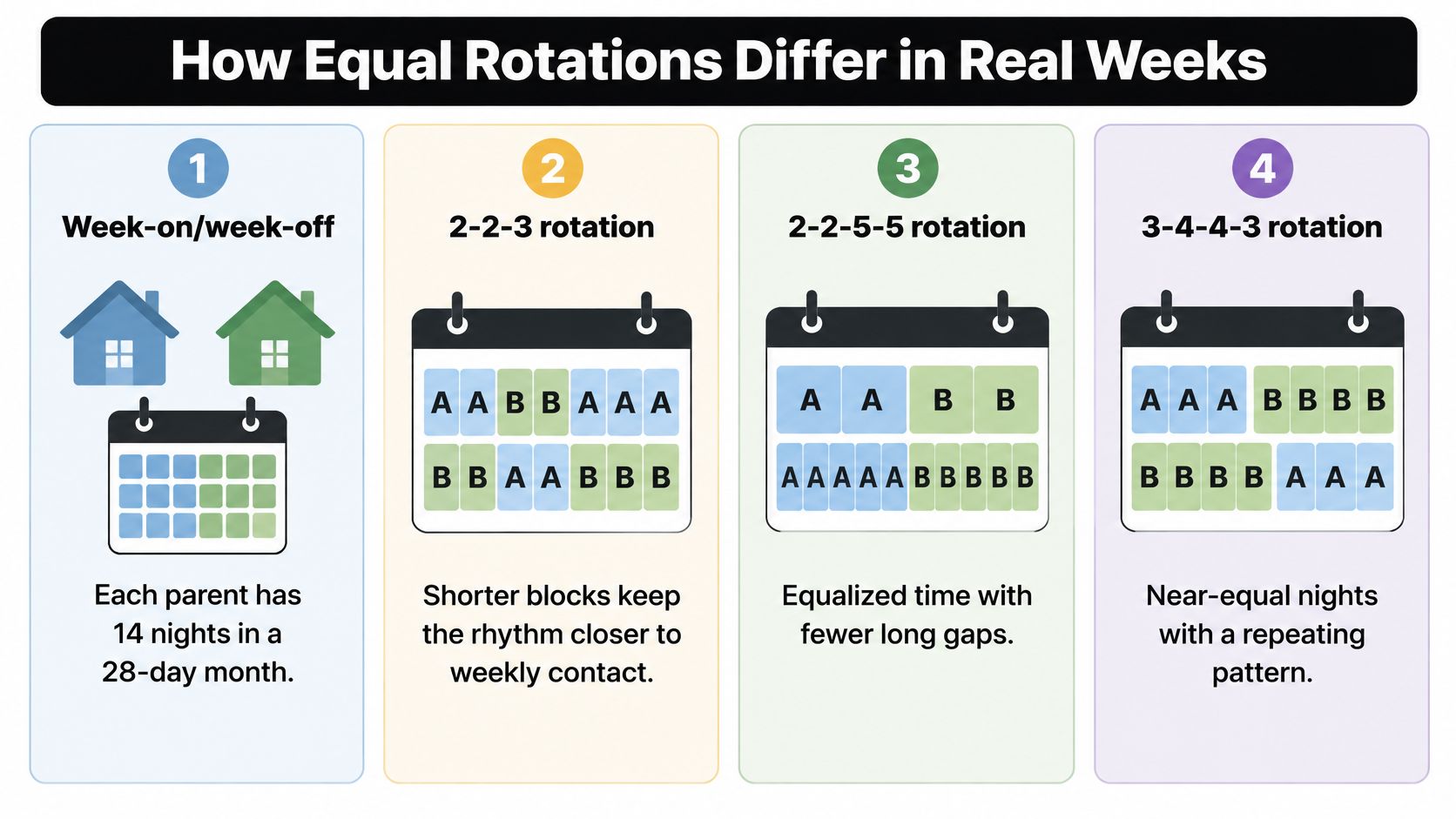
Equal overnight totals don't produce identical weeks. The difference lies in how long the child stays, which weekdays repeat, and how often someone must move bags, medication, or school materials.
This visual shows the basic shapes of the rotations.
Map a sample month
For this hypothetical 28-night calendar, A and B identify the parents. Repeat each sequence until the sample ends; every example gives each parent 14 nights, calculated directly from its blocks.
- Week on week off: AAAAAAA / BBBBBBB / AAAAAAA / BBBBBBB. The child settles into a household for a full school week, but contact in person with the other parent has a longer gap.
- 2-2-3: AA / BB / AAA / BB / AA / BBB, repeated. Weekend responsibility alternates, while short blocks require frequent preparation for another move.
- 2-2-5-5: AA / BB / AAAAA / BBBBB, repeated. When anchored correctly, each parent keeps designated weekdays and alternates the weekend-containing longer blocks.
- 3-4-4-3: AAA / BBBB / AAAA / BBB, repeated. The child gets medium-length stays, but parents must check which school nights fall within each block rather than assuming fixed weekday ownership.
The last pattern does not guarantee long weekends for both parents. Its usefulness for activities comes from where you anchor the exchange days, not from the number sequence alone.
For families considering fixed weekday assignments, our guide to the 5-5-2-2 rotation offers a closer look at that arrangement.
Test the work behind the numbers
Ask who can cover breakfast, school collection, and sick days during each block. A parent's nominal availability isn't enough if another caregiver must handle most of the routine.
In a German study published in the Journal of Marriage and Family, children in 463 joint-physical-custody families experienced an average of 9.5 household transitions per month, and symmetric arrangements were positively associated with parents' working hours and relationship quality. That association doesn't prove cooperation creates equality, but it highlights the practical conditions behind an equal calendar.
An overnight count measures where a child slept. It doesn't measure how difficult it was to get there.
Use a trial calendar to flag rushed mornings, forgotten materials, childcare gaps, and difficult handovers. Reject an arrangement that repeatedly requires the child to absorb problems the adults haven't solved.
Keep financial questions separate from the rotation test. Olson & Sons' explanation of child support despite equal parenting time is useful context for parents who assume matching overnight totals settle support obligations. Get advice under the rules that apply to your case rather than treating the residential calendar as a financial agreement.
Birdnesting When the Child Should Not Move
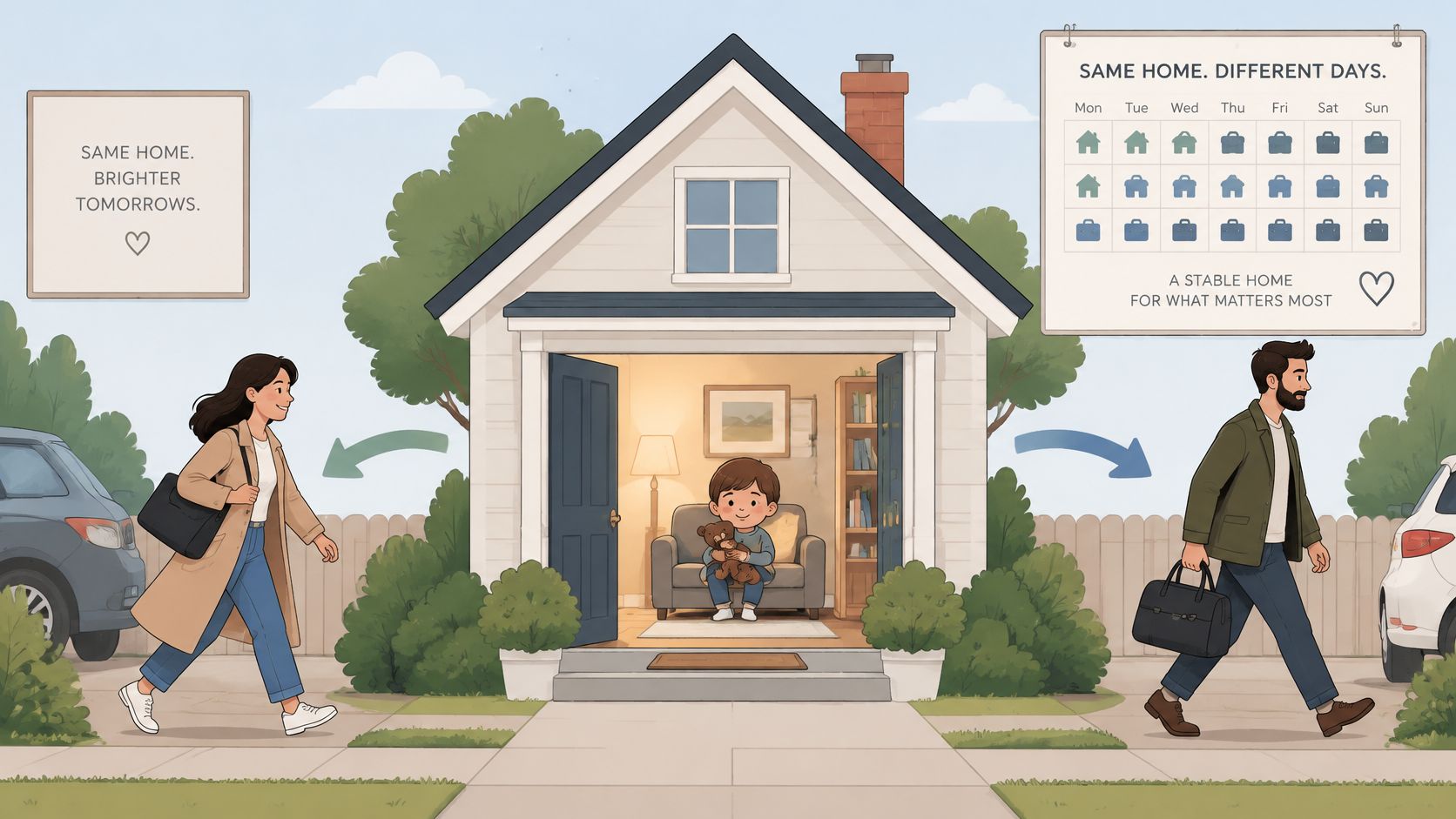
Birdnesting is a housing arrangement, not another overnight formula. The child stays in the family home while the parents move in and out according to their care schedule. The adults, rather than the child, manage the change of residence.
The arrangement looks simple from the child's side of the doorway.
Price the arrangement before trying it
Consider birdnesting when moving would add another disruption during an already difficult transition. It may be worth discussing when the child is also changing schools, needs familiar equipment at home, or is struggling with separation.
But preserving the child's address doesn't remove the parents' housing needs. Each adult needs somewhere suitable to stay while off duty, whether that means separate accommodation or an agreed arrangement with family.
Before starting, write down:
- Household spending: Who pays the mortgage or rent, utilities, groceries, cleaning, and repairs?
- Private space: Which belongings and documents remain private, and where are they kept?
- Visitors: What rules apply to relatives, friends, and new partners?
- Exit conditions: What ends the arrangement, and where will the child live afterward?
A defined review date matters more than an optimistic promise to keep going until things settle down. Don't make the child responsible for deciding when the arrangement should end.
Keep care information separate from the house
The off-duty parent still needs relevant school and health information. A notebook left on the kitchen counter isn't a reliable substitute for an agreed communication method, especially when messages concern medication or changes to collection.
The video below offers another way to consider the arrangement.
Birdnesting becomes difficult when parents argue over household standards, enter during each other's care time, or can't afford the accommodation. Don't treat it as the default or assume it resolves legal questions about possession of the home.
Try it only when the child's benefit is concrete and the adult boundaries are workable. If money, privacy, or the shared property is already the main dispute, separate homes may provide a clearer arrangement.
Fit by Child Age Distance and Conflict
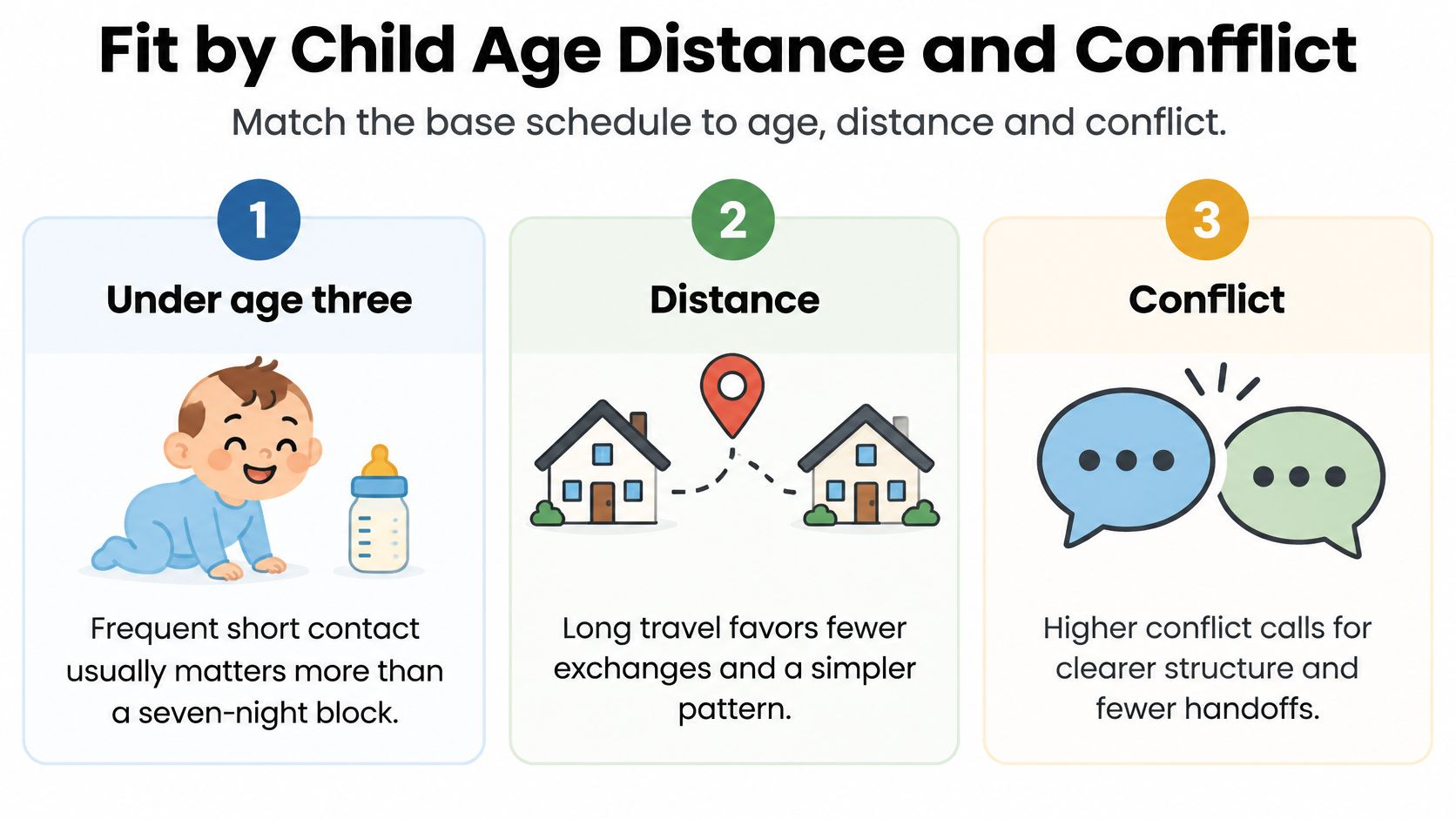
Choose a schedule by asking what this child can manage, not what children of the same age are supposed to tolerate. Development, caregiving history, school demands, disability, and temperament all belong in that decision.
Use these factors as prompts, not automatic age-based rules.
Match the rhythm to the child
For babies and toddlers, examine feeding, sleep, familiarity with each caregiver, and how the child settles after separation. Don't assume a full-week block is suitable just because it reduces driving. Seek individualized advice when care history or developmental needs make overnight arrangements uncertain.
For preschool children, predictability includes knowing who collects them and where they will wake up. Shorter blocks may be worth testing when both homes can support calm, consistent care, but frequent exchanges aren't helpful if every transfer becomes distressing.
For school-age children, test the timetable against homework, uniforms, medication, and activities. A stable weekday assignment may be more useful than a mathematically elegant rotation that constantly changes who handles a recurring appointment.
For teenagers, include sports, work, friendships, and their growing need for autonomy. Listen to their preferences without asking them to choose between parents or carry messages about changes.
Let distance and safety override convenience
Measure school travel at the time the child would make the journey. If the drive regularly displaces sleep, breakfast, or homework, reduce school-night moves rather than asking the child to tolerate the commute.
Where homes are far apart, our long-distance parenting plan guide can help frame school-term contact, travel responsibility, and longer visits.
Conflict also changes the calculation. Consider school-based transfers or another appropriate arrangement that reduces direct confrontation. Where abuse, coercive control, or safety concerns exist, get specialist legal and safeguarding advice rather than treating the problem as ordinary communication difficulty.
For families who can participate safely, Interactive Counselling's counselling for stronger family relationships offers a resource for addressing relationship strain alongside practical planning.
Read outcomes cautiously
A systematic review available through PubMed Central examined 39 studies and found equal outcomes between children in shared physical custody and nuclear families in 75% of the studies. That doesn't mean a particular rotation guarantees good adjustment or that the findings predict your child's experience.
Choose the pattern that protects ordinary care and limits strained exchanges. Then assess sleep, attendance, activity participation, and the child's experience without turning every difficult day into a verdict against the other parent.
Holiday Summer and School Break Overlays
Holiday and break rules to write into the plan
These are drafting options, not universal legal rules. The base schedule remains in force except where the written plan expressly replaces it.
| Occasion | Common rule | Write down |
|---|---|---|
| Winter break | Split at an agreed midpoint or alternate the whole break by year | Start date, end date, exchange time, and which school calendar applies |
| Spring break | Alternate odd and even years | Which parent has even years and when ordinary care resumes |
| Summer | Keep the base schedule and add agreed vacation blocks | Maximum block length, designation deadline, and no-overlap rule |
| Child birthday | Keep the ordinary schedule or add a defined visit | Visit hours, location, and transportation |
| Mother's Day and Father's Day | Assign the occasion to the relevant parent | Start time, return time, and priority over other arrangements |
| Three-day weekends | Follow the parent with the adjacent weekend | Return arrangements and how the additional overnight is counted |
Define which instruction wins
A holiday clause should say whether it overrides a weekend, a vacation booking, or both. Otherwise, parents may each follow a different provision and both believe they're complying.
The New Mexico Second Judicial District's time-sharing guide addresses rotating holidays, travel, and adjustments as children's school and extracurricular commitments develop. Use the child's actual school calendar when translating those considerations into dates.
For example, a winter-break provision can identify the start as school dismissal and the end as return to school. If parents split the break, they should name the exchange date and time rather than leaving the midpoint to later calculation.
Summer provisions need their own decision process. Set a deadline for requesting vacation dates, explain how conflicting requests are resolved, and say what happens if a parent doesn't submit a request.
Keep activities and travel workable
Write operational details alongside the holiday allocation:
- Transportation: Identify who collects the child and where the exchange happens.
- Travel information: State the notice and itinerary information required by the agreement or order.
- Activities: Assign attendance and transport responsibility during each parent's care.
- Resumption: Identify exactly when the ordinary schedule restarts.
Our guide to creating a parenting plan in a divorce can help place these provisions within the broader agreement.
Document the exception: An agreed holiday swap should identify the affected dates and whether it is a temporary exception, not leave either parent guessing about future years.
Flexibility doesn't require vague records. Preserve the request, acceptance, and resulting arrangement in writing, without implying that a casual message necessarily changes a court order. Get legal advice about any formal modification requirements that apply.
Write the Plan You Can Prove Later
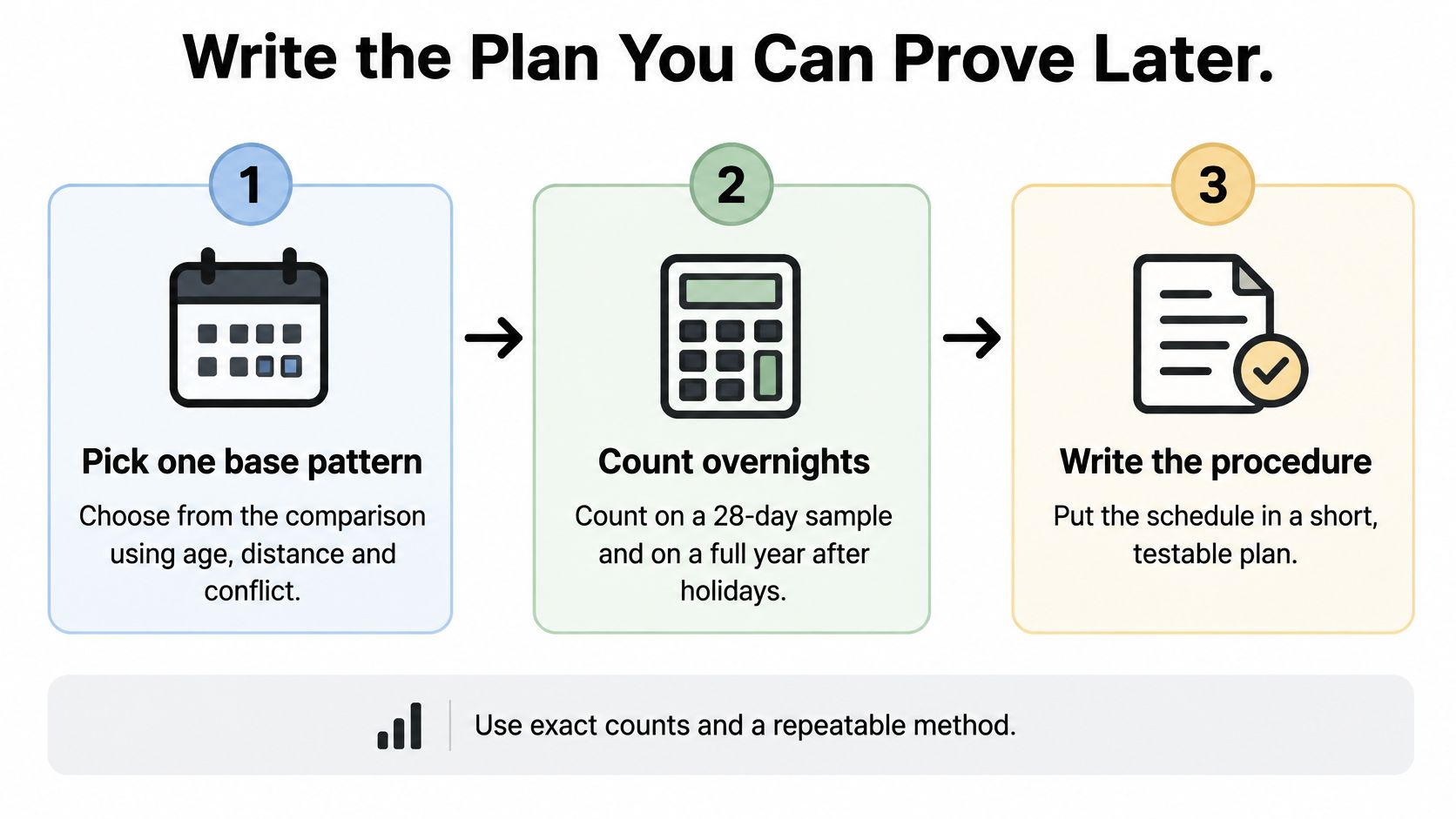
- Choose the base pattern. Select the arrangement that fits the child's care needs, school route, and the parents' availability.
- Calculate overnight shares. Assign every night in a sample calendar, then check the full year after holidays. Divide each parent's nights by the total nights counted.
- Count household transitions. Separate school-day transfers from weekend transfers and identify who handles each journey.
- Add the exceptions. Preserve the ordinary rotation and write holiday provisions as explicit overrides.
- Write the exchange procedure. Name the location, time window, transportation responsibility, and process for requesting or agreeing to make-up time.
- Record planned versus actual care. Keep dated entries for completed care, delays, missed exchanges, agreed changes, and relevant supporting documents.
This planning sequence keeps the calendar testable.
Keep facts distinct from interpretation
Write what happened before describing what you think it means. Record the scheduled collection time, actual arrival, location, and relevant message, rather than describing the other parent as unreliable.
When an informal change or shared expense becomes disputed, identify the dated entry connecting the original agreement, what happened, the stated reason, and any receipt or school record. Our guide on how to prove parenting time explains how to organize that record for review.
Casewell provides a private place for that documentation. Our parenting time log records scheduled care, changes, overnights, and the time that took place; our handovers and pickups log records planned and actual times, delays, missed exchanges, locations, and outcomes. Focused PDF reports include event dates, saved revisions, and linked supporting material for a lawyer, mediator, or other professional.
Preserve the right boundaries
The other parent doesn't need an account and can't approve, edit, or delay your entries. If your order requires a particular communication platform, keep using it and maintain your private record alongside it.
A personal log isn't an independent finding that an event occurred exactly as described. Keep original supporting material, record corrections transparently, and avoid surveillance or unnecessary information about the other household. Courts set their own rules for exhibits, so a clear export supports professional review but doesn't guarantee admission.
Leave the planning process with a usable base calendar, explicit exceptions, and a factual way to compare scheduled care with completed care.
Casewell helps you keep scheduled parenting time, actual care, handovers, and supporting documents together in a private custody journal. Visit Casewell to start recording how your shared custody schedule works in practice and prepare focused records for your next legal or mediation meeting.