 Casewell

You've agreed to share time equally, your co-parent texts you "let's do 5 5 2 2," and you're staring at a blank calendar trying to work out who has your child next Thursday. You're not alone in that confusion. The numbers look simple, but they don't tell you the start day, the exchange time, or what happens when a holiday lands mid-cycle. This guide builds the calendar one block at a time so you can check any written plan against real dates.
The 5-5-2-2 Schedule at a Glance
The 5-5-2-2 schedule is a 14-day loop where Parent A takes five days, Parent B takes five days, Parent A takes two days, and Parent B takes two days, then it repeats. It's a two-week parenting-time rotation designed to divide overnights equally, with each parent receiving a five-day block before the shorter two-day exchanges begin.
Think in cycle days, not weekdays, for this first pass. Day 1 is just the first day of your loop, whatever weekday that turns out to be. Once you label the days 1 through 14, every block falls in the same place in every cycle.
The Four Blocks in Order
| Block | Cycle days | Parent A overnights | Parent B overnights | Handoff after |
|---|---|---|---|---|
| Block 1, Parent A | Days 1-5 | 5 | 0 | Day 5 to Day 6 |
| Block 2, Parent B | Days 6-10 | 0 | 5 | Day 10 to Day 11 |
| Block 3, Parent A | Days 11-12 | 2 | 0 | Day 12 to Day 13 |
| Block 4, Parent B | Days 13-14 | 0 | 2 | Day 14 to Day 1 |
| Full cycle | Days 1-14 | 7 | 7 | 4 handoffs |
Read the table top to bottom. Parent A holds days 1-5, Parent B holds days 6-10, Parent A returns for days 11-12, and Parent B closes with days 13-14. After day 14, the loop restarts at day 1 with Parent A.
Checking the Math Yourself
Add Parent A's blocks together and you'll get 7 overnights out of 14, or 50% of the cycle, the same total Parent B reaches. Over a 28-day window, that works out to 14 overnights each, provided the full cycle is followed consistently.
Two features follow from that structure. First, there are four handoffs per cycle, one at the end of each block. Second, the longest stretch away from either parent is five days, compared with seven days in a traditional alternating-week plan.
Quick self-check: Count one full cycle on the table and confirm both parents reach 7. If either total is different, the calendar in front of you isn't this schedule.
The label alone isn't a complete agreement. Your plan still needs a start weekday, an exchange time, and a handoff location before anyone can follow it. The numbers describe block lengths, nothing more.
Sample Calendars for Each Start Day
A loop of numbered days doesn't run a household. You have to pin day 1 to an actual weekday, and that choice decides which weekdays, school nights, and weekends each parent receives. Two families can both follow 5-5-2-2 and still live very different weeks.
The visual below lays out four common start days side by side so you can compare them at a glance.
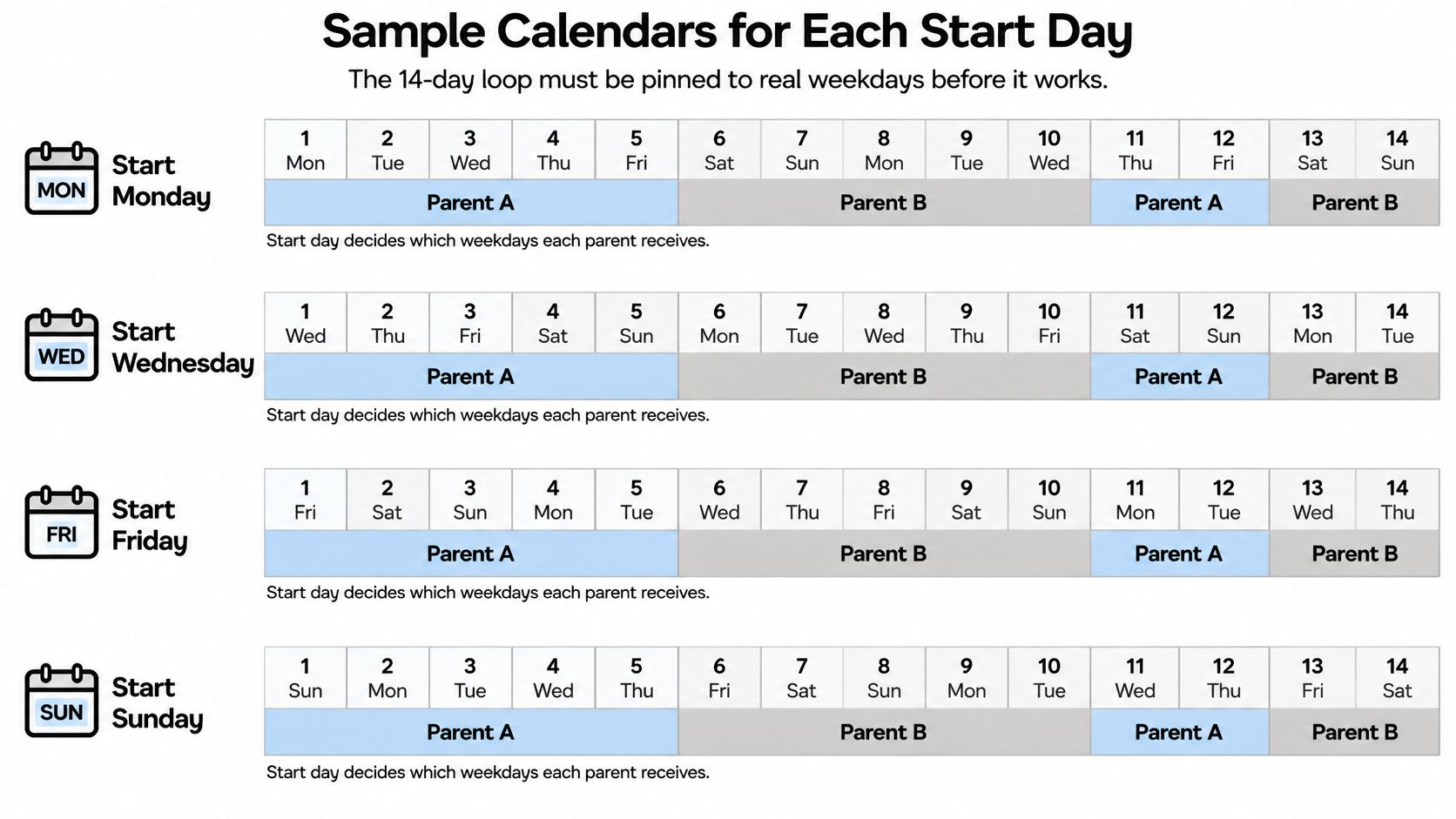
Building a Monday Start Step by Step
- Day 1 is a Monday. Parent A keeps the child Monday through Friday.
- Parent B takes Saturday through Wednesday. This block crosses into the second week, which is normal and expected.
- Parent A has Thursday and Friday of week two. That's the short two-day block.
- Parent B closes with Saturday and Sunday. The loop then restarts on Monday with Parent A.
Notice what the Monday start produces. Parent A gets the first week of school nights, Parent B gets the first weekend plus midweek days, and neither parent holds the same weekday in both weeks.
Comparing the Four Start Days
| Start day | Parent A (days 1-5) | Parent B (days 6-10) | Parent A (days 11-12) | Parent B (days 13-14) |
|---|---|---|---|---|
| Monday start | Mon-Fri | Sat-Wed | Thu-Fri | Sat-Sun |
| Wednesday start | Wed-Sun | Mon-Fri | Sat-Sun | Mon-Tue |
| Friday start | Fri-Tue | Wed-Sun | Mon-Tue | Wed-Thu |
| Sunday start | Sun-Thu | Fri-Tue | Wed-Thu | Fri-Sat |
A Friday start works differently. Parent A's opening block runs Friday to Tuesday, so it includes a full weekend plus two school nights. A Wednesday start gives Parent A the first weekend instead, while Parent B takes a solid Monday to Friday school week.
Details That Make the Calendar Usable
Write an exchange time for every handoff, such as school dismissal or 6 p.m., rather than assuming both parents picture the same moment. List holidays, vacations, and school breaks as named overrides, because they interrupt the rotation and the loop needs a rule for resuming afterward.
You don't need special software to track this. A printed 14-square grid on the fridge or a repeating entry in a calendar app is enough, as long as both parents read the same version.
Every handoff date on your calendar should trace back to the written start day. If a date doesn't match, the start day or a block length has drifted.
Why 5-5-2-2 and 2-2-5-5 Are the Same Loop
Two parents agree to "2-2-5-5" over the phone. One means fixed Mondays and Tuesdays. The other means the middle of a 14-day block rotation. They have just agreed to two different schedules using the same four digits, and neither knows it yet.
5-5-2-2 and 2-2-5-5 are the same 14-day loop read from different starting blocks. The rotation works like a necklace of beads: the beads stay in the same order no matter where you fasten the clasp.
Start reading at the third block and 5-5-2-2 becomes 2-2-5-5. Start at the second block and you get 5-2-2-5. Start at the fourth and you get 2-5-5-2. Every reading contains two five-day blocks and two two-day blocks, so the overnight totals never change.
The beaded bracelets below work as a handy mental model. The sequence of beads stays fixed no matter where you begin counting.

The Version You'll See Most Often in Writing
The label "2-2-5-5" also gets used for a different structure: a weekday-anchored schedule where one parent holds every Monday and Tuesday, the other holds every Wednesday and Thursday, and weekends alternate. In that version the weekdays never move. In the 5-5-2-2 block loop, no parent holds the same weekday in both weeks of the cycle.
One question tells you which structure a written plan means. Does a named weekday always belong to the same parent? If yes, the plan is weekday-anchored. If the weekdays shift between week one and week two, it is the block loop. A verbal agreement to "do 2-2-5-5" can describe either one, so the label alone never settles the calendar.
What Changes the Look Versus What Changes the Totals
Some choices only change how the schedule looks on paper. The start day, the exchange time, and which parent you call Parent A all fall in that category. None of them moves a single overnight.
Other choices change the totals themselves. A missed block, an unequal swap, or a holiday override that isn't balanced later will pull the cycle away from equal time. That's the category worth watching.
The rule that prevents most disputes: Write down the actual dates and weekdays for each block, not only the label. A date can't be misread the way four numbers can.
Pros, Cons and Who This Schedule Suits
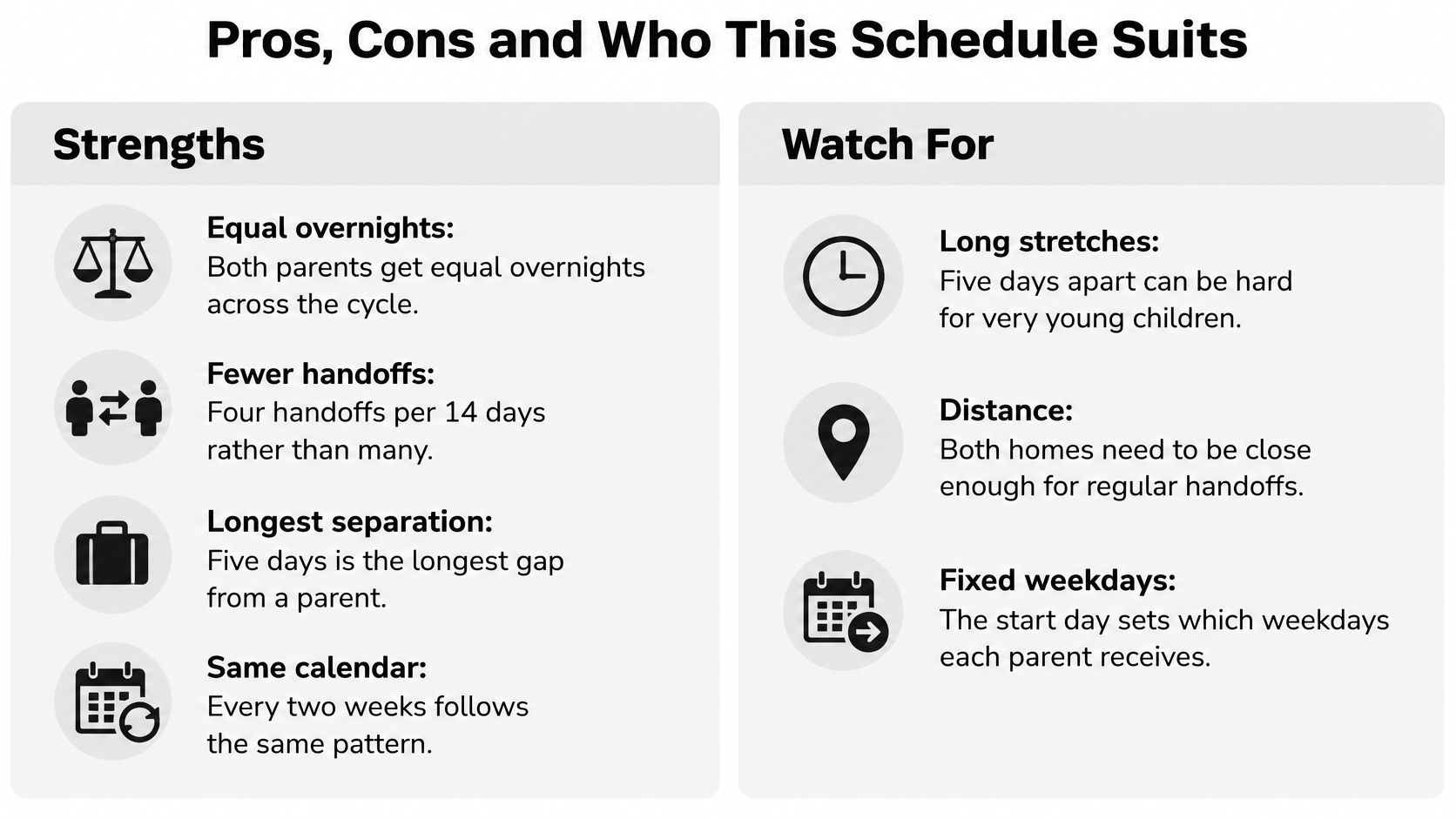
Equal math doesn't guarantee a good fit for your family. Weigh what the structure gives you against what it costs, then test both against your child's age, your homes, and your work patterns. The infographic below summarizes the main trade-offs.
Strengths Worth Counting
- Equal overnights: Both parents receive the same number of nights across each complete cycle.
- Manageable handoff count: Four exchanges per 14 days is fewer than schedules built on two-day rotations throughout.
- Shorter maximum gap: The longest separation from either parent is five days.
- Repeating rhythm: The same calendar every two weeks helps with school, childcare, and activity planning.
Costs That Show Up in Daily Life
- No fixed weekday: The weekday one parent holds changes between the two weeks, so neither parent owns, say, every Tuesday.
- Long blocks for very young children: Five days away from one parent can feel long for a toddler.
- Four chances for friction: Each exchange is a meeting point, and difficult handoffs repeat four times a cycle.
- Travel adds up: Distance between homes is paid on every block, not once.
- Uneven weekday tasks: Equal overnights don't mean equal school runs, homework supervision, or appointment coverage.
If you're weighing this pattern against alternatives like alternating weeks, a custody schedule comparison by overnights and exchanges can help you see the structural differences before you commit.
Fit Check by Family Situation
| Situation | Fit | Why |
|---|---|---|
| Parents live close together | Strong fit | Short trips make four handoffs per cycle easy to manage |
| School-age child with a steady routine | Good fit | A predictable 14-day rhythm supports school and activities |
| Very young child | Caution | Five-day blocks away from one parent can feel long |
| Parents live far apart | Poor fit | Long travel adds time to every block and handoff |
| High conflict at handoffs | Caution | Four exchanges per cycle create four chances for friction; school or a neutral site can help |
| Irregular work shifts | Caution | Fixed block lengths may clash with shift patterns |
| Parent needs the same weekday every week | Poor fit | Weekdays swap between the two weeks of the cycle |
One point deserves emphasis because it runs against instinct. Fewer exchanges aren't automatically better, since longer blocks reduce handoffs but create a longer separation, while a fixed-weekday model adds handoffs yet preserves regular contact with both parents, a trade-off worth weighing alongside travel, conflict at exchanges, age, and school demands. Distance, your child's age, and how handoffs go in practice should decide the question.
What Courts and Mediators Check Before You Sign
A judge or mediator won't approve your plan because the numbers divide evenly. They'll ask whether the arrangement serves your child's best interests, and they'll test the details you'd have to live with on an ordinary school morning.
The Questions Behind the Review
Courts generally evaluate factors including school logistics, parental work schedules, distance between homes, the child's age and health, and each parent's ability to manage transitions, because the numerical schedule itself does not determine whether a court will approve it. Frame each factor as a question. Can both homes get your child to school on time? Does either parent's shift pattern collide with a five-day block? Who handles a Wednesday activity when Wednesday belongs to the other parent that week?
Mediators tend to probe the same ground in practical terms. They'll ask whether the plan works at school drop-off, who covers an activity that falls on the other parent's day, and how you'll agree to changes in writing. If you want a fuller picture of that evaluation, a guide to what judges look for in child custody walks through the reasoning.
What Your Written Plan Should Specify
- Start date and weekday. Name the exact date Parent A's first five-day block begins.
- Exchange times and locations. Cover all four handoffs in each cycle, using one consistent time.
- Named overrides. List holidays, vacation weeks, and school breaks that interrupt the rotation.
- A swap rule. State who may ask, how far ahead, and how the agreed change gets recorded.
- A make-up rule. Explain how a missed five-day block is repaid, not just a missed day.
- A missed-handoff rule. Describe what happens, step by step, when an exchange doesn't occur.
Don't skip item six because it feels pessimistic. A plan that only describes perfect weeks leaves both parents improvising during the first illness, breakdown, or work emergency.
Wording Varies by Place
Terms such as custody, visitation, and parenting time don't mean the same thing everywhere, and some jurisdictions have replaced older labels with newer ones. Check the wording your own jurisdiction uses so your plan matches local forms. Rules and required forms vary, so have an attorney or mediator review your draft before anything is filed.
A plan that names dates, times, locations, and exceptions gives a reviewer something concrete to approve. A plan that only says "5-5-2-2" gives them four numbers and a guess.
Documenting Exchanges and Deviations Over Time
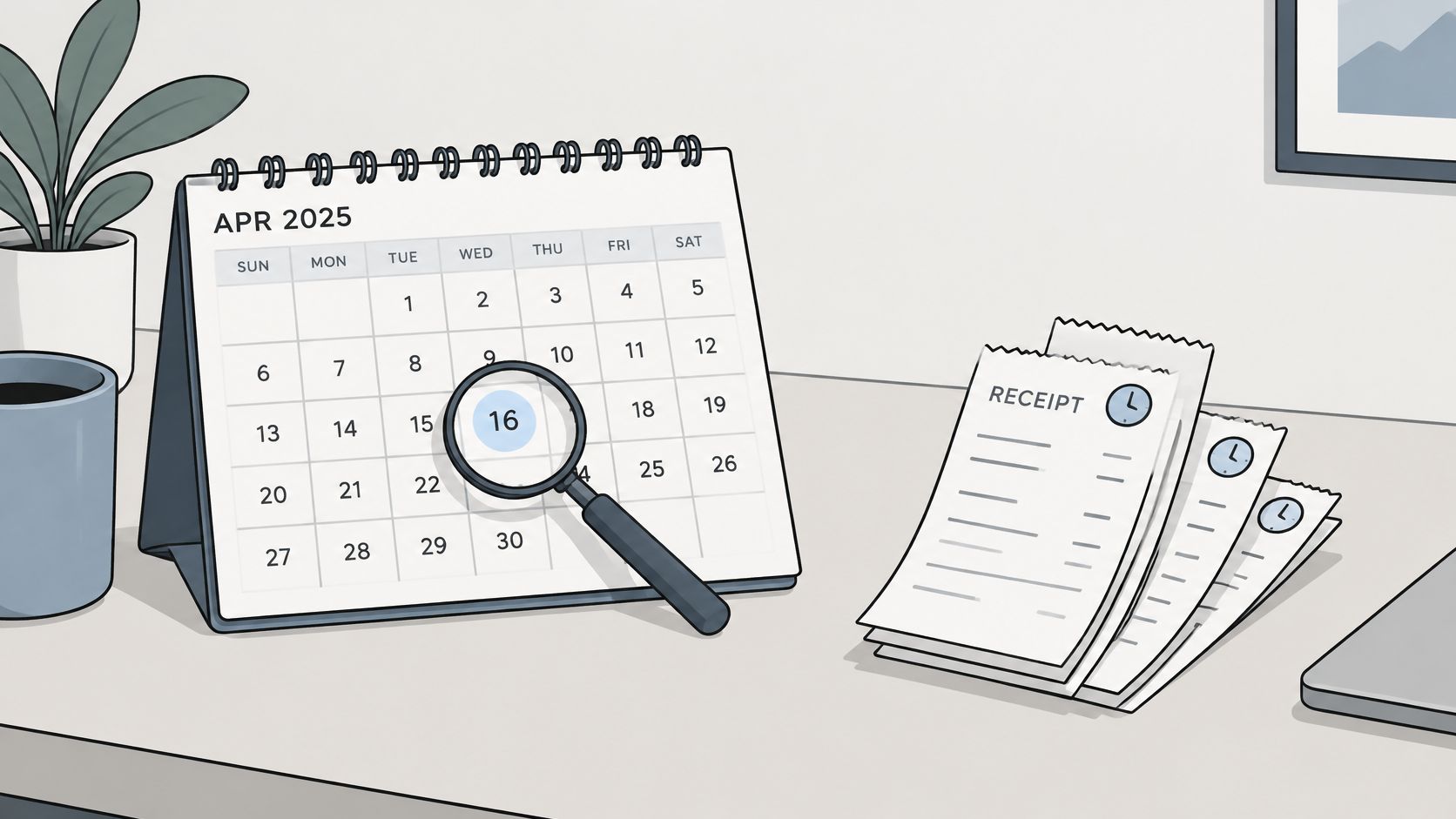
A 50/50 plan on paper can drift from the parenting time your child truly receives. Swaps, late handoffs, and missed blocks pile up without notice, and months later neither parent can reconstruct them from memory. A simple, dated record is what lets a mediator, attorney, or judge compare the written schedule with real life.
The calendar and receipts in the photo below capture the basic idea. Dates plus supporting documents beat recollection every time.
The Timestamp Rule Comes First
Keep two dates separate in every entry. One is when the event happened. The other is when you wrote the entry, plus the time of any later edit. Guidance on preserving file times and metadata for accurate timelines supports this distinction, since a defensible record preserves when an event occurred separately from when the record was created or modified.
Be clear about what a timestamp proves. It shows when a record existed, not whether every statement inside it is true. That's why structured entries work better than freeform notes.
Writing Entries a Reviewer Can Use
Capture who, what, when, and where, and name which document supports the statement. Keep observable fact on one line and your interpretation on another. For example, you'd write "handoff at 6:20 p.m., 20 minutes after the agreed 6:00" as the fact, then place any opinion about why it happened on a separate line. A reader who wants practical methods for this can review guidance on how to prove parenting time with dated records.
Records to Keep for Each Cycle
| Record | What to log | Why it matters |
|---|---|---|
| Exchange times | Scheduled time, actual time and minutes late | Shows whether handoffs follow the written plan |
| Deviations | Date, who asked, and what changed | Separates agreed changes from one-sided ones |
| Make-up time | Days owed, days repaid and the date repaid | Reconciles actual overnights against the 7-7 split |
| School and activities | Missed events and school notices | Documents the effect on the child |
| Expenses | Receipt, payer, amount requested and amount repaid | Tracks the balance owed between parents |
| Attachments | File, capture date and a fingerprint of the file | Supports checks that the file has not changed |
Casewell is one tool built for this routine. It's a private custody journal that prompts an exchange check-in after handoff days, keeps entries in a searchable timeline and calendar, tracks expense balances, links deviations to the original agreement, preserves edit history, and exports PDFs showing event dates, entry dates, and attached proof.
Giving the Schedule a Fair Test
Run a review window of two to three full cycles, roughly four to six weeks, before requesting any modification. During that period, track lateness, school impact, conflict at handoffs, and your child's adjustment. A documented window turns an abstract label into observable evidence about whether this schedule works for your child in practice.
Decide Whether to Sign or Change
Once your review window closes, work through this checklist in order. It converts weeks of records into a decision you can explain to the other parent, a mediator, or a court.
The Four Checks
- Calendar match. Confirm the start date and exchange times on the written calendar match how the schedule is being followed in practice.
- Review criteria. Check late exchanges, school impact, conflict at handoffs, and your child's adjustment against what you logged.
- Overnight count. Compare recorded overnights with the 7-of-14 split, counting make-up time owed in both directions.
- Weekday burden. Note whether any activity or work shift repeatedly fell on the other parent's days, since that reveals where responsibilities are uneven despite equal nights.
If the results point toward change, background on reasons to modify a custody arrangement can help you frame the request around documented facts rather than frustration.
The Decision Rule
If the schedule meets your criteria after the review, sign it and keep the record current. If it doesn't, use the documented review to propose one specific change, such as a different start day or exchange location, instead of asking to scrap the whole plan.
Keep recording after you sign. A continuous record gives any later change the same baseline to be judged against, and it protects both parents when memories differ.
Ready to turn your 5-5-2-2 calendar into a record you can rely on? Casewell gives you a private custody journal with exchange check-ins, a searchable timeline, expense tracking with receipts, and court-ready PDF exports that show event dates, entry dates, and attached proof. Start your first cycle today and let the record, not recollection, show whether the schedule is working.