

You're probably staring at the same problem a lot of divorced parents face, a schedule that worked when everyone was trying to be decent, then collapsed the minute school nights, holidays, money, and new partners entered the picture. The late pickup turns into a text argument, the holiday swap becomes a power struggle, and suddenly nobody trusts memory anymore.
A parenting plan in a divorce is the document that stops those fights from living in the air. Done right, it tells each parent what happens on ordinary Tuesdays, how holidays are split, who decides on school or medical issues, and what to do when one parent misses an exchange or refuses to cooperate. Done badly, it becomes another vague promise that breaks the first time stress shows up.
What a Parenting Plan Actually Changes in Your Daily Life
The first breakdown is usually mundane. One parent says pickup was at 5:00, the other says 5:30. Someone paid for braces, soccer, or camp and expects reimbursement. A holiday weekend arrives, and both parents think the child is supposed to be with them.
A written parenting plan turns those disputes into rules. Formal shared-placement agreements show up more often among divorced parents than among never-married parents. A national survey analysis reported 19.8% for divorced parents and 6.2% for never-married parents. Informal shared parenting was closer, at 23.1% and 21.1% respectively (national survey analysis). The point is simple, a recurring schedule without written terms works only until the first real disagreement.
What changes once it is written
A written plan turns memory into a document both parents can point to. It sets the regular exchange pattern, identifies which holidays override the normal rotation, and spells out transportation when neither parent wants to improvise.
Practical rule: if a term can be argued later, it is not specific enough.
It also makes later changes easier to document. Washington State review materials note that parenting plans often change after the first order, and that only a small share of cases use equal residential time (Washington State review). That matters because the plan is not a one-time memo, it becomes the record courts and parents rely on when schedules shift, exchanges fail, or conflict rises.
Parents who do well are usually the ones who write down the awkward details before those details turn into a fight. Courts care about clarity, repeatability, and whether the plan works under pressure.
The Core Clauses Every Parenting Plan Needs
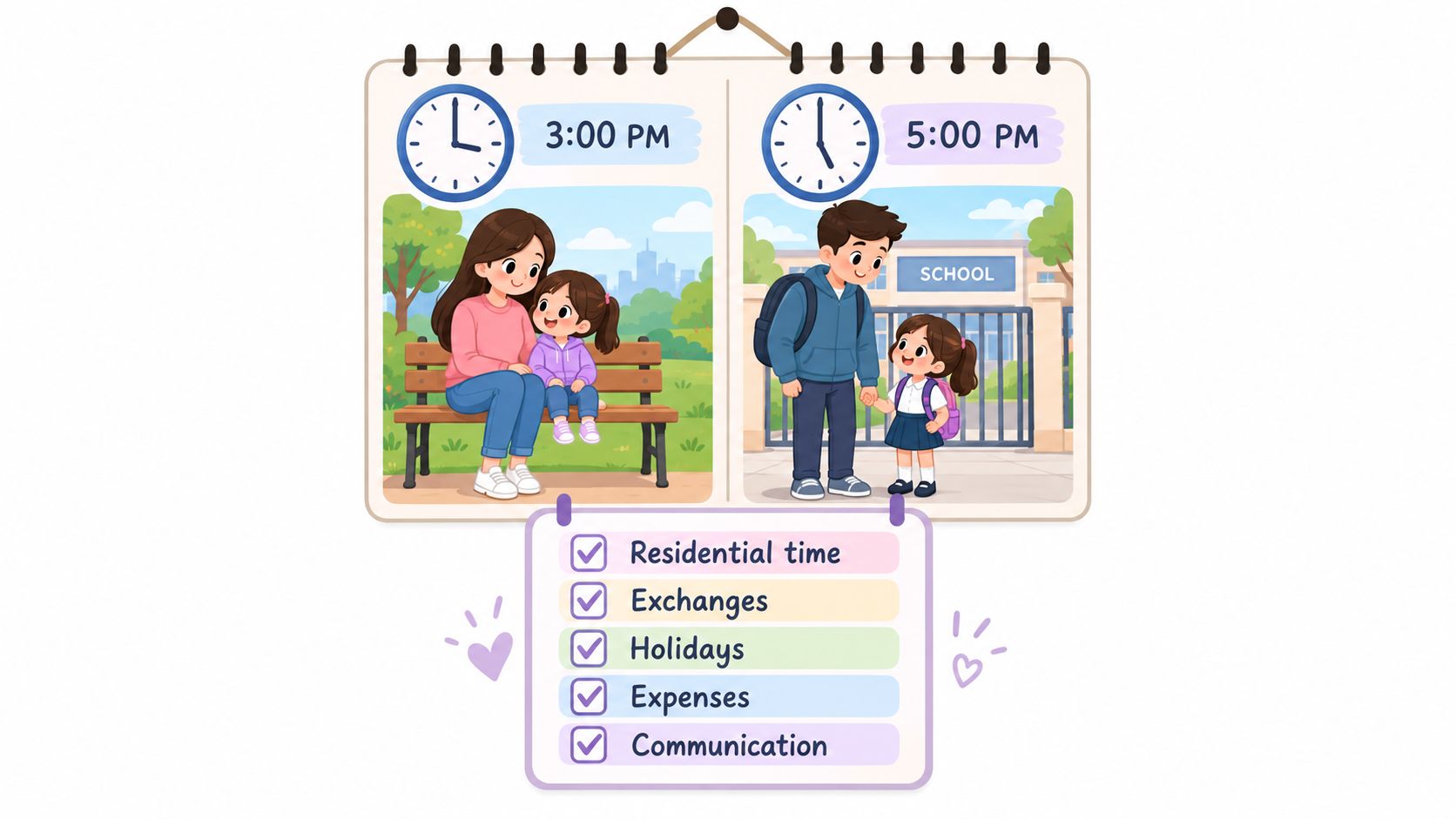
A real plan doesn't just say “shared parenting” and call it a day. It breaks the schedule into clauses that answer the questions parents fight about.
Residential time and exchanges
Start with exact exchange days, times, locations, and transportation responsibility. Write the school pickup spot, the fallback location if school is closed, and what happens if a parent is late or doesn't show. If you want fewer arguments, stop using phrases like “reasonable time” unless you also define them.
A solid clause sounds like this in substance, not necessarily in form, “Parent A exchanges the child at school dismissal on Fridays, Parent B returns the child at school drop-off on Mondays, and if school is closed the exchange happens at the front entrance of the public library at 6:00 p.m.” Specificity beats goodwill every time.
Decision-making and communication
Decision-making should be divided by topic, not left as a vague joint-duty promise. Education, health care, activities, travel, and emergency treatment need their own rules, their own response deadlines, and, if necessary, a tie-break process. Illinois family law examples commonly treat decision-making as separate from ordinary parenting time, which is the right way to think about it in practice, even when the exact local labels differ.
Communication should also be structured. Set the permitted channel, usually one written channel, and say what belongs there, school notices, medical updates, schedule changes, and expense requests. Don't require constant texting about every small decision, because that's how ordinary co-parenting turns into surveillance.
The parent who writes the cleanest record usually has the cleanest argument later.
Holidays, vacations, and expenses
Holiday clauses should override the weekly schedule without confusion. Name the holiday, the start and end time, the handoff location, and whether the regular schedule resumes before or after the holiday ends. For vacations, include notice deadlines and travel details, especially if one parent may take the child out of state.
Expenses need a separate clause too. Spell out who pays for what, how reimbursement is requested, what documentation is required, and how long the other parent has to respond. If you leave reimbursements undefined, every receipt becomes a negotiation.
Sample structure by clause
| Clause Topic | What it Must Answer | What Goes Wrong if Vague |
|---|---|---|
| Residential time | When, where, and how exchanges happen | Late pickups become a pattern, then a dispute |
| Decision-making | Who decides on education, health, activities, travel | Every school form becomes a fight |
| Communication | Which channel is used for what | Important notices get buried in random texts |
| Holidays | Who has the child, and when the regular schedule pauses | Both parents claim the same weekend |
| Expenses | What gets reimbursed and how proof is shared | Receipts turn into arguments instead of records |
If you're drafting this with a lawyer or mediator, bring your actual calendar, expense receipts, school schedule, and every recurring conflict point. That's what gives the plan teeth.
Calibrating Your Plan to Conflict Level and Safety Risk
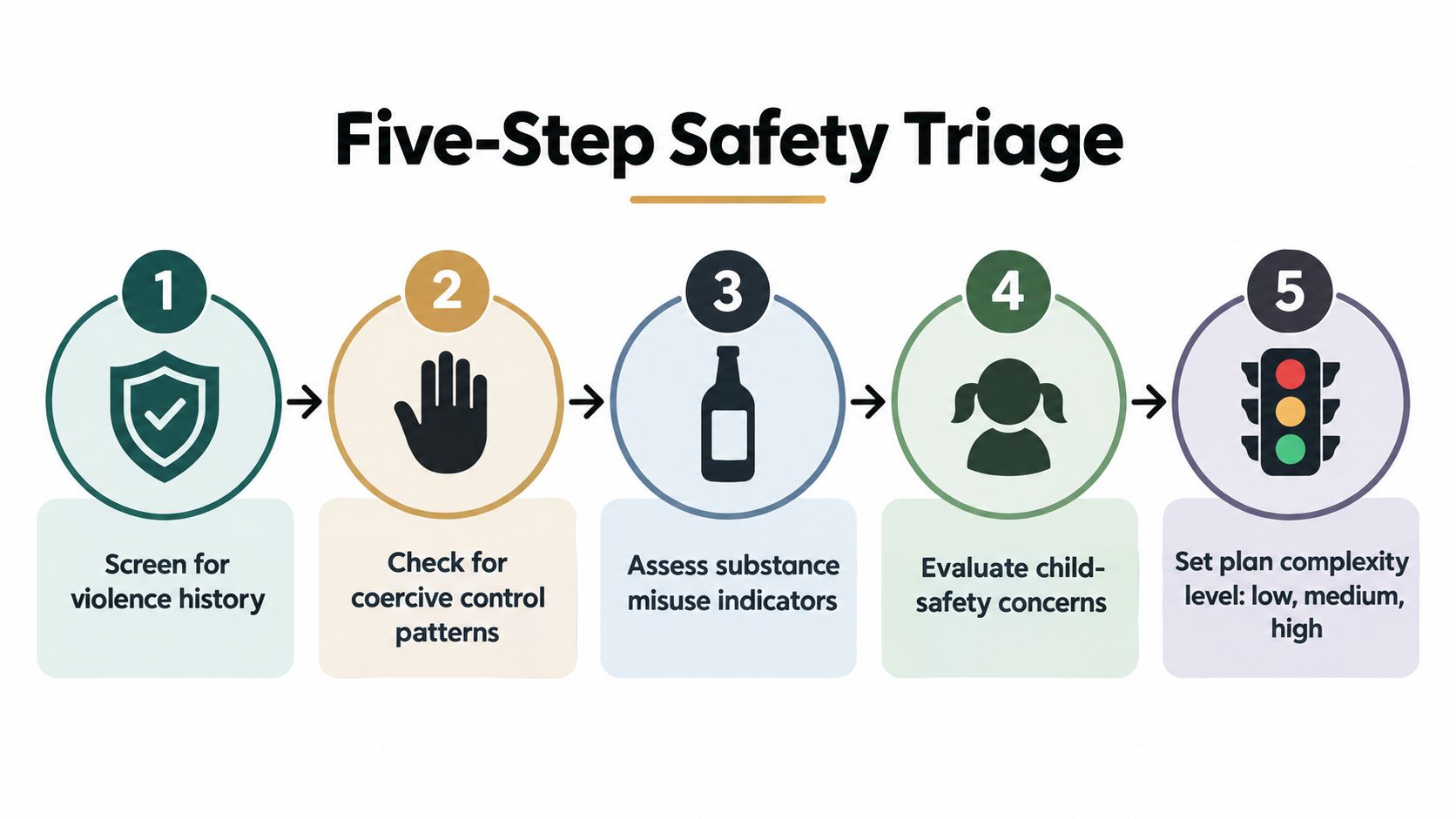
A parenting plan fails fast when it assumes cooperation in a volatile relationship. Start by screening for violence, coercive control, substance misuse, neglect, and any child-safety issue. Then write the schedule around the risk level, not around wishful thinking.
Family courts see this mismatch all the time. In the Canadian case analysis, 76% of cases were high-conflict, 18% were moderate-conflict, and 6% were low-conflict. Poor communication appeared in 59% of cases, and shared parenting with shared decision-making was ordered in about 27% (Canadian analysis). Those figures are not a promise of what works for every family. They do show why a template built for friendly parents breaks down in a hostile case.
Use a five-step triage
- Screen for violence history. If there is abuse, stalking, or intimidation, do not bury it under a standard clause.
- Check for coercive control patterns. If one parent controls access, monitors devices, or uses the child to gain an advantage, the plan needs guardrails.
- Assess substance misuse indicators. Missed pickups, unsafe driving, intoxication, and erratic behavior all change the draft.
- Evaluate child-safety concerns. School attendance, medical needs, exposure to conflict, and emotional harm all belong in the analysis.
- Set the complexity level. Low-risk cases can use ordinary exchanges. Medium-risk cases need tighter communication rules. High-risk cases may need parallel parenting, supervised contact, or neutral handoffs.
Australian longitudinal findings point in the same direction. Four years after mediation, 41% maintained primary residence, 27% maintained shared care of at least 35% of nights with each parent, and 32% changed their care pattern. Rigid shared care tracked with higher conflict and poorer dispute management. The lesson is simple, flexibility has to survive stress.
Use neutral exchanges, written issue-specific notices, defined response windows, and a narrow escalation ladder when conflict is real, as outlined in this high-conflict co-parenting guide. If safety is at stake, a plan that forces direct negotiation can do harm.
Standard Clauses Versus High-Conflict Adaptations
The same clause should not read the same way in every case. Cooperative parents can use lighter language. High-conflict parents need tighter rules, fewer moving parts, and less direct contact.
| Clause Language by Conflict Level | Cooperative Plan | High-Conflict Plan |
|---|---|---|
| Exchange logistics | “Parents will exchange at school or another mutually agreed location.” | “Exchanges occur only at school, curbside, or through a third party. No direct interaction.” |
| Communication channel | “Parents may text or email about schedule changes and school issues.” | “All non-emergency communication must be in writing only through a single designated channel.” |
| Decision-making | “Parents will consult each other on education and medical care.” | “The decision-maker must send written notice, allow a fixed response window, then decide if there's no agreement.” |
| Dispute resolution | “Parents will try to work it out informally first.” | “Parents will use a mediator or lawyer before any face-to-face dispute discussion.” |
The main mistake parents make is copying cooperative language into a hostile case and hoping maturity will show up later. It won't. If one parent weaponizes conversation, require writing only. If one parent creates scenes at handoff, use third-party transfers. If one parent delays every decision, put deadlines in the plan.
Change “Parents will exchange at a mutually agreed location” to “Exchanges occur only at school curbside at 6:00 p.m. or through the named third party, with no direct contact.”
Direct advice: don't draft for the relationship you wish you had. Draft for the one you actually have.
A strong high-conflict plan is narrow on purpose. It should cut open-ended negotiation and replace it with steps that are easy to document and simple to enforce. If you want a practical comparison of the kinds of arrangements families use, the schedule examples discussed in the custody-schedule comparison later in this guide make the differences clear without pretending every family can use the same format.
Documenting Deviations Without Escalating Conflict
A parenting plan only works if you document the misses without turning every mistake into a fight. A late pickup, a missed appointment, or an unpaid reimbursement should be recorded as a clean fact, because a mediator or judge needs a usable timeline, not a blow-by-blow argument.
A private custody journal helps because it strips the emotion out of the record. Write the date, time, child, what happened, which clause was affected, and what proof exists. “He was awful again” adds nothing. “Pickup at school happened at 6:12 p.m. instead of 5:00 p.m., and the child waited with staff” preserves the fact.
What a useful entry contains
- Event type: late pickup, missed medical visit, expense request, school issue, exchange problem.
- Date and time: record when it happened, not when you remembered it.
- Child and context: name the child and the relevant setting.
- Observed facts: what you saw, heard, or received.
- Attachments: receipts, screenshots, notices, or photos, logged as described in this communication-log guide.
- Agreement link: the clause that was breached or followed.
Leave interpretation out of the first entry. Record the message itself, not your theory about motive. If the other parent says traffic caused the delay, note that explanation and any proof without turning the log into a debate.
The discipline matters as much as the format. Keep the original entry, mark later edits, and store supporting documents with the event. If the same problem keeps returning, a documented timeline beats a pile of scattered screenshots. Tools built for private journaling organize dated entries, attachments, and focused exports for professional review, which is the right shape for this kind of recordkeeping.
When Equal Time Is Not the Right Default
Equal time sounds fair until the exchanges start breaking down. A child gains nothing from symmetry if handoffs turn tense, one home is less stable, or the parents cannot communicate without a fight.
Courts and court research have long treated shared time as one option, not the default answer for every family. The Washington State review cited above shows that traditional parenting plans often center a primary residential parent, with alternate-weekend time and a midweek visit for the other parent, while substantially equal time remains uncommon. The point is simple. Equal time is a tool, not a rule.
Use the child's routine as the anchor. School start times, travel distance, extracurricular load, work schedules, and the strain of transitions matter more than a neat split. A schedule can look balanced on paper and still fail in daily life.
When exchanges require direct negotiation and prior handoffs produced documented conflict, change the default to primary residence with defined parenting time, then set a review date after one school term. That gives the child a stable base and creates a built-in checkpoint.
If you are comparing schedule models, the custody schedule comparison above is a useful decision aid. Choose the arrangement your family can sustain. Fit beats formula every time.
Review Cycles, Modification Triggers, and Finalizing the Plan
A parenting plan should be reviewed before it starts failing. Revisit it when the child changes school, when a parent relocates, when the child gets older and the routine no longer fits, or when repeated unresolved deviations show the current arrangement isn't working.
Bring the same kind of evidence you'd want a judge or mediator to trust, dated records, school changes, transportation problems, expense disputes, and any pattern of missed exchanges. That's where a record set built with custody modification records becomes useful. You're not building a grievance folder, you're building a modification file.
Finalize the plan by checking that every clause answers a real-world question. If it doesn't tell a parent where to go, when to show up, how to communicate, or what happens if things go wrong, it isn't finished. The best plan is the one that reads like an operating protocol and survives ordinary life, not just a calm courtroom conversation.
If you want a cleaner way to keep dates, exchanges, receipts, and deviations in one place, Casewell is built for private custody documentation and court-ready exports. It helps separated parents turn scattered co-parenting incidents into dated, factual records that are easier to review with a lawyer or mediator.