

How to read this in Canada
Keep the record in layers: what the plan says, the dated event and its source, then what happened next. A fact stops being useful the moment it is written up as a legal conclusion.
Canadian rules can come from federal, provincial or territorial law. Start with the order or plan that applies to you, and keep its exact terms, such as parenting time or decision-making responsibility.
If you need to correct an error, add a dated note rather than editing the original. Keep routine events near the disputed ones so a family lawyer in your province or territory can judge which facts actually matter.
What counts as a co-parenting expense in Canada?
A child's costs may be handled through monthly child support, direct purchases in each home or separate contributions to particular expenses. Housing, clothing and travel may also be duplicated when a child spends substantial time in both homes.
The Federal Child Support Guidelines use “special or extraordinary expenses” for a defined group of more costs. These can include childcare, health premiums, uninsured healthcare, certain education costs, post-secondary education and qualifying extracurricular activities.
The label does not mean every requested cost will qualify. Necessity, reasonableness, family spending patterns and parental means can matter. Parents should check the applicable agreement, order and provincial or territorial court process.
What did the national family-law surveys measure?
Justice Canada surveyed 404 lawyers and 106 judges about expenses commonly paid by one parent in shared-parenting cases. The questions covered clothing, school costs, electronics, health, childcare, sports and other child-related purchases.
These are expert observations from cases they handled. They are not a household expenditure survey. Families who resolve expenses without lawyers or judges may have different experiences.
That limitation is useful rather than fatal. The surveys identify the costs that repeatedly reach expert attention. They show where unclear types and unequal payment create practical disputes.
Source: Justice Canada, 2022 National Family Law Surveys — lawyer and judge reports about shared-parenting cases
How are ordinary expenses handled in shared-parenting cases?
Forty-one per cent of lawyers said costs were commonly shared by both parents as they were incurred. Seventy per cent of judges gave the same answer. This method keeps the cost outside the ongoing monthly support amount.
A separate 41% of lawyers said one parent commonly paid the costs without adding them to monthly support. Only 6% said the ongoing amount was commonly increased to account for the expenses. Eleven per cent of judges selected that approach.
These figures are not pieces of one universal budget. They describe the most common method reported by each expert group. They also show why a support order may not reveal who is carrying everyday purchases.
Which purchases are often paid by one parent?
Lawyers and judges often identified clothing, electronics and school-related costs. The chart in the Justice Canada report also covers health expenses, childcare, activities, personal care, transit and other items.
Some purchases serve both homes even when one parent pays first. A winter coat, laptop or school lunch account may follow the child. Other items, such as toiletries or room furniture, are more likely to remain in one home.
The practical question is not only who used a card. Parents need to know whether the purchase needed agreement, what contribution was expected and whether monthly support already addressed the type.
Source: Justice Canada, 2022 National Family Law Survey of Lawyers — 416 lawyers answered frequency questions; judges were not asked this item
Why are special expenses difficult to settle?
Thirty-two per cent of lawyers said special or extraordinary expenses were usually or almost always difficult to settle. Another 51% said they were difficult about half the time. Only 17% said they were rarely difficult.
Extracurricular activities and medical or insurance premiums were the most often requested types. Lawyers ranked education third, while judges ranked childcare third. The ranking reflects expert caseloads, not the spending of every Canadian family.
Disputes can concern classification, consent, amount or proportional sharing. A receipt answers only the amount. It does not settle whether the expense qualifies under section 7 or another applicable rule.
Does shared parenting mean expenses divide 50/50?
Shared parenting time does not automatically create an equal dollar split. The Guidelines consider both parents' table amounts, the increased costs of shared parenting and the conditions, means and needs of each parent and child.
In the Justice Canada survey, about half of lawyers most often used a set-off calculation without special expenses. Large income differences or different living standards were common reasons not to rely on a simple set-off.
Expense shares may also be proportional to income rather than equal. A family lawyer can explain the calculation and any provincial or territorial rules that apply.
Worked fictional expense record
This example records an expense and its section 7 question without deciding whether the cost qualifies.
- Expense
September 12, 2026 · Child A · orthodontic deposit · C$480 paid to Northfield Orthodontics.
- Insurance
C$180 reimbursed by the insurer. Note of benefits attached as EXP-024-A.
- Agreement context
Agreement says uninsured qualifying health costs are shared in proportion to income. Relevant clause attached.
- Contribution requested
C$120 requested from the remaining C$300 on September 15, based on the recorded 60/40 division.
- Response
Other parent asked whether the treatment qualified and requested the treatment plan. Full exchange kept.
- Status
C$120 remains disputed pending documents. It is not described as an established debt.
What should parents record for each cost?
Record the date, child reference, provider, type, purpose and total. Attach the full receipt or invoice. For insured healthcare, keep the submitted claim, insurer response and final unreimbursed amount.
Link the agreement, order or message that explains approval and division. Record the amount requested, the date sent and the response. If the classification is disputed, keep both positions without choosing a legal conclusion.
Add each payment separately and keep the original cost unchanged. A clear record can show what remains open without presenting a disputed balance as an established debt.
How can parents track expenses manually?
A spreadsheet can keep the arithmetic visible when every cost uses the same fields. Store receipts with matching IDs and separate monthly support from itemized section 7 or other shared expenses. The expense checklist and child-expense tracker give a structure.
Record prior approval when the agreement needs it. If consent arrives after the purchase, keep both dates. This prevents a later summary from making the decision look clearer than it was.
Review open costs and add later payments as dated updates. Include resolved items so the record reflects everyday follow-through as well as disputes.
How does Casewell organise shared expenses?
Casewell gives one parent a private timeline without requiring the other parent to join. Add the amount, type and notes, then attach the receipt, approval and repayment messages to the same event.
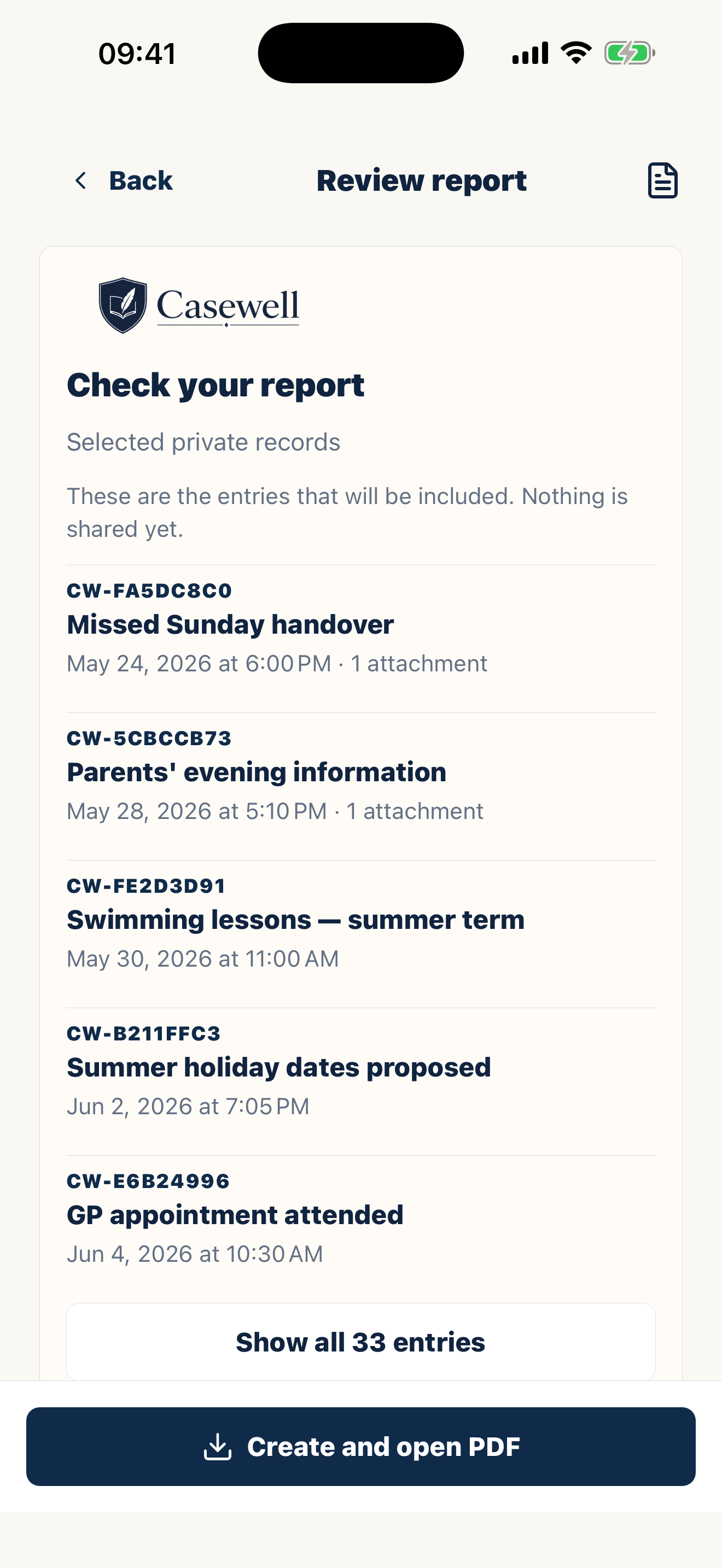
Search and filters can isolate a date range or expense type. Selected records can be clear into a PDF for a lawyer, mediator, adviser or court-related review. You control which entries are included.
“Court-ready” means clear, dated, factual and prepared for review. It does not decide whether an expense qualifies or whether a document is admissible. An expert or court makes those decisions.
What do Canadian statistics leave out?
The national surveys report how lawyers and judges usually see expenses handled. They do not follow the same family month by month or total purchases across both homes. Everyday costs resolved privately are largely invisible.
Provincial and territorial court steps can also differ. A national percentage cannot replace the wording of an order or the local process for changing support. It is context, not a rule for one household.
For budgeting, separate the table amount, section 7 expenses and direct spending during parenting time. Those types may interact, but they should remain traceable. A parent can then show the calculation without presenting every grocery or item of clothing as a repayment claim.
How should an outstanding expense be reviewed?
Start with the agreement, order or written consent that may govern the item. Confirm whether the cost is an everyday expense, a section 7 expense or another type before applying a percentage.
Check the gross invoice against insurance, tax relief, subsidies and refunds where the applicable documents need them. Keep each document so the route to the net amount remains visible.
Keep the contribution requested separate from the payment received. Do not assign an unclear e-transfer to a particular expense without evidence.
Review open items on a regular date. Add questions, part-payments and revised proposals as dated updates rather than rewriting the first entry.
Finish with a factual status such as requested, part-paid, paid, disputed or withdrawn. Including resolved costs gives a family lawyer, mediator or adviser a fuller and less selective record.
What is the useful conclusion?
Canadian evidence does not give one price for co-parenting. It shows that many expenses are handled outside monthly support and that special costs often become difficult to settle in expert cases.
Separate the purchase, approval, requested contribution and later payment. Keep the source that explains the expected split. This makes a disputed cost easier to review without claiming the record itself decides the answer.
Casewell keeps those details and files together in a private timeline. Track co-parenting expenses in a private, court-ready timeline with Casewell.
Province-or-territory checklist for a Canadian review
Name the province or territory and the court. Add the law or order tied to the parenting plan. Keep its own terms for parenting time, major decisions, contact, and support. Use local forms and due dates. If two legal areas may be involved, flag that point for a lawyer.
A Canadian review note
Canadian co-parenting expense statistics show how shared costs are handled. This expenses cause disputes and why two homes have no single price. Sharing any of it in Canada takes a few more steps.
Keep a review pack short: the current order or plan, a factual timeline and the source files that matter. Say plainly where something is missing.
Ask a family lawyer in your province or territory before you file or share records. Privacy, court, and evidence rules can differ across Canada. One PDF does not make those rules the same.
Name the province or territory. Note whether federal divorce law or another family law applies. Keep the terms used in the order itself.
Keep each expense linked to approval and payment
Casewell keeps the receipt, agreement context, request, response and payment history in a private timeline with clear PDF exports.
Try for freeWhat is a section 7 expense?
It is a special or extraordinary expense within the Federal Child Support Guidelines, subject to defined types and tests. A requested cost does not qualify automatically.
Does shared parenting mean every cost is divided equally?
Not necessarily. Income, table amounts, increased shared-parenting costs and the family's circumstances may affect the result.
Should monthly support and shared expenses be tracked separately?
Usually yes, unless the agreement or order combines them. Separate records reduce double counting and clarify each request.
What can Casewell record?
An entry can keep the date, amount, type, receipt, approval, related messages and later payments together.
What does court-ready mean?
It means clear, dated and factual for expert or court-related review. It does not decide qualification, admissibility or an outcome.
Does this replace provincial or territorial guidance?
No. Federal, provincial and territorial family-law rules can interact, and court process differs across provinces and territories. Check the current order or plan and current official guidance for the relevant legal area.
Sources
Justice Canada's figures report the experience of family lawyers and judges, not a representative survey of all separated parents. Their caseloads are more likely to include disputed matters. Older Statistics Canada payment figures give national context but use a different population and year.