
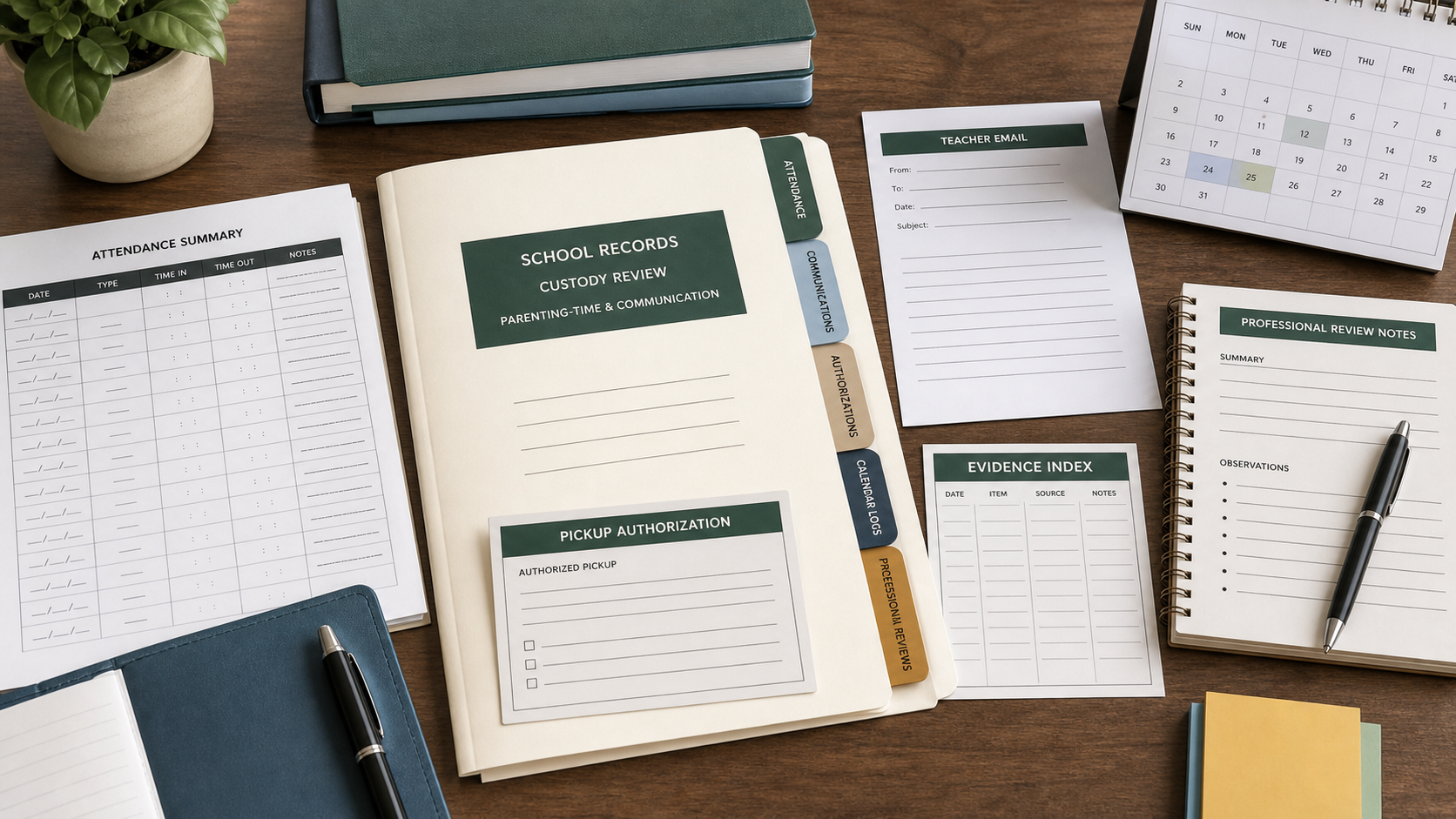
How to read this in Canada
Keep the record in layers: what the plan says, the dated event and its source, then what happened next. A fact stops being useful the moment it is written up as a legal conclusion.
Canadian rules can come from federal, provincial or territorial law. Start with the order or plan that applies to you, and keep its exact terms, such as parenting time or decision-making responsibility.
If you need to correct an error, add a dated note rather than editing the original. Keep routine events near the disputed ones so a family lawyer in your province or territory can judge which facts actually matter.
Province-or-territory checklist for a Canadian review
Name the province or territory and the court. Add the law or order tied to the parenting plan. Keep its own terms for parenting time, major decisions, contact, and support. Use local forms and due dates. If two legal areas may be involved, flag that point for a lawyer.
Identify the school record type
Separate attendance, lateness, pickup, teacher messages, activity, report and wellbeing records. Each type answers a different question. Do not mix them into one general school folder.
Link the record to the parenting issue
A late arrival may matter if it connects to exchange times, transport or schedule changes. It may also have another note. Record the related event and the limits of what the school document shows.
Preserve the complete communication
For teacher emails, keep the full email with date, sender, recipients and files. A pasted excerpt may lose context. If you create a summary, link it to the original.
Respect privacy and school boundaries
School records can include sensitive child information and third-party details. Keep access limited and ask what can be shared, redacted or filed in your legal area.
Prepare a focused school-record pack
For review, group records by issue: attendance pattern, pickup confusion, messages failure or medical/school coordination. Add a short timeline so the reader sees the sequence.
Check what the school record cannot show
Before drawing a conclusion, write down the limit of the source. Attendance may show when a child was marked late. But not automatically why. Keep that limitation beside the record so a reviewer can separate the school's observation from your interpretation.
A Canadian review note
Organize school records for custody planning. Attendance, lateness, teacher emails, pickup records, activities, source context and review packs. Sharing any of it in Canada takes a few more steps.
Keep a review pack short: the current order or plan, a factual timeline and the source files that matter. Say plainly where something is missing.
Ask a family lawyer in your province or territory before you file or share records. Privacy, court, and evidence rules can differ across Canada. One PDF does not make those rules the same.
Name the province or territory. Note whether federal divorce law or another family law applies. Keep the terms used in the order itself.
School records checklist
Collect only records that connect to a real issue.
Copyable school record index row
Use this to connect school material to your timeline.
SCHOOL RECORD REF:
RECORD TYPE:
DATE OF RECORD:
DATE RECEIVED:
CHILD:
SOURCE OR SENDER:
WHAT IT SHOWS:
RELATED EVENT REF:
ACTION TAKEN:
LIMITS OR CONTEXT:
PRIVACY REVIEW STATUS:- Useful note
Attendance record shows late arrival on 4 Feb. Related exchange entry EX-014 records actual handover time. Cause not stated by school record.
- Weak note
This proves the other parent is causing school problems.
Example school-record bundle
A focused bundle is easier to review than a folder dump.
- Issue
Three late arrivals after weekday exchanges.
- Records
Attendance records SCH-004 to SCH-006 and exchange entries EX-014 to EX-016.
- Context
Two everyday on-time arrivals included for comparison.
- Question
Ask counsel whether the pattern is relevant to schedule review.
What a coherent Canadian record looks like
Casewell keeps the dated entry, its source file and any later addition together in one private timeline. When a review is needed, select only the records that answer the question in front of you and share those with a family lawyer in your province or territory.
Try for freeCan this type of record be used in custody preparation?
It can help organize facts and source material. A court or qualified expert decides relevance, court process, privacy and weight.
Should I keep the original source?
Yes. Keep the original where possible and use a separate working copy for notes, summaries or redactions.
How should I share these records?
Share a focused, filtered pack only after checking privacy, safety and local process with a qualified expert.
Does this replace provincial or territorial guidance?
No. Federal, provincial and territorial family-law rules can interact, and court process differs across provinces and territories. Check the current order or plan and current official guidance for the relevant legal area.
Sources
Federal, provincial and territorial family-law rules can interact, and court process differs across provinces and territories. The official source gives orientation only. This page is a records guide, not legal advice.