

Start with the issue, not the file type
A message, photograph or receipt is only a source. Its value depends on the question it helps a reviewer answer. Before collecting more material, write the issue in one neutral sentence. Ask, for example: Which handovers happened later than the agreed time between March and May? That is more workable than asking how to prove the other parent is unreliable.
Then identify the baseline. That may be a current order, parenting plan, written agreement, school timetable or established routine. The baseline explains what was expected. Your event record explains what happened. An attached source supports one or more details. Keeping those three layers separate prevents a screenshot from carrying more meaning than it can support.
This is also why “evidence” and “records” are not interchangeable. Records is the wider private record you keep. Evidence is material an expert or court may decide is relevant to a particular question. Casewell helps organise the first. It cannot decide the second.
The four tests for a useful custody record
Use four tests before adding a source to your working collection.
- Relevance: Which child-related issue or event does this source explain?
- Source: Who created it, where did it come from and is the original available?
- Context: What came before and after it, and what limitation should a reviewer know?
- Connection: Which dated timeline entry or question does it belong to?
Records can pass some tests and fail others. A cropped message may be relevant but lack context. Complete school attendance data may be reliable as a school record but irrelevant to the issue being reviewed. Notes made months later may still help explain your memory when the delayed recording date is stated openly.
Do not improve a weak source by writing a stronger description. Label the limitation instead. Screenshot supplied by Parent A. Original thread not available is more honest and useful than presenting the screenshot as a complete conversation.
Should this record go in the working collection?
Use this test before copying another file into the case folder.
Does it explain a child-related issue, arrangement, event, decision, expense or safety concern?
If not, leave it out. Relevance comes before volume.
Can you identify who created it and where the original is kept?
If yes, record the source. If not, keep it only with the limitation clearly labelled.
Does the surrounding context change its meaning?
Keep the complete thread, document or sequence before making a summary.
Can you connect it to a dated event or review question?
Add the reference to the timeline or issue index. An unconnected file is difficult to assess.
Could collecting or sharing it create a safety, privacy or legal problem?
Pause and get appropriate local advice before copying, recording or disclosing it.
Twelve common record types and what each may show
| Record type | What it may help show | What it cannot show by itself | Keep it this way |
|---|---|---|---|
| Orders, plans and written agreements | The arrangement or obligation in force on a date | Whether it was followed in practice | Keep the complete signed or issued version and later variations |
| Calendars and parenting-time logs | Planned and actual dates, times and repeated deviations | Why an event changed | Record the schedule source and link messages or other sources |
| Custody-journal or incident entries | A dated account of observations, actions and follow-up | Independent proof that every statement is correct | Keep event time, recording time, source and later corrections |
| Messages and emails | What was sent, received, requested or agreed | Whether every statement in the message is true | Keep the complete thread, participants, date and time |
| Call logs and voicemail | That a call occurred and what a saved voicemail contains | The full substance of an unrecorded call | Keep device records, original voicemail and a separate factual note |
| Photos and videos | Visible conditions at a particular moment | Motive, events outside the frame or an entire pattern | Keep the original file, metadata where available and event context |
| Audio recordings | What the recording audibly contains | Whether making or sharing it was lawful | Keep the original and get local advice before relying on it |
| School records | Attendance, messages, support and third-party observations | A general conclusion about either parent | Keep the complete record and identify the school source |
| Medical records | Appointments, instructions, diagnoses and expert observations | Facts outside the clinician's knowledge | Protect privacy and keep the complete official document |
| Receipts and payment records | Date, amount, merchant and payment trail | Who legally owed the amount | Link the receipt to the agreement, request and repayment status |
| Witness information | What another person directly observed | Matters outside that person's knowledge | Record identity and direct observation. Do not script a statement |
| Police, agency or expert records | That a report, contact or assessment occurred and what it records | That every allegation was proved | Keep the complete official record and note its status and limits |
Use the table as a routing tool, not a promise about admissibility. The next sections explain how each type fits into a defensible working record.
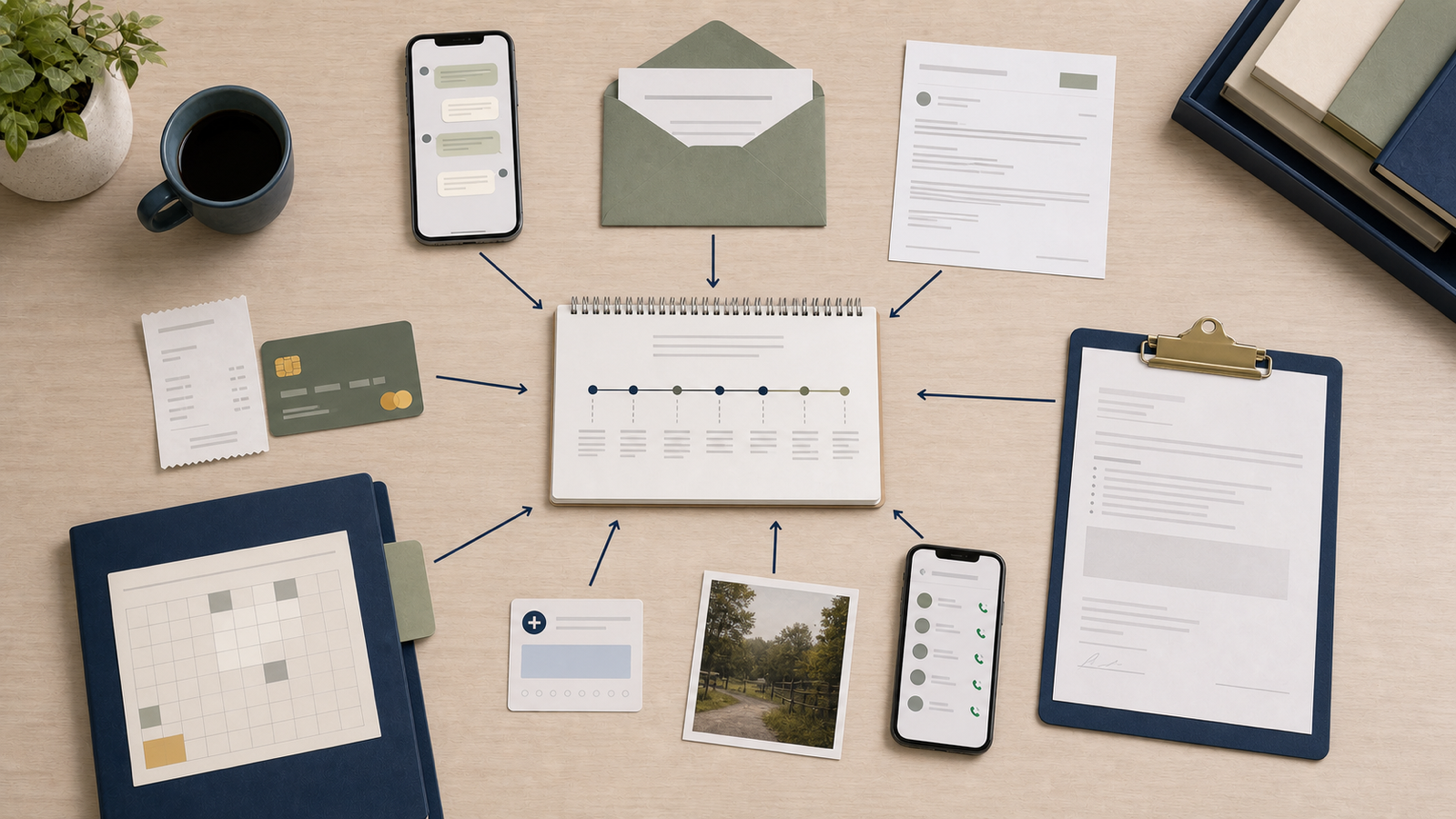
Orders, parenting plans and calendars establish the baseline
Start a record set with the document that governed the arrangement on the relevant date. Keep the whole order, plan or agreement rather than only the paragraph that appears helpful. Record its issue or signature date, when it took effect and whether a later version replaced it. If the wording is unclear, copy it accurately and save the interpretation question for a lawyer or solicitor.
A calendar then shows planned events. A parenting-time log shows actual events. Keep those concepts separate. For each exchange, note the scheduled start and end, actual time, location, agreed change, cancellation and make-up time. Everyday events belong in the log alongside disputed ones. Recording only negative outcomes can hide the denominator and make a pattern difficult to assess.
A calendar entry created after the event is not the same as a calendar invitation sent beforehand. Keep both creation timing and event timing where that distinction matters. If you need a repeatable structure, the parenting-time log template keeps planned and actual time on the same row.
Messages and emails need the surrounding conversation
Messages can document requests, responses, changes, acknowledgements and exact wording. They can also mislead when a single line is separated from the conversation around it. Capture enough of the thread to show participants, date, time, channel and the messages right away before and after the relevant passage. Keep your own messages too.
Where possible, keep an export or original device copy as well as screenshots. Name the platform and note any missing segment. Do not crop away a sender, date or reply that changes the meaning. A delivery indicator may show that a platform marked a message as delivered. It does not always prove that a person read or understood it.
Summarise one child-related issue as one messages event rather than creating a timeline entry for every message. The complete thread remains the source behind that summary. See the detailed guide to keeping text messages with context and the messages-log template.
Journal entries and incident records should label the source of each fact
A contemporaneous note—one made at or near the time—can keep details that would otherwise be forgotten. Include the event date and time, the date and time you wrote the note, location, people present, direct observations, action taken and supporting source references. If the date is approximate, say so.
Separate direct knowledge from reported information. I arrived at 17:55 and left at 18:25 is a direct observation. The school office told me at 09:10 that no collection authorisation had been received identifies a third-party source. My child said… needs particular care. Record spontaneous words and context without questioning the child for evidence or adding an adult conclusion.
Do not silently rewrite an earlier entry when new information arrives. Add a dated correction or follow-up and link it to the original. The factual incident-report guide shows how to keep observation, interpretation and evidence distinct.
One event, three separate layers
This example prevents an order, observation and message from being blended into one claim.
- Baseline
Parenting plan dated 4 February, paragraph 11. School-night return at 18:00.
- Event
11 March: arrival recorded at 18:37. Entry made at 19:05 by the receiving parent.
- Direct observation
Vehicle arrived at 18:37. Child entered the home carrying school bag and coat.
- Source
Complete message thread MSG-044 contains a 17:42 message: “Traffic is stopped. Updated arrival 18:35.”
- Limitation
The record supports the actual arrival time and stated note. It does not on its own verify the traffic conditions.
- Outcome
No missed activity or other practical impact recorded. The next three returns occurred at the planned time.
School, medical and childcare records add independent context
Third-party records can give dates and observations created for everyday expert purposes. School material may include attendance, lateness, collection records, teacher correspondence, support plans and activity information. Medical material may include appointments, treatment instructions, prescriptions and clinician notes. Childcare records may show booking, attendance and authorised collection.
Keep the complete document and the covering message or portal context where available. Record when you received it separately from the event date. Do not alter the original to highlight a passage. Make a working copy for annotations. A school record can show what the school recorded. But it does not automatically explain the cause. A clinician's note may report what a parent said without on its own verifying it.
These records contain sensitive information. Limit copies, use a secure transfer method and ask before sharing records about a child or third party. The dedicated school-record guide and medical-record guide cover their different privacy and context requirements.
Receipts and payment records need the agreement beside the amount
A receipt can show that a purchase occurred, when it occurred and what it cost. A bank record can show a payment path. Neither document alone decides whether the expense was needed, agreed, shared or reimbursable.
For each item, record the child-related purpose, date, amount, currency, payer, agreement or order wording, repayment request, response and balance. Attach the receipt and relevant message. Keep disputed items in the same ledger as agreed items and mark their status. Removing them creates an incomplete account.
Separate ongoing support from itemised child expenses unless the applicable document treats them together. Labels vary by legal area and by order. The child-expense tracker gives a copyable row, while Casewell's expense-tracking workflow keeps the receipt and repayment status attached to the dated record.
Photos, videos, calls and recordings require extra preservation care
Keep an original photo or video file before editing, resizing, annotating or sending it through another app. Record who made it, when and where, what device or account supplied it and which event it supports. Metadata can help with provenance, but metadata can be missing or changed and should not be described as conclusive.
For calls, keep the device call log and original voicemail if available. A factual note can record the participants, approximate duration, subject, action agreed and words you remember accurately. It should not be presented as a transcript. Laws on recording conversations differ substantially, including between US states. So get local advice before making, sharing or relying on an audio recording.
A photograph shows what appears inside its frame. A call log shows that the device recorded a call. Neither explains motive or a wider history without other records. Read the fuller guides to photo and video preservation and call logs and voicemail.
Preserve originals and make separate working copies
An original is the closest available version of the source as created or received. Keep it before adding arrows, highlights, redactions or notes. Use a separate working copy for review. Keep a simple preservation note: source, date received, original location, file name, working-copy name and any known change made during export.
Use stable file names that sort consistently, for example 2026-03-11_MSG_school-pickup_thread.pdf. Avoid renaming an original repeatedly. If a platform offers an export, keep the export instructions or format information. Back up important originals in a secure location consistent with expert advice and your privacy obligations.
Do not claim a forensic chain of custody merely because you used careful folders. A personal preservation log is still valuable. But formal authentication and disclosure rules are local. If you want one private place to connect a source to the event it explains, start a dated Casewell record and keep the untouched original alongside the working reference.
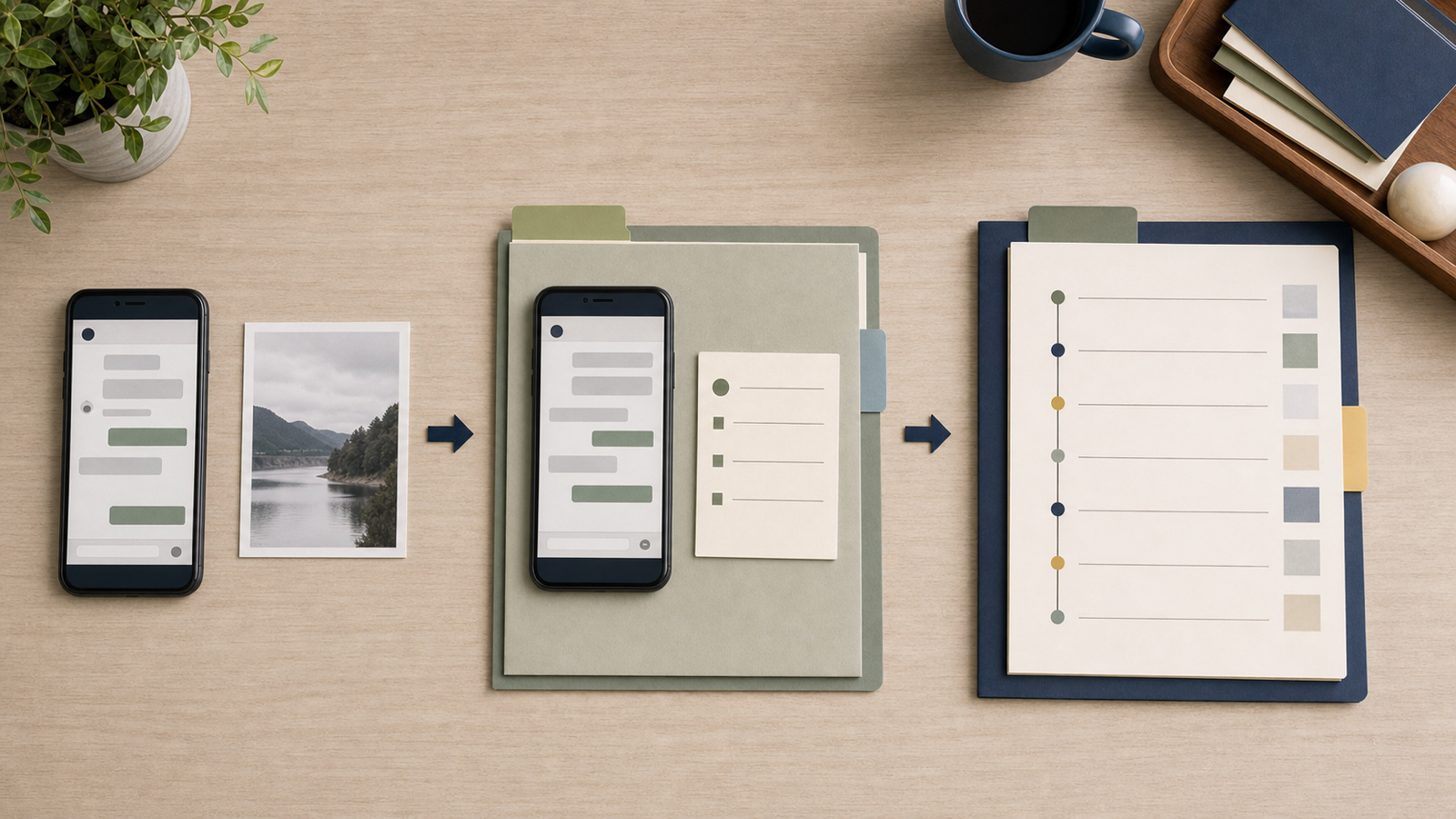
Original-source preservation check
Complete this before annotating, cropping or sending a working copy.
The checklist documents everyday handling. It does not certify authenticity or replace local disclosure requirements.
Build an evidence index before building a narrative
A master index is a map of the sources you hold. Give each item a stable ID, short neutral description, source date, date received, original location, linked issue, linked event and privacy status. The index should help another person find the original without reading a long account first.
Next create a selective timeline. Each line should contain the event date, neutral event summary, outcome and source IDs. The timeline is not the evidence itself. It points to the fuller entry and source. Include important normal outcomes, corrections, notes and resolved matters so that the timeline does not imply a pattern by omission.
Review by issue as well as by date. An expert may need to see all medical-information exchanges together, while still being able to place each exchange in time. Casewell can keep dated entries and files connected. Also, the free custody timeline builder can help test the structure before you prepare a report.
Copyable evidence-index row
Use one row per source and point it to the event it helps explain.
SOURCE ID:
SHORT NEUTRAL DESCRIPTION:
RECORD TYPE:
CREATOR OR SENDER:
SOURCE DATE AND TIME:
DATE RECEIVED:
ORIGINAL LOCATION:
WORKING-COPY FILE NAME:
LINKED ISSUE:
LINKED EVENT ID:
WHAT IT MAY SHOW:
WHAT IT DOES NOT SHOW BY ITSELF:
MISSING CONTEXT OR LIMITATION:
PRIVACY OR SHARING RESTRICTION:
REVIEW STATUS:
Select records for a question, not for maximum volume
A private archive can be comprehensive. A review pack should be selective. Begin with the question or decision for which advice is needed, then include the current baseline, short issue summary, focused timeline, source index and key originals. Keep background material available but separate.
Flag gaps and contrary facts. State when a source is incomplete, an event date is approximate, a later note was received or an issue was resolved. An expert can assess a visible limitation more efficiently than discover one after relying on a polished summary.
Do not send a large unencrypted file or unrestricted folder of child records without asking how the recipient wants to receive it. The lawyer and solicitor planning guide explains a focused review pack. When you are ready to share a selected timeline, Casewell's PDF report workflow lets you choose the relevant dated records rather than exporting the entire private archive.

How four sources become one reviewable timeline
Each short line points back to the full entry and original source.
Parenting plan signed. School-night return set for 18:00. Source: PLAN-01.
Return at 18:37 after 17:42 delay message. No practical impact recorded. Sources: EVT-014, MSG-044.
Return at 17:58. Completed as planned. Source: EVT-016.
Return changed to 19:00 by written agreement because of school event. Sources: SCH-08, MSG-052.
Return at 18:02. Completed as planned. Source: EVT-021.
One delayed return, one agreed change and two everyday returns are visible in the selected period.
Jurisdiction changes terminology, procedure and admissibility
There is no universal list of custody evidence that every court must accept. Court process, privacy, disclosure, authentication and recording rules differ. The main parenting terms vary too. England and Wales generally use child arrangements. Australian federal family law uses parenting arrangements. Canadian federal law uses terms such as parenting time and decision-making responsibility, while US terms changes by state.
Official guidance also shows why local court process matters. California Courts explains that documents or witness statements generally need to be filed and served for a family-law hearing. New York describes testimony, reports and a best-interests hearing. The Federal Circuit and Family Court of Australia explains that affidavits set out facts rather than opinion and that referenced documents need the correct annexure process. England and Wales has its own forms, witness-statement and permission rules.
Treat examples on this page as record-keeping guidance, not filing instructions. Check the current order and local court directions, and ask a qualified local expert what should be kept, disclosed, filed, served, redacted or left out.
Privacy, safety and children come before documentation
Collect only material with a legitimate child-related purpose. Avoid monitoring accounts or devices you are not authorised to access, recording where local law prohibits it, or gathering unrelated information about the other household. Protect addresses, account numbers, health information and third-party details.
Do not ask a child to investigate, choose sides, repeat an account or produce evidence. If a child says something spontaneously, record the exact words, setting and your response without repeated questioning. Safeguarding concerns need an appropriate expert or emergency response. A private record is not a safety intervention.
If disclosure of a record could expose a safe address, refuge location, medical information or another protected detail, get advice before sharing it. Casewell is designed for private organisation. But the user still controls what is imported and exported. Review every selected file before producing a report.
Turn scattered sources into a record another person can follow
The useful sequence is straightforward:
- Define the issue and identify the baseline.
- Record the dated event and keep the original source.
- State the source's limitation and add a stable reference.
- Connect the event to a selective timeline.
That method works whether the source is a message, receipt, school letter or photograph.
You do not need to document every irritation. Keep information that explains a child-related arrangement, decision, expense, event, wellbeing concern or needed follow-up. Record everyday outcomes as well as problems. Revisit the index periodically so resolved matters and later notes remain visible.
If your sources are still spread across your phone, email and paper folders, organise the next relevant event in Casewell. Add the factual entry, attach the source, and let the timeline grow one reviewable record at a time.
Keep the event and its source connected
Casewell lets you create a dated factual entry, attach the source that explains it and later select relevant records for a clear PDF. Your private archive remains broader than any single review pack, while you control what is exported.

What is the strongest evidence in a child custody case?
There is no universally strongest record. The useful material is the material that is relevant to a disputed child-related issue, comes from an identifiable source, retains its context and can be connected to a dated event. A complete official record may carry different weight from a personal note. But only the relevant expert or court can assess that in the applicable legal area.
Are screenshots enough for custody evidence?
A screenshot may keep useful content. But an isolated crop can omit participants, dates and surrounding messages. Keep the full thread or export where possible, keep the original on the device or account, and state any missing context. A screenshot does not become automatically admissible because it shows a timestamp.
Can a custody journal be used as evidence?
A dated journal can keep observations, actions, sources and corrections, and it can help an expert understand a timeline. It does not on its own prove every entry. Record when the event happened and when the entry was made, distinguish direct observation from reported information and keep supporting originals.
Should I record normal parenting-time exchanges too?
Yes, when you are using the log to assess a pattern. Everyday outcomes give the denominator and reduce the risk of a selective record. Keep entries brief and consistent. You do not need a long narrative for an exchange that occurred as planned.
Can I use secretly recorded audio in a custody case?
Recording and disclosure laws vary significantly by country and, in the United States, by state. Do not assume that a recording is lawful or usable because you participated in the conversation. Keep any existing original without editing it and get qualified local advice before recording, sharing or relying on audio.
How much custody evidence should I give my lawyer or solicitor?
Keep the full private archive, but begin a review with the current order or plan, a short issue list, a selective timeline, an evidence index and the key sources. Ask how the expert wants to receive sensitive material. More volume is not automatically more useful.
Who decides whether a record can be used in court?
A qualified expert can advise on relevance and plan, while the court applies the rules and decides what it will accept. Casewell helps you organise dated entries, files, expenses and selected PDF reports. It does not authenticate a source, give legal advice or decide relevance, admissibility or legal plan.
Sources
These official sources illustrate different court steps and terms. They do not create a universal evidence rule, and this guide does not replace current local court directions or legal advice.
- HM Courts & Tribunals Service: Making an application—children and the family courts checked
- California Courts Self-Help: Submit documents for your family-law hearing checked
- New York Courts: Custody and visitation hearings checked
- Federal Circuit and Family Court of Australia: Preparing an affidavit checked
- Department of Justice Canada: Parenting arrangements after separation or divorce checked