

The worst divorce advice is to “just ask for half.” That sounds simple, but it misses the essential fight, which is not a slogan, it's a classification problem, a deadline problem, and a documentation problem. If you want to know what you are entitled to in a divorce, you need to focus on what the court treats as marital, what it treats as separate, what support is currently available, and which rights disappear if you wait too long.
Many people think divorce entitlement means a clean 50/50 split. That's a lazy shortcut. In practice, courts usually divide property under jurisdiction-specific rules, they may award support only when the legal threshold is met, and they often care as much about paper trails as they do about fairness.
The Reality of Property Division and Marital Assets
The first mistake people make is assuming title decides everything. It doesn't. In modern U.S. divorce law, courts in most major markets don't just hand property to the person whose name is on the deed, they classify assets and debts, decide what belongs in the marital estate, then divide that pool using fairness factors tied to the jurisdiction (University of Michigan Law School review).
Marital property is the real battleground
If property was acquired during the marriage, it is often subject to division even when one spouse held legal title. That's the part people miss when they focus only on ownership paperwork. In contrast, property owned before marriage, or received by gift or inheritance, is commonly treated as separate and excluded from the divisible pool (Justia property division survey).
Practical rule: Don't argue from feelings. Argue from classification, valuation, and records.
That means your first job is to map the estate correctly. A house, brokerage account, pension, business interest, or debt can all be treated differently depending on timing, tracing, and whether the parties already signed an agreement that changes the court's power to divide assets. If you have a marital agreement, read it before you negotiate anything else, because it may already control the outcome in ways you can't undo later. For a useful example of how parties formalize those terms, review the framework in a stipulation and agreement.
Equal division is not the same as fair division
Some jurisdictions start from an equal-division presumption, but many courts still adjust based on contribution, duration of the marriage, and economic circumstances. So the right question is not, “Do I get half?” The right question is, “What assets are marital, how are they valued, and what does fairness look like under my state's rules?”
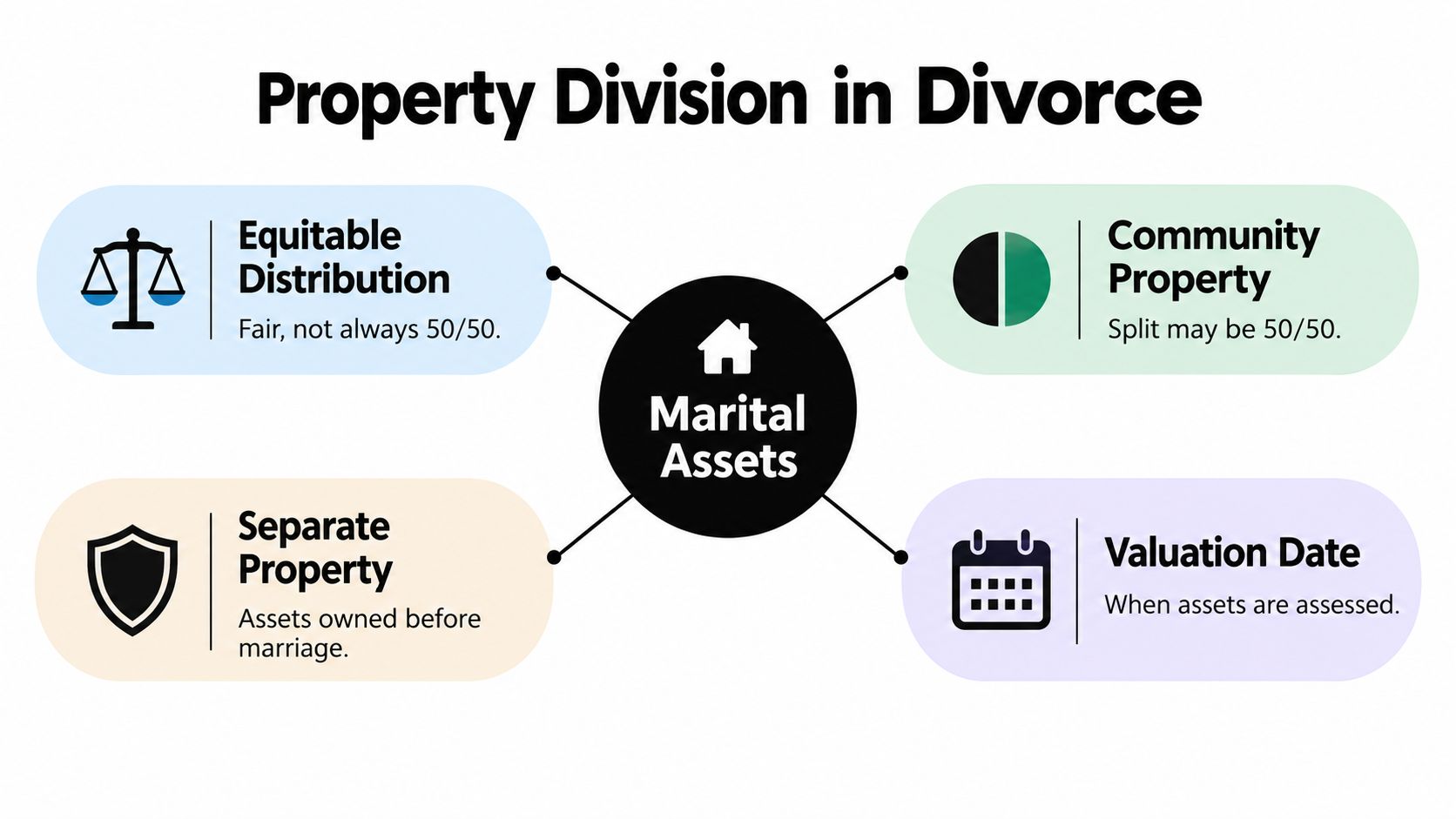
The timing of valuation matters too. If an account swung sharply in value, or if one spouse moved money around before filing, those facts can change the practical result. The smarter move is to freeze the facts early, gather statements, deeds, and account histories, and stop guessing about what the court will do.
Navigating Spousal Maintenance and Child Support
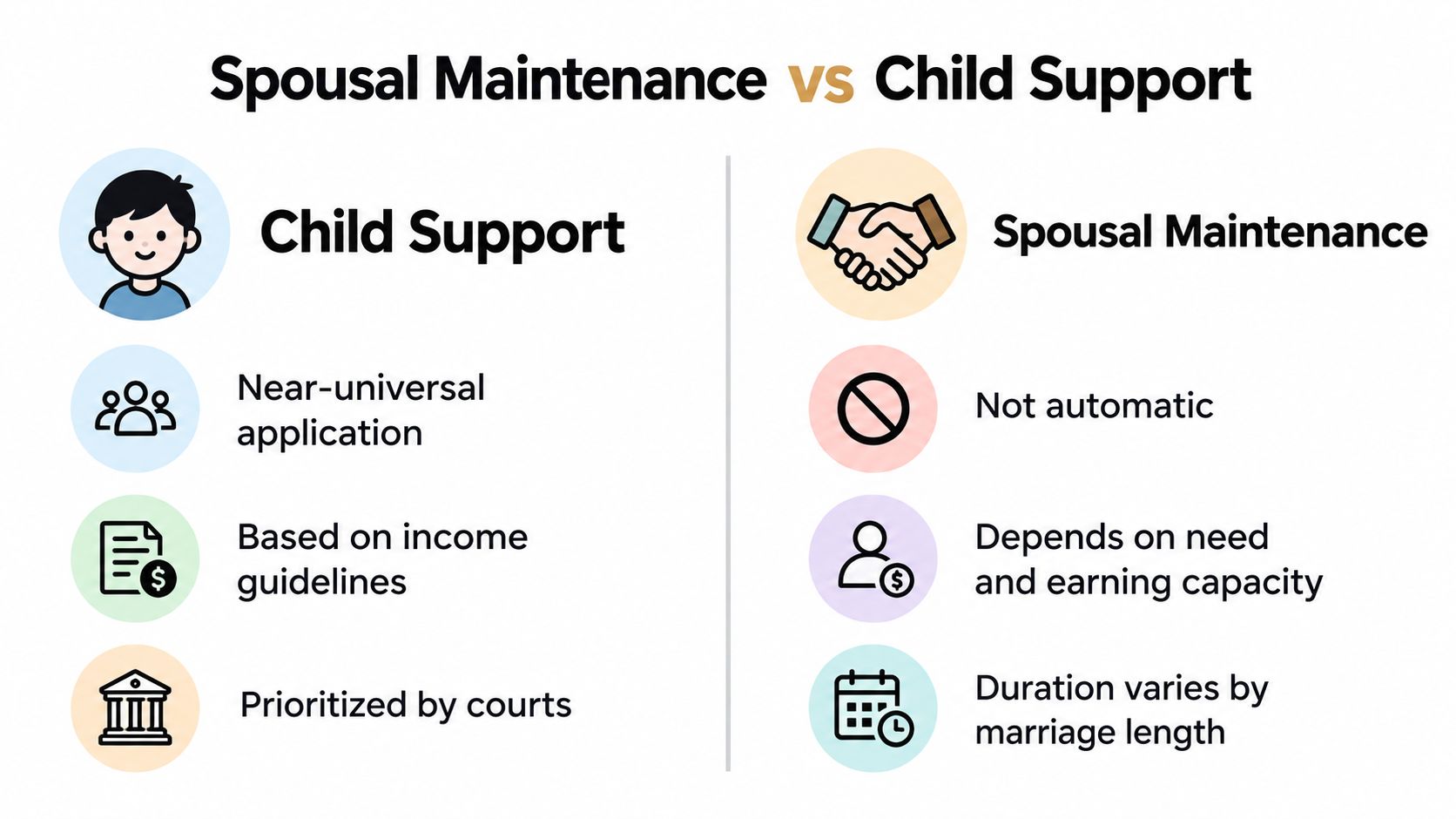
A support claim can disappear fast if you treat it like a default entitlement. Child support is tied to the child's needs and the parenting structure. Spousal maintenance is separate, and courts award it far less often than people assume. A U.S. law review article reported that spousal support is awarded in only about 10% to 20% of all divorces, and Wisconsin divorce data from 2005 showed only 8.6% included alimony awards, plus 2.6% family-support awards (Oldham law review article).
Child support and spousal support are not cousins
Child support usually follows guideline-based calculations and is built into the parenting order. Spousal maintenance turns on need, the other spouse's ability to pay, and the statutory purpose the court is trying to serve (British Columbia family law guidance). That is why many people who expect support receive none, or only a temporary award.
Support is usually a threshold question first, amount second.
That sequence matters. If entitlement fails, the math never starts. Income, reasonable monthly needs, earning capacity, and any agreement that waives or defines alimony rights can all change the result. Tax treatment and payment structure also affect the net value of an award, so a headline support figure is not the same thing as actual financial protection.
Duration Is Often the Toughest Battle
Support fights often turn on how long payments last. The historical record shows a long decline in alimony awards, and modern awards are often limited in duration rather than permanent, as discussed in Oldham law review article. Duration controls whether support bridges a gap or just delays the problem.
If you want the strongest position, collect income proof, monthly expense records, and any evidence showing why support is or is not justified. A practical reference point like average alimony payments can help frame expectations, but it is context, not a promise.
Custody Rights and Parenting Time Frameworks
Custody is where people confuse ownership with responsibility. Courts don't ask which parent “deserves” the child. They ask what arrangement serves the child's best interests, and that standard drives both legal custody, meaning decision-making authority, and physical custody or parenting time, meaning where the child stays and on what schedule.
Decision-making and time-sharing are different issues
Legal custody usually covers big-ticket decisions like health care, education, and sometimes religion. Parenting time is the day-to-day schedule. A parent can lose a request for primary time and still retain decision-making authority, or the reverse, depending on the facts and the court's view of stability, involvement, and co-parenting ability.
The safest strategy is plain and practical. Show consistency. Show that you can communicate without escalating conflict. Show that your requested schedule fits the child's routines, school demands, and developmental needs. Courts respond to evidence of reliability, not dramatic declarations.
A good parenting proposal protects the child's routine first, the parent's convenience second.
That matters because custody disputes often become a proxy war for control. Don't let that happen. Keep your request anchored to logistics, school pickup patterns, medical needs, extracurriculars, and the actual history of caregiving. If you need a framework for documenting that history, parenting time guidelines can help you think more clearly about the structure courts usually expect.
Parent-child rights survive the divorce decree
This is one place where people relax too early. Financial claims can be waived or lost, but parental rights remain a separate lane after the marriage ends. That distinction is critical. It means you need to treat custody evidence as an ongoing record, not a one-time filing.
Do not assume the court will piece it together for you. Bring a clear timeline, keep your language neutral, and focus on the child's needs. That is how credible parenting requests get stronger.
Uncovering Hidden Entitlements and Long-Tail Benefits
The biggest mistake in divorce planning is stopping at the obvious items. The marital home, the bank accounts, and the support question get attention. Then people leave without checking the quieter rights that can matter for years. Social Security retirement benefits based on an ex-spouse's work history can be available if eligibility rules are met, and that kind of benefit often gets ignored because it is not part of the usual settlement conversation (Justia after-divorce guidance).
The hidden value is often outside the settlement sheet
People also miss how divorce can change health insurance, inheritance rights, and access to certain retirement-related benefits. Legal separation and divorce can affect downstream rights in different ways, so the label on the case matters. If you're negotiating a settlement, don't just ask what gets divided today. Ask what disappears later if you sign.
One practical consequence is that some valuable rights are contingent, not immediate. They don't always show up as cash in hand, but they may be worth more than a minor asset split. That's why settlement talks need to be wider than a spreadsheet.
Benefits need to be checked before you sign
If pensions, survivor benefits, or post-divorce coverage are in play, treat them as part of the negotiation, not an afterthought. A clean break can look attractive until you realize you gave up long-tail value for a short-term convenience. The right move is to inventory every benefit, confirm the eligibility rules, and ask which items survive the decree.
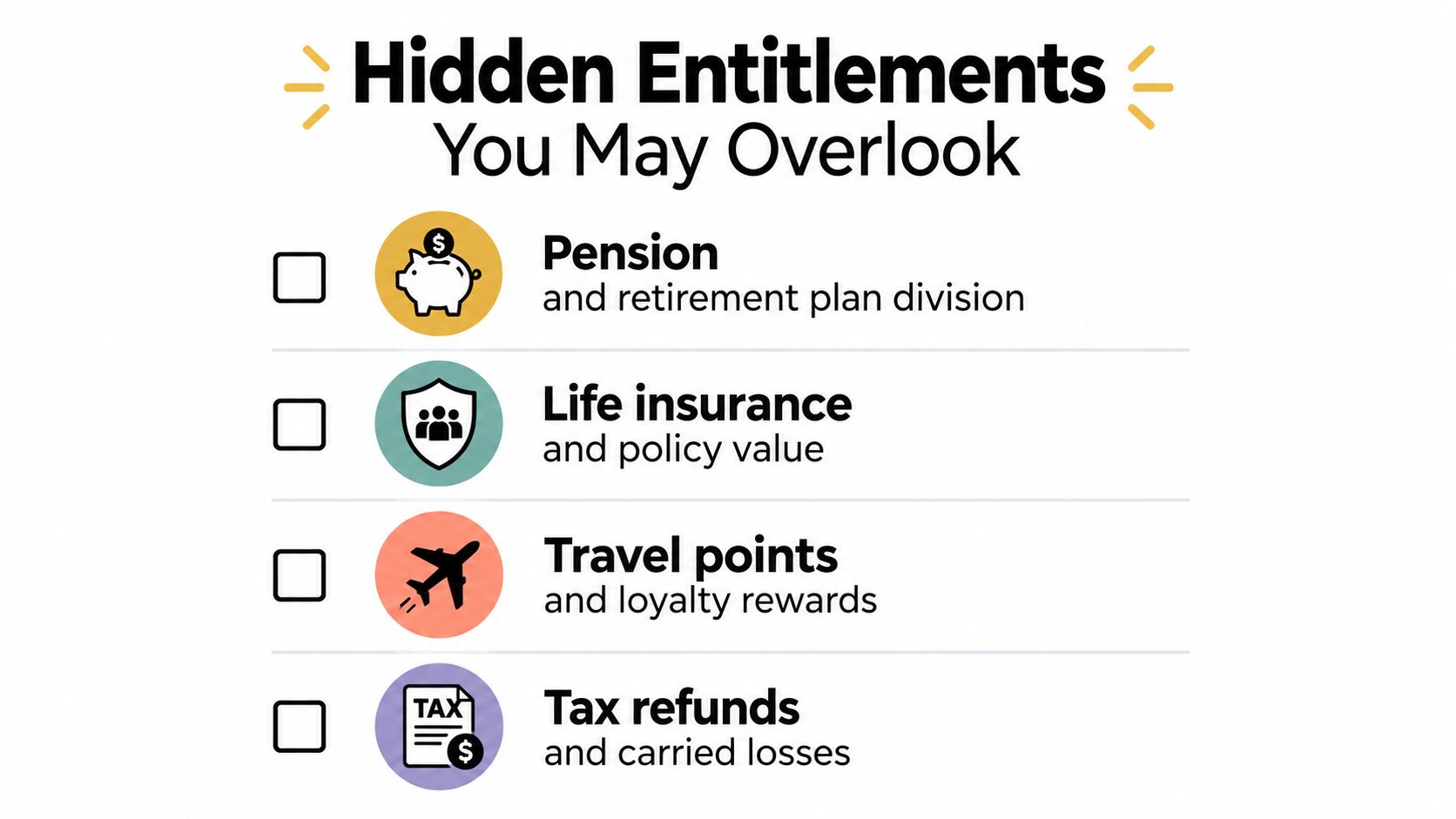
Do the boring work here. Read plan documents, ask for policy information, and check whether an agreement already waived something you thought you still had. Hidden entitlements are only hidden until someone looks for them.
The Deadline Trap and Procedural Time Limits
Many people lose rights because they wait too long, not because the law was against them from the start. That's the trap. In North Carolina, court guidance makes the point bluntly, equitable distribution and alimony claims can be forever lost if not asserted in time, while custody and child support remain separately available after divorce (North Carolina Courts divorce guidance).
Timing can decide whether the claim still exists
That is a hard truth, but it's the one people need. If you sign a final judgment without preserving financial claims, you may have no second chance. The court can only divide what it still has authority to divide, and a missed deadline can wipe that power out.
This is why you don't wait until the emotional dust settles to call a lawyer. You act while the case is still open. You confirm which claims must be filed, which must be reserved, and which can be pursued later.
If a right can be waived, treat silence as a risk, not a strategy.
Child-related claims are different because they remain modifiable after divorce, but that does not make the financial side forgiving. Property division and support are often front-loaded into the process. Miss the filing window, and you may be negotiating from nothing.
Finality is dangerous when you are unprepared
The settlement document can look routine, then close doors you didn't know were open. That is especially true in fast-moving separations where one spouse pushes for quick signatures. Slow down long enough to confirm the procedural order in your jurisdiction. A strong claim filed late is still weaker than a modest claim filed on time.
Building a Court-Ready Documentation Strategy
If you want to protect what you are entitled to, your records have to survive scrutiny. Judges do not reward emotional storytelling without structure. They respond to dated facts, consistent entries, and proof that aligns with the timeline. That means your private documentation system matters as much as your legal theory.
Build records the way a lawyer can use them
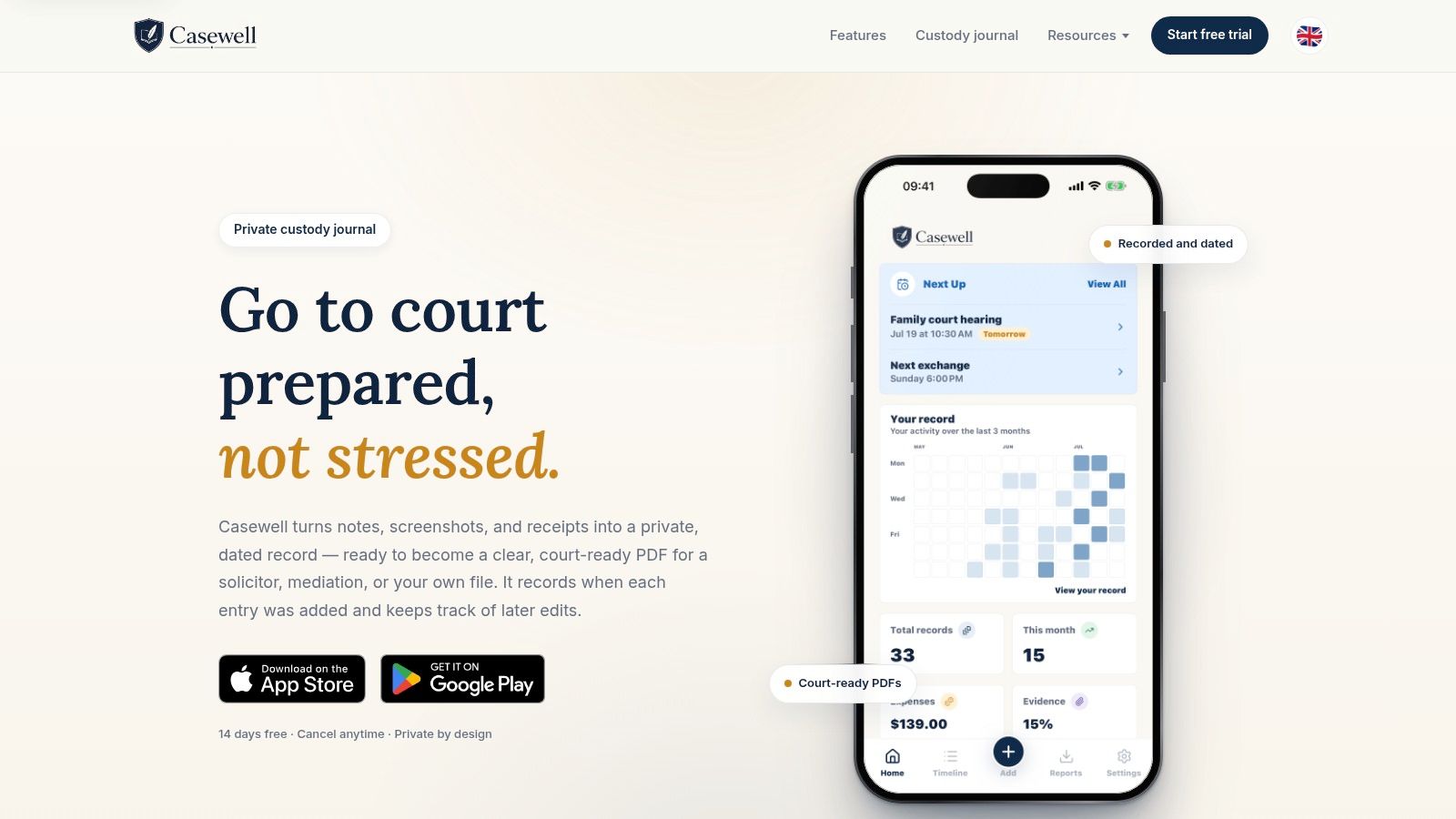
Start with a simple rule. Record the event the same day if you can, write what happened in neutral language, and attach proof immediately. That proof might be a receipt, screenshot, photo, or message export. A private custody journal like Casewell can organize those materials by child, category, date, and expense, then turn them into focused PDFs for review by counsel or a mediator. It is a documentation tool, not a communication channel, which is exactly what high-conflict cases need.
Use structured entries instead of freeform venting. Log the exchange time, the issue, the agreement, and whether the other parent followed through. If an expense was reimbursed only partly, note the balance and attach the receipt. For a concrete checklist, the evidence preparation guide is the kind of resource that keeps your file clean instead of messy.
Neutral language wins more often
Say what happened, when it happened, and what proof supports it. Leave out commentary that doesn't help your position. If you need to clean up rough notes before sharing them with an attorney, use a factual rewrite process, then review it carefully before exporting anything.
You can also use a calendar-style timeline to spot patterns, missed exchanges, or repeated reimbursement gaps. Once the record is consistent, it becomes usable. Without that consistency, it's just noise.
Finalizing Your Strategy and Next Steps
The right answer to what you are entitled to in a divorce is never just “half.” It is a mix of marital property rights, support eligibility, parenting-time decisions, hidden benefit checks, and strict filing deadlines. If you treat those as separate lanes, you stop making expensive assumptions and start building a credible case.
Your next move should be disciplined, not emotional. Get every financial account, deed, retirement statement, agreement, and benefit document in one place. Then confirm which claims must be filed before the divorce is final, which rights survive the decree, and which assets are marital under your jurisdiction's rules.
What to do before you sign anything
- Inventory the estate: List property, debts, retirement assets, and anything you received before marriage or by gift or inheritance.
- Check for waivers: Read any prenup, postnup, separation agreement, or temporary order before assuming a right still exists.
- Preserve your deadlines: File or reserve property and support claims on time, especially if your jurisdiction treats silence as a waiver.
- Document everything privately: Keep a dated record of exchanges, expenses, and agreements so your lawyer isn't forced to reconstruct the case later.
- Ask local counsel early: Family law is jurisdiction-specific, and the outcome depends on where your case is filed.
The strongest divorce strategy is simple. Know what you can claim, prove it with records, and move before the window closes. If you want a private way to keep your custody notes, expenses, and proof organized for attorney review, visit Casewell and use it to build a cleaner record before negotiations harden into deadlines.
Casewell helps separated parents keep private, dated records of exchanges, expenses, and agreements, then export focused reports when a lawyer, mediator, or adviser needs the facts. If you're sorting out what you're entitled to in a divorce, that kind of documentation can protect the claims that matter most.