

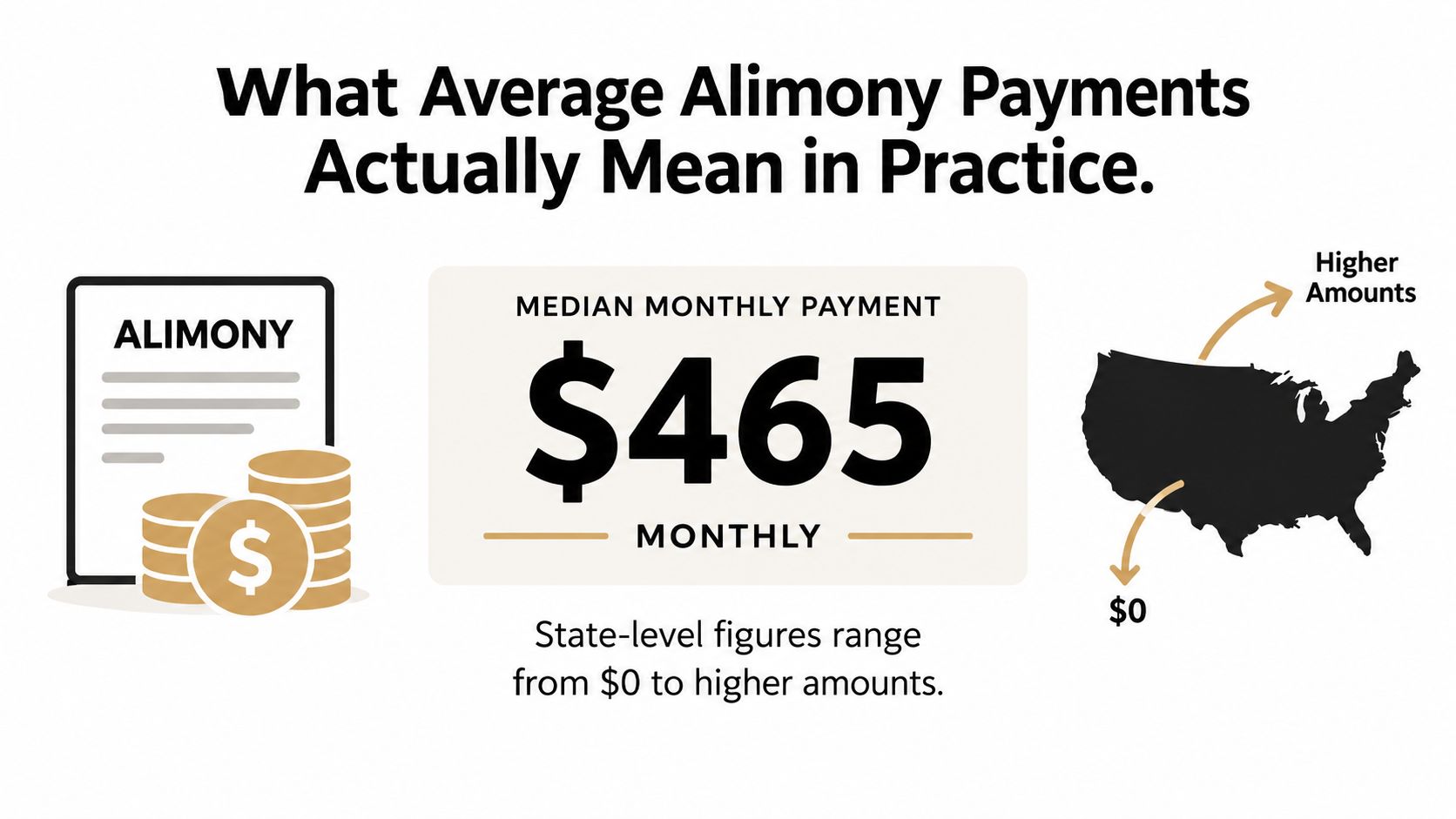
The best available multi-state analysis puts the typical monthly alimony award around $465, while state-by-state modeled figures stretch from roughly $0 to about $1,381 per month. That range is a more useful starting point than any supposed national average because alimony is a distribution shaped by state rules and personal finances.
Readers often search for one number because they need to budget, negotiate, or decide whether legal advice is necessary. The problem is that no single figure can predict what a court will order in an individual case. The amount depends on the income gap, earning capacity, marriage length, health, household needs, and the law in the state where the case is decided.
The practical task is therefore not to find a magic average. It's to identify the range your facts could occupy, understand how your state reaches that range, and assemble records that support your calculation.
What Average Alimony Payments Actually Mean in Practice
A $465 monthly median offers a useful reference point, not a promised award. A multi-state analysis reports modeled state figures ranging from roughly $0 to about $1,381 per month, showing how widely outcomes can vary by jurisdiction. It also explains that two-thirds of U.S. states lack a dependable standard amount because judges review case-specific financial records instead of applying one national benchmark. The multi-state alimony analysis provides that broader context.
Median is not the same as mean
A median identifies the middle observation in a distribution. Half of the reported awards fall below it, and half fall above it. A mean, commonly called an average, adds every award and divides the total by the number of awards.
The two measures can point to different conclusions. Suppose most awards are modest, while a small group of high-income cases produces very large payments. Those larger cases push the mean upward, while the median remains closer to the ordinary award. The median can therefore help describe a typical case, although state law still controls the actual decision.
The distribution also explains why similar financial circumstances can lead to different results. Two couples might have the same income difference, marriage length, and monthly budget. If one case is filed in a state using a guideline formula and the other in a state granting broad judicial discretion, the payments may occupy different parts of the range.
Practical rule: Use an average as a comparison point, not as a forecast.
Model your own range
Begin with three questions:
- Where is the case filed? State law determines whether a formula, statutory factors, or both guide the calculation.
- What is the actual financial gap? Gross salary does not always show available income, monthly needs, assets, or earning capacity.
- How long and in what form might support continue? The same monthly amount has a different financial effect when paid temporarily, rehabilitatively, or under a long-term order.
For example, $465 per month for a short period is not financially equivalent to $465 continuing under a longer arrangement. Record the assumptions behind each estimate, including income, expenses, and the rule used. That habit turns a national reference point into a working range grounded in the facts of your case.
The Main Types of Alimony You Might Encounter
The label attached to support often predicts how the court or settlement treats duration, modification, and the total obligation. A payment can be temporary while a divorce is pending, rehabilitative while a recipient gains skills, or structured as a long-term periodic or lump-sum arrangement.
Rehabilitative support is designed to help a recipient become more self-sufficient. For example, a 42-year-old earning $48,000 might receive $1,200 each month for 36 months while completing a nursing credential. The amount and end date would be tied to the training plan, not to the fact of financial need.
Temporary support applies during the case. A court could order $2,500 per month for nine months until a final hearing or settlement. Temporary support may use a different calculation from final support, and it doesn't automatically establish what the final order should be.
Lump-sum or permanent support requires careful wording. A 20-year marriage with a substantial income gap might settle on a $75,000 buyout plus $3,800 per month until remarriage or death. In practice, parties may also combine a fixed payment with limited monthly support, creating a hybrid arrangement.
A stay-at-home spouse's caregiving history can affect the financial analysis, but it doesn't itself determine the amount. Readers assessing that issue may find this overview of divorce considerations for a stay-at-home wife useful alongside state-specific legal advice.
Alimony types at a glance
| Type | Typical Duration | Example Monthly Amount |
|---|---|---|
| Temporary | Until final hearing or settlement | $2,500 |
| Rehabilitative | Fixed training or transition period | $1,200 |
| Periodic long-term support | Until a stated ending event or later modification | $3,800 |
| Lump-sum or hybrid | Fixed payment, sometimes combined with monthly support | $3,800 in a hybrid example |
Reimbursement support is another variant. It may compensate one spouse for contributions that helped the other complete education or build earning capacity. The key question isn't just “How much per month?” It is “What purpose does this support serve, and what event ends it?”
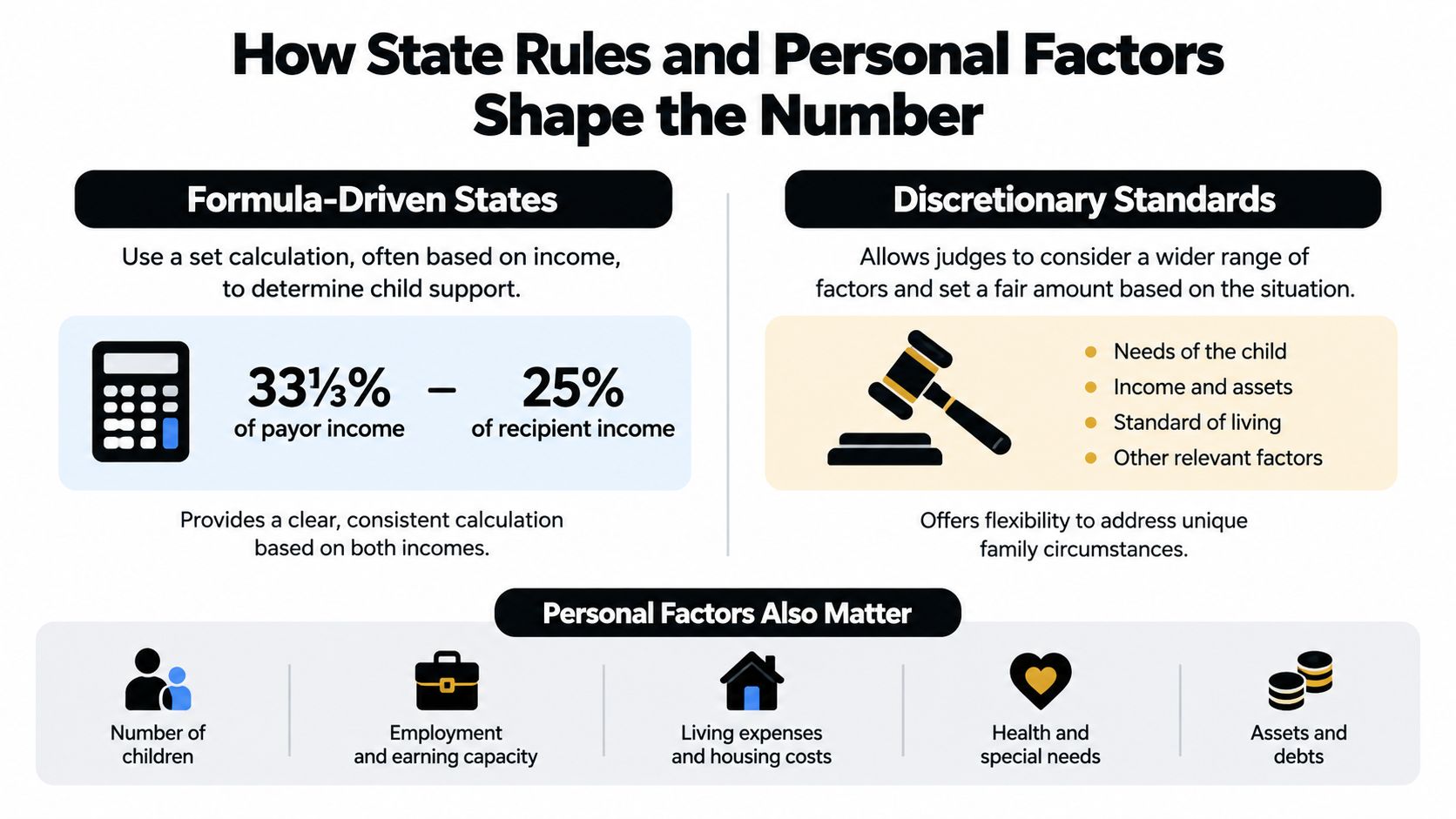
How State Rules and Personal Factors Shape the Number
State law supplies the framework, but the financial record supplies the inputs. One formula-style approach uses roughly 33⅓% of the payor's net annual income minus 25% of the recipient's net annual income, with a cap intended to keep combined support from exceeding roughly 40% of combined income. A discussion of formula-based alimony calculations describes this type of structure.
A discretionary state works differently. Instead of producing one answer from two incomes, the judge may weigh a broad statutory list, including need, ability to pay, marriage length, earning capacity, age, health, and the standard of living during the marriage. That gives the court more room to distinguish between cases that look similar on a spreadsheet.
| Formula-driven approach | Discretionary approach |
|---|---|
| Applies a stated income calculation | Weighs statutory and case-specific factors |
| Produces an initial mathematical estimate | Requires arguments supported by financial records |
| May include a combined-income cap | May have no single predictable output |
| Still depends on definitions of income and deductions | Still depends on need, ability to pay, and earning capacity |
The facts inside either framework
Marriage length often affects both eligibility and duration. A short marriage may support a limited transition award, while a longer marriage can justify more sustained assistance. A commonly used practical rule is that marriages under five years rarely produce long-term support, while marriages beyond fifteen years increasingly raise duration concerns. That is a planning heuristic, not a national rule.
The income gap matters because support responds to the difference between resources and needs. A high salary doesn't automatically mean the payor can meet every requested amount, and a lower salary doesn't automatically prove inability to work. Courts may examine bonuses, self-employment income, assets, education, work history, and whether either spouse is voluntarily underemployed.
Age and health can affect employability. Custody arrangements can change housing, transportation, childcare, and work availability. Career sacrifices may help explain why one spouse has less earning capacity after the marriage.
A move across a state line before filing can change the legal framework and create a substantial difference in the modeled result. The important lesson is not to assume that relocation guarantees a specific swing, but to obtain the relevant state's rules before treating an estimate as reliable. The state-by-state alimony overview can help organize that initial comparison.
Two Worked Examples That Show How Payments Are Calculated
The following examples use the stated formula approach, not a universal national rule. They show the mechanics clearly, while the actual award would still depend on the governing state's definitions, deductions, evidence, and duration rules.
Example one with the larger income gap
Assume one spouse earns $90,000 and the other earns $40,000. Using annual figures:
- Calculate 33⅓% of the payor's income: $90,000 × 33⅓% = $30,000.
- Calculate 25% of the recipient's income: $40,000 × 25% = $10,000.
- Subtract: $30,000 minus $10,000 = $20,000 per year.
- Convert to monthly support: $20,000 ÷ 12 = $1,666.67 per month.
- Check the combined-income cap: Combined income is $130,000. Forty percent is $52,000, which is higher than the proposed combined support figure used in this simplified check, so the cap doesn't bind in this example.
A 10-year marriage may support a different duration from a short marriage, but the formula alone can't decide that issue.
Example two with the reversed gap
Now assume the first spouse earns $40,000 and the second earns $90,000. The formula applies to the payor, so the $90,000 earner remains the payor in this illustration. The arithmetic would produce the same preliminary figure if every other input stayed identical, but a four-year marriage could lead to a shorter or more limited award after the court evaluates duration, earning capacity, and need.
That distinction matters. Income determines the preliminary amount in a formula, while marriage length and employability can strongly influence whether the preliminary amount lasts.
| Variable | Example 1: 10-Year Marriage | Example 2: 4-Year Marriage |
|---|---|---|
| Payor income | $90,000 | $90,000 |
| Recipient income | $40,000 | $40,000 |
| Formula result before duration analysis | $20,000 annually | $20,000 annually |
| Monthly calculation | $1,666.67 | $1,666.67 |
| Likely planning issue | Amount and meaningful duration analysis | Shorter duration and transition needs |
Use the calculation as a worksheet, not as a prediction. A lawyer or mediator should verify whether the state uses net or gross income, how child support affects available income, and whether the court follows this formula at all.
How Private Custody Records Strengthen an Alimony Case
After separation, a parent named Maya begins keeping a dated private journal. She records each parenting exchange, the school costs she paid, medical receipts, transportation expenses, and messages in which the other parent agrees to reimburse a portion of an expense.
At first, the entries seem unrelated to alimony. Over time, they reveal the household's actual financial arrangement. Maya can show that she covered recurring child-related costs, reduced work hours around exchanges, and received irregular contributions rather than a stable monthly payment. Those facts may help professionals evaluate her actual need and the other spouse's real contribution during separation.

Why contemporaneous records carry weight
A note written close to an event can preserve the date, amount, agreement, and outcome before memories blur. It also gives a mediator or attorney a sequence to compare against bank statements, messages, receipts, and formal support orders.
The journal doesn't prove every disputed claim by itself. Its value comes from links between the entry and supporting material, such as a receipt beside an expense, a screenshot beside an agreement, or a calendar record beside an exchange note.
Casewell is one private record-keeping option. Its co-parenting journal organizes dated entries, expense information, attachments, agreements, and focused PDF reports for professional review.
The indirect alimony connection is important. A court assessing support may need to understand each spouse's income, needs, contributions, and ability to work. A clear separation record can prevent the financial picture from being reduced to two annual salaries.
After the substantive record is built, a focused video can help parents think about organizing custody information without turning the journal into an emotional narrative.
Write facts neutrally. “The exchange occurred at 6:15 p.m. and the child left with a winter coat” is more useful than a conclusion about the other parent's character.
A Practical Documentation Routine Before Mediation or Court
Begin before a dispute becomes urgent. A reliable record is easier to build from small entries made consistently than from a rushed reconstruction prepared after a hearing is scheduled.
Log each exchange: Record the date, time, location, participants, and the events that occurred. If a schedule changed, preserve the original arrangement and the reason given. This can help distinguish an agreed change from a missed obligation.
Capture shared expenses: Photograph receipts and note the child, purpose, payer, amount, reimbursement request, and amount received. Attach the message or agreement that explains who was expected to pay.
Create monthly summaries: Export a PDF that groups entries by date and category. A summary can show recurring housing, transportation, childcare, medical, or education costs without forcing a professional to search through an entire phone.
Keep a protected backup: Store original files and exports in a private folder with access controls. Don't edit the original screenshot or overwrite an earlier note. Preserve the history of later additions or corrections.
A useful export checklist
Before mediation, prepare:
- PDF summaries: Include the relevant period, category labels, and page numbers.
- Original receipts: Keep image files at their original resolution.
- Message exports: Preserve dates, participants, and surrounding context.
- Agreement copies: Link expenses to the order, written agreement, or documented request.
- Timeline notes: Separate direct observations from interpretation.
A divorce mediation preparation guide can help you organize the broader meeting, while your documentation should remain focused on facts relevant to finances, parenting, and compliance.
The purpose isn't to produce the longest file. It's to produce a reviewable file that shows what happened, when it happened, what it cost, and what each person agreed to do.
Common Misconceptions About Average Alimony Payments
Myth one, one national average controls most cases. The reported multi-state median is $465 per month, yet modeled figures range from roughly $0 to about $1,381. Many states do not provide a reliable standard amount. The state analysis cited earlier supports viewing payments as a distribution rather than treating one figure as a national benchmark. A $465 estimate may orient you, but it cannot replace the local rule and your financial records. Practical takeaway: identify the governing state framework before using an average in negotiations.
Myth two, alimony always flows from a husband to a wife. Courts generally examine need, ability to pay, income, earning capacity, and the financial effects of the marriage. Gender does not determine which spouse earns more or needs support. For example, if either spouse has the higher income and the other cannot meet reasonable needs, the payment direction depends on those facts. Practical takeaway: prepare financial records for both parties rather than assuming the outcome from family stereotypes.
Myth three, a long marriage automatically creates permanent support until retirement. A longer marriage may affect duration, but it does not eliminate the need to show current financial circumstances or guarantee indefinite payments. Recent summaries describe movement away from indefinite support toward rehabilitative and self-sufficiency-focused arrangements, while reporting that permanent awards are rare. The divorce settlement statistics summary also reports that alimony is awarded in about 10% to 15% of U.S. divorces. Practical takeaway: examine the proposed end date, modification terms, and evidence of earning capacity instead of treating marriage length as a lifetime entitlement.
Historical labor data provides another warning about averages. In one household survey, alimony averaged $95 and represented 4.6% of cash contributions. The average reached $331 among households in the top income quintile and only $12 among households in the bottom two income quintiles. The Bureau of Labor Statistics analysis shows why income composition can shift a reported average. Use distributions, formulas, and documentation to model your circumstances rather than trusting a single national number.
Putting It All Together Before Your Next Negotiation
Take a portable file to mediation or a lawyer meeting. It should answer the questions behind the number, not merely display a requested monthly payment.
- Income records: Gather tax returns, pay records, benefit information, and business or investment records for the period your adviser requests.
- Monthly budget: Separate housing, food, transportation, insurance, healthcare, childcare, debt, and other recurring costs.
- State framework: Print the applicable guideline or statutory-factor list and mark whether the state uses a formula, discretion, or both.
- Marriage and income map: Put marriage length beside each spouse's income, earning capacity, health, and career history.
- Support timeline: Note temporary payments, informal contributions, missed reimbursements, and changes in employment.
- Custody and expense exhibits: Export only the relevant journal entries, receipts, messages, agreements, and summaries into readable PDFs.
- Negotiation position: Prepare one needs-based explanation and one ability-to-pay explanation, each tied to a document.
Use the $465 median only as a broad orientation point. Your useful estimate comes from applying the local framework to verified income, realistic needs, marriage circumstances, and a defensible duration.
Ask your attorney or mediator to test the estimate under more than one scenario. A shorter rehabilitative award, a periodic arrangement, and a lump-sum settlement can produce very different financial results even when the headline monthly amount looks similar.
Casewell helps separated parents keep private, dated records of parenting exchanges, child-related expenses, agreements, receipts, and supporting files, then organize selected material into court-ready PDF reports. Visit Casewell to create a clearer documentation routine before your next mediation or family-law consultation.