
You and the other parent agreed that your child would be picked up after school on a particular day. The conversation felt settled. Then the day arrives, and one parent expects a pickup at the usual location while the other expects a later exchange somewhere else. Both remember the discussion differently, and neither can point to a document that resolves the disagreement.
A stipulation and agreement becomes important. The agreement can record what both parents accepted, while the stipulation can identify the specific point they've agreed to present to the court. But signing a document is only part of the process. You also need to know what was agreed, which version controls, when the court made it enforceable, and how to prove a later departure from its terms.
A reliable record answers those questions without relying on memory. It preserves the exact language, signatures, attachments, filing details, communications, and dated events connected to the agreement. The guide to documenting verbal co-parenting agreements can help explain why informal conversations become difficult to prove later.
Introduction Why Agreements Fall Apart Without Writing
Co-parenting disputes often begin with a small difference in understanding. One parent says, “We agreed I'd have the child for the holiday.” The other says the holiday was discussed but never finalized. A text message may contain part of the conversation, while another important term exists only in a phone call or an exchange at the child's school.
The problem isn't always dishonesty. Parents may remember the same conversation differently, overlook an exception, or assume that a general promise includes details the other parent never accepted. A phrase such as “flexible summer schedule” may sound cooperative, but it doesn't answer which dates apply, where exchanges occur, or what happens when plans change.
The documentation gap
A signed agreement can still create later confusion if it lacks attachments, dates, complete provisions, or proof that a judge entered it as an order. A parent may have a document titled “agreement,” but that label alone doesn't establish that the court reviewed and adopted it.
The practical questions usually come later:
- What exact term applied? Was the exchange at school, at a parent's home, or at another location?
- Which version controls? Did a later message change the schedule, or was it only a temporary accommodation?
- When did enforcement begin? Was the document merely signed, or did a judge sign and enter it?
- What happened afterward? Can you connect a missed exchange or disputed expense to the precise provision involved?
Washington Superior Court Civil Rule 2A illustrates the importance of memorialization. Disputed agreements between parties or attorneys generally aren't recognized unless they're made on the record in open court, entered in the minutes, or put in writing and signed by the attorney denying the agreement, as described in the Washington rule on disputed agreements.
What a dependable record does
A well-prepared stipulation makes the agreement readable. A court-entered order gives it an enforcement framework. A dated record of later events helps show whether each parent followed the operative terms.
This article explains the meaning of a stipulation and agreement, how it differs from an order or judgment, where families use stipulations, how to draft one carefully, and what to bring to mediation or court. The focus is the step many general explanations leave out: proving what happened after signing.
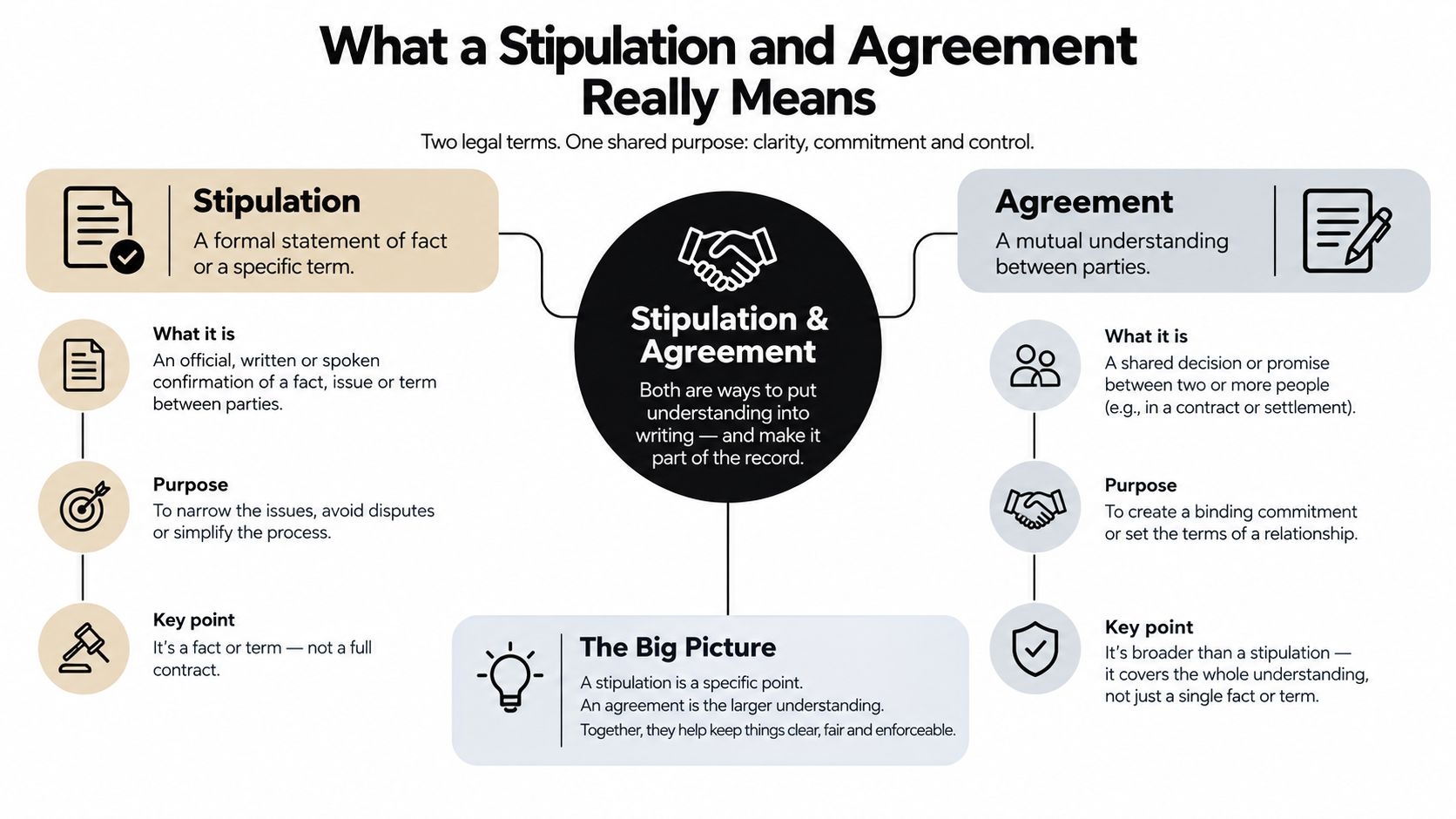
What a Stipulation and Agreement Really Means
A simple analogy helps. An ordinary agreement is like a handshake between two people. A stipulation is like that handshake written down so a court can see exactly what both sides accepted. When a judge incorporates the stipulation into an order, the arrangement gains a formal court command that can be enforced through the court process.
Modern legal references define a stipulation as an agreement or condition. In litigation, it commonly means an agreement between opposing parties about a relevant point, as explained by the Cornell Legal Information Institute's explanation of stipulation.
Key definition: A stipulation is an agreement between parties about a relevant issue, recorded in a form that can establish what they accepted.
Where the term came from
The idea has a long legal history. In Roman law, the stipulatio was one of the oldest contract forms and is described as dating to before the Law of the Twelve Tables, placing its origins earlier than 450 BCE. It began as a strictly verbal, one-sided promise created through a formal question-and-answer exchange, then expanded beyond money to cover specific things, acts, or refraining from acts, according to the Cornell reference on stipulation.
That evolution matters because it shows how a rigid oral ritual became a flexible way to bind obligations. Modern family-law stipulations are usually written, signed, and connected to court filings, but the central idea remains similar: the parties identify an obligation and create a record of assent.
The three parts parents should identify
Mutual assent means both parents accepted the same terms. A draft one parent prepared and the other parent never signed may show a proposal, but it doesn't automatically prove agreement.
Clear terms explain who must do what, when, where, and under which conditions. “Reasonable parenting time” may require further interpretation. A schedule that identifies exchange times, locations, holidays, notice requirements, and communication methods gives the reader something concrete to apply.
Proper memorialization means preserving the agreement in a legally meaningful form. Depending on the jurisdiction and proceeding, that may involve signatures, a court record, minutes, a filed document, or incorporation into an order. A practical custody agreement example can help parents recognize the difference between broad intentions and operational terms.
The word “stipulation” doesn't automatically make a document enforceable. Its strength comes from the combination of assent, precision, proper signatures, judicial treatment where required, and a record that shows which document governed at the relevant time.
How a Stipulation and Agreement Differs From Orders and Judgments
Parents often use these terms interchangeably, but they describe different legal functions. A private agreement records what the parents accepted. A court order states what the court requires. A consent judgment generally resolves claims through an agreed judgment entered by the court.
The distinction matters most after a disagreement. If one parent fails to follow a private agreement, the other parent may need to seek relief based on contract principles or ask the court to adopt the terms. If the same terms appear in a signed and entered custody order, the parent can usually frame the issue as noncompliance with a court directive, subject to local procedure and legal advice.
A practical comparison
| Feature | Stipulation and Agreement | Court Order | Consent Judgment |
|---|---|---|---|
| Main source | The parties' mutual agreement | A judge's directive | An agreed resolution entered as a judgment |
| Who creates it | The parents, their attorneys, or both | The court | The parties propose terms, and the court enters judgment |
| Signature role | Shows assent by the parties or counsel | Shows judicial approval or issuance | Shows agreement and judicial entry |
| Enforcement | Depends on its form, jurisdiction, and whether it was incorporated into an order | Enforced through the court's authority | Enforced as a judgment, subject to applicable law |
| Modification | May be changed by a later valid agreement, but formal requirements still matter | Usually requires a new order or approved modification | Usually requires judgment-related modification or relief |
| Proof of breach | Requires proving the terms and their legal status | Requires comparing conduct with the order | Requires comparing conduct with the judgment |
This table is a working guide, not a substitute for jurisdiction-specific advice. Family courts can apply different requirements to custody, support, property, and procedural agreements. The overview of family court provides broader context for how these documents fit within family-law proceedings.
Why incorporation changes the analysis
California's FL-355 procedure shows the operational difference clearly. The parents' written custody or visitation agreement is converted into a judicial order through the required process, including detailed parenting-time terms, signatures, and the judge's signature before copies are filed for the record, as shown in the California FL-355 procedure.
The shift is straightforward. A standalone document says, in substance, “we agreed.” A signed court order says, “these are the terms the court has entered.” That distinction can affect the available enforcement route, the evidence needed, and how a mediator or judge evaluates a later dispute.
A consent judgment may go further by resolving claims in a final judgment. It can include agreed provisions, but parents shouldn't assume that every signed settlement has judgment status. Look for the document's title, the judge's signature, the filing or entry information, and language showing what the court adopted.
Common Uses for Stipulations in Family Law
Family-law stipulations help parents resolve defined issues without asking the court to decide every detail after a contested hearing. They can address custody and parenting time, child support adjustments, property division, and procedural matters such as continuances or discovery arrangements.
The most useful stipulations translate cooperation into instructions. A parenting-time term should tell the parents how an exchange works in real life, not merely express a preference.
Custody and parenting time
A vague clause might say:
“The parents will share holidays fairly and remain flexible.”
A more usable clause identifies the holiday, the relevant dates, the exchange time, the location, transportation responsibility, and whether the holiday schedule overrides the regular weekly schedule. It can also address notice for travel, makeup time, and how parents communicate an unexpected delay.
Useful provisions may include:
- Exchange location: Name the school, residence, public location, or other agreed place.
- Exchange time: State the time and identify what happens if school is closed.
- Holiday priority: Explain whether holiday or vacation terms override the ordinary schedule.
- Communication rules: Identify the approved channel and the type of notice required for changes.
- Decision-making: State which parent handles education, medical care, activities, or emergency decisions.
Specificity isn't about making the document hostile. It reduces the number of decisions parents must renegotiate under pressure.
Support and property matters
A stipulation may record an agreed adjustment to child support, allocation of a child-related expense, or reimbursement procedure. It may also address property division, possession of personal items, or responsibility for a particular account. These terms often need supporting schedules, receipts, account information, valuations, or other attachments.
The document should identify what happens next. “Parent A will reimburse Parent B” leaves open the amount, deadline, method, and required proof. A stronger provision explains the expense covered, the documentation required, the date for payment, and the process for disputing an item.
Procedural agreements
Parents and attorneys may also stipulate to procedural matters, such as moving a hearing date or setting a timetable for exchanging documents. These agreements can save time, but they still need proper memorialization. A message that says both sides are “fine with moving the hearing” may not be enough if the court requires a formal filing or approval.
The drafting question is always the same: Could a neutral reader identify the obligation and determine whether each person complied? If not, the language needs more work before anyone relies on it.
How to Draft a Clear and Enforceable Stipulation
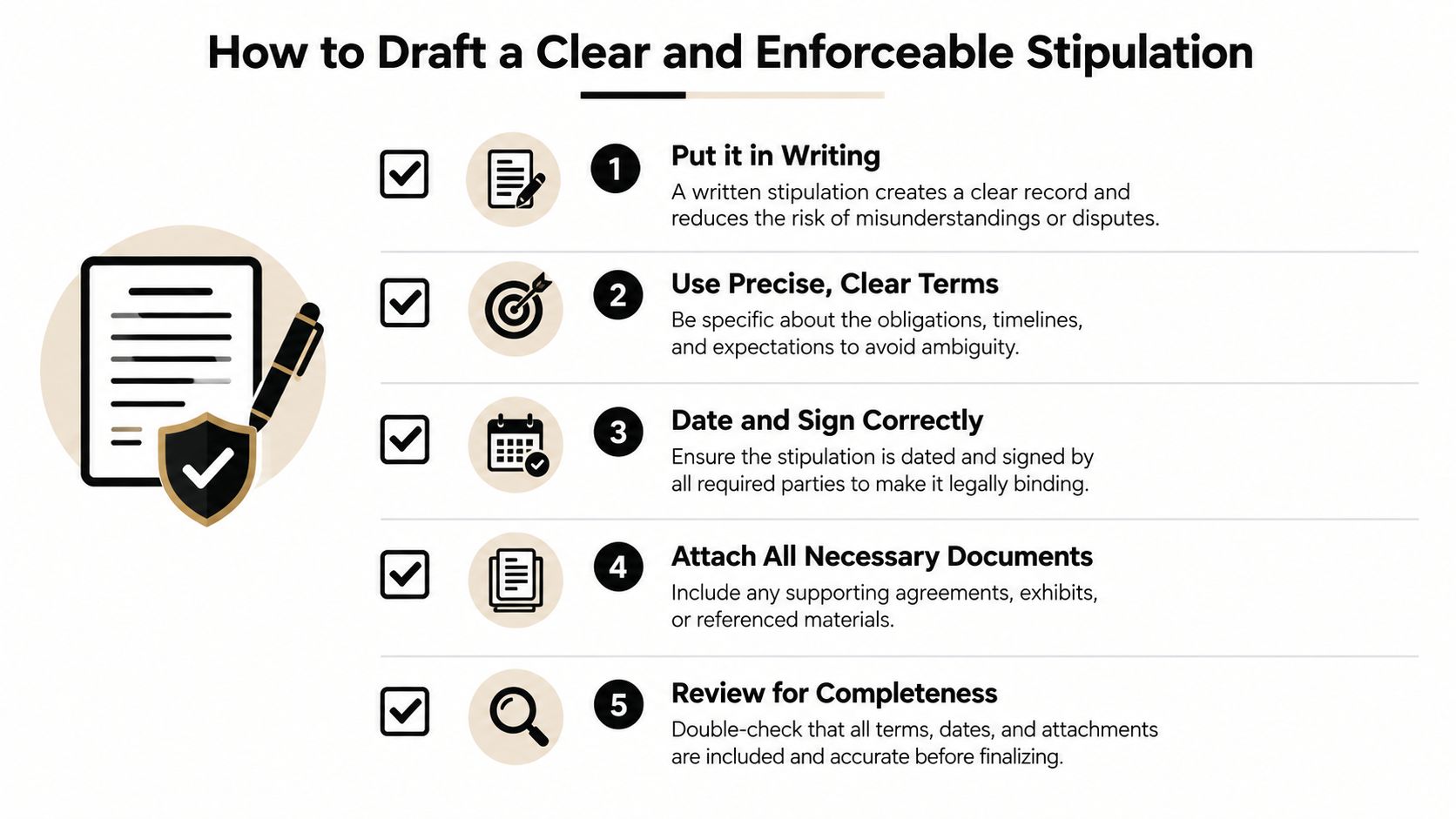
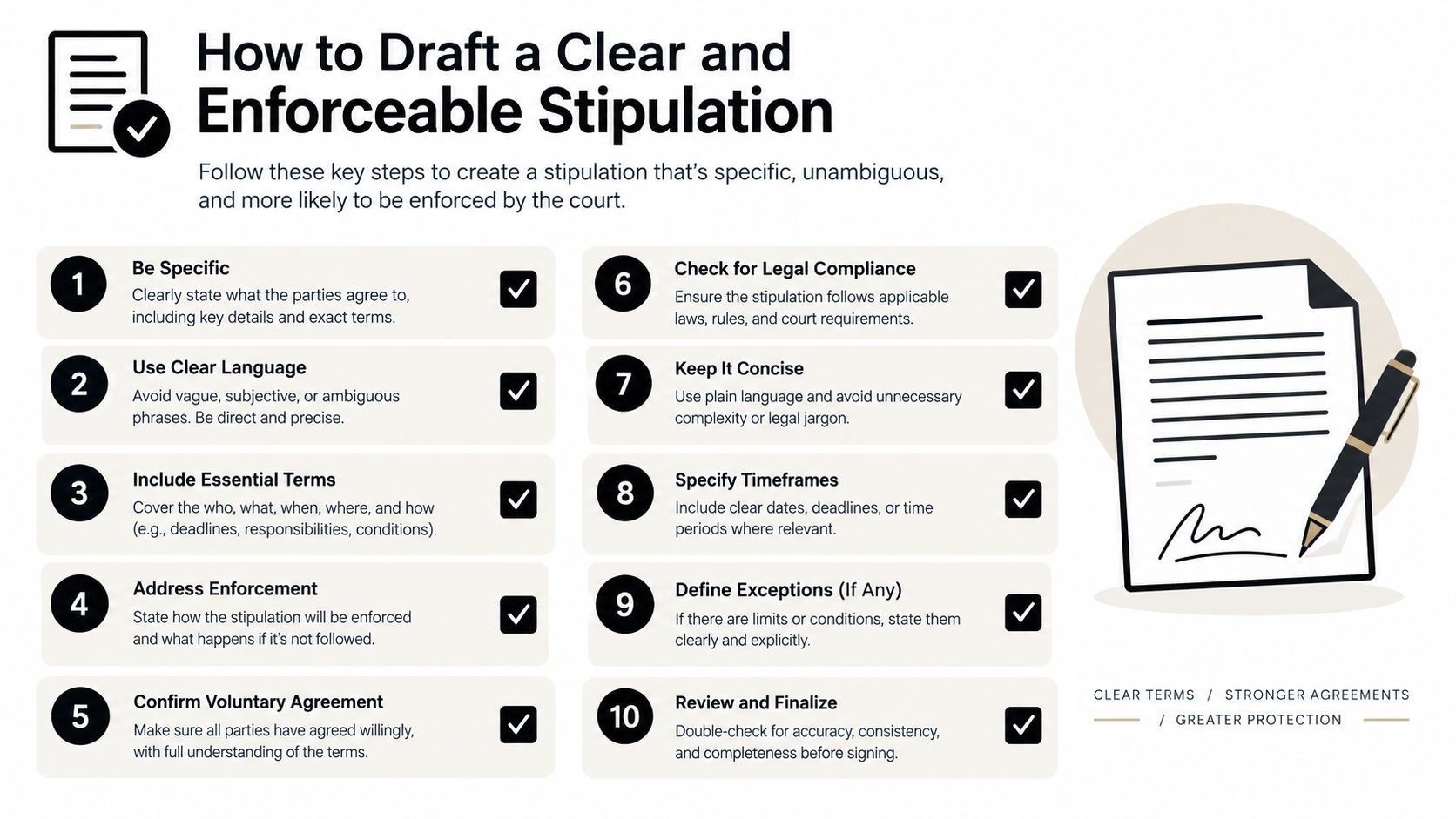
Drafting should begin with the event that could later cause disagreement. For custody, start with the handoff, holiday, school break, appointment, or expense that needs a predictable rule. Then write the provision so a person who wasn't part of the negotiation can apply it without guessing.
Build the document in layers
Put it in writing. Record the complete agreement rather than relying on scattered messages. If negotiation occurred by email or text, use those communications to confirm intent, but place the final terms in one identifiable document.
Use precise language. Replace “early,” “late,” “regularly,” and “as needed” with dates, times, locations, notice methods, and decision rules. Include exceptions, because a schedule that works during school weeks may not answer what happens during closures or holidays.
Date and sign correctly. Preserve the signature page with the full agreement and every attachment. Technical custody practice treats dates, signatures, and the preservation of attachments as core parts of the record, not clerical details.
Attach supporting documents. Include the parenting-time schedule, holiday calendar, expense list, transportation plan, or other exhibit the text relies on. A provision that says “according to the attached schedule” is incomplete if the schedule isn't attached to the signed version.
Identify the legal status. State whether the document is intended as a private agreement, a stipulation for court approval, or a proposed order. Don't assume that a title answers this question. Check whether the judge signed it and whether it was filed or entered.
Protect the version history
A later change creates a common documentation problem. One parent may say a text message permanently changed the schedule, while the other says it granted a one-time exception. Preserve the original agreement, the proposed modification, the messages discussing it, the signed replacement, and the date the court approved or entered the change.
Wisconsin legislative materials describe pre-judgment custody or physical-placement stipulations as potentially becoming enforceable initial orders after court approval, unless the court finds the terms contrary to the child's best interest, as reflected in the Wisconsin legislative materials on custody stipulations. The practical lesson is that approval and entry can determine whether a signed agreement has become an enforceable order.
Use a consistent file name and preserve earlier versions rather than overwriting them. A useful record can show the original text, the later edit, who signed each version, and which version was operative on the date in question.
Draft for later comparison
Write each obligation so you can compare it with an event record. For example, “Parent B will pick up the child at the school office at the end of the school day on designated weekdays” can be tested against the date, time, location, and outcome of an exchange. “Parent B will be reliable” can't be evaluated with the same precision.
Practical rule: If you can't connect a later event to a specific sentence in the agreement, the provision probably needs clearer terms.
What to Bring to Court or Mediation to Support Your Agreement
A signed stipulation becomes easier to use when you separate two workflows. The court workflow establishes the document's legal status. The evidence workflow shows what happened under that document afterward.
For the court workflow, gather the complete agreement, signature pages, every attachment, proof of filing, and the order showing judicial approval or entry. California's FL-355 materials demonstrate why detailed custody descriptions and judge signatures matter when parents ask the court to convert their agreement into an order.

Build an evidence packet around provisions
Don't bring a large, unorganized collection of screenshots and notes. Link each item to the provision it helps prove.
- Agreement copy: Bring the complete operative version, not only the page that mentions the disputed issue.
- Entry information: Include the judge-signed order, filing record, or other material showing when the terms took effect.
- Communication records: Preserve messages that confirm a planned exchange, request a change, report a delay, or dispute what occurred.
- Event records: Note the date, time, location, people present, and observable outcome for each relevant event.
- Supporting proof: Keep receipts, school records, photographs, calendars, and files beside the event they support.
- Response history: Record whether the issue was corrected, repeated, partially resolved, or left unanswered.
A mediator or attorney can work faster when each event includes a short reference to the relevant paragraph or schedule. Neutral wording is also more useful than conclusions. “The exchange was scheduled for the school office at the end of the school day. The child was not transferred at that location” gives a professional something concrete to evaluate.
Preserve edits and chronology
The date an event occurred and the date you wrote it down are different facts. Keep both where possible. If you later correct a note, preserve the earlier version and identify what changed, rather than replacing the original entry.
The mediation preparation guide can help parents think about organizing documents for a professional review. The central principle is simple: present the agreement, then present a chronological set of records that lets another person compare the terms with the conduct.
This method also helps with partial compliance. A parent may have completed one part of an obligation but not another. Separate records can show what occurred, what didn't occur, and whether the parents later reached a valid modification.
Conclusion Turning Your Agreement Into a Reliable Record
A stipulation and agreement is more than a promise, but it isn't automatically a complete enforcement tool. Its practical strength depends on several connected facts: the parents assented to the same terms, the document states those terms clearly, the required signatures and attachments are present, and the court approved or entered it when necessary.
The record shouldn't stop at the signature page. Preserve the original agreement and later versions. Track the filing and entry information. For each disputed event, record the date, time, location, communication, expense, or outcome and connect it to the exact provision involved.
This approach helps distinguish three different questions that are often blended together. What did the parents agree to? When did the agreement become enforceable? What happened afterward? A well-organized file gives a mediator, attorney, or judge a clearer path through each question.
Review your current custody documents with those questions in mind. Look for vague terms, missing attachments, unclear holiday overrides, incomplete signature pages, and informal changes that never made it into a signed or court-entered document. If a provision is difficult to test against a dated event, consider asking a qualified family-law professional how it should be clarified or formally modified.
You can't control how another person remembers a conversation. You can control whether the operative agreement, its history, and the relevant events are preserved in a factual, readable record.
Casewell helps co-parents keep private, dated records of exchanges, communications, expenses, agreements, attachments, and later edits in one organized place. Visit Casewell to create structured custody records and focused PDF reports for review with your attorney or mediator.