

At 11 p.m., a parent sits at the kitchen table with a blank parenting plan open on a laptop. The questions are practical but loaded: Will alternating weeks work for a young child? Who handles a weekday bedtime? What happens during Christmas break? How should missed time, long drives, or a last-minute school event be recorded?
These questions are exactly why parenting time guidelines exist. They turn broad legal standards into schedules that identify dates, overnights, exchanges, holidays, transportation, and make-up time. A workable plan does more than divide a calendar. It creates a record that can be understood in mediation, followed at home, and enforced by a court.
When the Schedule Is the Hardest Part
The hardest parenting-time disputes rarely begin with a dramatic legal argument. They begin with an ordinary Tuesday. One parent works late, the child has soccer, the other parent lives across town, and the order says only that parenting time should be “reasonable.” By the time mediation arrives, both parents have different memories of what reasonable meant.
A schedule has to account for the child's actual life. A toddler may need a predictable bedtime and shorter transitions. A school-age child may need a midweek overnight that doesn't create a difficult morning commute. A teenager may need flexibility for exams, friends, sports, and part-time work. The right plan is the one that can be followed repeatedly, not the one that looks most equal on paper.
Why guidelines matter
Parenting-time guidelines serve as a bridge between a legal principle, usually the child's best interests, and the details of daily care. They commonly address:
- Weekly routines: Regular daytime periods, overnights, weekends, and weekday visits.
- Holidays and school breaks: Rotations that prevent one parent from receiving every important occasion.
- Transportation: Pickup locations, exchange times, and responsibility for travel.
- Make-up time: Procedures for missed parenting time and agreed changes.
- Communication: Contact between the child and the parent who isn't present.
Mediators often start with the recurring weekly schedule because nearly every later issue depends on it. The number and length of overnights can affect transportation, school preparation, childcare, expenses, and child support analysis. A vague plan forces parents to renegotiate ordinary events. A precise plan gives them a default answer before conflict starts.
Practical rule: If a schedule doesn't say who picks up, where the exchange occurs, and what happens when school is closed, expect disagreement later.
The rest of this guide focuses on the parts that make a plan defensible: measurable time, age-appropriate structure, legal factors, detailed drafting, and neutral documentation. The schedule matters, but the record showing how the schedule operates matters too.
What Parenting Time Guidelines Actually Are
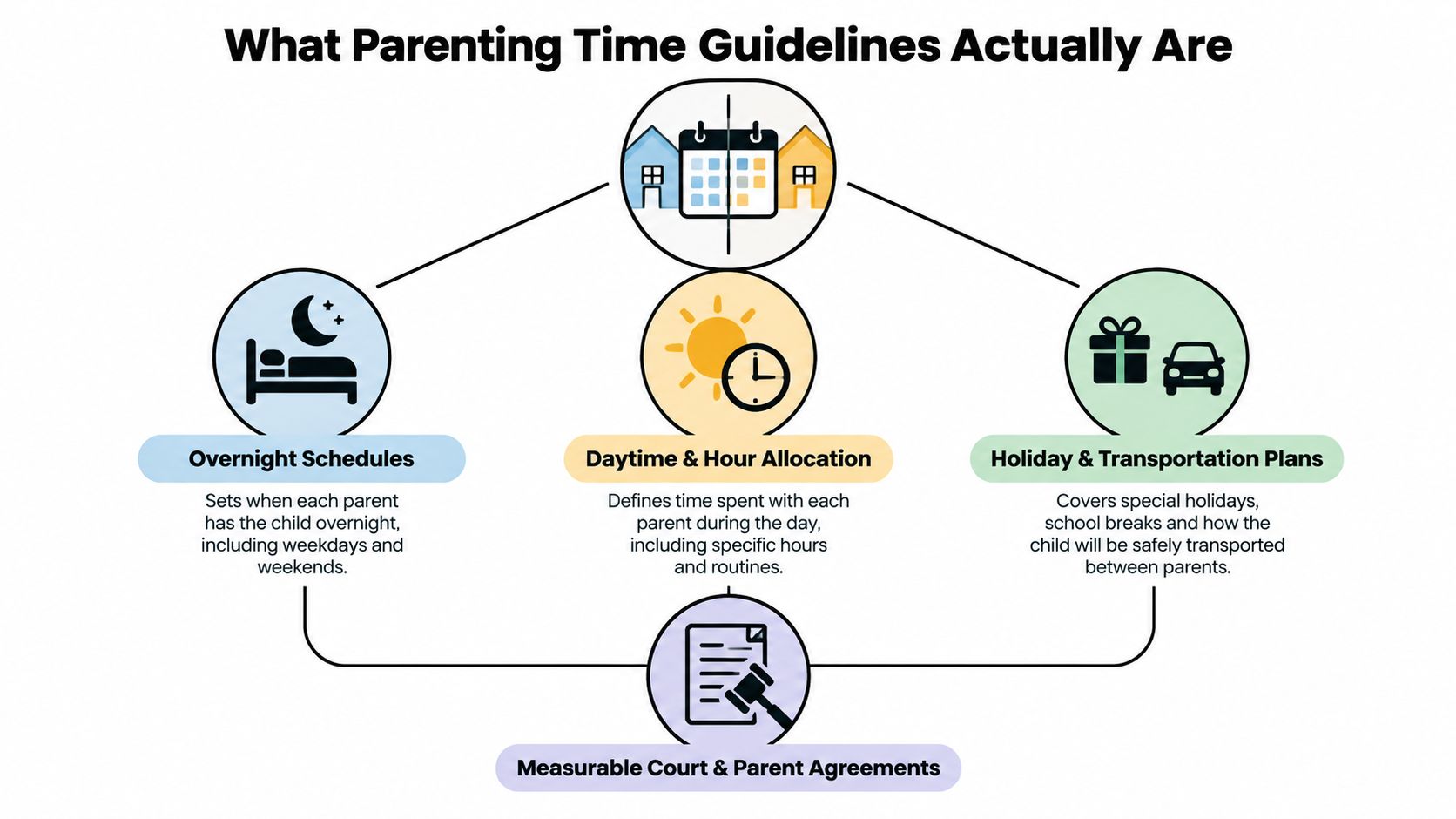
Parenting time guidelines are practical rules for allocating a child's time between households. They may describe regular weekends, weekday visits, overnights, holidays, school vacations, transportation, and procedures for missed time. Courts use them as starting points, while parents use them to turn a general custody order into instructions they can follow.
Indiana offers a useful example. Its Parenting Time Guidelines state that the usual goal is “frequent, meaningful and continuing contact” with each parent, and they provide concrete schedule blocks when parents can't reach their own agreement. The materials include alternating weekends from 6:00 p.m. Friday to 6:00 p.m. Sunday and a weekday evening from 6:00 p.m. to 8:30 p.m. Indiana Parenting Time Guidelines also address holidays, school breaks, and make-up parenting time.
Why courts measure time
Canada's Federal Child Support Guidelines show why percentages and overnights matter. Under section 9 of the Federal Child Support Guidelines, when each parent exercises not less than 40% of parenting time over a year, the support calculation must account for both table amounts, the increased costs of shared parenting time, and each parent's circumstances. Federal guidance also distinguishes shared parenting time, at least 40% with each parent, from majority parenting time, more than 60% with one parent.
That rule doesn't make a 40% schedule automatically appropriate. It does show why a court or support professional needs actual dates and times instead of a label such as “shared care.” A measurable schedule supports clearer calculations, more predictable enforcement, and a record that can be reviewed.
Guidelines aren't always binding in the same way as a final court order. Their legal effect depends on the jurisdiction, the type of proceeding, and the wording of the order. Treat them as a serious starting point, then verify the rules that apply in the court handling your case.
Common Schedule Templates From Infancy to Teens
A schedule should develop with the child. Indiana's guidelines use age-banded provisions rather than forcing one formula on every family. The current materials describe staged arrangements from birth through later childhood, with more frequent and longer periods as children mature. Examples of custody schedules can help parents compare patterns, but a published template still needs to be tested against sleep, school, work, distance, and transitions.
For infants, the Indiana framework identifies birth through 4 months as three non-consecutive 2-hour visits per week. From 5 through 9 months, it moves to three non-consecutive 3-hour visits, with limited overnights when a parent already handles regular care responsibilities. From 10 through 12 months, it provides three non-consecutive visits, including one 8-hour non-workday visit. These are guideline examples, not an automatic order for every infant.
Toddlers often move toward a midweek period and a rotating weekend, sometimes with one overnight if the child handles transitions well. The tradeoff is straightforward: more overnights can build continuity with both households, but poorly timed exchanges can disrupt sleep, daycare, and morning preparation.
| Age Band | Typical Pattern | Overnights per Parent | Key Tradeoffs |
|---|---|---|---|
| Infancy | Short, frequent visits that may progress to longer daytime blocks | Limited or staged | Frequent contact must be balanced against sleep, feeding, and travel |
| Toddler years | Midweek time with a rotating weekend and possible overnight | Increasing gradually | More continuity, but greater attention to bedtime and transitions |
| School age | Alternating weekends, weekday time, school breaks, and summer periods | Regular overnights | Supports routine while requiring careful school and transportation planning |
| Teen years | A flexible shared pattern, such as a 2-2-3 or 2-2-5-5 rotation | Regular, adaptable | Activities, homework, employment, and the teen's practical needs become central |
The points parents renegotiate
Parents commonly revisit bedtime returns, school-night transportation, summer blocks, extracurricular activities, and holiday conflicts. A schedule that worked before a child started school may become unworkable once attendance, homework, and activities control the week.
Don't describe a proposed plan as “equal” and stop there. Write the exact exchange times, identify school-night limits, and state how parents will handle activities that fall during the other parent's period. The court can evaluate a concrete schedule. It can't enforce an aspiration.
Legal Factors Courts Weigh and Why State Rules Differ
Courts generally decide parenting time under a best-interest-of-the-child standard. The wording varies, but judges usually examine how a proposed schedule affects stability, caregiving, education, health, safety, and the child's relationship with each parent.
The practical questions are more specific than “Who deserves custody?”
- Continuity: Which home, school, daycare, neighborhood, and community relationships will remain stable?
- Availability: Does each parent's work schedule allow the proposed periods without excessive third-party care?
- Distance: Can the child travel between homes without undermining school, sleep, or activities?
- Cooperation: Have the parents exchanged information, followed agreements, and supported the child's relationship with the other parent?
- Safety: Are there concerns involving domestic violence, substance use, untreated mental-health issues, neglect, or unsafe supervision?
- Care history: Who has handled ordinary routines such as meals, homework, medical appointments, and bedtime?
Why jurisdiction changes the answer
Parents often assume every state publishes a detailed default schedule. That isn't true. The Congressional Research Service has explained that only a handful of states have formal default parenting-time guidelines, while many jurisdictions rely on broad best-interest statutes and judicial discretion. Indiana, Arizona, and Washington are examples of states associated with more formal published guidance, but the details and legal force differ.
| State/Jurisdiction | Publishes Numerical Guidelines? | Primary Legal Standard |
|---|---|---|
| Indiana | Yes, formal parenting-time guidance exists | Child's best interests, with guideline schedules as a starting point |
| Arizona | Formal guidance is available | Child's best interests under applicable custody statutes |
| Washington | Formal parenting-plan standards are available | Child's best interests, safety, and residential-plan requirements |
| Other jurisdictions | Often no detailed default schedule | Broad statutory factors and judicial discretion |
Before relying on an online template, check the relevant state court website, family-court self-help center, and family-law section of the local bar association. A guide can inform your proposal, but it doesn't replace the statute, local rule, or order in your case. For orientation on court processes, parents can also review what family court is, then confirm the procedure locally.
A published guideline is a starting point, not permission to ignore the child's school, safety, or lived routine.
How to Draft a Parenting Time Plan That Survives Real Life
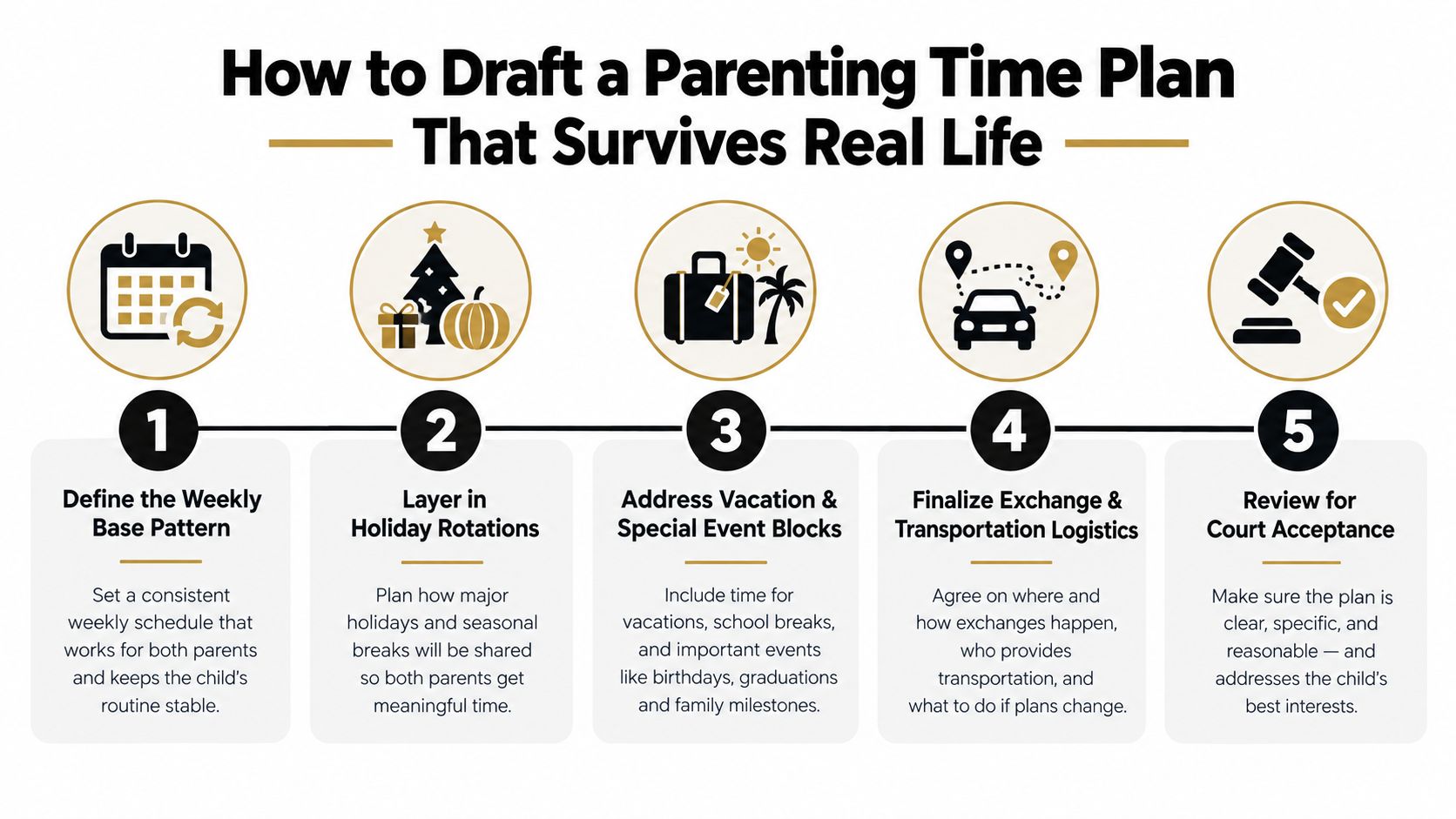
Start with the weekly base pattern. Don't begin with Christmas. First decide where the child will be on ordinary school days, weekends, and overnight periods. Mark the child's school hours, daycare, activities, each parent's work schedule, commute times, and regular childcare before selecting a rotation.
Then layer in exceptions. Holidays and school breaks should override the regular schedule where necessary, and the plan should state when the ordinary schedule resumes. Add summer periods, birthdays, cultural or religious observances, and important school events. If a holiday falls during a parent's regular weekend, the order should make clear which provision controls.
A practical drafting sequence
- Define the weekly pattern. State the day, start time, end time, overnight location, and return arrangement.
- Add holiday rotations. Identify each holiday, the start and end time, and the rotation or division method.
- Address vacations and special events. State notice requirements, travel information, destination details, and how conflicts are resolved.
- Finalize transportation. Name the exchange location, identify the responsible parent, and state how long-distance travel is handled.
- Review enforceability. Remove vague phrases, check for contradictory provisions, and attach the schedule as an exhibit.
Choose a template or build a custom plan
Use a published template when the parents live reasonably close, work predictable hours, the child has ordinary school needs, and exchanges are manageable. Build a custom schedule when the family involves long-distance travel, an infant, special medical or educational needs, rotating work shifts, frequent conflict, or safety restrictions.
The plan should answer operational questions. Who picks up from school? What happens if school closes? Where does a child exchange medication? How much notice is required for a requested swap? What happens if a parent is late? “Reasonable phone contact” sounds cooperative, but it leaves too much room for argument. Specify a practical window, method, and limit.
For drafting support, how to write a co-parenting agreement offers a useful planning reference. Keep the court order concise if possible, and attach a detailed schedule exhibit. That structure makes the operative terms easier to locate and easier to enforce.
Building Court-Ready Records With Structured Documentation
A court-ready record doesn't need emotional commentary or a daily essay. It needs a consistent account of what the order required, what happened, when it happened, and what proof supports the entry.
Use four documentation pillars.
Record the event as it occurs
A structured journal entry should identify the child, date, scheduled time, actual time, location, event type, and a short factual description. Write “exchange occurred at 6:12 p.m. at the school parking lot” instead of “the other parent was irresponsible again.” If a period was missed, record the stated reason and whether make-up time was requested or completed.
Exchange check-ins matter because memory becomes unreliable after repeated handoffs. Log pickup and drop-off at the time of the exchange, including cancellations, delays, early returns, and deviations from the written schedule.
Preserve the supporting material
Keep communication in its original platform where possible. Preserve messages, emails, and co-parenting-app threads through PDF exports rather than relying only on screenshots. A PDF export can retain surrounding conversation, dates, and platform context that a cropped image may omit.
Track child-related expenses separately. Record the item, date, amount, payer, receipt, reimbursement request, repayment, and remaining balance. Link the expense to the agreement or event that created the obligation.
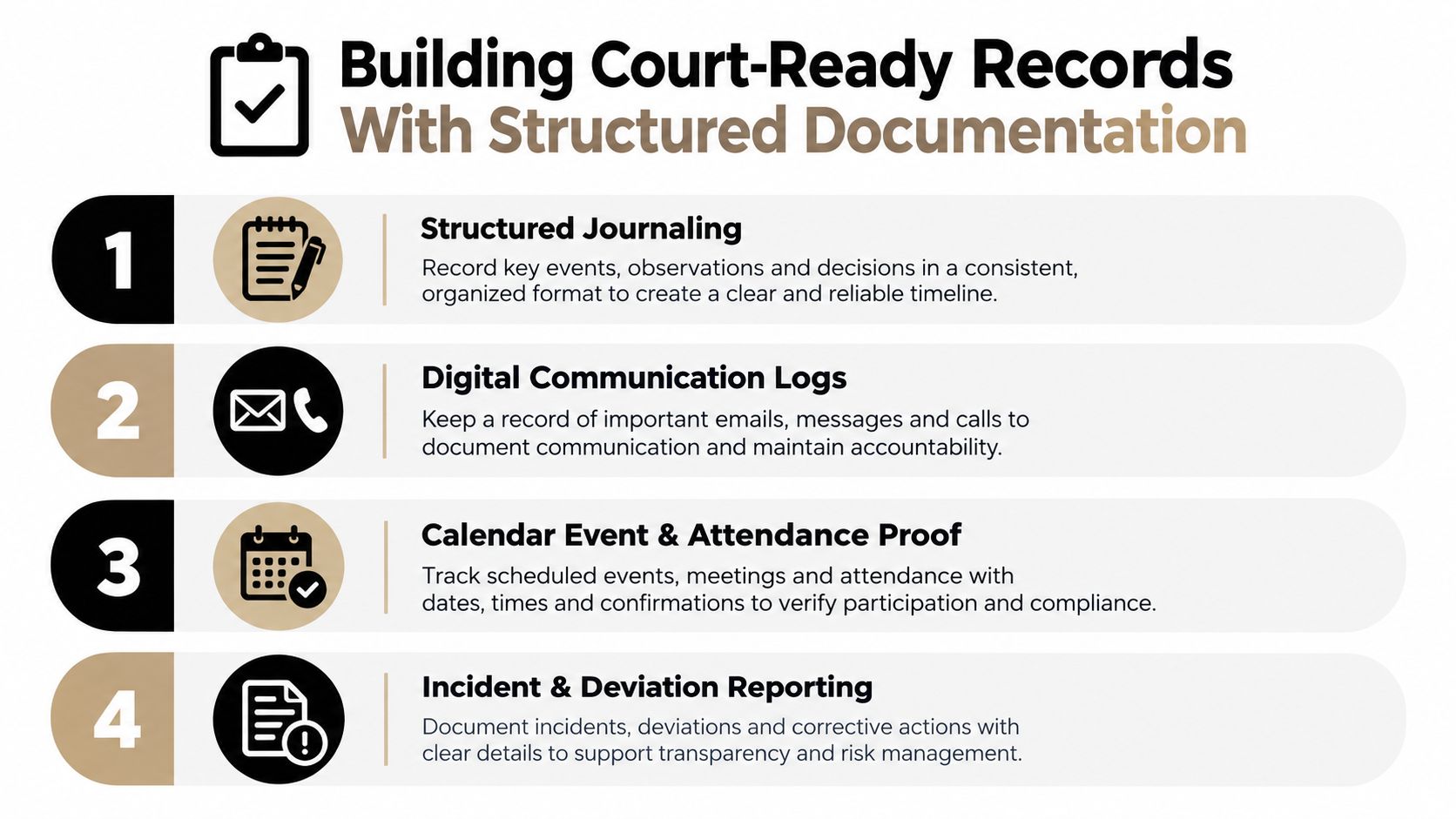
Decision-makers usually need patterns, not isolated grievances. Useful records may show repeated denied time, missed exchanges, failure to share medical information, or a consistent history of ordinary caregiving. The record should also include compliance and successful exchanges. A file containing only accusations can look selective.
This co-parenting journal guide explains how to organize dated entries and supporting material. One option parents may use for private record-keeping is Casewell, which organizes custody notes, exchange check-ins, agreements, expenses, attachments, and focused PDF reports. It's designed for a parent's documentation rather than shared messaging.
Documentation standard: Write every entry as if a neutral professional will read it without knowing either parent.
Avoid over-documenting minor frustrations in a way that looks retaliatory. Don't record every disagreement as an incident. Use a stable format, neutral wording, and relevant attachments. Your goal is a reliable chronology that helps a mediator or judge understand the child's routine and the actual operation of the order.
Sample Language, Checklist, and Frequently Asked Questions
The strongest parenting plans use language that identifies an action, a time, and a responsibility. The following clauses are starting language, not a substitute for jurisdiction-specific legal review.
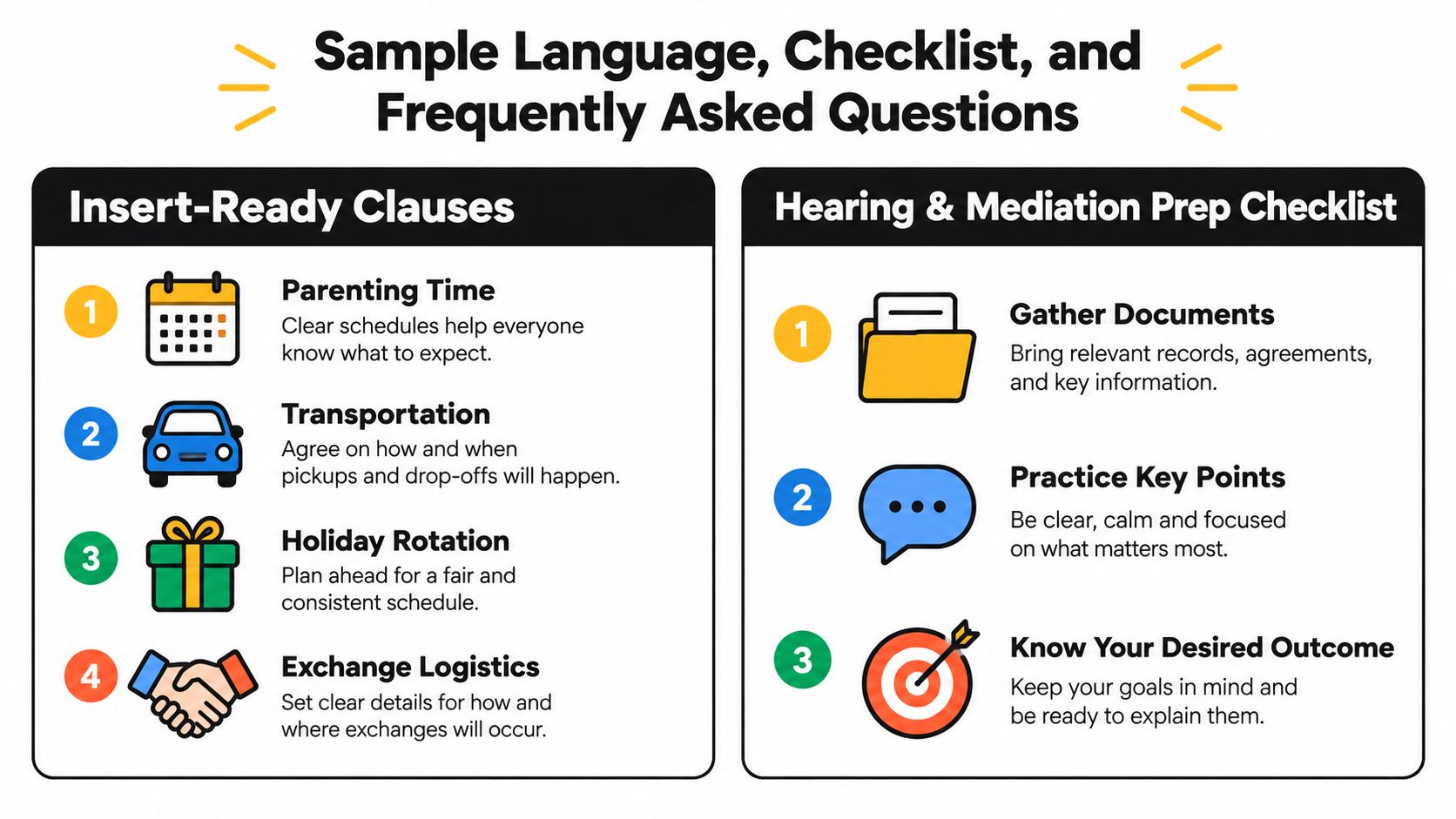
Insert-ready clauses
- Parenting time: “Parent A shall have parenting time from the end of school on Wednesday until school begins on Thursday, unless school is not in session. If school is not in session, the exchange shall occur at [time] at [location].”
- Transportation: “The parent beginning parenting time shall collect the child from [location]. The parent ending parenting time shall return the child to [location], unless both parents agree in writing to another arrangement.”
- Holiday rotation: “The holiday schedule takes priority over the regular weekly schedule. The holiday period begins at [time] on [date] and ends at [time] on [date]. The parents shall alternate the holiday by [year or agreed rotation].”
- Exchange logistics: “Each parent shall provide the child's required medication, school materials, clothing, and activity equipment at the exchange. A parent who cannot exercise scheduled time shall notify the other parent promptly and propose make-up time in writing.”
Hearing and mediation checklist
Bring the order, proposed schedule, school calendar, work schedules, travel information, and a concise parenting-time calendar. Pair each point with proof:
- Missed or denied time: Journal entries and exchange logs.
- Transportation dispute: Exchange records, route details, and written proposals.
- Child-related expenses: Receipts, reimbursement requests, and payment records.
- Medical or school information: Notices, appointment records, and communication exports.
- Requested schedule change: A side-by-side comparison of the current schedule and proposed schedule.
Frequently asked questions
Are parenting time guidelines binding? Their effect depends on the jurisdiction and the language of the order. A final court order is enforceable as written, while published guidelines may operate as presumptive or persuasive standards.
What if my proposed schedule differs from the guideline? Explain the child-specific reasons, show how the plan preserves meaningful contact, and provide exact times and transportation details. A reasoned custom plan is stronger than an unsupported demand for equal time.
When should parents depart from an age-based template? Consider a different structure when the child's sleep, health, developmental needs, school demands, distance, or safety circumstances make the template impractical. Document the reason and propose a review process.
How do courts treat relocation requests? Courts generally examine the effect on the child's stability, school, relationships, transportation, and contact with each parent. Bring a specific long-distance schedule, not just a proposed move.
What should I bring to first mediation? Bring the current order, a proposed calendar, school and work information, holiday priorities, transportation options, and a short factual record of recurring problems. Decide what outcome you need before the session begins.
Casewell helps parents organize dated parenting-time entries, exchange check-ins, agreements, expenses, attachments, and focused PDF reports for mediation or professional review. Visit Casewell to turn your schedule history into a clear, factual record before your next hearing or mediation.