 Casewell

If you fear your child is not safe during the other parent’s time, the most useful thing you can do is act in the right order. In an emergency, you call 911. For everything else, you go to the court with a clear, dated record of what happened. Judges act on patterns that are documented and factual, not on suspicion or anger. That is why a private custody journal such as Casewell, which logs exchanges, messages and expenses in one place and exports court-ready PDFs, is the practical foundation for any safety request.
This guide covers what courts treat as unsafe, what to do when danger is immediate, why refusing a court-ordered visit on your own is risky, how to build the record, and which options a judge can order. It is general information, not legal advice. For your own situation, talk to a family law attorney in your state.
TL;DR
- If a child is in immediate danger, call 911 first. Everything else comes after safety.
- Do not stop court-ordered visits on your own unless a true emergency exists. The legal route is asking the court to change the order.
- Courts look for patterns backed by dated, factual records, not isolated incidents or opinions.
- Judges can order supervised visits, neutral exchange locations, sobriety conditions or, in serious cases, no visitation.
- Log each exchange the same day, in plain facts, and keep originals so the record holds up.
Table of Contents
- What courts treat as unsafe visitation
- If your child is in immediate danger
- Can you refuse a visit you believe is unsafe?
- How to document unsafe visitation concerns
- Legal options a judge can order
- Recent changes in state law
- Putting your record to work
- Our perspective
- FAQ
- Sources
What courts treat as unsafe visitation
Every U.S. state and tribal court decides custody by the “best interest of the child” standard. The National Council of Juvenile and Family Court Judges (NCJFCJ), a professional body for judges, says a child’s physical, emotional and psychological safety are always in the child’s best interest. Its guide tells judges to award visitation to an abusive parent only when adequate safety provisions can be made for both the child and the at-risk parent.
In practice, “unsafe” usually means one of these:
- Physical, emotional or sexual abuse, or a pattern of coercive and controlling conduct.
- A history of family violence, including a child witnessing it. The NCJFCJ notes that children who witness domestic violence can suffer effects as severe as those from direct abuse.
- Regular, ongoing substance abuse. The California Courts self-help guide lists family violence and ongoing substance abuse among the factors judges weigh.
- Real risk of abduction, or repeated threats and stalking.
The bar is high. The American Bar Association explains that visitation is a right unless it would harm the child, and that a parent’s suspicion alone is probably not enough to get supervised visits. You have to show a real threat to the child’s physical or emotional safety. One late pickup with a reasonable explanation is a scheduling problem. Repeated missed exchanges combined with threatening messages, or a parent arriving intoxicated, begins to look like a safety pattern.
If your child is in immediate danger
When a child is in immediate danger and you cannot safely get them out of the situation, call 911 and/or Child Protective Services. Virginia Law Help notes that a 911 call will most likely trigger a CPS report, and that if CPS removes a child in an emergency, a first court hearing must follow within 72 hours in Virginia. Other states set their own timelines.
A few practical points for the moment itself:
- Keep a copy of the custody order on hand so officers can see what it says.
- Ask for an incident number or report number before the officers leave.
- Save any threatening messages exactly as received. Do not edit or delete anything.
- If you are in danger yourself, the National Domestic Violence Hotline is available at 800-799-SAFE (7233) or by texting START to 88788.
Police usually will not decide custody. Texas Law Help explains that if no crime is being committed and the child is not in immediate danger, law enforcement’s job is not to decide custody. For concerns that are serious but not immediate, the court is your route.
Can you refuse a visit you believe is unsafe?
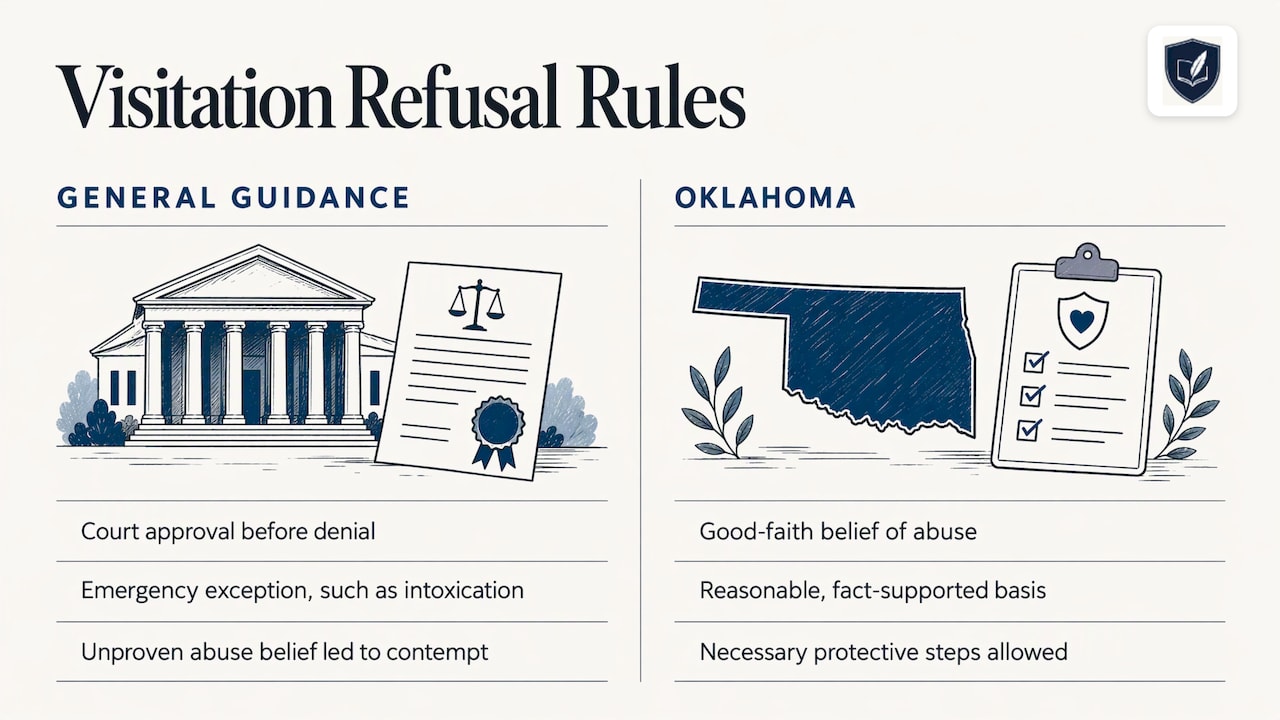
This is where well-meaning parents get hurt. The ABA says a parent should not deny visitation without advance court approval unless a true emergency exists, such as the other parent arriving to pick up the child while drunk.
Outside a genuine emergency, withholding a child can lead to make-up time orders, contempt findings with fines, fees or jail, and a change in custody. Texas Law Help describes the bind: a parent has a duty to follow the order and a duty to protect the child, and Texas treats interference with child custody as a state jail felony in some situations. In A.G. v. R.M.D., the Missouri Supreme Court held that a mother’s good-faith but unproven belief of abuse did not excuse her from contempt, and that the proper remedy was asking the court to modify the order.
Some states write a narrow protection into statute. Oklahoma, for example, allows a parent who acts in good faith on a reasonable, fact-supported belief that a child is being abused to take necessary protective steps, as summarized by an Oklahoma family law treatise. Rules differ widely by state, so confirm yours with a local attorney before relying on any such defense.
The safest pattern is the same everywhere: follow the order as written, document what happens, and go to court quickly for a change. Our guide on what counts as a custody agreement violation walks through where the line sits.
How to document unsafe visitation concerns
In a safety dispute, the judge cannot see what you saw. The record is the only way to show it. Legal practitioners describe the same goal: a clean, chronological, factual record. A Maryland attorney answer on Justia puts it this way: emergency relief rises or falls on credibility and documentation. Here is the routine, step by step, with where each step usually goes wrong.
1. Log every exchange the same day
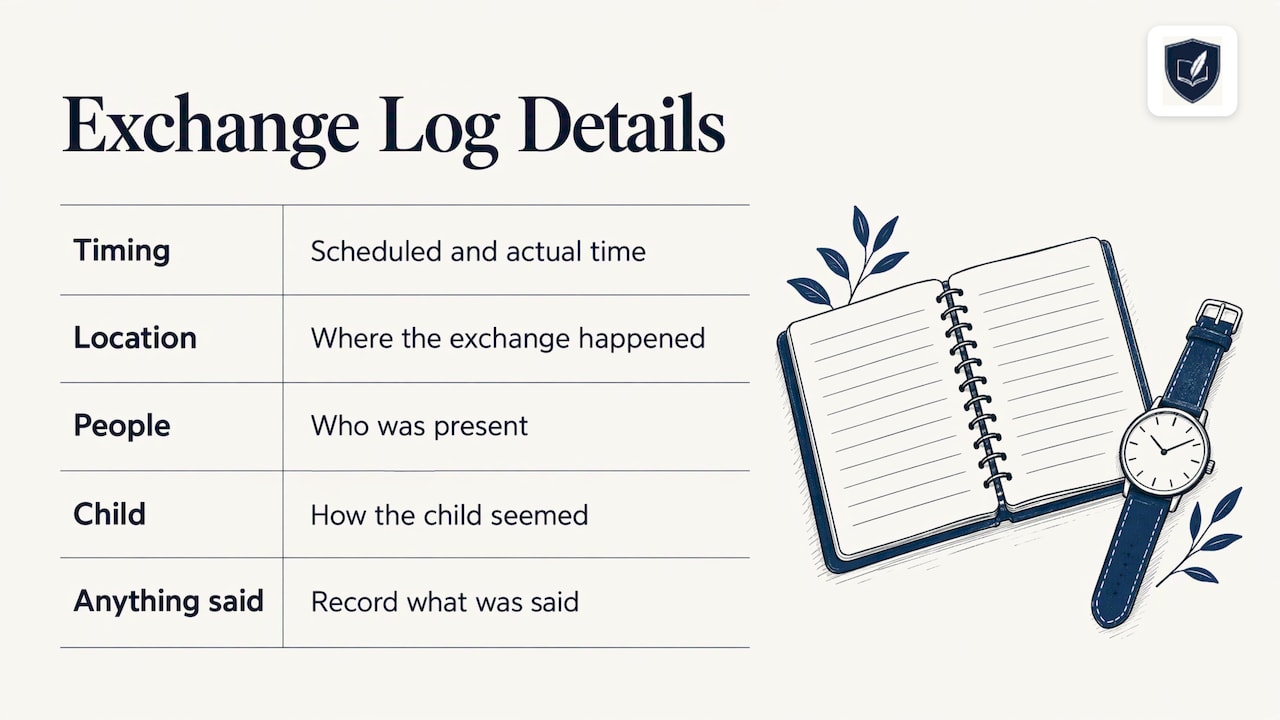
Record the scheduled time and the actual time, the location, who was present, how the child seemed, and anything said. Memory fades and entries written weeks later look reconstructed. This is where most parents fall behind, because after a tense handover the last thing you want to do is write.
Casewell prompts you after each exchange or handover, so the entry gets made while it is fresh. Entries are timestamped, and the timeline builds in real time as you add them.
2. Write facts, not conclusions
“He arrived 45 minutes late and smelled of alcohol” is evidence. “He is a terrible father” is an opinion. Parker Elder Law advises avoiding labels like “irresponsible” or “always late” and instead recording specifics such as three late exchanges over two weeks.
This is hard when you are frightened or angry, and your tone shows up on the page. Casewell offers optional AI-assisted rewriting that turns an entry into neutral language. You review and approve every change, so the final wording is yours.
3. Keep messages complete and unedited
Save whole conversations with dates and times visible. Do not crop, edit or delete unfavorable messages. Catalyst Legal’s guidance is to preserve originals and context and to check your state’s law before recording any calls. Casewell lets you keep messages alongside your exchange log so they sit in the same timeline.
4. Record the good with the bad
A record that only lists accusations reads as a campaign. The same Catalyst guidance says a balanced record showing on-time exchanges, reasonable cooperation and your own efforts to follow the order is more persuasive than accusations alone. Log the smooth handovers too. It makes the concerning ones stand out.
5. Track related expenses
If a safety issue created costs, such as a medical visit, counseling, or supervised exchange fees, log them with receipts. Casewell keeps expenses in the same place as exchanges and messages, so you do not rebuild the story from three apps and a shoebox.
6. Keep the record private and organized
A safety record can be sensitive, especially if the other parent is not cooperative. Casewell stores records encrypted on your device and does not keep copies on company servers. When the time comes, you can produce a filterable, indexed PDF focused on the dates and incidents that matter, instead of handing a judge hundreds of screenshots.
For more on what judges look for, see our guides on what counts as evidence in a custody case and how to prove parenting time.
Legal options a judge can order
When you ask the court to act, you are asking it to match the response to the risk. The NCJFCJ describes a two-step process: first identify the risks of visitation to both the child and the victim-parent, then address them in the order. That can mean unrestricted access, denied visitation, or specific safety terms.
Supervised visits and other safeguards
The California Courts self-help guide explains that supervised visitation is used when there are concerns about the child’s safety and well-being, with visits supervised by another adult or a professional agency. “No visitation” is reserved for cases where even supervised contact would be physically or emotionally harmful. Our overview of how supervised visitation works explains the day-to-day.
Massachusetts law gives a concrete list of conditions a court may attach when abuse is found. Under Chapter 208, Section 31A, these include:
- Exchanges in a protected setting or through a third party.
- Supervised visitation.
- Abstinence from alcohol or controlled substances during visits and for 24 hours before.
- A certified treatment program as a condition of visitation.
- No overnight visits.
- A bond to secure the child’s return and safety.
Your state’s menu will differ, but the idea is the same: the least restrictive step that keeps the child safe.
Emergency and temporary orders
When harm is imminent, courts can act quickly, often without the other parent present at first. Texas Law Help notes that a temporary restraining order in a custody emergency lasts only 14 days and requires showing immediate and irreparable harm. California’s Rule 5.151 uses emergency orders to prevent immediate danger, and the supporting declaration must state facts within personal knowledge, with dates, rather than opinions.
That is exactly what a dated log supports. If you want a primer on how these requests work in one state, this explanation of ex parte orders in New Hampshire covers the facts and documentation courts may require. Our own guide to a temporary custody order covers the general picture.
Changing the order over time
If the concern is serious but not an emergency, you file to modify the existing order. This is the path courts expect. An attorney in your state can tell you which form, which county court and what standard of proof applies. Some states require a finding that a child is seriously endangered before restricting parenting time, and the restriction must be narrowly tailored.
Recent changes in state law
Several states have strengthened how courts weigh child safety. Two examples:
- Pennsylvania: Kayden’s Law took effect in August 2024. It requires courts to give substantial weight to child-safety factors, and a finding of ongoing risk of abuse creates a presumption that only supervised physical custody is allowed. A 2026 law firm update also describes a 2025 rule requiring courts in custody cases to check each participant’s child-abuse or protective-services history.
- Maryland: Senate Bill 548, effective October 1, 2025, says that where the court has reasonable grounds to believe a party abused or neglected a child, it shall deny custody or visitation unless it finds no likelihood of further abuse, though it may approve supervised visitation that assures the child’s safety.
If you live elsewhere, ask a local attorney or your county’s family court self-help center what your state currently requires. Laws and court rules change, and the current text is what controls.
Putting your record to work
When you are ready to talk to an attorney or file, the question is whether you can show the facts quickly. A good record answers it: dates, times, locations, quotes, and the supporting messages and receipts, all in order.
Casewell Premium costs $2.99 per week or $49.99 per year, after a free trial. You log exchanges, messages, expenses and parenting time in one place, with prompts after each handover, optional neutral rewriting that you approve, and encrypted storage on your device. When you need it, you generate a court-ready PDF report that is filterable and indexed, so an attorney or judge can go straight to the incidents that matter. You can see everything it includes on the U.S. features page, or start a record with Casewell Premium.

If you already have a pile of records and need them turned into a clear sequence for a hearing, our Court timeline service is available from £29 as a one-off.
Our perspective
Most parents who come to us are not trying to win a war. They are frightened, tired, and trying to protect a child while still following an order they did not write.
What we believe is simple: the parent with the clearest record has the most options. A judge cannot act on a feeling, and an attorney cannot build a motion from memory. A dated, calm, factual entry written the same day does more than any argument made months later.
That is why Casewell is built the way it is. Your records stay encrypted on your device and we do not keep copies on our servers, because a safety record is among the most sensitive things a parent holds. Our optional AI rewriting helps you say what happened without the heat, and you approve every word. Our PDF reports are built to be filtered and indexed, so the incidents that matter are easy to find.
Start the log before you think you need it. If a concern turns out to be nothing, you have a tidy record of ordinary parenting. If it turns out to be something, you are ready.
Mielad
FAQ
Can I stop visits if I think my child is unsafe?
Only in a true emergency, such as the other parent arriving intoxicated, and even then you should contact law enforcement and promptly ask the court for relief. For non-emergency concerns, keep following the order and file to modify it. Withholding visits on your own can lead to contempt and custody consequences, so speak with a family law attorney in your state first.
What evidence helps most in an unsafe visitation case?
Judges respond to firsthand, dated records: exchange logs, complete message threads, police reports, medical or school records you are entitled to, and receipts. Facts and patterns carry more weight than opinions. A same-day log in plain language is the backbone of that evidence.
Can a court order supervised visitation?
Yes. When a judge finds a safety concern, supervised visitation is a common middle step between unrestricted time and no visitation. A judge may also order neutral exchange locations, sobriety conditions or treatment programs, depending on state law and the facts.
Who do I call if I suspect child abuse?
If a child is in immediate danger, call 911. To report suspected abuse that is not an emergency, contact your state’s child abuse hotline or Child Protective Services. For domestic violence support, the National Domestic Violence Hotline is 800-799-SAFE (7233).
Sources
- A Judicial Guide to Child Safety in Custody Cases, NCJFCJ
- Custody and Visitation in Civil Protection Orders, NCJFCJ Guiding Principles
- Child custody and parenting time, California Courts Self-Help
- Visitation, American Bar Association
- Getting Emergency Custody in Virginia, Virginia Law Help
- How to Navigate a Custody Battle With a High-Conflict Co-Parent, Catalyst Legal
- Court-Ordered Visitation and Child Safety, Texas Law Help
- A.G. v. R.M.D., 730 S.W.2d 543 (Mo. 1987)
- Enforcing visitation and interference with custody, OK Family Law Compass
- How to Document Parenting Communication Clearly, Parker Elder Law
- Can I seek emergency custody due to safety concerns, Justia
- Massachusetts General Laws, Chapter 208, Section 31A
- Temporary restraining orders and temporary orders in child custody, Texas Law Help
- Emergency custody and visitation requests, Kern County Superior Court
- Pennsylvania Family Law Update on Child Custody, Leech Tishman
- Maryland Senate Bill 548, Chapter 484 (2025)
- Ex Parte Order NH: A Guide for New Hampshire Parents