 Casewell

A Congressional Research Service report on international parental child abduction reports that approximately 80% of abducting parents were primary or joint-primary carers. That finding reframes a common assumption. A custody agreement violation is often committed by the parent who has the child most of the time, and a tense exchange alone does not prove one.
Most disputes are classification problems first. You will make better decisions if you separate a change both parents accepted, quantified lost parenting time, a money dispute, and a safety risk before you call any of them contempt. Start with today's event, find the exact clause, and record what happened in dates and durations.
What Counts as a Custody Agreement Violation
A custody agreement violation is noncompliance with a specific court order or approved parenting plan. It isn't dislike, rude texts, poor co-parenting, or a schedule that merely feels unfair. If you can't point to an enforceable term, you don't yet have a clear violation to sort.
Use the table on the same day the event happens. It gives each incident a plain first label, not a final legal conclusion.
| Event | Usual character | Record to keep |
|---|---|---|
| Missed or refused exchange | Possible denial of parenting time | Clause, date, place, scheduled window, what occurred, reason given |
| Late return or shortened visit | Quantified loss of time, not always contempt | Scheduled duration, actual duration, notice timing |
| Change both parents accepted | Often a modification, not a violation | Who agreed, channel, new plan, whether makeup time happened |
| Verbal side deal later denied | Depends on the written order | Exact words, date, witnesses, later performance |
| Holiday or vacation blocked | Possible material denial | Order language, travel notice, denial message |
| Unpaid shared child expense | Often separate from a parenting-time violation | Amount, receipt, request, repayment |
| Cross-border removal or retention | Serious interference; return process may differ from contempt | Consent, travel dates, habitual residence, retention date |
| Unsafe handover or threats | Safety issue before ordinary enforcement | Observable acts, witnesses, any protection order |
Four Tests for Every Row
Apply the same four tests before you react.
- Exact clause: Which sentence in the order or approved plan covers this exchange, holiday, decision, or expense? Copy it word for word.
- Notice: Did the other parent have the order or the agreed change in a form you can show? Note when and how it was shared.
- Willfulness: Does the conduct look like a deliberate refusal, or could it be inability? Save the reason given, not your guess about motive.
- Recognized reason: Did an emergency, illness, travel failure, or safety order affect the event? Record the fact and any supporting message.
A missed exchange may satisfy the clause and notice tests but fail the willfulness test if a parent was in an emergency room and texted proof. A late return is easier to assess when you write scheduled duration beside actual duration. An unpaid shared expense often belongs on a money track even when it happened during the same argument as a missed visit.
Verbal side deals create the most confusion. If a parent later denies the deal, the written order usually remains the starting point, so record the exact words, the channel, and whether either parent acted on the deal. A worked example of custody agreement language can help you see how specific clauses differ from general expectations about cooperation.
Why Willfulness Matters
Maryland offers one clear illustration, not a universal rule. Under the Maryland appellate decision on civil contempt for a custody order, the court must determine by a preponderance of the evidence that the violation was willful.
That standard explains why a note saying the other parent interfered isn't enough. It doesn't identify the term, show notice, or separate intentional refusal from inability. A stronger note names the clause, the date, time, and location, the conduct, and the explanation offered.
Practical rule: If your note could describe almost any bad week, it's too vague to classify. Add the clause, the clock times, and the reason given.
Labels, burdens, and filing names change by jurisdiction. Your task today is narrower. Copy the clause that matches the event, run the four tests, and keep the first label provisional until a local professional reviews the record.
Why Schedule Changes Are Not Automatically Contempt
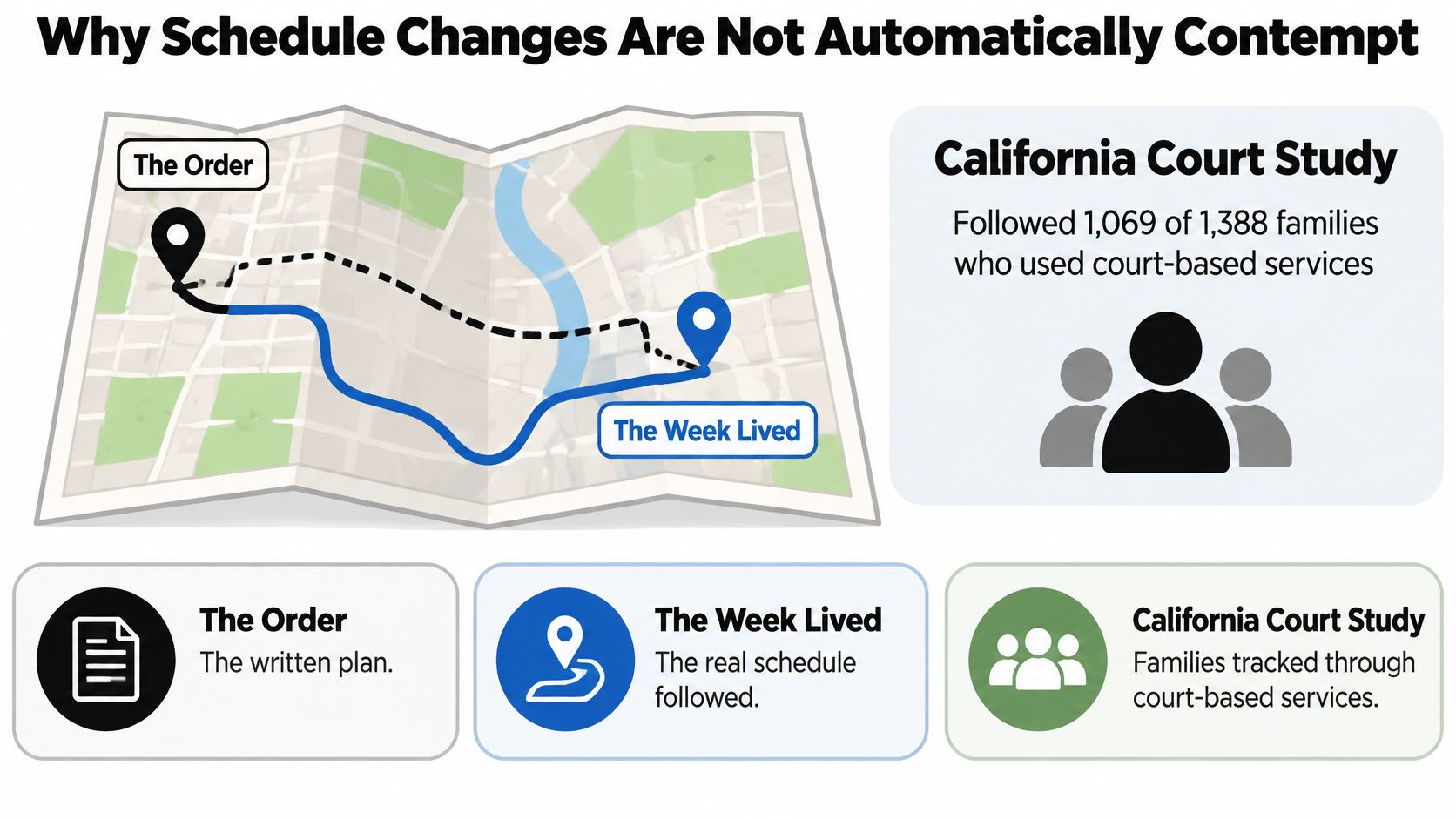
Think of the order as a road map and the week you lived as the route driven. Families often leave the mapped route without either parent treating the change as defiance. Work shifts, school events, illness, and a child's changing needs can all move an exchange.
The California court study of families who used court-based mediation followed 1,069 of 1,388 families, 77%, through 1993. It found that 57% of families made informal modifications to their legal parenting plan within the first year. By the two-year point, that share had increased to 64%.
Those figures don't prove deliberate violations. Some families accepted the changes, some made practical adjustments, and some responded to evolving child needs. The study is older and California-specific, so treat it as a benchmark for schedule drift rather than a national rate for your family.
The visual below separates the written plan from the schedule a family follows.
Four Markers That Sort Consent From Conflict
A dated record should answer four questions for each deviation.
- Who proposed the change? Name the parent and the date.
- Was agreement clear? Record whether it was by text, email, app, or conversation, and preserve the wording.
- What reason was given? Write the stated reason without adding a motive.
- Did makeup time occur? Add the replacement date and duration, or state that none was offered.
Say the order sets a Friday exchange at 6 p.m., but both parents repeatedly move it to Saturday morning because of a sports schedule. If the messages show agreement and the child still gets the same overnights, that pattern looks like an informal modification. If one parent announces the move, ignores objections, and keeps the lost night, the same clock change looks contested.
Three Edge Cases That Cause Trouble
A standing informal pattern becomes risky when one parent later denies it. Your messages, calendar entries, and history of performance become the only way to show what both parents treated as normal.
A one-time accommodation can also harden into an expectation. Write whether a swap was for one date only, especially if you agreed because of a funeral, shift change, or school trip.
Sometimes the written plan no longer fits school or work hours. That mismatch may support a request to modify the plan, but it doesn't automatically rewrite the order. Keep recording the gap between the map and the route. Disputes usually turn on timing, frequency, and the nature of deviations, not one dramatic scene, which is why a chronology matters more than a single summary written months later.
How to Build a Factual Record
Many parents organize this material without a lawyer doing it for them. A 2025 legal-access chapter on family justice cites research finding that 72% of cases across eleven U.S. jurisdictions involved at least one self-represented litigant, and describes estimates of 80 to 90% in family cases.
A usable record has to help a lawyer, mediator, or court self-help office review facts quickly without overstating them. Start by sorting each event before naming a remedy: consensual schedule drift, quantified lost parenting time, an expense dispute, or a safety concern that leaves the documentation track altogether. The category decides which details matter and which local process fits.
The routine below turns scattered screenshots and memories into a dated sequence.
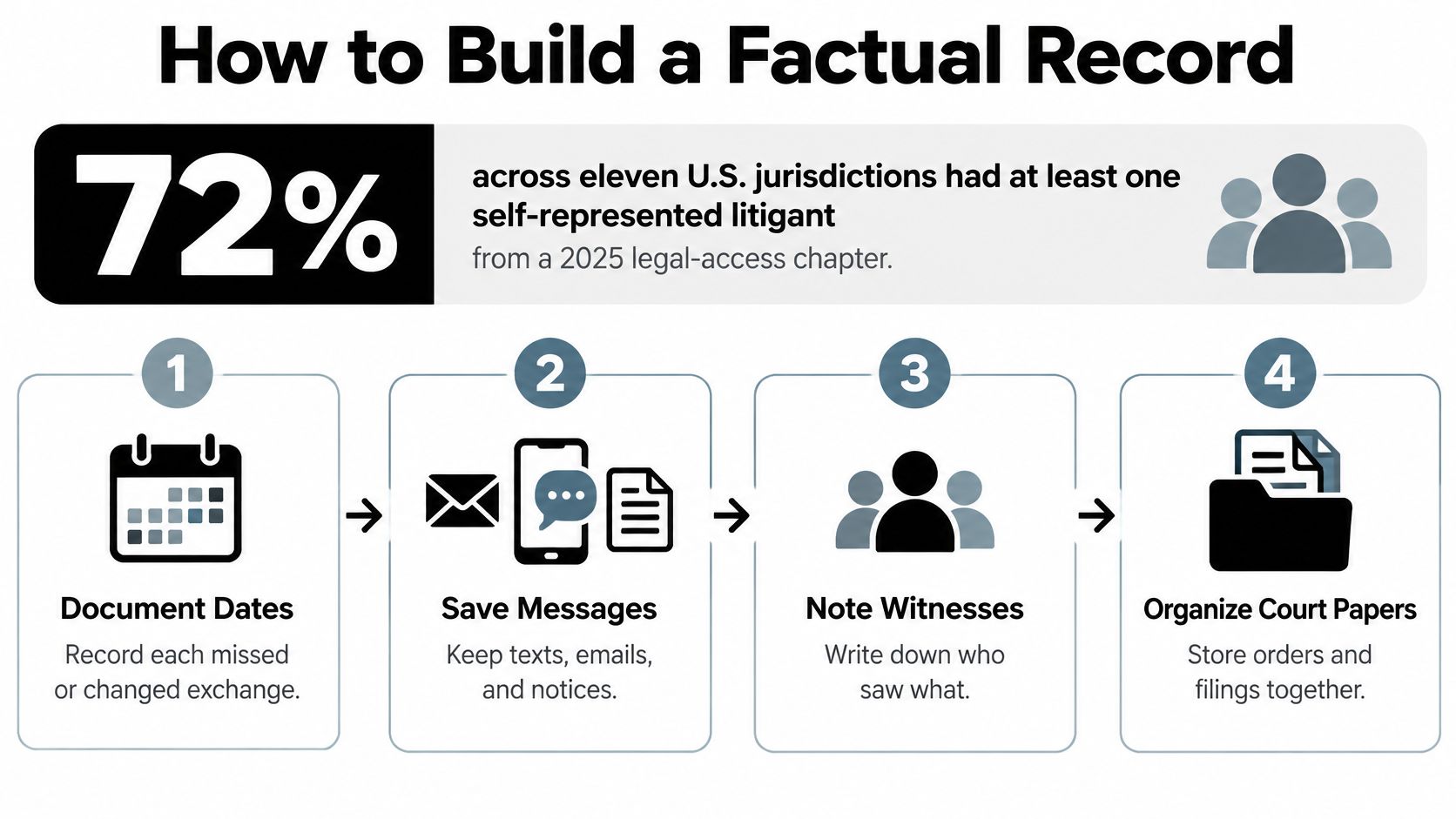
An Eight Step Routine
- Identify the operative order. Use the latest approved plan, including modifications. Copy the exact clause beside the entry so a reviewer doesn't have to hunt for it.
- Classify the event before drafting. Label it as an agreed change, lost parenting time, a money issue, or a safety concern. A clear label keeps schedule drift from being treated like defiance before the facts support that.
- Build a dated chronology. For each event, record the child, place, scheduled start and end, and actual start and end. Chronology shows sequence, which a pile of screenshots can't do alone.
- Preserve originals. Keep full messages, screenshots, and metadata where available. Don't retype only the angry lines, because missing context can change the meaning.
- Separate observation from conclusion. Write what you saw or heard first. Labels such as alienating or unstable are conclusions, so keep them out of the factual line.
- Quantify lost time and makeup efforts. Use minutes, hours, or overnights for the loss, then add the date you asked for makeup time, the replacement you proposed, and the reply.
- Keep expenses on a separate track. Store the amount, receipt, who paid, repayment requested, and amount repaid apart from parenting-time entries. Mixing tracks makes both disputes harder to review.
- Ask which local process applies. A lawyer, mediator, or court self-help office can tell you which motion, notice, or modification process fits your jurisdiction. A log can't choose that procedure for you.
A guide to factual incident reports can help you keep each entry in the same structure. Consistency matters because a reviewer can compare April with August without decoding a new format each time.
Write the entry you'd be comfortable having read aloud slowly, with the other parent's lawyer asking only, "How do you know that?"
If a court order or parenting plan requires a specific communication platform, keep using it. Casewell is built to sit alongside that platform as a private documentation layer, and the record belongs to the user without needing the other parent to install, approve, or join.
A neutral, organized record can make professional review easier. It doesn't prove contempt, decide admissibility, or replace local procedure. Its value is narrower and still important: it lets another person test notice, occurrence, causation, and intent without relying on your memory months later.
When Safety Comes Before More Evidence
The image below belongs with a point many enforcement guides miss. Not every missed exchange is a safety-neutral paperwork problem.
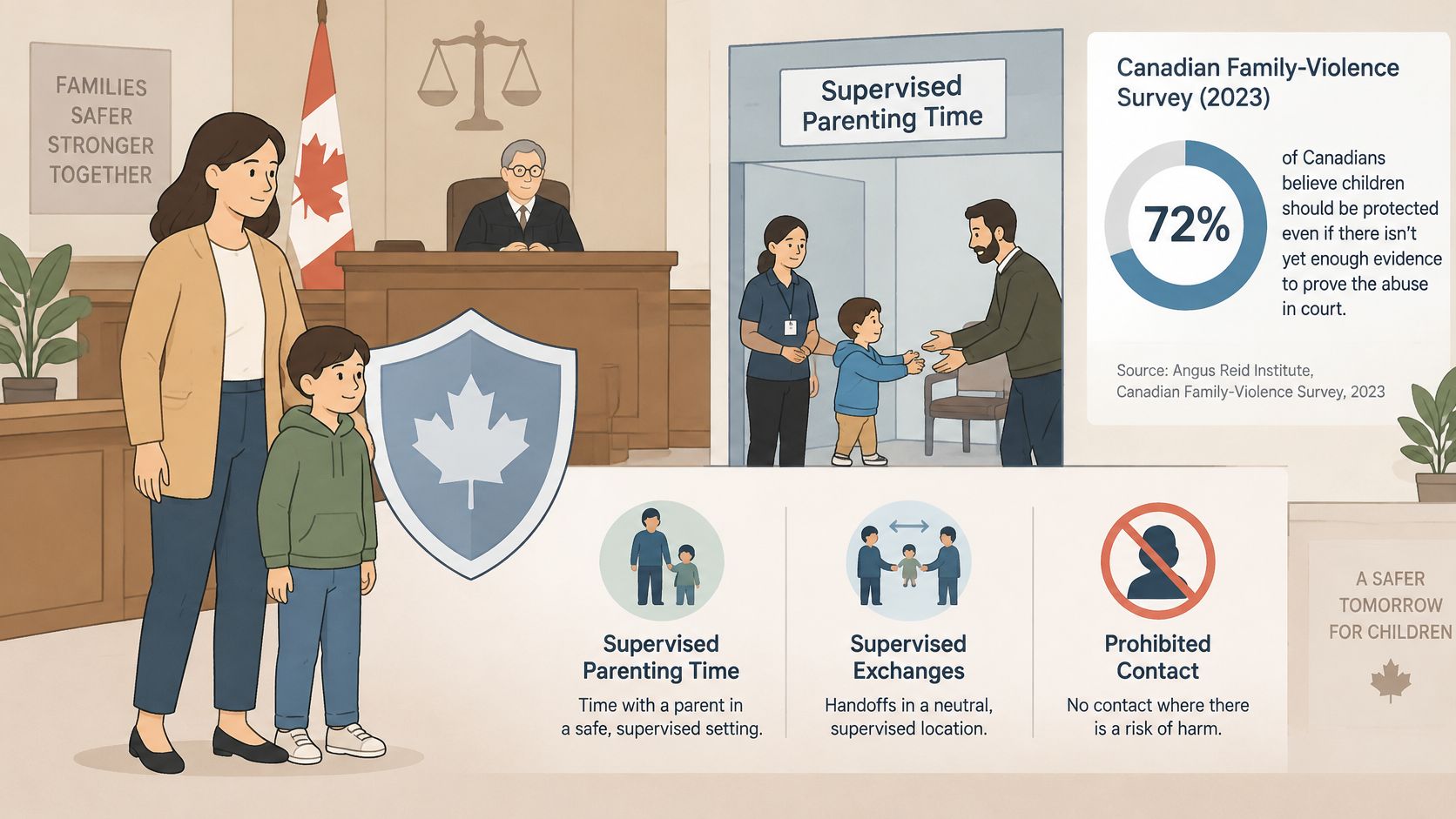
A 2025 Canadian survey on family-violence cases found that supervised parenting time or exchanges were among the three most frequent court-ordered remedies at 72%. In that survey, prohibiting contact was selected by 69% of legal advisers, while only 10% selected denying parenting time to the abusive parent as a frequent remedy.
That contrast matters for classification. A routine late pickup isn't the same pattern as intimidation, stalking, threats, an unsafe handover, or using the child to carry messages between adults. If you file all of them under noncompliance, you may choose direct contact or mediation when a safer exchange arrangement should come first.
The Order of Steps
- Check immediate danger first. Ask whether anyone could be harmed at the next exchange or contact attempt.
- Contact local help before documenting. If there's immediate danger, contact local emergency services or a domestic-violence service. Don't delay that call to finish a private log.
- Record observable facts once you're safe. Note what was seen or heard, who else was present, the child's immediate condition, any protection-order language, and the exact custody clause.
Ordinary direct contact or mediation can increase risk where coercive control is present. A parent who monitors messages, follows the other parent after exchanges, or pressures the child to report on the other home may use ordinary negotiation as another point of control. In that setting, supervised contact, a neutral exchange place, staggered arrival times, or protective-order terms may protect the child better than collecting one more exhibit.
The video below offers additional context on safer, supervised arrangements.
Our guidance for high-conflict co-parenting situations can help you think through communication boundaries, but it can't assess danger in your home. Only local emergency, legal, or domestic-violence support can do that with your specific facts.
Use a clear escalation threshold. When a pattern involves fear, threats, stalking, unsafe handovers, or the child carrying adult messages, move from documentation to professional support before the next exchange. More evidence isn't always the first priority.
Illustrative Patterns From Missed Time to Retention
Hypothetical examples help because the same label can hide different patterns. Each case below is illustrative, not a real family's record. Compare the excuse, the notice, and the scale before you name a remedy.
Hypothetical Case One Repeated Short Delays
Say a parent returns a child 45 minutes late on eight weekends, gives no notice, and refuses makeup time. Each entry is small. Together, the entries show repeated lost time and no correction.
Contrast that pattern with one snowstorm delay. The parent texts before the exchange, shares a road closure, arrives 45 minutes late once, and offers the time back the next evening. The clock difference is identical, but notice, reason, and repair point in opposite directions.
For both versions, keep the scheduled return, actual return, message time, reason given, and whether makeup time happened. Those facts let a reviewer distinguish a pattern from an excuse without relying on adjectives.
Hypothetical Case Two A Holiday Week Withheld
Say the order gives one parent a named holiday week. The other parent keeps the child and sends a message saying you'll swap later, but proposes no date and provides no makeup week.
That vague promise isn't a written modification. Record the order language, the travel or holiday notice you sent, the exact denial message, the first and last dates of the lost week, and every later attempt to set a replacement. The gap between later and an actual date is the central fact.
Don't blend in unrelated complaints about gifts, travel costs, or tone. They may matter elsewhere, but they dilute the clearest question. A full week was scheduled, it didn't occur, and no substitute date was fixed.
Hypothetical Case Three Retention Abroad
Say a parent who already provides most daily care travels abroad with the child for an agreed holiday, then keeps the child past the agreed return date. Daily caregiving doesn't answer the consent question. The relevant facts are the consent given, the travel dates, the scheduled contact or return, the child's habitual residence, and the date retention began.
The 1980 Hague Convention provides a civil process for seeking return to the country of habitual residence. It doesn't decide the underlying custody merits in the destination country, and it isn't a criminal sanction against the parent who retained the child.
That process has limits. Consent, habitual residence, and possible return exceptions can be disputed, and the Convention process may not apply if the destination country isn't a signatory. Precise travel and retention dates therefore matter from the first missed return, even while you seek urgent local legal advice.
Remedies Courts May Consider
Remedies usually aim to restore parenting time first and discourage repeat violations afterward, subject to the child's best interests. The remedy also tends to follow the category you sorted the event into earlier. A consensual swap needs no remedy at all. Quantified lost time points to compensatory time. Money disputes point to fees and fines. Safety risks call for urgent protective orders, not a makeup schedule.
The table uses three jurisdictions as examples. It isn't a menu you can order from, and another state or country may use different names and thresholds.
| Place | Time remedy | Other listed tools | Noted threshold |
|---|---|---|---|
| Oregon | Compensatory parenting time | More specific terms, conditions, monetary penalties, counseling or parent education, attorney fees, possible custody-change hearing | Child's best interests; sanctions vary |
| New Hampshire | Compensatory time at a convenient time | Counseling, a fine payable to the affected parent, compliance bond, relationship-rebuilding counseling costs | Substantial and material denial without good cause |
| Florida | Additional time-sharing to cover calculated denial | Contempt or other remedies | Court calculates improperly denied time-sharing |
| Other jurisdictions | Often restore time before penalties | Local equivalents only | Best interests and local procedure control |
The Oregon courts parenting plan enforcement page lists compensatory parenting time, more specific schedule terms, additional conditions, monetary penalties, counseling or parent-education orders, attorney fees, and potentially a custody-change hearing. Other states follow a similar shape. Some allow a monetary fine when parenting time is substantially and materially denied without good cause. Florida courts award additional time-sharing to compensate for a calculated improper denial, with contempt or other remedies available alongside it.
Why Quantified Time Controls the Remedy Discussion
A court can't restore time it can't calculate. For each missed or shortened period, preserve the scheduled duration, actual duration, reason given, notice timing, and makeup time requested. That arithmetic connects the documented loss to a proportionate request.
One missed evening is a single dated entry. A pattern is eight dated entries with start and end times, which give a reviewer something to calculate. A paragraph saying time is always stolen gives them a conclusion to test instead.
Money needs the same discipline, but on its own track. Counseling costs, attorney fees, or fines shouldn't be mixed into a parenting-time total without receipts and dates. If legal costs become part of your record, a separate resource on documenting legal expenses for tax season can help you keep those papers distinct from exchange evidence.
Our overview of parenting time orders explains how order language frames the time a court may later try to restore. Whether a record is used is up to the court. Casewell cannot determine whether a record is admissible, prove a disputed claim, or replace legal advice.
Confirm the Order and Choose a Safe Next Step
Leave with three actions, not a stack of labels.
- Read the file-stamped order or latest approved plan. Mark the clause, dates, and exchange location that apply to this event. Don't rely on an older draft or a memory of what a mediator suggested.
- Keep following the order during the dispute unless safety requires a change. Don't withhold the child because the other parent was late. Self-help retaliation creates a second deviation and weakens your record.
- Send one short, neutral written message if it's safe and useful. Name the clause, date, missed time, and a specific proposed makeup date. Leave accusations and motive claims out.
Then ask a lawyer, mediator, or court self-help office in the jurisdiction that issued the order which motion or modification process applies. Processes differ across borders, and even reconciliation steps differ, as shown by this overview of Dubai reconciliation explained by Goodhand. If there's immediate danger, local emergency or domestic-violence help comes before any message or filing.
For ongoing notes, our parenting time log records scheduled care, changes, overnights, and the time that took place. Casewell is made for separated parents in Germany. It does not provide legal advice, cannot guarantee that a professional will accept its entries, and cannot decide whether an item is admissible or prove a disputed claim.
Aim to finish today with one clause identified, one chronology started, and local advice requested before you file anything.
If you're sorting missed exchanges from accepted changes, Casewell gives you a private, dated place to record scheduled care, actual time, agreements, and supporting files by child. Start with today's clause and one factual entry, then export only the relevant records when you're ready for a lawyer, mediator, or other professional to review them.