

A temporary custody order is a time-limited, enforceable court order that governs custody and access until a final ruling is reached. It gives parents and children a legal structure to follow while the court continues deciding the larger custody case.
You may have expected a short hearing followed by a quick return to normal life. Instead, you're looking at a document that says where your child will sleep, when each parent can visit, and who can make important decisions, yet calls the arrangement “temporary.” The other parent may interpret one sentence differently from you, while school pickups, holidays, phone calls, and exchanges continue in real time.
That uncertainty creates practical problems. A parent may believe a temporary order lasts only briefly, then discover that the same arrangement remains in place through multiple hearings. Another parent may assume visitation is clearly scheduled, only to find that the order grants access without saying which days, where exchanges occur, or how holidays work.
The safest approach is to treat the order as both legally binding and operationally incomplete until you understand every term. Read the words closely, identify what the order doesn't address, follow the written requirements, and keep neutral records of what happens afterward.
Introduction - The Reality of Court Orders
A parent named Elena leaves a custody hearing carrying several pages of legal language. She understands that the court has allowed the child to stay primarily with her for now. She also understands that the other parent has parenting time. What she doesn't understand is whether “reasonable parenting time” means alternate weekends, a few hours after school, or an arrangement they are expected to negotiate themselves.
The other parent has a different concern. The order mentions weekend visits but says nothing about the exchange location. Neither parent knows whether school holidays follow the regular schedule. Both are worried that making the wrong assumption could trigger another conflict or make them appear uncooperative before the judge.

The word temporary often gives parents the wrong expectation. It sounds like a measure designed to last for a short interval, but the order may remain the working arrangement while the case moves through hearings, evidence, negotiations, and delays. During that period, children still need predictable routines, and parents still need to make decisions about school, health care, transport, clothing, and expenses.
Practical rule: Treat a temporary order as the current rulebook, not as an informal suggestion.
This guide focuses on the gap between the label and the lived experience. You'll learn what the order does, what courts commonly require before issuing one, how to prepare factual documentation, and why a partial schedule can create as much difficulty as no schedule at all. Local procedures differ, so a family-law lawyer or qualified court service should review the order when the wording is unclear.
What Is a Temporary Custody Order
A temporary custody order is an enforceable court directive that sets out custody and access arrangements while a family-law case is still unresolved. Canadian family-violence guidance describes interim custody as the regime that applies until the matter is finally resolved, and comparable U.S. court guidance describes temporary orders as remaining effective until the main case finishes or a final order is entered. The Justice Canada guidance on interim custody orders supports this general legal description.
The order can address different parts of a child's life, depending on local law and the wording used by the court:
- Where the child lives: The order may identify a primary residence or divide time between homes.
- When the child spends time with each parent: It may set specific periods, supervised contact, or broader access terms.
- Who makes significant decisions: It may assign decision-making authority or require parents to consult one another.
- How transitions occur: It can identify exchange times, locations, transportation duties, and conditions.
- What happens during the case: It provides a structure the family must follow until the court changes it or replaces it with a final arrangement.
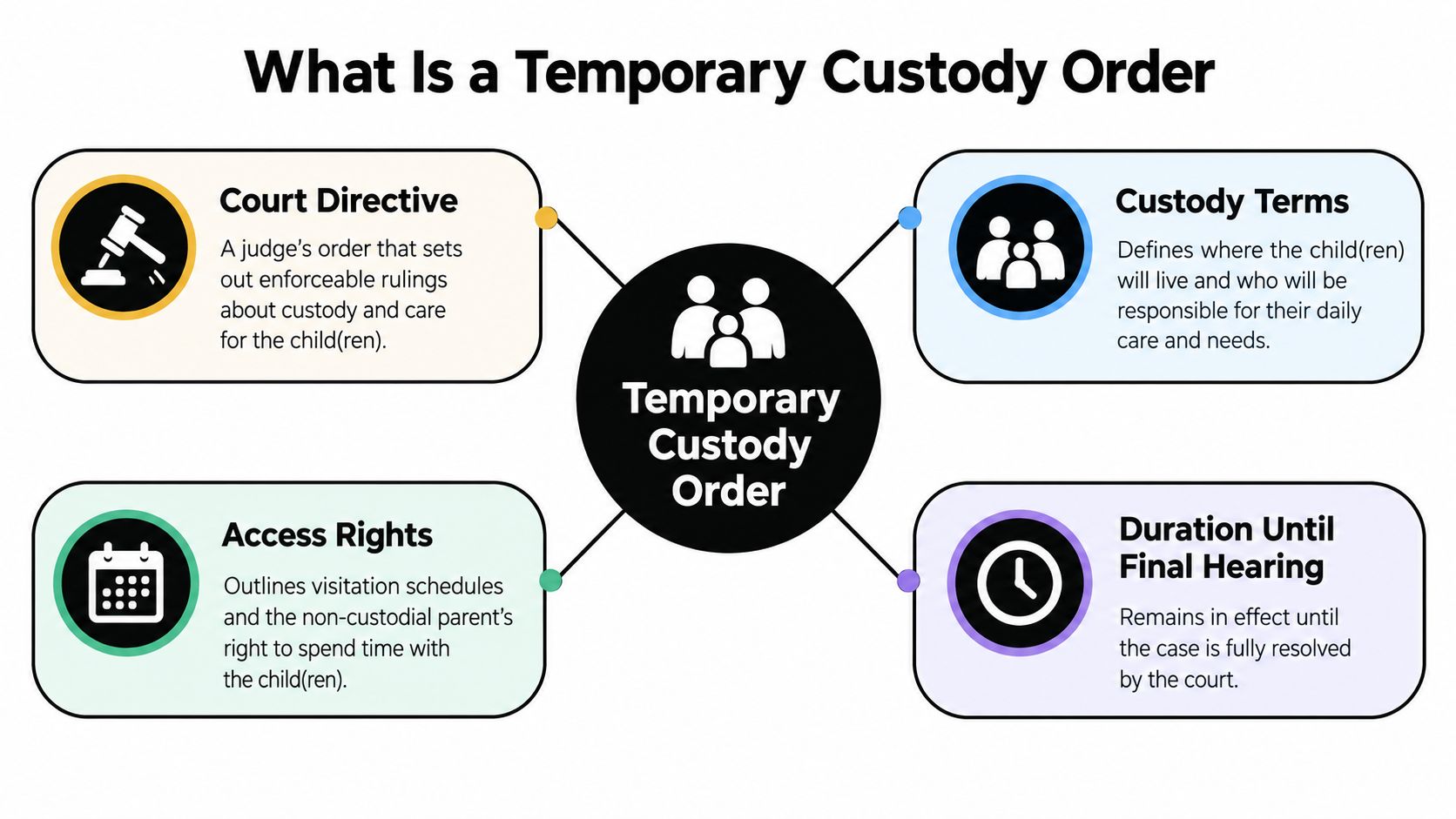
It helps to think of the order as a bridge, not a prediction of the final result. The court needs a workable arrangement while it considers the wider evidence. The temporary terms may resemble the final plan, or they may be revised after further hearings, negotiations, or a change in circumstances.
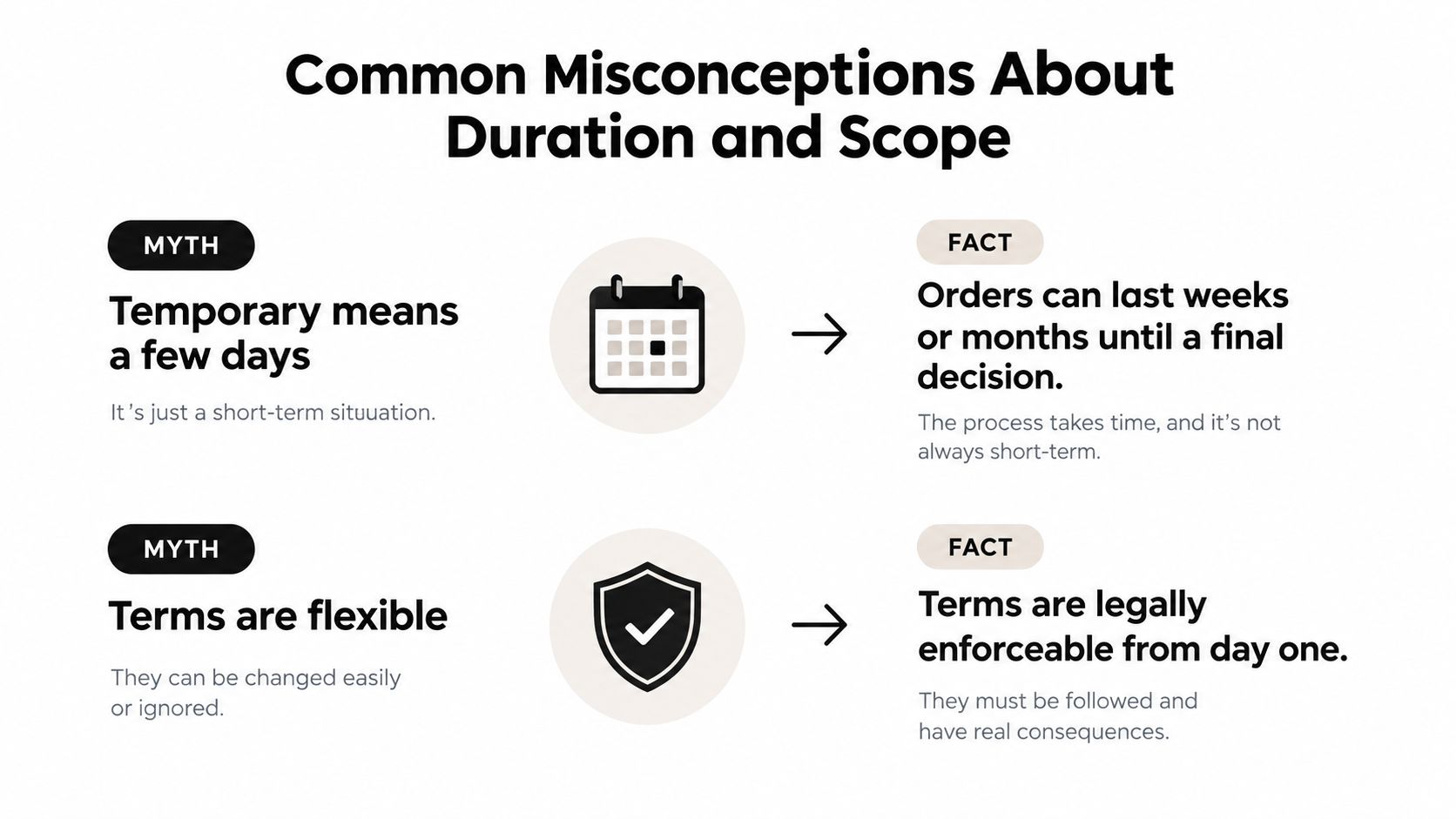
That distinction matters. A parent shouldn't assume that a temporary arrangement has no legal force because it may later change. Nor should a parent assume that every detail has already been decided merely because the court issued an order. The document controls what it says, not what either parent believes the judge intended.
Read each operative sentence carefully. Words such as “shall,” “may,” “reasonable,” “as agreed,” and “as arranged” can create very different practical obligations. If a term is ambiguous, don't choose the interpretation most favorable to you without question. Ask a lawyer, court clerk, mediator, or other appropriate professional how your jurisdiction handles clarification.
How to Obtain a Temporary Custody Order
Courts generally don't issue a temporary custody order based only on one parent's informal account. In many jurisdictions, the applicant must make a structured evidentiary request that includes a filed motion, an affidavit or written request, and a hearing where evidence can be presented. The family-law procedure guidance from the Illinois chapter on temporary relief describes this type of formal process.
Start with the correct court filing
The first step is usually connected to an existing custody, divorce, separation, or family-law case. The filing asks the court to establish an interim arrangement and explains what the parent wants the judge to order.
Before filing, confirm:
- The correct court: Jurisdiction and venue rules determine where the request belongs.
- The current case status: Some jurisdictions require the underlying custody case to have started before a temporary request can be made.
- The requested terms: State the proposed residence, parenting time, exchanges, decision-making, and any safety conditions as clearly as possible.
- The hearing process: Find out whether the court schedules a hearing automatically or requires a separate request.
A parent preparing forms can also review this practical resource on filing custody papers, then confirm the requirements with the relevant court or legal professional.
Support the request with a sworn account
An affidavit or written statement should focus on specific events and their effect on the child. “The other parent is irresponsible” gives the court little to evaluate. A stronger account identifies what happened, when it happened, who observed it, and why the requested arrangement would address the concern.
Attach documents when the rules permit it. Label them consistently and connect each document to a particular statement rather than submitting a disorganized collection of screenshots or messages.
Prepare for the hearing
At the hearing, the judge may ask questions about the child's routine, each parent's proposal, disputed events, and the immediate needs of the family. Bring the filed materials, supporting records, and a short list of the orders you're asking the court to make.
Emergency or ex parte relief follows a higher threshold in many jurisdictions. The requesting parent generally must show immediate irreparable harm, and some courts require the underlying custody case to have begun before the emergency request can be filed. An urgent application isn't a faster version of an ordinary disagreement. It's a request for the court to act before the other parent has a full opportunity to respond because waiting could cause serious harm.
Documentation and Evidence You Need
Good custody evidence is usually specific, dated, and connected to a child-related issue. A judge needs more than a parent's overall impression of the other household. The useful question is not, “Can I show that I'm upset?” It's, “Can I show what happened and why it matters to the requested temporary arrangement?”
A practical record may include:
- School information: Attendance notices, pickup records, teacher communications, and messages about missed school responsibilities.
- Medical material: Appointment records, care instructions, prescription information, and communications about whether a parent was informed.
- Parent communications: Relevant emails, texts, and written agreements, preserved in their original form.
- Exchange details: The date, time, location, arrival, delay, cancellation, and what happened to the child's handover.
- Child-related expenses: Receipts, requests for reimbursement, payments, and unresolved balances.
- Third-party records: Documents from schools, medical providers, childcare services, or other relevant institutions, where lawful and appropriate.
Build a timeline before building an argument
Start with a simple chronology. Put the date and time first, then write a short factual description. Separate what you directly observed from what someone told you. If you don't know a detail, mark it as unknown instead of guessing.
For example:
“Tuesday, 3:15 p.m. The child's school called to say the scheduled pickup had not occurred. I arrived at 3:32 p.m. and collected the child. The other parent sent a message at 4:05 p.m. stating that traffic caused the delay.”
That entry is more useful than, “The other parent always abandons the child.” The first version preserves an event that can be checked. The second makes a broad conclusion that may distract from the underlying issue.
Keep original records with your notes
Don't edit a screenshot to make it easier to read, delete surrounding messages, or rely on memory after a stressful exchange. Preserve the original file and add your neutral explanation separately. A custody evidence checklist can help you identify missing dates, attachments, and categories before a meeting with a lawyer or mediator.
A record should also include ordinary successes. If an exchange happened on time, a parent shared school information, or a child attended an appointment as planned, recording that fact creates a more credible account than documenting only conflict. Courts and professionals need a reliable picture of the interim period, not a collection of the most upsetting moments.
Common Misconceptions About Duration and Scope
The first misconception is that “temporary” means “brief.” Independent legal guidance explains that a temporary order can remain in force until a final custody ruling, which may take several months to over a year. Texas family-court guidance describes temporary orders as a bridge to the final SAPCR order, while Oregon court materials describe them as continuing until they're changed, finalized, or dismissed. The discussion of temporary custody order duration addresses this practical gap between the label and the timeline.
The length matters because a temporary arrangement can shape ordinary life. A child may follow the same school transport routine for months. Parents may continue using the same exchange location, paying the same childcare costs, and managing the same communication pattern while waiting for a final decision. If the order is unclear, a small omission can create repeated disputes rather than a one-time inconvenience.
Temporary doesn't always mean complete
Parents often assume that a custody order contains a full parenting plan. Court research from Nebraska found that 45% of temporary custody orders included a temporary parenting plan, while 19.5% granted visitation without specifying a schedule. Those figures appear in the Nebraska Judicial Branch custody court file research.
The practical lesson isn't that every order will be vague. It's that you must inspect the actual document rather than assume that a familiar custody label answers every scheduling question.
Look for missing or unclear terms involving:
- School breaks and public holidays
- Birthdays and special occasions
- Pickup and drop-off locations
- Transportation responsibility
- Late arrivals and missed visits
- Telephone or video contact
- Notice for travel or schedule changes
- Access to school and medical information
- Authority to make urgent decisions
If the order says parenting time occurs “as agreed,” that may require a separate written agreement for each change. If the parents can't agree, the phrase may offer no workable schedule by itself. Don't rewrite the order privately or treat silence as permission. Ask for clarification or a further order through the proper process.
For context on why family cases can remain unresolved while an interim order continues, review this guide to how long a child custody case can take. The key point is simple: a temporary order may govern a substantial part of a child's routine, even though it isn't the final judgment.
Next Steps - Managing the Interim Period
Once the order is issued, the family still has to live by it every day. Read the operative terms before agreeing to a change, follow the schedule as written, and put any permitted adjustment in writing. A cooperative conversation can solve a practical problem, but it doesn't automatically amend a court order.

A private custody journal app can help a parent record handovers, missed exchanges, parenting time, incidents, communication issues, and child-related expenses in one place. The useful feature isn't dramatic language. It's consistent structure: date, time, child, event type, practical facts, supporting attachment, and any follow-up needed.
Use a neutral format after each significant event:
- Record the event: Write what happened without diagnosing the other parent's motives.
- Preserve the proof: Keep the related message, receipt, photograph, or document with the entry.
- Note the impact: Explain the immediate effect on school, care, transport, or the child's routine.
- Identify the next action: Record whether you requested information, proposed a solution, or contacted a professional.
- Separate fact from interpretation: Keep your concern, conclusion, or legal question in a separate field.
This approach also helps when the order is silent. If exchanges repeatedly fail because the document doesn't identify a location, a dated record can show the pattern and the practical problem without turning every entry into an accusation. If you later ask a lawyer or mediator to seek clarification, a focused timeline is easier to review than a long message history.
The record should remain private and controlled. Don't use documentation as a way to provoke the other parent, threaten court action, or publish family conflict. Its purpose is to preserve an accurate account for your own decisions and for professional review when appropriate.
The same discipline applies to agreements. If both parents temporarily agree to change a weekend, record the original term, the agreed change, the date of the agreement, and what happened. For guidance on how written arrangements relate to parenting time, consult this resource about a parenting time order.
Here's a short reminder worth keeping near your calendar:
Record what happened, follow what was ordered, and get help when the wording leaves a real gap.
The interim period can feel like a waiting room, but it isn't legally or practically empty. Your conduct, communications, and records may influence how professionals understand the family's needs. Calm compliance won't resolve every dispute, yet it gives you a stronger foundation when the order needs clarification, modification, or replacement by a final arrangement.
If you're unsure what a term means, don't rely on a search result or an assumption based on another family's order. Take the document to a qualified family-law professional, identify the exact sentence causing difficulty, and ask what procedure applies in your jurisdiction.
Casewell offers a private custody journal for dated, factual records of parenting time, exchanges, agreements, expenses, and supporting files, with focused PDF exports for professional review. Visit Casewell to organize the interim period around the temporary custody order you're following now.