

Supervised visitation is court-ordered parent-child contact in the presence of a neutral third party to ensure safety. It's usually temporary, continuing until the risk factors that led to supervision are reduced or resolved.
You may have received an order that says visits must be supervised, then sat in your car wondering what that means in practice. The wording can feel like a judgment about your parenting, especially when the order doesn't explain who watches, where visits happen, what you can do together, or how progress is measured.
Supervised visitation is better understood as a structured safety intervention. It creates a controlled setting where a child can maintain contact with a parent while an approved adult watches for safety, follows the court's instructions, and records relevant events. It isn't ordinary parenting time, but it also isn't automatically a permanent loss of the parent-child relationship.
The practical details matter. A supervised visit may involve intake, orientation, scheduling, separate arrivals, carefully defined activities, continuous observation, separate departures, and written documentation. Understanding that sequence can make the arrangement less mysterious and help you avoid mistakes that could prolong restrictions.
Introduction to Supervised Visitation for Worried Parents
A parent may learn about supervised visitation through a temporary court order, a custody agreement, or a notice from a visitation center. The immediate reaction is often a mixture of fear and confusion: Am I being punished? Who decides what happens? Will my child think I did something wrong?
The answer depends on the order and the circumstances, but supervision itself is designed to manage safety while preserving contact. Court and agency standards treat it as a formal service, not an informal favor arranged between relatives. The supervisor's role is to remain neutral, follow the order, observe the interaction, and respond if conduct creates a safety concern.
That distinction matters in high-conflict co-parenting. A supervised setting can reduce direct confrontation between adults, limit opportunities for pressure or coaching, and give the child a more predictable environment. It also gives each parent a clear set of expectations, rather than leaving every visit open to argument. For broader guidance on managing difficult parenting dynamics, see this guide to high-conflict co-parenting.
What the arrangement is meant to accomplish
Supervision commonly serves two purposes at once:
- Immediate protection: The supervisor helps maintain the child's physical and emotional safety during contact.
- Preserved connection: The child can continue seeing the parent within boundaries suited to the current level of concern.
- Reliable observation: The provider can document whether the parent follows rules and responds appropriately.
- A path toward change: When safety concerns improve, the record of compliant visits may help inform future decisions.
This doesn't mean every supervised arrangement will automatically become unsupervised. Courts assess the facts of each case, and some restrictions may continue when concerns remain. Still, the order is often connected to a safety problem that the adults and professionals must address, rather than being a label that defines the parent forever.
You can approach the process in stages. First, identify exactly what the order requires. Next, learn the provider's rules and prepare your child-friendly activities. During the visit, focus on calm, appropriate interaction. Afterward, keep a private factual record of what happened, including any deviation from the schedule or written agreement. That combination of understanding and consistency gives you a clearer way to respond to the process.
What Supervised Visitation Means in Plain Language
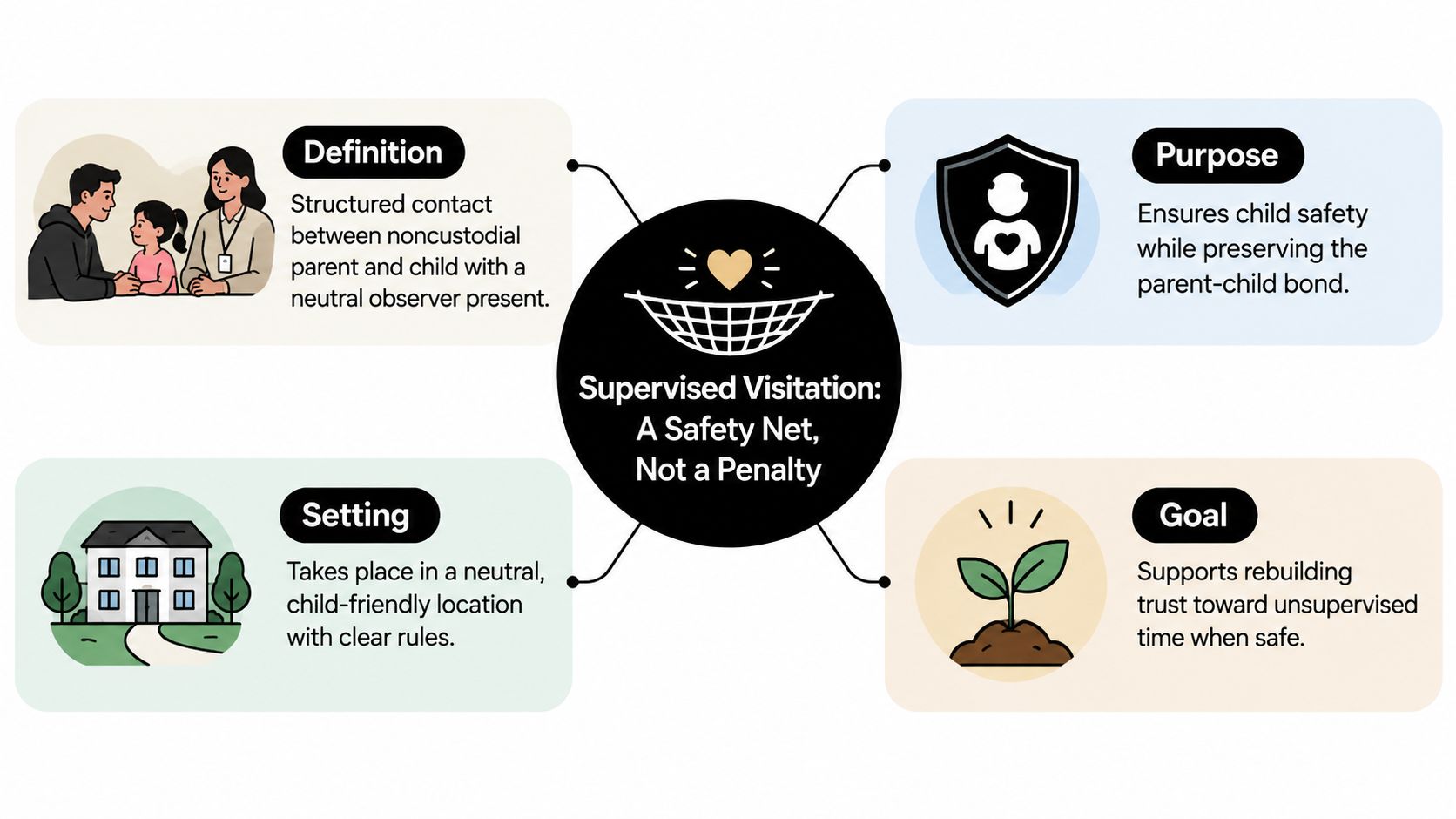
At its simplest, supervised visitation means a parent spends time with a child while a neutral third person remains present. The visiting parent usually isn't the custodial parent for that period, and the supervisor's job isn't to take sides or coach the adults. The supervisor creates a safety net around the contact.
Think of a safety net rather than a penalty box. A penalty box exists to isolate someone. A safety net exists to reduce the consequences of a fall while allowing movement to continue. Supervised visitation limits privacy and flexibility, but it can preserve a relationship while the adults address the reason the court required monitoring.
California's uniform standards define supervised visitation as contact between a noncustodial party and one or more children in the presence of a neutral third person. Those standards place the safety and welfare of children, adults, and providers at the center, while keeping the child's best interest paramount once safety has been secured. You can review the California uniform standards for supervised visitation for the formal framework.
How it differs from other parenting arrangements
Ordinary parenting time allows a parent to care for a child without a supervisor present. Supervised visitation requires active oversight during the contact itself. The supervisor may watch play, listen to conversations, redirect unsafe behavior, and end the visit when the order or safety rules require it.
A monitored exchange is different again. It focuses on the handoff between adults. A monitor may help the child move safely from one parent to the other and reduce confrontation, but doesn't necessarily stay for the parenting time. Supervised visitation covers the interaction between the visiting parent and child, not merely the transition.
The field has also moved toward professional standards. In 1994, the Supervised Visitation Network adopted a resolution to develop draft standards and guidelines, reflecting a shift away from ad hoc monitoring toward consistent professional practice. By December 1, 2024, the network's standards had been revised and re-adopted, with members expected to comply one year later, according to the organization's continuing standards framework cited in the California court materials.
That history helps explain why a center may require forms, orientation, neutral reporting, and strict rules. The supervisor isn't just a family friend sitting nearby. The service is intended to operate according to defined safety expectations.
Why and When Courts Order Supervised Visitation
Courts order supervision when unsupervised contact could expose a child or another adult to a meaningful safety concern. The concern may involve alleged abuse, domestic conflict, substance use, emotional harm, abduction risk, or a parent-child relationship that needs to be rebuilt carefully after a long absence. The exact reason should appear in the order, court findings, or related documents, but the supervisor usually shouldn't debate that reason during the visit.

The court's central question is usually whether the proposed arrangement protects the child's best interests while allowing contact to continue safely. Supervision may therefore be more intensive when the perceived risk is higher, and less restrictive when a parent can demonstrate reliable compliance and safe conduct. A state guide, for example, describes fully supervised visits as requiring the supervisor to watch and listen throughout the entire visit, while less intensive supervision requires regular supervisory review rather than constant observation.
Florida's administrative data show that this isn't an unusual or marginal service. From October 1, 2020, to September 30, 2021, documented referrals to Florida supervised visitation programs totaled 1,844 cases, and programs served 7,022 clients, including 3,129 children and 1,998 visitors, as reported in the Florida Clearinghouse annual statistical analysis. The report also noted that roughly 67% to 69% of parents receiving services over the prior four years had never been married to each other. The following year's Florida data included participation from 45 supervised visitation programs, with a combined service count that included 23,586 supervised visitation contacts and 1,156 monitored exchanges.
Temporary does not mean automatic
Supervision is often temporary, but time passing alone doesn't guarantee a change. The parent generally needs to address the concerns that led to the order and show consistent compliance with the current rules. That may involve treatment, stable conduct, appropriate communication, or evidence that the parent can respond to the child's needs without creating new safety concerns.
Practical rule: Treat every visit as a chance to demonstrate safe, child-focused behavior, not as a hearing where you argue the case.
A parent who believes the arrangement is unfair should raise that issue through the appropriate legal process, not by ignoring the order or pressuring the supervisor. If a visit is denied, cancelled, or blocked, record the facts and seek advice about the proper response. This guide to denied visitation can help you identify what information to preserve without turning a difficult event into a confrontation.
Types of Supervised Visitation and Who Can Supervise
Not every supervised arrangement looks the same. Your order may require a professional center, approve a particular relative, or describe a level of monitoring that determines whether the supervisor must remain within sight and hearing for the entire visit.
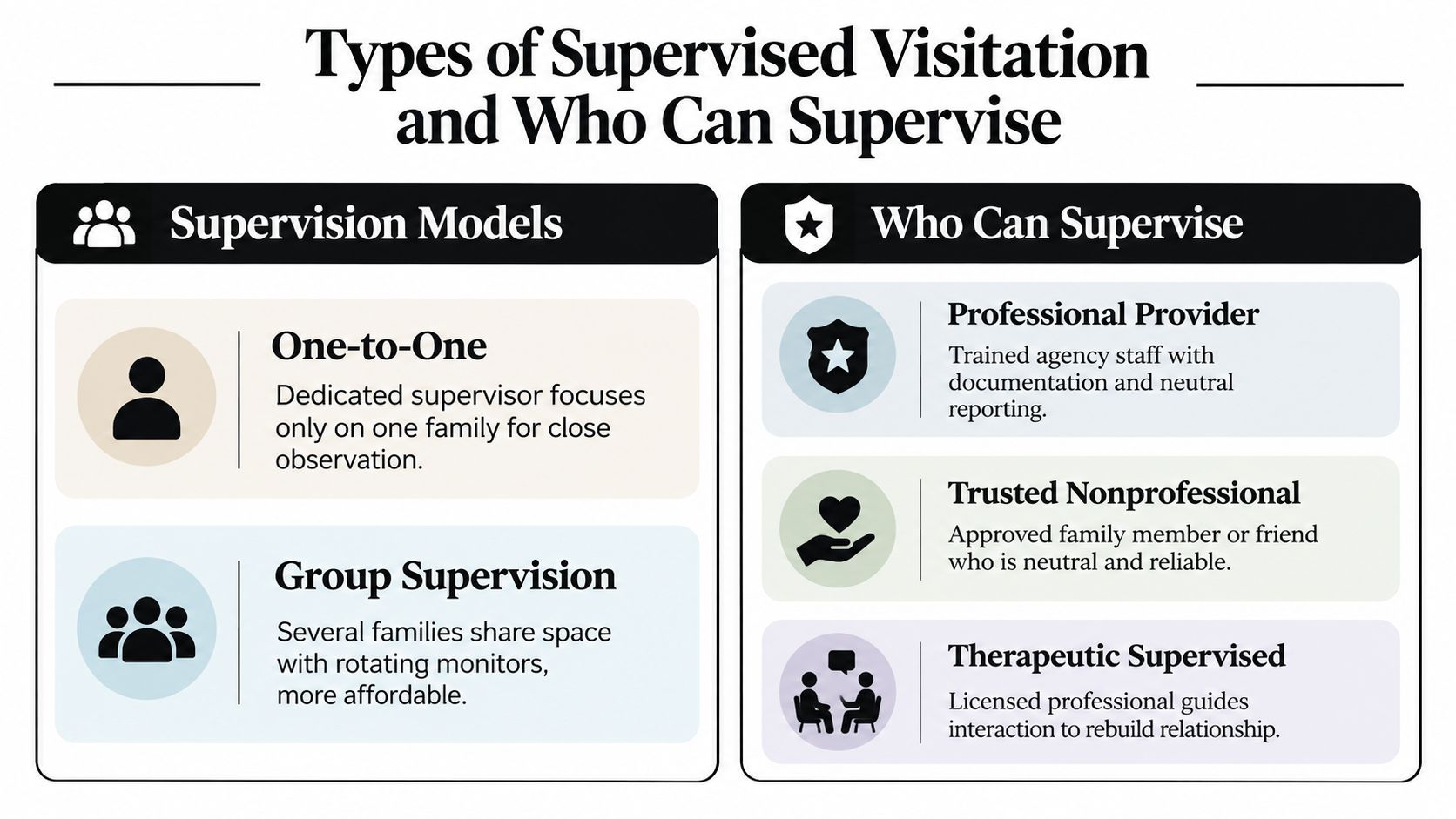
One-to-one supervision gives one family dedicated attention from a supervisor. That can make close observation easier and may suit cases with significant safety concerns or complicated child needs. Group supervision places several families in the same general setting with staff monitoring the space. It may offer a different cost or availability profile, but the supervisor's attention is shared.
A professional provider usually works through a visitation center or agency and follows written procedures for intake, scheduling, observation, and reporting. A trusted nonprofessional supervisor may be a relative or friend if the court or both parents approve that person and the supervisor can remain neutral. A close relationship with the visiting parent doesn't automatically make someone suitable. The person must be willing to intervene and follow the order even when doing so is uncomfortable.
Comparing the options
| Supervision Type | Who Supervises | Best For | Key Trade Off |
|---|---|---|---|
| One-to-one | A dedicated professional or approved adult | Families needing close, focused observation | More individual attention, but availability and fees may be limiting |
| Group setting | Staff monitoring several families or areas | Families whose order permits a shared center environment | A structured setting, with less individual attention |
| Professional center | Trained agency or visitation-center staff | Orders requiring formal procedures and documentation | Clear reporting and neutral processes, but stricter center rules |
| Trusted nonprofessional | An approved relative or friend | Arrangements where the court permits a known supervisor | Familiarity may help the child, but neutrality and reliability must be strong |
| Therapeutic supervision | A qualified mental-health professional | Parent-child relationships needing guided support | Combines contact with professional guidance, subject to provider availability |
| Monitored exchange | A third party handling transitions | Parents who need conflict-free handoffs rather than monitored visits | It protects the exchange, not the parenting time itself |
Location and intensity matter
Visits may happen at a center, in a public setting, or in another location allowed by the order. Virtual contact may be permitted in some situations, but you shouldn't assume it satisfies a supervised-visitation requirement. Ask the court, attorney, or approved provider what the order permits.
Supervision also comes in tiers. A fully supervised arrangement generally requires active watching and listening throughout the contact. A less intensive arrangement may require periodic oversight instead. Read the wording carefully, because “supervised” doesn't always answer how close the monitor must remain or what activities are allowed.
How Supervised Visits Are Scheduled and What Happens During a Visit
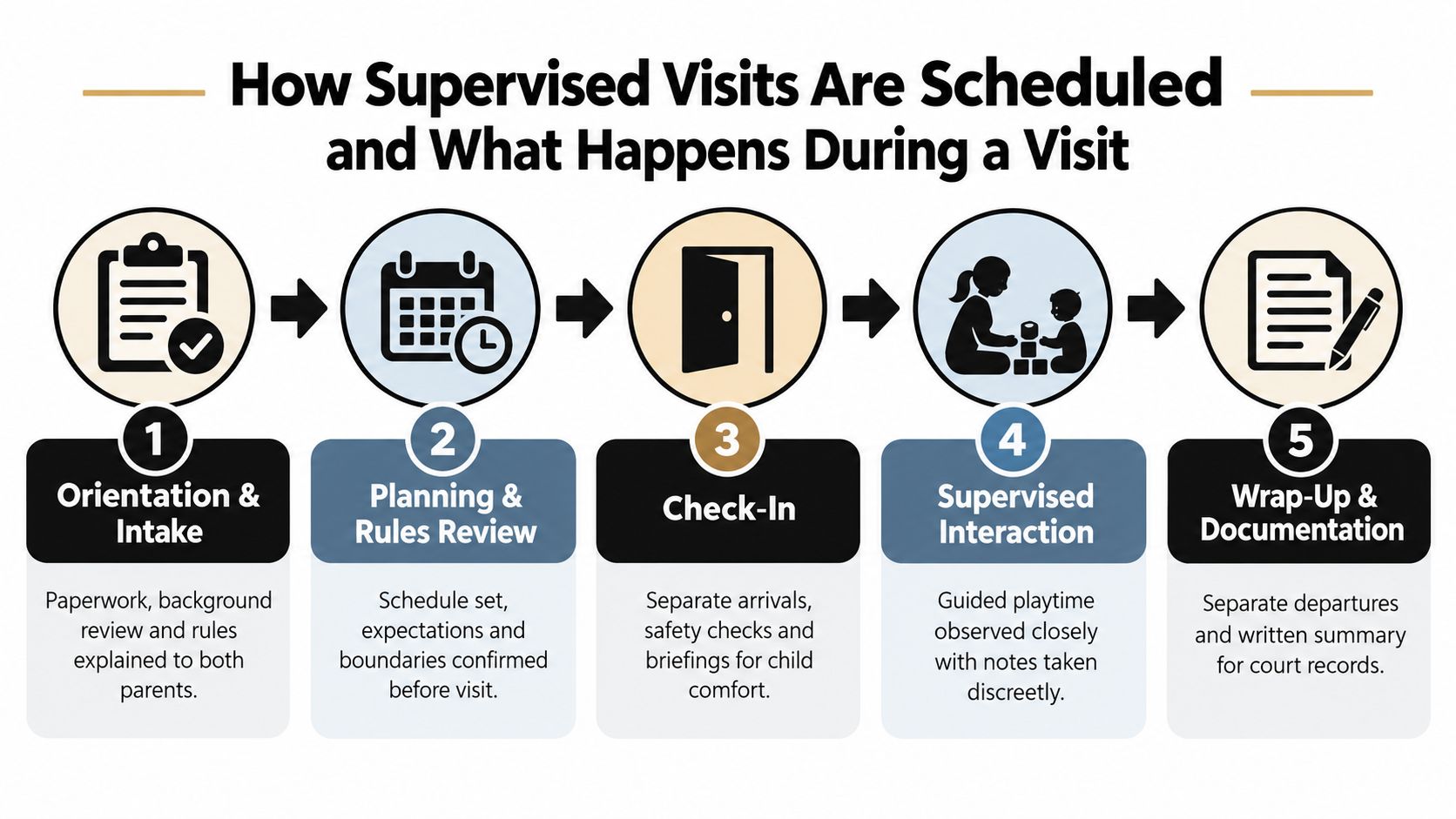
A supervised visit usually begins before the parent and child enter the room. The provider may collect information, review the order, assess practical safety needs, and explain what the supervisor can and can't do. Earlier practice research has described supervised visitation as including orientation, planning, and debrief stages, not only the parent-child meeting itself. A 2026 study likewise described the visiting parent's experience around the restricted environment, the rules, and how to make meaningful use of the available time, as reported in this research on supervised visitation experiences.
Before the visit
Orientation and intake establish the participants, approved supervisor, contact information, safety concerns, transportation plan, and order requirements. The provider may explain prohibited topics, arrival procedures, permitted items, and what happens if someone is late.
Planning and rules review turn the order into a workable schedule. Parents may need to confirm the date, start time, location, duration, who brings the child, and how separate arrivals and departures will occur. The child may need preparation in age-appropriate language, without being asked to take sides or carry messages.
During the visit
The supervisor should maintain the level of observation required by the order. For fully supervised contact, that means continuous line-of-sight and hearing. The supervisor watches the child's behavior and the parent's responses, remains neutral, and may redirect conduct that violates a rule or creates discomfort.
The visiting parent should bring simple, age-appropriate activities that fit the setting. Reading, drawing, a board game, or a calm conversation may work better than trying to create an elaborate event. Don't use the visit to discuss litigation, criticize the other parent, ask the child to report household details, or make promises about future custody.
After the visit
The provider may arrange separate departures, debrief the participants, and prepare notes. Documentation can include attendance, timing, compliance, notable interactions, interventions, and whether the supervisor ended the visit early. The supervisor's notes aren't a substitute for the court order, but they may help professionals evaluate whether the arrangement is functioning safely.
A supervisor can redirect behavior or terminate a visit when safety concerns arise. Arguing about that authority during the contact usually makes the situation worse. If you believe the supervisor acted improperly, write down the specific facts afterward and address them through counsel, the provider's complaint process, or the court.
Rules Costs and Legal Considerations You Should Know
Supervised visitation centers commonly impose rules that may feel restrictive because the setting must protect the child, the other parent, and the provider. The exact rules come from the court order and provider policy, so read both documents rather than relying on advice from another case.
You may need to arrive on time, use a designated entrance, leave personal belongings in a particular place, avoid recording, limit gifts, follow food restrictions, and keep conversations child-focused. Some providers restrict photographs, physical activities, private rooms, or contact with the other parent. If the order requires continuous sight and hearing, taking a child out of the supervisor's view can violate the arrangement even if the activity seems harmless.
Costs and access
Professional services charge fees, but the amount varies by provider and location. The order or court may assign responsibility to one parent, divide expenses, or address ability to pay. If cost prevents regular contact, ask about approved lower-cost providers, community programs, sliding-scale arrangements, or a motion addressing payment. Don't arrange an informal substitute if the order requires an approved supervisor.
The evidence base also deserves a realistic explanation. A 2023 research note found that supervised visitation services have expanded while research evaluating programs and guiding evidence-based practice remains limited. A 2025 peer-reviewed article described supervised visitation as an underused opportunity to support parent-child connections and noted that empirical literature in child welfare is particularly limited, as discussed in this research note on supervised visitation. That means a visit can produce useful process information, but parents shouldn't assume the arrangement itself guarantees a long-term outcome.
For general context on the court process, you can review this explanation of family court.
Conduct that protects your position
- Follow the order exactly: Ask questions before the visit if a rule is unclear.
- Keep the child out of adult conflict: Don't coach, interrogate, or ask the child to deliver messages.
- Respect the supervisor's role: Raise objections later through the proper channel.
- Prepare practical materials: Bring permitted activities, snacks, medication information, or comfort items.
- Record what occurred: Note facts, timing, cancellations, and deviations without exaggeration.
How to Document Supervised Visits Effectively With a Private Journal
A private journal can help you preserve a reliable sequence of events without turning documentation into another argument with the other parent. Write soon after each visit while details are fresh, but separate what you directly observed from what you believe it means.
Start with the basic record:
- Date and time: Record the scheduled and actual arrival, start, end, and departure times.
- Location and participants: Identify the provider, supervisor, child, and any other approved person present.
- Agreement and outcome: Note what the order, provider, or written agreement required, then state what happened.
- Factual observations: Describe words, actions, interventions, and cancellations without labels such as “awful” or “manipulative.”
- Supporting material: Keep permitted receipts, screenshots, notices, and documents beside the related entry.
A useful sentence says, “The visit was scheduled to begin at the agreed time, and the provider recorded the start after the child arrived.” A weaker sentence says, “The other parent deliberately ruined everything.” The first preserves verifiable information. The second adds an interpretation that a professional may not be able to evaluate.
A private custody journal such as Casewell can organize entries by child and category, record exchange check-ins, link deviations to agreements, store screenshots and receipts beside an event, and produce focused PDF exports showing dates, timestamps, edit history, and attached proof. It is designed for personal documentation rather than shared messaging, so you don't need to invite the other parent to create a record. Its structured prompts can also help you keep facts separate from conclusions, while any rewritten wording remains subject to your review and approval.
Use a focused record, not a diary of every emotion. Preserve the original details, identify edits, and export only the material relevant to an attorney, mediator, or court professional. For a simple starting framework, see this visitation log template.
Casewell gives you a private way to organize supervised-visit dates, arrival and departure details, agreements, exchange check-ins, receipts, screenshots, and factual observations in one custody journal. Visit Casewell to keep a clear personal record and create focused PDF reports for professional review without using a shared messaging app.