

You handle school runs, bedtime, permission slips, prescriptions, and holiday logistics. Then a receptionist asks whether you're authorized to consent to your stepchild's routine treatment, or a school refuses to release information, and the family's practical reality collides with its legal paperwork. Living like a parent doesn't automatically make you a legal parent or guardian.
That gap matters most during emergencies, medical appointments, school decisions, travel, separation, or the death of the parent you married. Step parent legal guardianship can provide meaningful authority, but it isn't the only possible solution, and the order's exact wording controls what you can do. The strongest cases usually begin before filing, with a disciplined record of caregiving, agreements, decisions, and changes over time.
When a Stepmom or Stepdad Is Already a Parent in Every Way but Law
The moment often arrives without warning. A stepparent has taken a child to appointments for months, knows the teacher's concerns, pays for activities, and manages the household schedule. One afternoon, the child needs treatment or a school form requires a legal signature. The stepparent is the adult standing there, but the institution wants a biological parent, legal guardian, or written authorization.
That isn't a judgment about the relationship. It's a question of legal authority. Marriage to a child's parent doesn't automatically turn a stepparent into a guardian, and daily caregiving doesn't by itself create independent power to make major medical, educational, residence, or travel decisions. In England and Wales, for example, stepparents don't automatically acquire parental responsibility by marrying or partnering with a natural parent. Formal agreement or a court order is required, and such arrangements have remained uncommon. This analysis of blended families and parental responsibility also separates the household role from the legal one.

What guardianship can change
A court-appointed guardian may receive authority for daily care and specified decisions, but the scope depends on local law and the signed order. The order might address medical consent, school participation, placement, or other responsibilities. It may also preserve some rights and responsibilities of the biological parents.
That's why a guardianship order isn't a magic label. Ask exactly what authority it grants:
- Medical care: Can you consent to routine treatment, access records, or only act in emergencies?
- Education: Can you enroll the child, attend meetings, receive records, or make placement decisions?
- Travel and residence: Can you approve travel, handle identification documents, or decide where the child lives?
- Continuity: What happens if the custodial parent is hospitalized, dies, or becomes unavailable?
A limited authorization may solve a narrow problem. A standby arrangement may protect continuity if a parent can no longer act. Guardianship may be appropriate where a stepparent already provides stable care and needs court-recognized authority. Adoption is a different decision entirely because it generally creates a permanent parent-child relationship.
Practical rule: Don't ask only whether you have “rights.” Ask which decision you need to make, who currently has authority, and what document will be accepted by the school, doctor, agency, or court.
Before choosing a filing path, review how custody rights differ from other family-law arrangements in this guide to legal custody. Then write down the specific problem you're trying to solve. A precise problem produces a better legal strategy than a general desire to be recognized as a parent.
Guardianship, Adoption, and Custody Compared
These paths are often treated as interchangeable. They aren't. Guardianship usually adds authority without necessarily ending a biological parent's legal relationship. Adoption generally creates a permanent legal parent-child relationship and can alter or terminate another parent's status. Custody orders govern care and decision-making under the rules of the relevant jurisdiction.
The right choice depends on the child's circumstances, the other parent's position, and the authority you need. Don't pursue adoption merely because guardianship sounds incomplete, and don't pursue guardianship when your real concern is a parenting-time schedule after separation.
Guardianship vs Adoption vs Custody at a Glance
| Path | Authority Granted | Effect on Biological Parents | Reversibility | Common Trigger |
|---|---|---|---|---|
| Guardianship | Authority defined by statute and the court order, often involving care and specified decisions | Some parental rights and responsibilities may remain | May end or change when circumstances change, depending on local law | A stepparent provides stable care and needs formal authority |
| Adoption | Permanent legal parent status, with the rights and responsibilities of a parent | Usually requires consent or a legally sufficient basis to dispense with consent, and may alter or end another parent's status | Generally not treated as a temporary arrangement | A family seeks permanent legal parentage and the legal conditions are satisfied |
| Custody | Care, residence, parenting time, or decision-making authority under a custody order | Biological parents usually retain legal status unless a separate legal process changes it | Can be modified under applicable standards | Parents or other eligible parties need a court-defined care arrangement |
Choose the path by the problem
Guardianship fits an authority gap. If you're already caring for the child but cannot reliably handle school, healthcare, or placement decisions, a guardianship order may be the practical answer. The order must be read line by line. A general statement that you have "parental rights" doesn't tell a school or physician what you can sign.
Adoption fits permanent legal parentage. It carries greater consequences and usually requires a careful analysis of consent, notice, parental rights, and the child's interests. Courts commonly encourage stepparent adoption in situations such as the death of a biological parent or termination of parental rights, but historical practice doesn't decide an individual case. A comparison of legal custody concepts can help clarify whether your concern is authority, residence, or decision-making.
Custody fits a care arrangement. A custody order may define where the child lives, when each adult has parenting time, and who decides major issues. It doesn't automatically make a stepparent a legal parent. Standing rules also vary, and a stepparent may need to establish a qualifying relationship or a legal basis to ask the court for relief.
The decision should be practical. List the decisions you need to make now, the decisions you may need to make if the other parent is unavailable, and the legal relationship you want the child to have with each biological parent. That list gives local counsel something useful to assess.
How the Court Process Actually Works
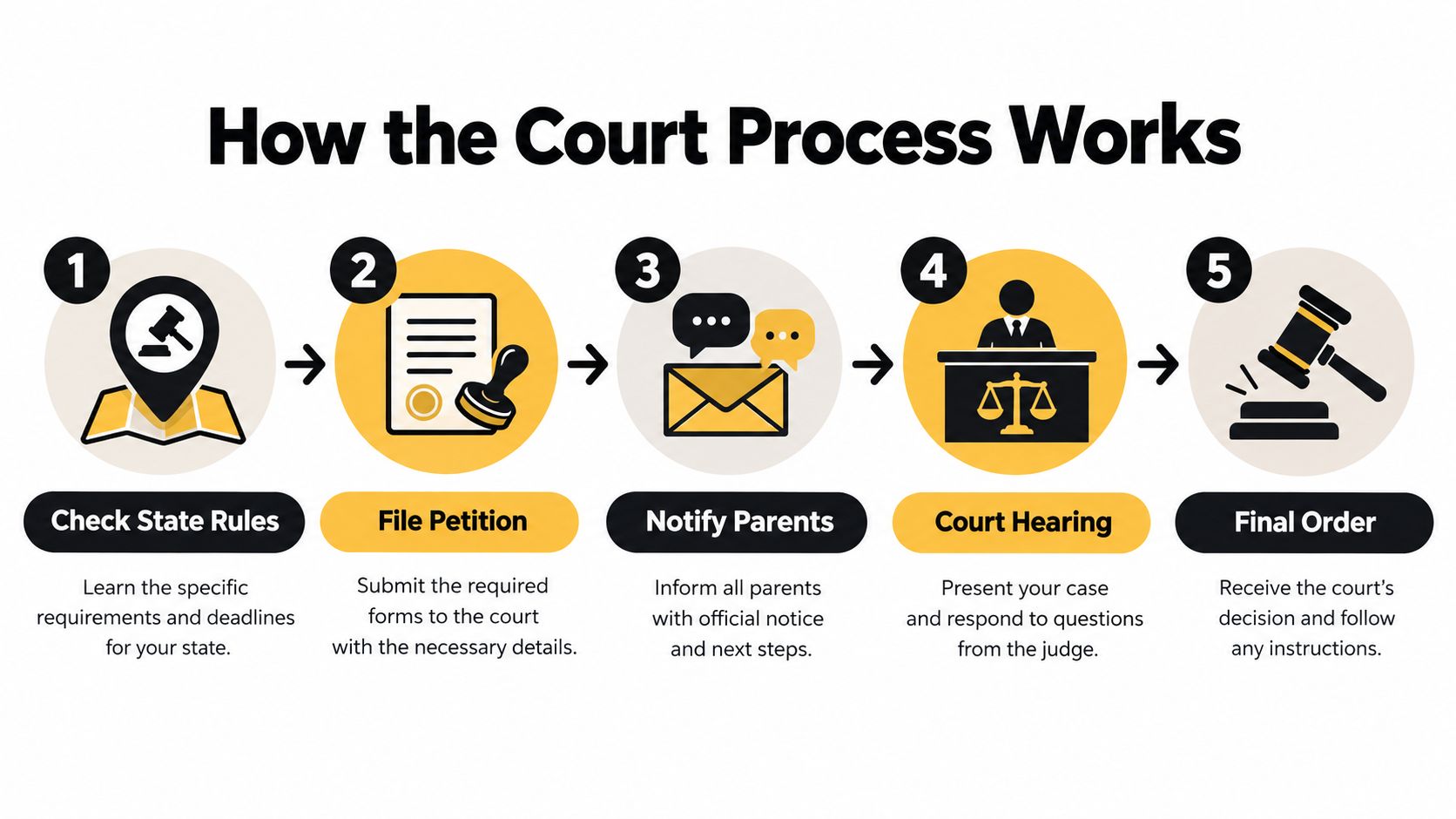
A guardianship case begins with standing and jurisdiction, not with a dramatic statement about how much you love the child. Confirm which state or country's law applies, whether a stepparent may file, and whether the case belongs in family court, probate court, or another venue. The answer can change based on the child's residence, existing custody orders, and the location of the legal parents.
Start gathering records before filing. Courts may examine the stepparent's caregiving role, household stability, relationship with the child, financial capacity, and the child's needs. Oregon's formal guardianship framework, for example, illustrates the kinds of evidence that can matter, including an updated home study, caregiving capability, a stable child relationship, financial support, and clear and convincing proof tied to the child's best interests. British Columbia's official guidance for stepparents likewise emphasizes that marriage alone doesn't make someone a guardian and that a court application may be required.
Filing creates an evidence trail
The petition sets out the requested authority, the child's circumstances, the parties involved, and the legal grounds for the application. Attachments may include existing orders, records of caregiving, school or medical involvement, agreements, and evidence addressing the child's best interests. Don't fill the petition with conclusions such as “the other parent is dangerous” unless you can connect that assertion to admissible, dated evidence.
Every legal parent and any other required party must receive proper notice. Service is not a technical nuisance. If a required person isn't served correctly, the hearing may be delayed or the order may later be challenged. Keep the filed petition, proof of service, returned documents, and court notices together in chronological order.
The court may require background checks, a home study, financial information, or an investigation by a guardian ad litem. Treat each requirement as a chance to provide consistent records, not as a separate performance. A mismatch between your petition, interview answers, school records, and medical history can weaken credibility even when the underlying caregiving is genuine.
The hearing decides scope, not just status
At the best-interests hearing, the judge may evaluate safety, stability, relationships, the child's needs, each adult's involvement, and the effect of the proposed order. The court may hear from parents, professionals, investigators, or other witnesses, depending on local procedure.
If the court grants relief, preserve the signed and entered order, not merely a hearing summary or an unsigned draft. Give approved copies to the institutions that need them, and read the decision-making language carefully. For a practical overview of hearing preparation, consult this guide to what happens in child custody hearings. A guardian's authority exists in the terms the court entered.
Consent, Parental Rights, and Where Cases Stall
Consent is often the technical bottleneck. Guardianship may preserve some parental rights, while adoption generally requires consent or a legally sufficient basis to proceed without it. Those are not interchangeable standards, and a parent's lack of cooperation doesn't automatically establish abandonment, unfitness, or unavailability.
Begin by classifying the situation.
The other parent consents. Consent can simplify the dispute, but it still must meet local requirements for form, notice, timing, and scope. Determine whether the parent is agreeing to guardianship, adoption, a temporary delegation, or a specific order. Vague family agreement is not a substitute for a legally effective document.
The other parent may have abandoned the child. Courts usually need evidence of conduct over time, not a label. Preserve dated communication records, missed arrangements, financial records where relevant, and information showing who directly provided care. Don't delete inconvenient messages or exaggerate gaps. A credibility problem can undermine the entire petition.
The other parent is alleged to be unfit. This requires facts tied to statutory standards. Medical records, school reports, agency records, witness observations, and documented incidents may matter, but generalized hostility or a difficult co-parenting relationship isn't enough by itself. Identify what happened, when it happened, who observed it, and how it affected the child.
The other parent is unavailable. Unavailability may involve inability to locate the person, incapacity, incarceration, deployment, or another legally recognized circumstance. The petitioner may need to show reasonable efforts to locate or notify the parent, then satisfy the jurisdiction's alternative process.
A historical comparative study reported that 9,222 of 13,559 California adoptions in 1974, or 68%, involved stepparents. The study also cautioned that reliable denial rates weren't available, so the figure is not a success rate for an individual petition. The study itself is useful precisely because it warns against confusing the volume of stepparent cases with the likelihood that your case will succeed.
A high number of stepparent cases proves that the legal route exists. It doesn't prove that your evidence satisfies the required elements.
The recurring mistake is presenting family conflict instead of proof. Replace “the parent never helps” with dated records showing missed exchanges, unanswered requests, unpaid agreed expenses, or documented decisions. Replace “I'm the parent” with a care timeline that identifies school involvement, medical coordination, transportation, routines, and the child's response to the arrangement.
Building Court-Ready Records Before You File
A court-ready file is built in ordinary moments, not the night before a hearing. Record the event close to when it happened, use the actual date and time, identify the child, describe what you personally observed, and attach the original supporting material. The aim is not to create an impressive diary. It's to give a judge or lawyer a reliable sequence of facts.
Write facts, not verdicts
Compare these entries:
- Weak: “The other parent was irresponsible again.”
- Stronger: “The child's appointment was scheduled for Tuesday. I sent the appointment details on Monday. The other parent didn't attend and didn't respond before the appointment. I took the child, received the treatment instructions, and attached the clinic summary.”
- Weak: “I do everything for school.”
- Stronger: “I attended the school meeting, received the reading plan, arranged the requested materials, and recorded the teacher's stated follow-up date.”
The stronger versions identify actions, dates, documents, and witnesses. They don't ask the reader to accept a conclusion without the underlying facts.
Use a repeatable record structure
Create categories that match the issues a court may evaluate:
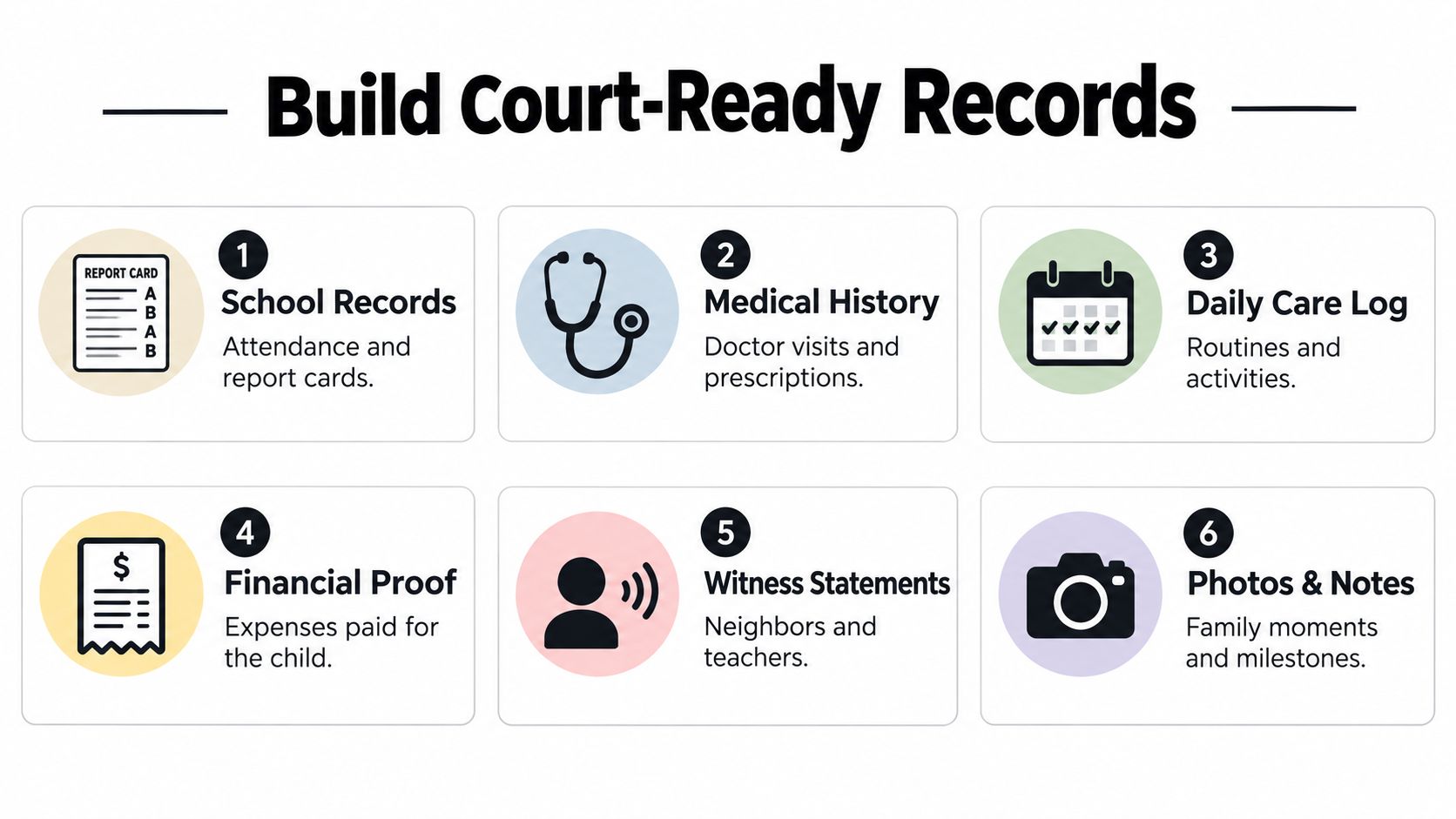
- Caregiving: pickups, meals, routines, activities, supervision, and overnight arrangements.
- Medical: appointments, prescriptions, treatment instructions, consent problems, and follow-up.
- Education: attendance, meetings, reports, communications, transport, and support plans.
- Agreements: what the adults agreed, when they agreed, and what happened afterward.
- Expenses: what you paid, why it was necessary, whether reimbursement was requested, and the receipt.
- Deviations: the agreed plan, the actual event, notice given, and the child's practical impact.
Preserve screenshots, emails, receipts, school notices, medical paperwork, and photographs beside the relevant entry. Keep originals where possible. If you correct an entry, retain the earlier version and record the edit rather than rewriting history without a trace.
A private journal such as Casewell's parenting journal can be useful when you need structured entries, attachments, edit history, and focused exports rather than scattered phone notes. The tool matters less than the discipline. Your system should show when the entry was made, what changed, and which document supports the statement.
Prepare for the hearing you may not expect
Don't record only the incidents that support your preferred narrative. Record ordinary stability too, including school routines, medical follow-through, successful handovers, and cooperative decisions. A balanced record is more credible than a file that treats every interaction as misconduct.
Before filing, create a short chronology and map each important entry to a legal issue. Mark the records that prove caregiving, the records that address consent or notice, and the records that show the child's continuity. Give counsel the focused material first. A disorganized archive forces the professional to spend time sorting instead of analyzing.
The Child's Position and When Less Legal Authority May Be Better
More authority isn't always better for the child. A child may want a stepparent to handle school and healthcare while still preserving the legal and emotional relationship with both biological parents. A full guardianship or adoption can intensify loyalty conflicts if the child experiences the order as a choice between adults.

Courts may consider a child's views according to local rules, age, maturity, and the type of application. Some legal systems limit who can hold parental authority. Comparative material describes Belgium as recognizing only two legal guardians, meaning a stepparent can't share parental authority with both biological parents. That can make adoption more consequential because one biological parent may lose legal status. The comparative discussion of stepparent recognition and child-centered outcomes shows why adult convenience shouldn't be the only measure.
Consider whether a limited written authorization, standby arrangement, or carefully defined order solves the underlying problem. The right document might preserve school and healthcare continuity without changing parentage. Ask the child's professionals and local counsel how the child's views, objections, and relationships will be handled.
U.S. legal commentary notes that stepparents commonly lack custody or visitation rights after divorce or the biological parent's death, even after a long caregiving relationship. That absence of legal protection can outlast the household that created the bond.
For families facing that risk, the question isn't "How do I become the legal parent?" It's "What arrangement protects the child's continuity while respecting the relationships the child wants to keep?"
Your First Seven Practical Moves
Start this week with decisions, not more vague research.
- Define the goal: Write the exact decisions you need to make, from school records to medical consent.
- Confirm jurisdiction: Identify where the child lives, which orders already exist, and which court handles guardianship.
- Audit your records: Gather school, medical, expense, communication, and caregiving material in date order.
- Map the evidence: Connect each record to stability, caregiving, safety, the child's needs, or another best-interests factor.
- Address consent early: Determine whether the other parent consents, objects, may be unavailable, or raises a legal-rights issue.
- Choose a reliable system: Use structured entries with attachments, preserved originals, and edit history.
- Verify filing requirements: Ask local counsel to confirm standing, forms, venue, service, investigations, hearing dates, and the precise authority requested.
Don't wait for a crisis to discover that your records are incomplete. Build the timeline now, then take it to a family-law attorney who can distinguish between a limited authorization, guardianship, custody order, and adoption.
Casewell helps stepparents and families keep private, dated records of caregiving, agreements, expenses, exchanges, and supporting documents in one organized custody journal. Create focused, court-ready PDF reports with attachments and edit history, then visit Casewell to start building a clearer record before you file.