

You're at the school pickup desk with your stepchild's permission slip in hand. You've handled the morning routine, arranged the appointment, and regularly care for this child, but the school says it can't accept your signature without authorization from a legal parent or guardian. The moment feels unfair because your role is real, yet the law may still treat you as a non-parent.
So, do stepparents have custody rights? Usually, not automatically. Marriage to a child's parent and years of daily caregiving generally don't create custody or decision-making authority by themselves. In most major U.S. family-law frameworks, biological parents remain the primary legal decision-makers unless a court recognizes the stepparent through adoption, guardianship, a custody order, or another specific legal route. The Berkeley Law discussion of stepparent rights describes this general baseline.
That doesn't mean a stepparent has no meaningful role. It means everyday parenting and enforceable legal authority are different things. A stepparent may prepare meals, help with homework, attend school events, or take a child to an appointment, while still lacking power to consent to major medical care, enroll the child in school, or demand custody after separation. This overview of stepparent rights and responsibilities explains why informal delegation can leave blended families exposed.
Where Stepparents Stand Before the Law Steps In
A stepparent can often manage ordinary household responsibilities without special paperwork. You may supervise play, drive a child to practice, collect a prescription that a parent has already authorized, or communicate with teachers about routine matters. Those actions reflect trust inside the household, but they don't necessarily create legal custody, parental responsibility, or independent decision-making power.
The dividing line appears when an institution needs proof of authority. A school may require a parent or guardian for enrollment and formal permissions. A healthcare provider may need consent from someone with legal authority before providing significant treatment. A travel provider, government office, or court may also ask for documentation rather than relying on the fact that you're married to the child's parent.
Practical rule: Caring for a child can make you a trusted adult. It doesn't automatically make you a legal parent.
Legal custody usually includes authority over major decisions about education, healthcare, religion, and living arrangements. Physical custody concerns where the child lives and who provides regular care. A stepparent may exercise practical caregiving power because the legal parent delegates it, but that delegation can be limited, revocable, or unacceptable to a third party without a written authorization.
The distinction becomes especially important during separation. Marriage doesn't give a stepparent an automatic claim to custody or visitation when the relationship ends. A plain-language guide to family court can help you understand the setting, but only state-specific legal advice can tell you whether you have standing to ask a court for relief.
The formal routes are adoption, guardianship, a court order, or recognition as a de facto parent or other legally qualified third party. Each route answers a different need, so the first question is not just whether you love or care for the child. It's what authority the child needs, for how long, and under what family circumstances.
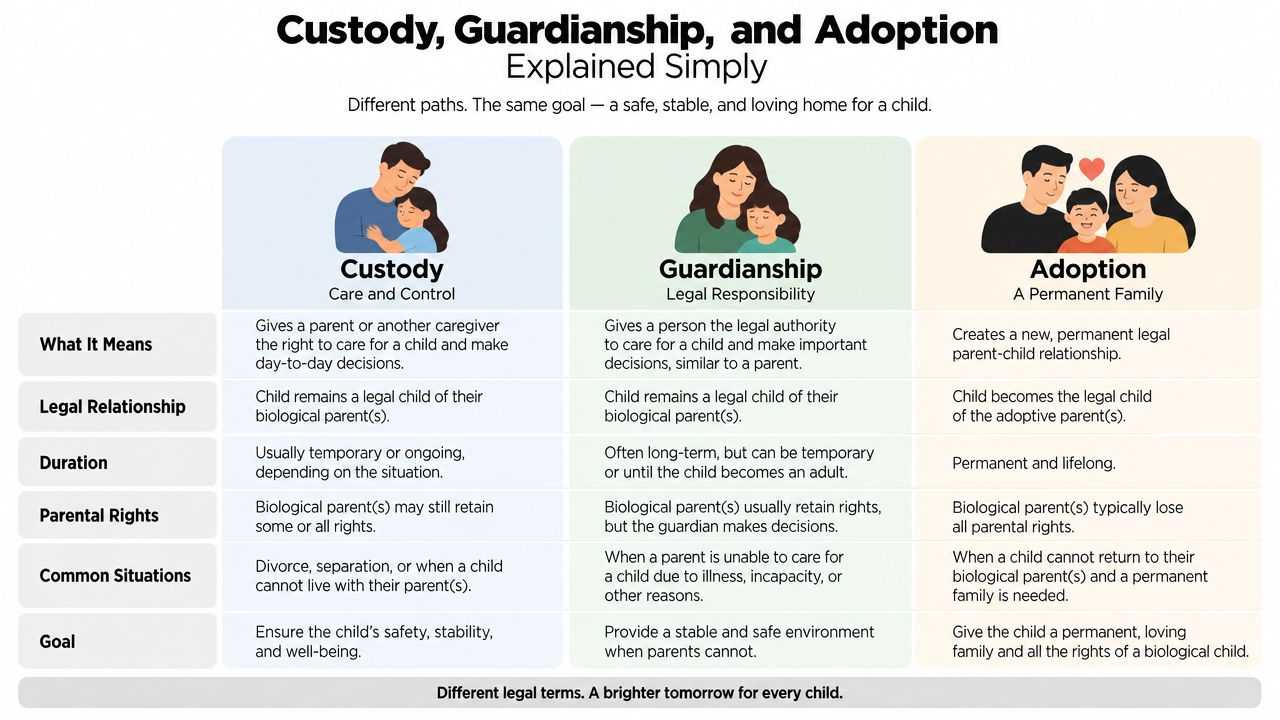
Custody, Guardianship, and Adoption Explained Simply
These terms overlap in everyday conversation, but they don't mean the same thing in court. Think of them as different legal tools rather than different names for one status.
Legal custody is the authority to make important decisions. It can cover school choices, healthcare, religious upbringing, and other major aspects of a child's welfare. Physical custody describes the child's living arrangement and daily care. A stepparent might receive one form of authority without receiving every form of authority, depending on the order and the state.
Guardianship gives responsibility without replacing parenthood
Guardianship is closer to being handed the keys to a car than buying the car. A guardian may receive authority to care for the child and make specified decisions, sometimes temporarily and sometimes for a longer period. The biological or adoptive parent's rights usually remain in place unless a separate legal process changes them.
That makes guardianship useful when a parent is alive but unable, unavailable, or unwilling to manage care. It can provide stability without permanently ending the legal relationship between the child and a parent. The exact powers depend on the type of guardianship and the order issued by the court.
Adoption creates full legal parent status
Stepparent adoption is the most complete route. Once finalized, the stepparent becomes a legal parent, with the rights and responsibilities that accompany parenthood. Adoption can also terminate the other biological parent's legal rights, but that consequence depends on consent or a court finding that supports termination under applicable law.
Adoption, guardianship, and custody therefore carry different paperwork, hearings, evidentiary demands, and long-term consequences. A family deciding among them should start with the desired result. Do you need emergency authority for medical care, a stable long-term caregiver, a continuing relationship after divorce, or full legal parenthood? The answer points toward a different legal process.
The Main Legal Routes a Stepparent Can Take
A stepparent's options depend on the child's legal parents, the family's level of cooperation, and the law of the state where the case is filed. These routes aren't interchangeable.
Stepparent adoption is the clearest path to full legal parenthood. In a cooperative case, the other biological parent may consent. If consent isn't available, the requesting party may need to prove a legally recognized basis for terminating that parent's rights, such as abandonment or unfitness. Adoption is permanent in a way that a temporary authorization or limited custody order usually isn't.
Guardianship can fit a family that needs court-supervised care but isn't pursuing adoption. A court may appoint a stepparent when a parent can't safely or consistently care for the child. Depending on state law, a guardianship may be limited, temporary, emergency, or longer term. A standby arrangement can also help families plan for a foreseeable absence, but the order's exact authority matters.
Third-party custody or de facto parent status addresses the stepparent who has functioned as a parent without becoming one legally. The threshold is often demanding. Courts may require proof of a substantial parent-child relationship, meaningful caregiving, and circumstances showing that the request serves the child's best interests. Some jurisdictions require evidence of detriment if contact is denied, while others require the stepparent to qualify as a de facto parent or guardian. This legal scholarship on stepparent custody and access describes the higher-threshold nature of nonparent claims.
Less-formal tools can cover immediate gaps. A parent may use a power of attorney or written authorization for childcare, school communication, or specified medical decisions. Those documents can help with practical tasks, but they usually don't give the stepparent an independent right to custody or visitation.
| Legal Route | What It Requires | What It Grants the Stepparent |
|---|---|---|
| Stepparent adoption | Consent or legally sufficient grounds to terminate the other parent's rights, plus the required court process | Full legal parent status |
| Guardianship | Court findings that guardianship serves the child's welfare | Authority defined by the guardianship order |
| Third-party custody | State-specific standing and proof supporting a nonparent request | Custody rights set by the court |
| De facto parent claim | Proof of a parent-like relationship and other jurisdiction-specific requirements | Potential standing for custody or visitation |
| Written authorization or power of attorney | Cooperation and signatures from the legally authorized parent or parents | Limited delegated authority, not automatic custody |
Before filing, review the requirements for filing custody papers in the relevant court and speak with a family-law attorney. A filing can start a process, but it doesn't itself create legal authority.
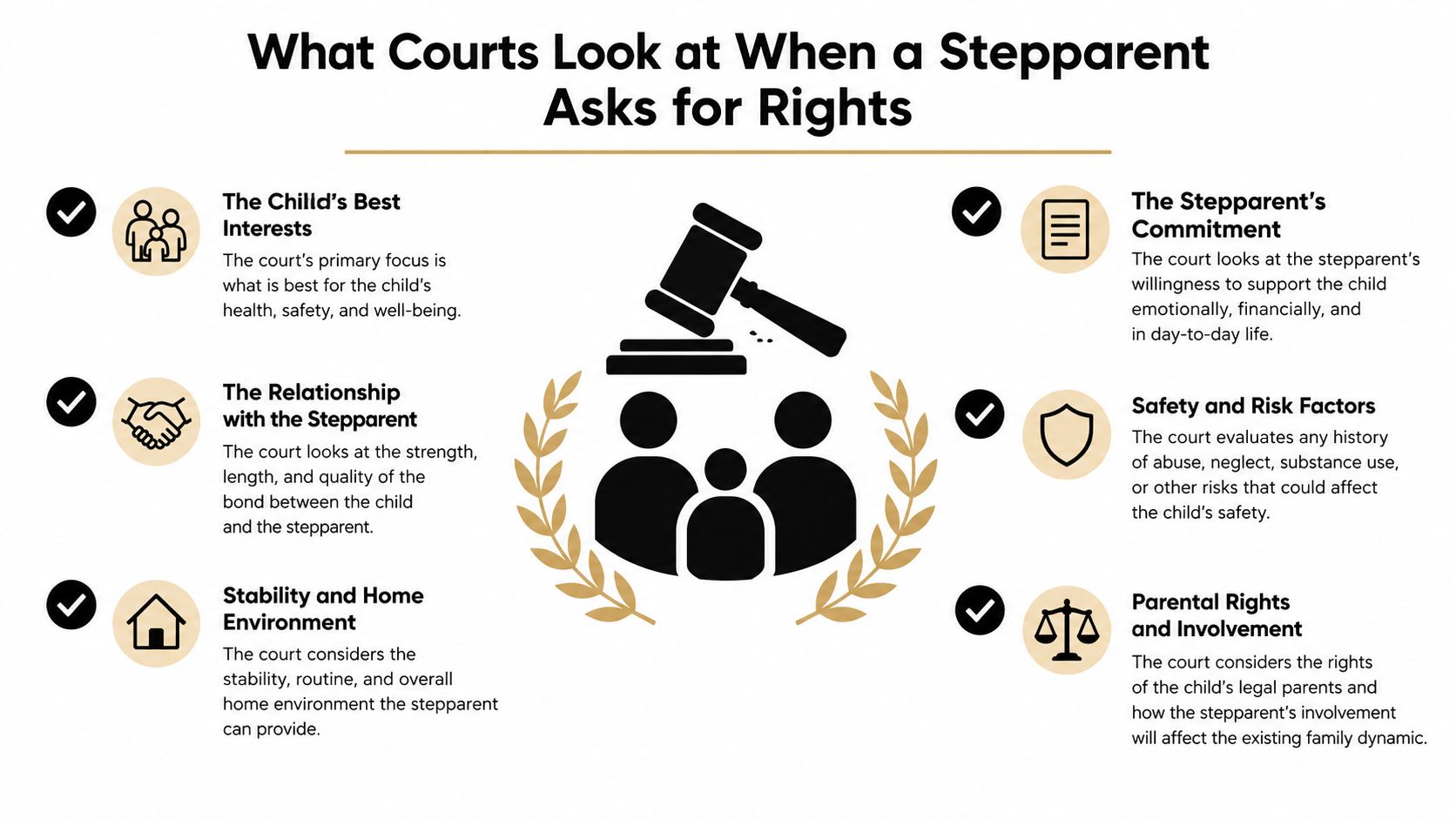
What Courts Look at When a Stepparent Asks for Rights
A court typically reaches the child's best interests only after deciding whether the stepparent is legally allowed to bring the request. Standing is the entry ticket. Without it, a judge may never weigh the quality of the relationship, the stepparent's caregiving history, or the proposed schedule.
Standing rules vary. Some states recognize a de facto parent who has lived with and cared for a child in a parent-like way. Others require a more serious disruption, such as a parent's death, incapacity, unavailability, or alleged unfitness. The summary of stepparent custody law and exceptions describes the uneven legal environment, including the fact that only a limited number of states have statutes specifically addressing stepparent custody.
Best interests are child-focused, not adult-focused
Once a stepparent clears the standing hurdle, the judge focuses on the child rather than rewarding the adult who provided the most help. Relevant considerations can include:
- Relationship history: How long the stepparent has been involved and whether care has been consistent.
- Emotional connection: Whether the child relies on the stepparent for comfort, guidance, and ordinary support.
- Parental positions: What the biological parents request and whether they can safely meet the child's needs.
- Home stability: Which arrangement supports continuity in school, health care, routines, and relationships.
- Requested contact: Whether the proposed custody or visitation schedule fits the child's life.
- Potential disruption: Whether the change would create avoidable emotional or practical harm.
A custody request generally asks the court to alter who has substantial authority or where the child lives. A visitation request is narrower, though it can still interfere with a fit parent's choices. Courts may therefore demand a stronger justification for one request than the other. Guidance on what judges look for in child custody can help families prepare questions, but it can't replace the law governing the specific case.
Real Scenarios Where Stepparent Rights Are Decided
Consider a cooperative family in which a stepparent has raised a child for years and the other biological parent agrees to adoption. The adults complete the required investigation, filings, consents, and hearing. If the court approves the adoption, the stepparent becomes a full legal parent, and the former legal parent's rights end if the order terminates them.
The lesson is that a close relationship alone didn't produce the result. Consent and a completed adoption process did. The family should still obtain advice about the consequences before signing anything because adoption changes the legal structure permanently.
A relationship tested by separation
In a contested case, a stepparent has been part of a child's daily life and seeks visitation after divorcing the child's parent. The biological parent objects, arguing that continued contact should be a private parenting decision. The judge may first ask whether the stepparent qualifies to petition under state law, then examine the relationship, the child's needs, the proposed schedule, and the likely effect of court-ordered contact.
The outcome could be limited visitation, no court-ordered contact, or another arrangement supported by the evidence. The practical lesson is to avoid assuming that years of caregiving guarantee access. The stepparent must identify a legal basis and show why the requested order helps the child.
A sudden loss or incapacity
A biological parent dies or becomes unable to care for the child. The stepparent may expect to continue parenting, but another relative may seek placement, or the child may face an emergency change in living arrangements. A guardianship petition, an existing will or nomination, temporary relief, and evidence of the established home can become important immediately.
Here, preparation matters before the crisis. Families should ask an attorney about standby or emergency arrangements, guardianship nominations, school and medical authorizations, and the documents a court would need to see. The discussion of stepparents and child custody after separation or parental loss highlights why the broad phrase “no rights” can hide important exceptions.
Building a Strong Record of Stepparent Involvement
A stepparent who may need legal recognition should document the parenting role while life is stable. Courts and mediators need more than a statement that you have always been involved. They need a clear account of what happened, when it happened, and how the child's routine depended on that care.
Keep entries factual. Record school pickups, homework supervision, medical appointments, activities, overnight care, expenses, and communications about the child's needs. Preserve supporting material, such as receipts, appointment confirmations, school messages, photographs, and written observations from teachers, coaches, or healthcare professionals when those observations are appropriate and lawfully obtained.
| Type of Record | Examples | Why It Helps |
|---|---|---|
| Daily caregiving | Pickup dates, meals, homework, bedtime routines | Shows continuity and practical responsibility |
| Education | School notices, meetings, permission requests, activity records | Connects the stepparent to the child's educational life |
| Healthcare | Appointment attendance, authorized communications, treatment logistics | Documents involvement without claiming authority you don't have |
| Financial support | Receipts for clothing, activities, medication, or supplies | Shows contributions tied to the child's needs |
| Relationship evidence | Neutral notes from teachers, coaches, or other adults | Helps describe the child's bond and routine |
| Agreements and exchanges | Written plans, handover notes, changes, and outcomes | Creates a dated account of cooperation or disruption |
A private custody journal such as Casewell's guide to custody journal contents can help organize entries, attachments, agreements, and expenses into a searchable timeline. Casewell is designed for private record-keeping and can produce focused PDF reports for professional review, but any record should remain accurate and consistent with legal advice.
Avoid turning documentation into a running argument. Don't use loaded labels, speculate about motives, or post private disputes publicly. Write as though a neutral professional will read the file later.
If a stranger opened the record, would they see a consistent caregiving role, or only a collection of grievances?
That question helps separate useful evidence from emotional commentary. Documentation can't create custody rights by itself, but it can help an attorney assess whether a de facto parent or other third-party claim is realistic.
Practical Next Steps and Common Misconceptions
Start with the family's immediate risk, not with a label. During the next week, identify the state whose law applies, list the decisions the stepparent currently makes, and note which tasks have already caused problems. Then create a dated caregiving timeline, gather existing records, and schedule a consultation with a family-law attorney.
Ask the attorney to compare the available route with the family's actual goal:
- Adoption by consent: Is the other biological parent willing to participate, and does the family understand the permanent consequences?
- Guardianship: Does the child need a responsible caregiver without terminating a parent's rights?
- De facto parent or third-party petition: Does state law recognize the relationship, and can the evidence meet the required threshold?
- Delegated authority: Would a written authorization solve a school, travel, or routine medical problem while the family considers a longer-term option?

Several common assumptions create avoidable confusion. Marriage alone doesn't grant custody rights. A higher income doesn't let a stepparent claim custody only because the biological parent earns less. Adoption doesn't merely add another supportive adult, it can terminate the other biological parent's rights when the legal requirements are met. And informal caregiving doesn't equal authority to consent to every medical, educational, or legal decision.
Urgent advice is appropriate when a child needs hospitalization consent, school enrollment is blocked, a custodial parent has died, or a parent is suddenly incapacitated. If there's no immediate crisis, neutral records, a cooperative conversation, and mediation may give the family time to choose the right legal path. A lawyer can tell you whether a proposed document is enough or whether only a court order will solve the problem.
Casewell helps stepparents and separated families keep dated, factual records of caregiving, exchanges, expenses, agreements, and supporting files in one private custody journal. Visit Casewell to organize the evidence an attorney or mediator may need when a real parenting role must be explained clearly.