

You're staring at a message thread at the end of a difficult exchange. The pickup happened late, the schedule changed without agreement, and the explanation arrived in fragments. You know the pattern is serious, but you also know that anger, memory, and scattered screenshots won't present it clearly to a mediator or judge.
That's where a parenting journal earns its place. It isn't a private space for insults, speculation, or emotional release. It's a chronological record of what happened, supported by original messages, receipts, photographs, calendar entries, and other evidence that someone outside the conflict can review.
Understanding the Purpose of a Parenting Journal
A parenting journal is a private, structured record of co-parenting events. It belongs to the parent keeping it, rather than functioning as a shared conversation with the other parent. The useful entry records the date, time, participants, event, and supporting proof while the details are still fresh.
Start one immediately if you're dealing with repeated missed or shortened parenting time, unapproved schedule changes, disputes about exchanges, unpaid child-related expenses, or communication that has become hostile and unreliable. You don't need to wait for a hearing. By the time a legal dispute is active, reconstructing months of events from memory is harder and less credible than maintaining a contemporaneous record from the beginning.
A journal is not a communications thread
A text message, email, or co-parenting conversation shows what people said to each other. A custody journal records what took place, including the scheduled arrangement, the actual result, and the proof attached to that event. Those are different functions.
Shared communication tools are often reactive. A parent sends a message because something has already gone wrong, and the exchange quickly turns into argument. A private journal should be observational. It should answer practical questions such as:
- What was scheduled: Record the agreed or ordered date, time, location, and parenting responsibility.
- What occurred: State when the child arrived, when the exchange ended, who attended, and what changed.
- Who was present: Identify the child, parents, witnesses, or other relevant people without guessing at their motives.
- What supports the entry: Preserve the full message thread, receipt, photo, calendar item, or other original artifact.
The purpose isn't to “win” every disagreement with the other parent. It's to create a reliable timeline that helps a lawyer, mediator, or court understand the sequence without asking you to rely on emotion or memory. Practical family-court guidance emphasizes that entries are strongest when they're factual, specific, written at or near the event, and cross-referenced to supporting evidence, as explained in this guide to documenting co-parenting for court.
Practical rule: Write for a neutral professional who knows nothing about your relationship with the other parent.
Avoid turning the journal into a running character assessment. “The other parent is selfish and always manipulates the schedule” is an allegation without usable detail. “The scheduled pickup was at 5:00 p.m. The other parent arrived at 5:28 p.m. A message stating ‘running late' was received at 5:14 p.m.” gives a reviewer something verifiable.
Legal and Mediation Benefits of Documented Records
A strong parenting journal follows the same basic logic as a chain of custody. In legal and forensic settings, chain-of-custody documentation tracks evidence chronologically from collection through handling, analysis, and disposition. Digital material deserves particular care because messages, files, and screenshots can be duplicated, altered, cropped, or separated from their original context. The discussion of co-parenting journals and chain-of-custody principles explains why chronology, accountability, and verifiability matter when a record may later be reviewed by someone outside the family.
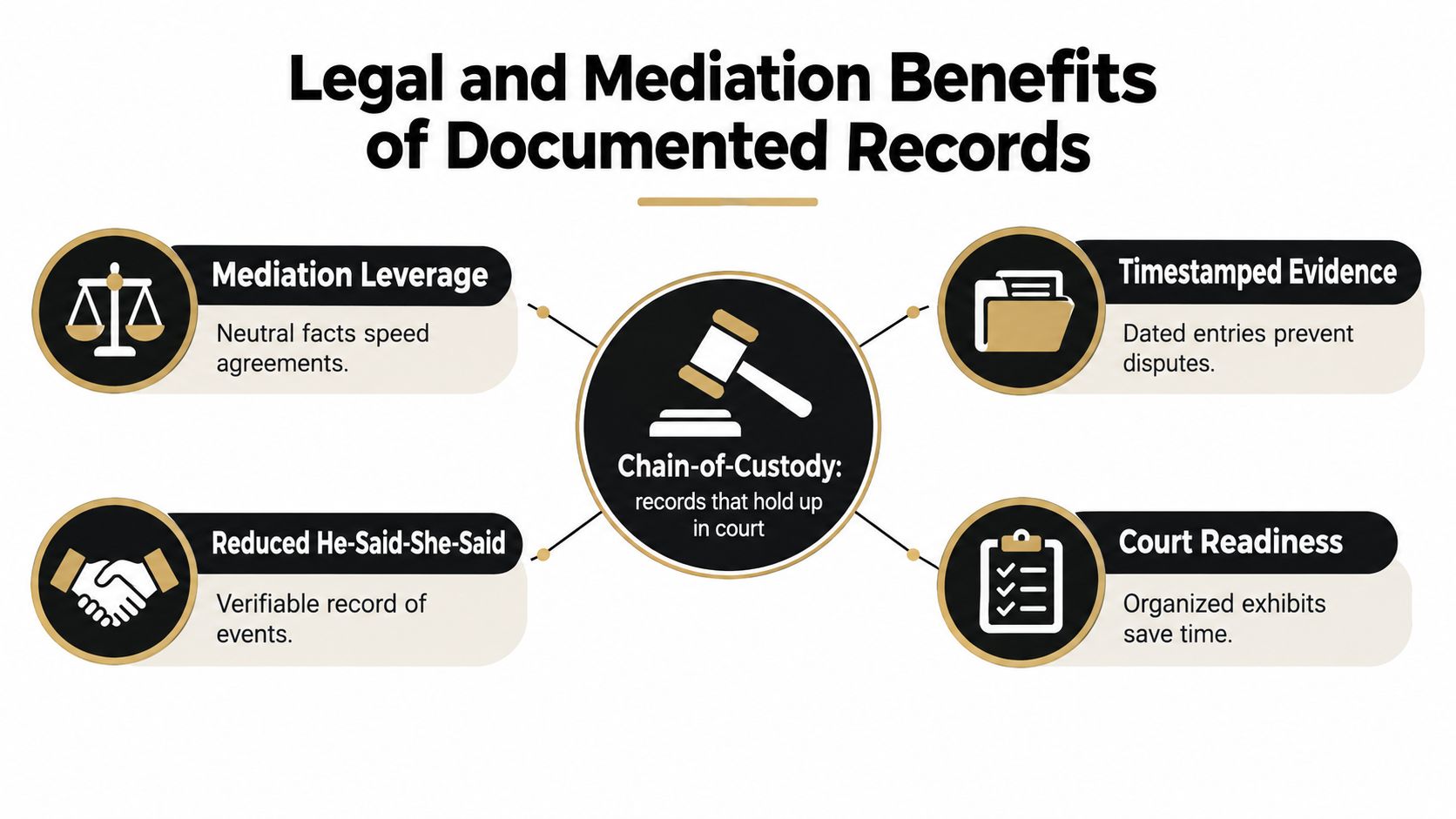
A contemporaneous note is one written at or near the time of the event. It's generally easier to authenticate and interpret than a timeline assembled long afterward, particularly when the entry preserves the original artifact beside it. That doesn't mean a journal guarantees admission or determines the outcome. Courts apply their own rules, and your attorney should advise you about admissibility in your jurisdiction. The practical point is that a dated, consistent record gives your professional adviser something concrete to evaluate.
Why structure improves credibility
High-conflict custody disputes produce fragmented evidence. One fact sits in a text thread, another in a payment receipt, another in a calendar, and another in a photograph. A single running log connects those pieces in sequence. It shows not only the complaint, but also the surrounding context, including agreed changes, attempted reimbursements, and exchanges that occurred without incident.
Memory is vulnerable under stress. People remember the emotional significance of an event while losing its exact time, wording, or order. A structured journal acts as an external memory anchor. It also discourages exaggeration because each statement should fit a date, an event, and an underlying source.
Mediation benefits from the same discipline. A neutral timeline can replace broad accusations with specific questions: Was the change agreed? When was notice given? What expense was requested? Was a receipt supplied? Which part of the parenting plan applies? That clarity can help professionals focus on resolving the disputed issue instead of sorting through a communications battle.
The guidance on documenting custody cases recommends recording events promptly, preserving original message threads and visible timestamps, and organizing records into a running timeline. Keep the original material intact. A cropped screenshot may hide the message before it, the account identifier, the date, or the response that changes its meaning.
Essential Categories to Track in Your Custody Journal
A freeform diary invites omissions. Use categories that match the disputes a legal professional is likely to assess. Each category should capture the event and connect it to the underlying proof.
| Category | Data Points to Capture | Legal or Practical Purpose |
|---|---|---|
| Exchange check-ins | Scheduled time, actual arrival and departure times, location, people present, child's condition as observed, related messages | Shows whether parenting-time exchanges followed the agreed arrangement and preserves context around delays or disruptions |
| Expenses and reimbursements | Date, item or service, amount shown on the receipt, who paid, request for repayment, response, amount repaid, remaining balance | Separates a genuine reimbursement request from a general complaint and keeps financial proof with the relevant event |
| Agreement deviations | Provision or agreement involved, scheduled arrangement, actual change, notice given, whether consent was requested or received, supporting communication | Makes it easier to compare conduct with the governing parenting plan or written agreement |
| Behavioral incidents | Date, time, location, people present, exact observable conduct, immediate response, witnesses or supporting files | Records concrete events without turning the journal into a diagnosis or argument about intent |
| Child-related information | Appointment, school communication, activity, missed responsibility, practical impact on the child, source document | Helps identify whether an issue concerns logistics, care, information sharing, or a disputed interpretation |
The difference between “track expenses” and a useful expense record is substantial. Identify the purchase, keep the receipt, note who paid, preserve the request for repayment, and record what happened afterward. Don't describe an expense as “refused” unless the messages or transaction history support that description. “Receipt sent with reimbursement request on [date]; no payment recorded as of [date]” is more defensible than “the other parent never pays anything.”
Record deviations without editorializing
A schedule change may be agreed, requested, imposed, or caused by an emergency. Those circumstances aren't interchangeable. Log what was scheduled, what notice was provided, what response you gave, and what transpired. If you don't know why the other parent acted, don't fill the gap with an assumption.
The custody journal contents guide can help you build a consistent contents checklist. Use it as a prompt, not as a substitute for your court order, parenting plan, or attorney's advice. Your journal should reflect the documents that govern your particular family.
Structuring Entries for Neutrality and Evidentiary Weight
Write the entry as if you're preparing a factual report, not an argument. Begin with the who, what, when, where, and why, but only state a reason when you personally know it or the source clearly provides it. If the other parent says traffic caused a delay, record that they gave that explanation. Don't convert the explanation into an established fact unless you can verify it.
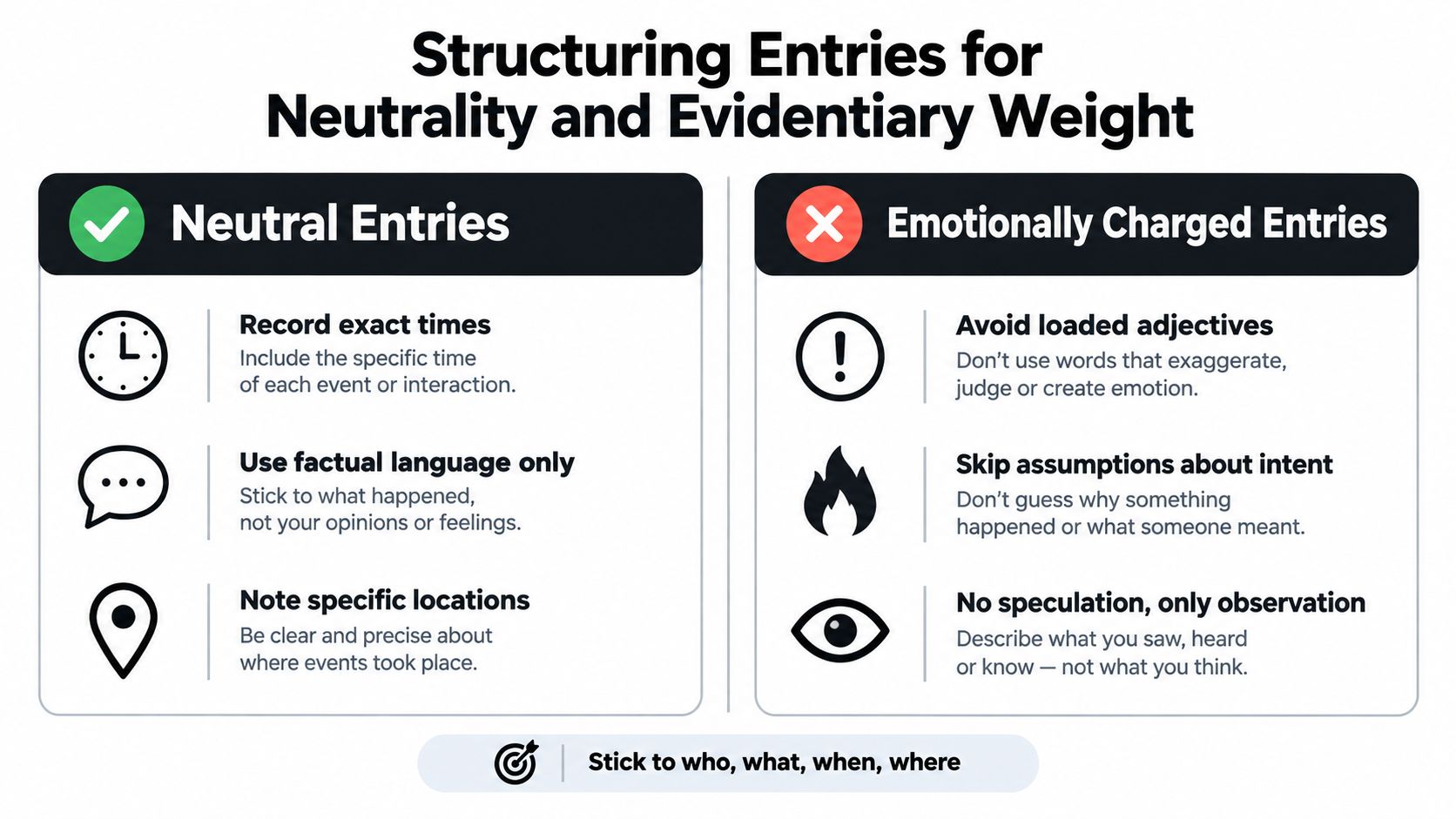
Compare these two entries:
“The other parent was deliberately late again and clearly doesn't care about our child.”
“The exchange was scheduled for 5:00 p.m. at the school parking lot. The other parent arrived at 5:28 p.m. The child and I waited in the vehicle. At 5:14 p.m., the other parent sent a message stating, ‘Running late.’ Full message thread attached.”
The first entry assigns intent and uses loaded language. The second identifies the scheduled time, actual time, location, people involved, observable conduct, and source proof. That structure gives a professional a basis for assessing the issue.
Use a repeatable entry method
Record the event as soon as practical. If you're too upset to write neutrally, save the original artifact first, then draft the journal entry once you're calm. A factual rewrite can remove judgment, but it shouldn't erase the original note or change the underlying facts.
- Date and time: Separate the event time from the time you wrote the entry when your system allows it.
- Participants and location: Name the child, adults, witnesses, and specific place involved.
- Observed facts: Describe conduct, words, arrival times, transfers, payments, or absences.
- Agreement or expectation: Identify the relevant schedule, order, or prior written arrangement.
- Supporting proof: Attach the full thread, unedited image, complete receipt, email, or calendar record.
Preserve original artifacts with their context. Don't rely only on a cropped screenshot or a paraphrase of a long conversation. A complete conversation with visible timestamps is easier to understand than a selected line that may appear misleading when isolated. The evidence checklist for custody documentation provides a practical way to check whether your supporting material is complete before you share it with a professional.
Your journal can include a separate personal reflection if writing helps you process the experience, but label it clearly and keep it apart from the evidentiary record. The court-facing portion should remain factual. A private emotional note may help you cope, yet it shouldn't be mistaken for proof.
Purpose-Built Custody Apps Versus Generic Note-Taking Tools
Apple Notes, WhatsApp, email, and ordinary calendar apps are convenient, but convenience isn't the same as evidentiary organization. A generic note may omit the event time, the child involved, the category of dispute, the original source, or the history of later edits. A message platform may preserve a conversation while leaving you to prove which exchange, expense, or schedule change it relates to.
| Tool type | Useful feature | Common weakness for custody records |
|---|---|---|
| Generic notes app | Fast freeform writing | No required fields, weak event categorization, and limited connection between notes and proof |
| Messaging platform | Preserves communication between participants | Shared, reactive, and focused on conversation rather than a private factual timeline |
| Calendar app | Shows planned appointments and exchanges | Usually records what was intended, not what actually happened or why it changed |
| Purpose-built custody journal | Structured entries, categories, attachments, timelines, and focused exports | Still requires accurate user input and should be reviewed with a legal professional before submission |
A dedicated custody journal should prompt the details people regularly forget: child, event type, scheduled time, actual time, location, participants, agreement involved, and attached evidence. It should also preserve the distinction between the time an event happened and the time an entry was created. That distinction matters when someone later asks whether the record was written contemporaneously or reconstructed.
Choose structure over convenience
Look for a searchable timeline, exchange prompts, linked agreement records, expense fields, attachment support, and export controls. Edit history matters too. If a record changes, the system should preserve earlier versions or otherwise show what was changed and when. A polished PDF is useful only when the underlying record remains trustworthy.
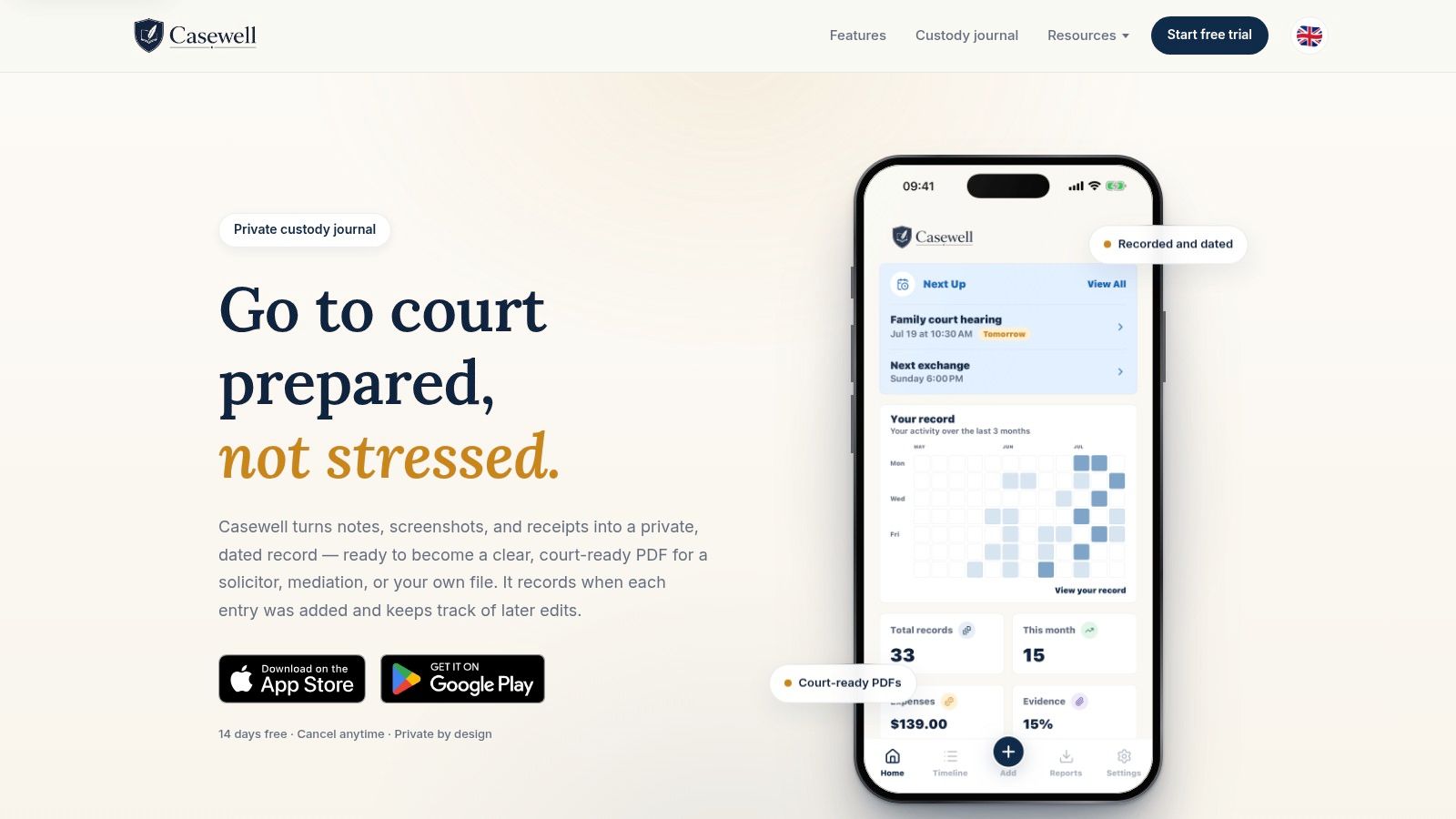
A private tool is also preferable to a shared message space when communication is unstable or unsafe. You shouldn't need to invite the other parent to keep your own factual records. Casewell is one example of a purpose-built private custody journal. It organizes dated entries, exchange check-ins, agreements, expenses, screenshots, receipts, and other files, then supports focused PDF exports that show dates and edit history.
Before choosing any app, read its privacy and export terms. A tool that looks organized but automatically shares your notes, hides revisions, or makes it difficult to retrieve original files creates a different problem. This comparison of custody journal apps can help you evaluate tools by their documentation features rather than by appearance alone.
Privacy and Security in High-Conflict Co-Parenting
In a high-conflict separation, privacy is part of the documentation strategy. A shared calendar can be changed. A message may be deleted from one platform. A co-parent who has access to a private journal could read emotional reflections, remove context, or use unrelated personal material to distract from the actual issue.
That's why a custody journal should be private by design. It shouldn't automatically share entries with the other parent, and it shouldn't turn every factual note into another opportunity for confrontation. The parent maintaining the record needs control over access, attachments, exports, and revisions.

Separate communication from preservation
Use the communication channel required by your order or parenting agreement for notices, requests, and necessary co-parenting information. Use the private journal to document what happened and preserve the related evidence. Don't send the journal entry to the other parent as a way to force an admission. That usually turns a record into another argument.
Security features should match the risk. Consider app locks, private vaults, device security, controlled backups, and clear export permissions. On-device storage by default can reduce unnecessary exposure, but no digital system is risk-free. Protect the device itself, use a strong passcode, and understand whether files are synchronized to other devices or accounts.
Keep sensitive material proportionate
Privacy doesn't mean saving everything indiscriminately. Store material that relates to the parenting issue, the child's care, an agreement, an expense, or a specific incident. Don't collect unrelated private information just because it's available. A focused record is easier to defend and easier for a lawyer or mediator to review.
The high-conflict co-parenting resource reflects the practical distinction between private documentation and shared communication. Your journal should protect your ability to record facts without requiring cooperation from the person whose conduct you're documenting. If you're concerned about stalking, coercive control, device access, or retaliation, speak with your attorney or a domestic-violence advocate before selecting a storage method or exporting records.
Building a Sustainable Documentation Routine
A parenting journal works only if you can maintain it. Don't aim to write a perfect narrative after every difficult interaction. Capture the essential facts promptly, attach the original proof, and reserve a regular review period for organization.
Use a simple workflow:
- Capture the event: Write the date, time, participants, location, and immediate facts as soon as practical.
- Attach the source: Keep the full message thread, receipt, photograph, email, or calendar record with the entry.
- Check for neutrality: Remove conclusions about motive, labels, sarcasm, and language you can't support.
- Review the timeline: Look for missing dates, duplicate entries, unlinked evidence, and unresolved expenses.
- Export selectively: Prepare a focused report for the specific issue your attorney or mediator needs to assess.
A weekly review is useful because it catches gaps without encouraging you to rewrite history. Check whether each entry distinguishes the scheduled arrangement from the actual event. Confirm that receipts and screenshots are readable, that attachments still open, and that later edits are visible rather than replacing the original without a trace.
Write for the next professional reader
An attorney rarely needs an unfiltered dump of every personal note. They need the records relevant to the hearing, motion, mediation issue, expense dispute, or schedule pattern under review. Export the narrow set requested, organized chronologically, with a short factual summary and links or attachments to the underlying proof.
AI factual rewriting can help turn an angry draft into neutral wording, but treat it as an editing aid, not a fact-finder. Review every suggested sentence yourself. Preserve the original note, confirm all times and names, and reject any wording that adds certainty, motive, or detail you didn't provide.
The core discipline is simple: record promptly, preserve originals, separate observation from interpretation, and keep the timeline organized. That approach doesn't guarantee a particular legal result. It gives your adviser a clearer record and protects you from relying on a stressful, incomplete memory when the details matter most.
Start with the next exchange, expense, or schedule change. Open a private record, enter the facts while they're fresh, attach the original proof, and ask your attorney which records should be exported for professional review.
Casewell gives separated parents a private custody journal for dated, factual records, with structured entries for exchanges, agreements, expenses, screenshots, receipts, and related proof. If you need a controlled timeline and focused PDF reports for an attorney or mediator, visit Casewell and review whether its documentation workflow fits your situation.