

You may be sitting at your kitchen table with a court notice, a folder of screenshots, and the same question running through your mind: what happens at a child custody hearing? You might be worried that one awkward answer, missing document, or emotional moment will determine where your child lives forever.
That fear usually comes from treating court as one dramatic event. In practice, custody litigation is more often a sequence of hearings, temporary decisions, evidence reviews, negotiations, and follow-up orders. The more clearly you understand which stage you're entering, the easier it becomes to prepare the right records and respond to what the judge is deciding that day.
Walking Into Your First Custody Hearing
Maria, a fictional mother of two, arrives at the family courthouse on a Tuesday morning, 45 minutes early. She has a manila envelope containing her notice, a folder of school emails, and a notebook where she has written questions she doesn't want to forget.
Security checks her bag before she enters. At the clerk's window, she gives her name and case number. The clerk hands her a hearing-calendar sticker and points toward a hallway where several parents are already waiting. Along one wall, posted orders and courthouse notices overlap in neat but intimidating rows. The hallway is quiet except for muted conversations, footsteps, and occasional announcements through a speaker that aren't quite clear enough to understand.
Maria sits among other parents holding folders and envelopes. Some are with attorneys. Others stare at their phones or read the same page repeatedly. A line forms outside the judge's chambers. A clerk calls brief status matters. Someone asks where to file a paper-only document. These ordinary routines help Maria understand that the courthouse isn't waiting for a dramatic speech. It's processing many small procedural steps.
The first hearing may be short and focused on procedure, scheduling, or temporary orders rather than a full trial. Many initial custody hearings last about 20 to 60 minutes, while contested final hearings can take substantially longer, from half a day to several days, and complex matters may require multiple court dates over a much longer period, as described in this guide to first custody hearings.
When the bailiff calls Maria's case, her stomach feels hollow. The heavy courtroom doors open, and she follows the other parent inside. The judge may ask what issues remain, what temporary schedule is in place, or what must happen next. That day matters, but it may be one checkpoint in a staged process, not the final judgment on the family.
The Three Types of Custody Hearings You May Be Called To
The label on your notice matters. A date described as a temporary, evidentiary, or final hearing usually signals what the judge is authorized to decide and how much evidence the court expects to hear. Local rules differ, so read the notice carefully and ask the clerk or your lawyer if the wording is unclear.
| Hearing Type | Timing | Purpose | Evidence Allowed | Typical Outcome |
|---|---|---|---|---|
| Temporary hearing | Early in the case or after an urgent motion | Address immediate custody, safety, or parenting-time needs | Sworn declarations and limited exhibits may be used, depending on local rules | Interim schedule, temporary restrictions, or directions for the next stage |
| Evidentiary hearing | After the parties have identified disputed facts | Receive testimony, documents, and other evidence in a trial-style setting | Authenticated records, witnesses, exhibits, and evidence admitted under applicable rules | Findings about disputed facts and directions toward a final order |
| Final hearing | At the conclusion of the contested case, sometimes combined with the evidentiary hearing | Decide the lasting parenting arrangement and related issues | The complete evidentiary record permitted by the court | Final custody order, parenting plan, and related financial determinations |
Temporary hearings
A temporary hearing isn't necessarily a smaller version of a final trial. The judge may need to establish a workable schedule while the case continues, especially when parents disagree about immediate care, exchanges, or contact. The court may rely on sworn written statements and limited documents rather than hearing every witness.
That means a parent should be accurate and focused even if the hearing is brief. An interim order can shape daily life while the remaining evidence is gathered.
Evidentiary and final hearings
An evidentiary hearing is the stage where disputed facts receive closer examination. Parents or other witnesses may testify under oath, answer questions from the opposing side, and offer documents through the required foundation. A final hearing may include that same process and end with a binding custody order.
Look for phrases such as “temporary relief,” “motion hearing,” “status conference,” “trial,” “evidentiary hearing,” or “final hearing.” If the notice only says “custody hearing,” don't guess what format applies. Confirm whether you're expected to bring witnesses, exhibits, proposed orders, or only materials related to a specific motion.
What Actually Happens Inside the Courtroom
A courtroom has a physical order that reflects the legal order of the hearing. The judge sits at the raised bench. The clerk manages the file and records. A court reporter or recording system preserves the proceeding where required. The parties usually sit at separate tables, and a witness speaks from a designated chair after taking an oath.
The moving party, sometimes called the petitioner, generally presents first. The responding party follows. The exact sequence can change based on local rules, the type of hearing, or the judge's instructions, but the basic structure is designed to let each side present a position and respond to the other.
The Virginia custody-hearing explanation describes a mini-trial structure involving live testimony under oath and documentary exhibits such as emails, school records, medical records, bills, photographs, texts, videos, and voice messages.
How testimony and exhibits fit together
An opening statement is a roadmap. It tells the judge what you expect the evidence to show. It isn't the time to interrupt the other parent, argue every detail, or introduce a document that hasn't been admitted.
In some family courts, much of a parent's direct evidence comes through declarations or written submissions. If live testimony is required, the witness answers questions from the party who called them. The opposing party then conducts cross-examination, which means asking questions designed to test accuracy, memory, completeness, or consistency.
Objections are short statements about a legal problem with a question or answer. The judge may sustain an objection, meaning the problem is accepted and the question or evidence is limited, or overrule it, meaning the evidence can proceed. You don't need to argue with every objection. Wait for the judge's ruling and follow the instruction.
To offer a text message or record, the presenting party generally must establish a foundation. That may involve identifying who created it, how it was received, and why it is an accurate copy. The document becomes part of the evidence only if the judge admits it.
What happens after the evidence
At the end, the judge may announce an oral ruling, reserve a decision, or direct the parties to submit proposed orders. A clerk's minute entry or signed order may later reflect what the judge decided. If a commissioner or standing master presides, that judicial officer may conduct the hearing under the authority and procedures established by the court.
The case moves forward through this sequence: a question, a response, a document, an objection, a ruling, and a written order. A single emotional statement rarely carries the case by itself.
Building an Evidence Packet a Judge Can Trust
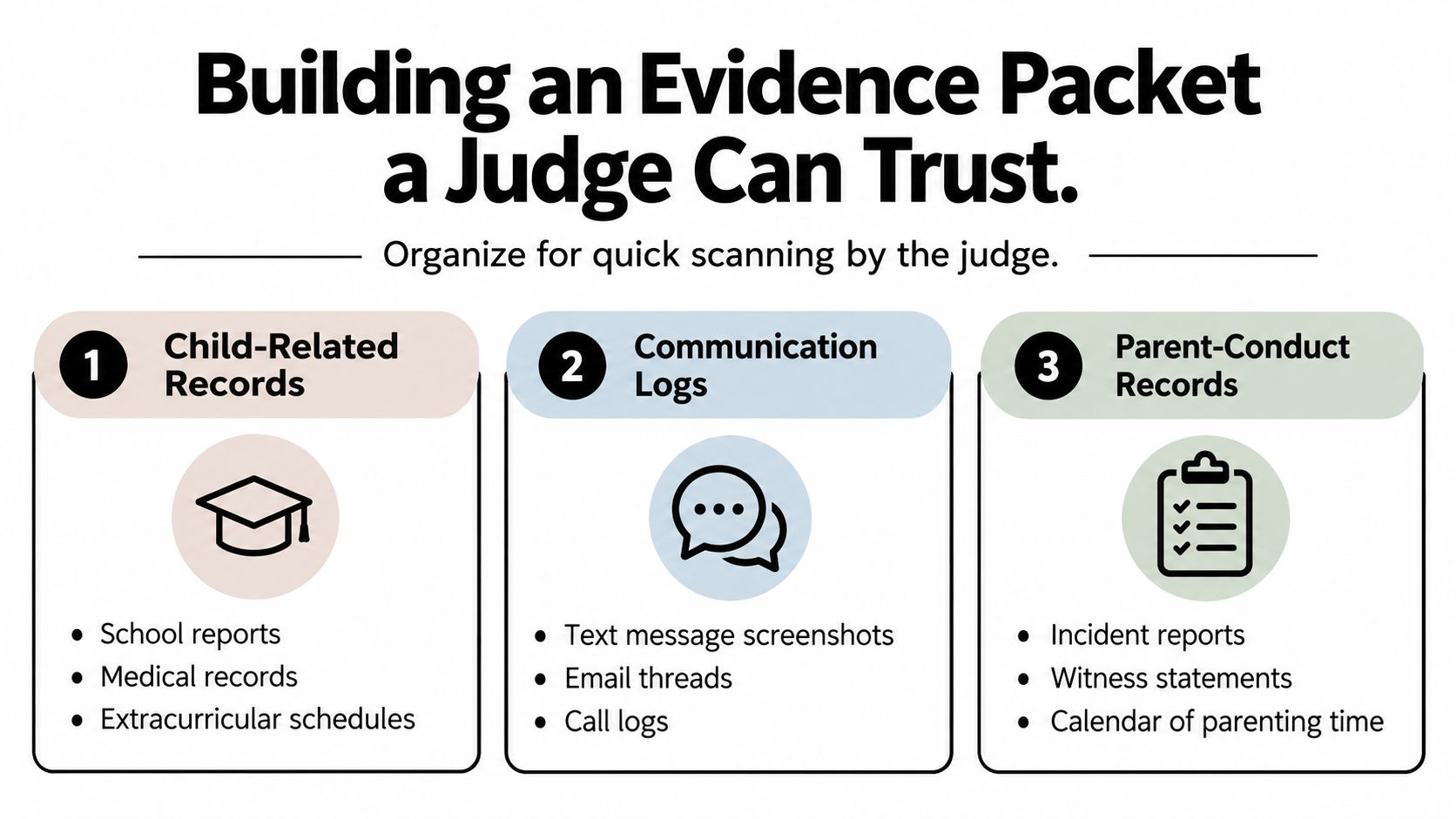
A useful evidence packet lets the judge answer a factual question quickly. Start with an index, mark each proposed exhibit, and separate records into categories instead of placing every screenshot and receipt in one pile.
Three tabs that make the file readable
- Child-related records: Include school attendance information, report cards, medical records, appointment information, activity schedules, and documents showing who handled a child-related task.
- Communication logs: Preserve relevant texts, emails, co-parenting messages, and call information in date order. Keep the sender's identity, timestamps, and enough surrounding conversation to explain the exchange.
- Parent-conduct records: Use incident reports, neutral witness statements, parenting-time calendars, exchange notes, and records tied to a specific concern.
A screenshot without a visible date, sender, or surrounding context may raise more questions than it answers. Don't crop away the identifying information that helps establish authenticity. A photo should retain available file information, and a social-media post may require testimony or a declaration from someone who can explain where it came from and whether it accurately reflects the original.
The evidence preparation checklist can help you identify missing categories before you meet with counsel.
Practical rule: Every exhibit should answer one factual question, and that question should connect to a custody issue the judge must decide.
Weak evidence often consists of a voicemail reduced to “the other parent was terrible,” an unsorted folder of hundreds of photographs, or an email printed without its header and surrounding thread. Those materials may contain useful information, but the judge needs dates, authorship, context, and a clear reason the item matters.
Print a one-page index listing the exhibit number, date, short description, and issue supported. Keep the original files safely stored, and don't alter the underlying material after creating a court copy without recording what changed and why.
A short demonstration of the type of documentation that can support a custody record appears below.
What Judges Actually Weigh in Custody Decisions
Custody decisions usually turn on the best interests of the child, but that phrase is too broad to guide preparation by itself. The useful question is: what dated record would help the judge evaluate a particular factor?
A parent's general statement, “I'm very involved,” is less useful than a school record, appointment confirmation, activity schedule, or calendar entry showing what happened and when. The judge is evaluating patterns and reliability, not awarding points for the most emotional description.
| Best-Interests Factor | Supporting Documentation |
|---|---|
| Stability and continuity | School attendance records, housing documents, consistent schedules, and dated routine notes |
| Safe environment | Police or protective-service records where relevant, medical summaries, and documented safety concerns |
| Parent-child relationship | Teacher or coach observations, activity records, appointment participation, and neutral descriptions of time spent together |
| Ability to cooperate | Exchange logs, calendar records, written proposals, and child-focused communications |
| Educational and medical involvement | School correspondence, report cards, medical appointment records, treatment instructions, and follow-up notes |
| Financial and practical support | Healthcare receipts, daycare invoices, activity costs, clothing expenses, and payment or reimbursement records |
Turn each concern into a document question
Suppose you're asking for a schedule that protects school continuity. Your records should show the school routine, attendance, transportation, and your ability to handle the proposed exchanges. If the dispute concerns medical care, identify the appointment, the information received, the action taken, and any follow-up.
A record doesn't become stronger because it criticizes the other parent. It becomes stronger when it is specific, neutral, and connected to the child's welfare. Keep descriptions factual: “The exchange occurred at the agreed location at the recorded time,” not “The other parent was impossible again.”
The guide to what judges look for in child custody matters can help translate broad custody concerns into categories for review.
Create a spreadsheet with one row for each issue, a date range, the relevant factor, the supporting document, and the action you want the court to take. That map is easier to evaluate than a stack of unlabeled pages.
Courtroom Etiquette and Day Of Preparation
Good courtroom conduct won't replace evidence, but poor conduct can distract from it. Treat the hearing as a professional appointment where the judge must manage a formal record, not as a private argument with the other parent.
Before you leave home
Wear clean, conservative clothing suitable for a business setting. Avoid hats, slogans, clothing that restricts movement, or anything that makes you look as though you're attending a casual outing. Bring your photo identification, hearing notice, exhibit binder, copies required for the other side, writing materials, water, and a quiet snack for waiting time.
Leave weapons and noisy devices at home. Silence your phone and disable alerts on watches or tablets. Unless the court order requires a child's presence, arrange childcare. Children often shouldn't sit through adult testimony or see parents react to allegations.
Inside the courtroom
Stand when the judge enters or leaves if the courtroom instructs you to do so. Address the judge as “Your Honor.” Speak only when it's your turn, answer the question asked, and pause if you need a moment to collect yourself.
If you need a break, say so respectfully: “Your Honor, I'm having difficulty concentrating and request a brief break if the court permits.” Don't interrupt testimony, react visibly, whisper across the table, or send messages while someone else is speaking. If the other parent says something upsetting, write a note for your attorney or wait for your opportunity to respond.
Unscheduled witnesses can create procedural problems. Confirm in advance whether the court requires a witness list, subpoenas, or permission to call someone who wasn't disclosed.
If the hearing is remote
Test the video link, microphone, camera angle, and internet connection before court begins. Position the camera at eye level, use front lighting, mute yourself when you aren't speaking, and keep your documents within reach. Have a backup phone number for the clerk or court contact, but don't assume you can substitute a remote appearance without authorization.
The divorce preparation checklist offers a broader logistics framework that can be adapted to a custody hearing. During the week before court, confirm the location or link, review your exhibit index, organize transportation and childcare, notify work, sleep normally, and plan to arrive early enough to clear security.
Working With Attorneys, Mediators, and Court Appointed Experts
The same dated record can serve different purposes depending on who reviews it. An attorney may divide it into pleadings, motion exhibits, trial exhibits, and documents reserved for cross-examination. That doesn't mean every private note belongs in court. Counsel must decide what is relevant, admissible, safe to disclose, and strategically useful.
A mediator looks for concrete information that can turn accusations into proposals. A dated exchange record may help identify a workable pickup location. A school calendar may expose a scheduling conflict. A series of written proposals may show where the parents agree and where they need a specific solution.
A guardian ad litem or other court-appointed child representative may review documents, interview parents, speak with the child, and compare competing accounts. Neutral records are often easier to evaluate than a long narrative about the other parent's character. Don't coach your child or ask the child to collect evidence. Give professionals the records they request and let them conduct their own assessment.
After an order is entered
A parenting coordinator, where appointed, may help manage implementation problems such as exchanges, communication, or recurring disagreements. A dated log can show whether a disagreement arose from a one-time misunderstanding or a repeated departure from the parenting plan.
The lawyer preparation guide can help you bring an organized record to an attorney meeting. A private custody journal such as Casewell lets a parent store dated entries, exchange notes, messages, receipts, agreements, and attachments, then select relevant records for a PDF that a lawyer or mediator can review. It's a record-keeping tool, not a substitute for legal advice or communication with the other parent.
The Hearing Is One Stage, Not the Final Verdict
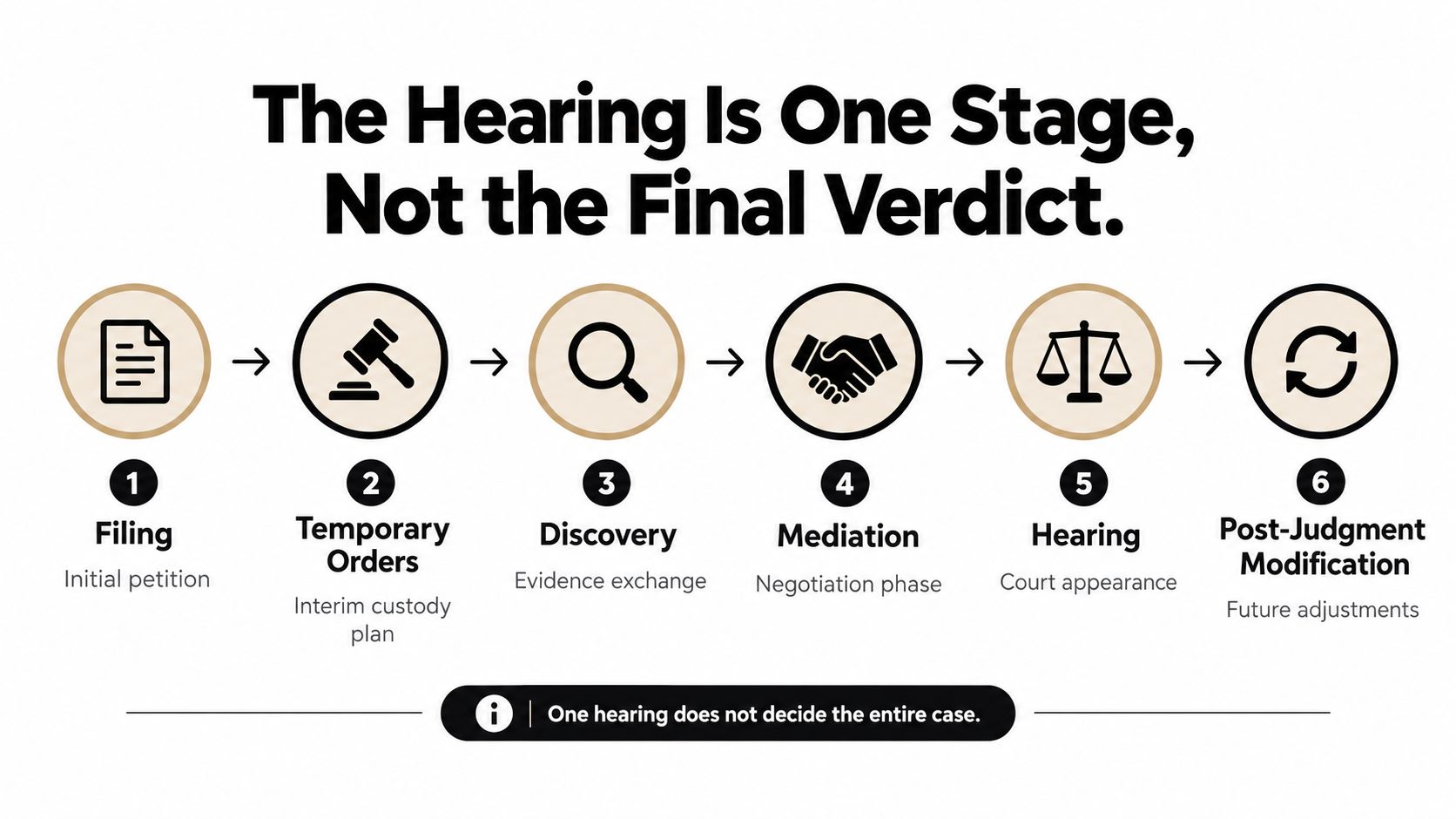
Many parents assume the first contested hearing decides custody permanently. That assumption creates unnecessary panic and can lead someone to treat a temporary ruling as proof that the judge has already chosen a winner.
A custody case may involve filing, temporary orders, evidence gathering, mediation, a contested hearing, and later review or modification. Court materials also describe practical distinctions between brief procedural appearances and proceedings where the judge receives more substantial evidence. The New Jersey parent handbook emphasizes preparation for courtroom logistics, documents, notes, and the possibility that an early appearance won't resolve every issue.
What the broader pattern tells you
A widely cited estimate reports that roughly 90% of custody cases settle without trial through mediation or agreement, while a separate 2020 estimate says 71% of child custody cases involved at least one hearing, according to this family-court statistics overview. Those figures point to a process in which hearings and negotiated agreements often overlap, rather than a single courtroom event deciding every matter.
A hearing may result in a temporary schedule, a discovery deadline, mediation, a custody evaluation, a guardian ad litem appointment, parenting coordination, or another information-gathering step. The judge may be deciding what must happen next, not only who is right.
Before the date, confirm:
- Documents: Is the exhibit index complete, and are copies prepared as required?
- Witnesses: Are the expected witnesses available, disclosed, or subpoenaed if necessary?
- Childcare and transportation: Can you attend without bringing the child unless directed?
- Work and access: Have you notified your employer and confirmed the courthouse or video link?
- Follow-up: Will you review the order, calendar deadlines, and preserve new records afterward?
A calm lawyer isn't necessarily a lawyer with a weak case. A temporary setback isn't automatically permanent. The judge isn't selecting a winner between parents. The court is applying legal standards to the child's needs, the available evidence, and the order that can function in real life.
If you're preparing for a custody hearing, Casewell can help you keep private, dated records of parenting time, exchanges, messages, expenses, agreements, and attached proof. Use those organized records to prepare with your attorney or mediator, and start building a clear timeline before your next court date.