

You may be looking at a parenting-time calendar and still not know who has the authority to make an important decision. Your child spends weekdays with one parent, weekends with the other, and both parents attend school events. Then a disagreement arises about a medical treatment, school enrollment, counseling, or religious instruction. The schedule shows where the child is, but it may not answer who gets to decide.
That uncertainty is why the legal custody definition matters. Legal custody is a court-created status involving decision-making authority and parental responsibility. The exact answer always depends on the wording of the custody order and the law in the relevant jurisdiction, so a label such as “joint custody” should be treated as a starting point, not a complete explanation.
What Legal Custody Actually Means in Family Court
A parent can have frequent overnight visits and still lack authority over a major school or healthcare decision. Another parent may have fewer overnights but hold the legal power to approve treatment, choose a school, or make a welfare decision. The parenting schedule and the decision-making structure can overlap, but they aren't the same legal question.
A formal Ohio legal definition of custody describes legal custody as giving the custodian the right to exercise physical care and control, determine where and with whom the child lives, and the responsibility to protect, train, discipline, and provide food, shelter, education, and medical care, subject to remaining parental rights. That wording shows why custody reaches beyond a visitation calendar. It connects authority with ongoing duties toward the child.
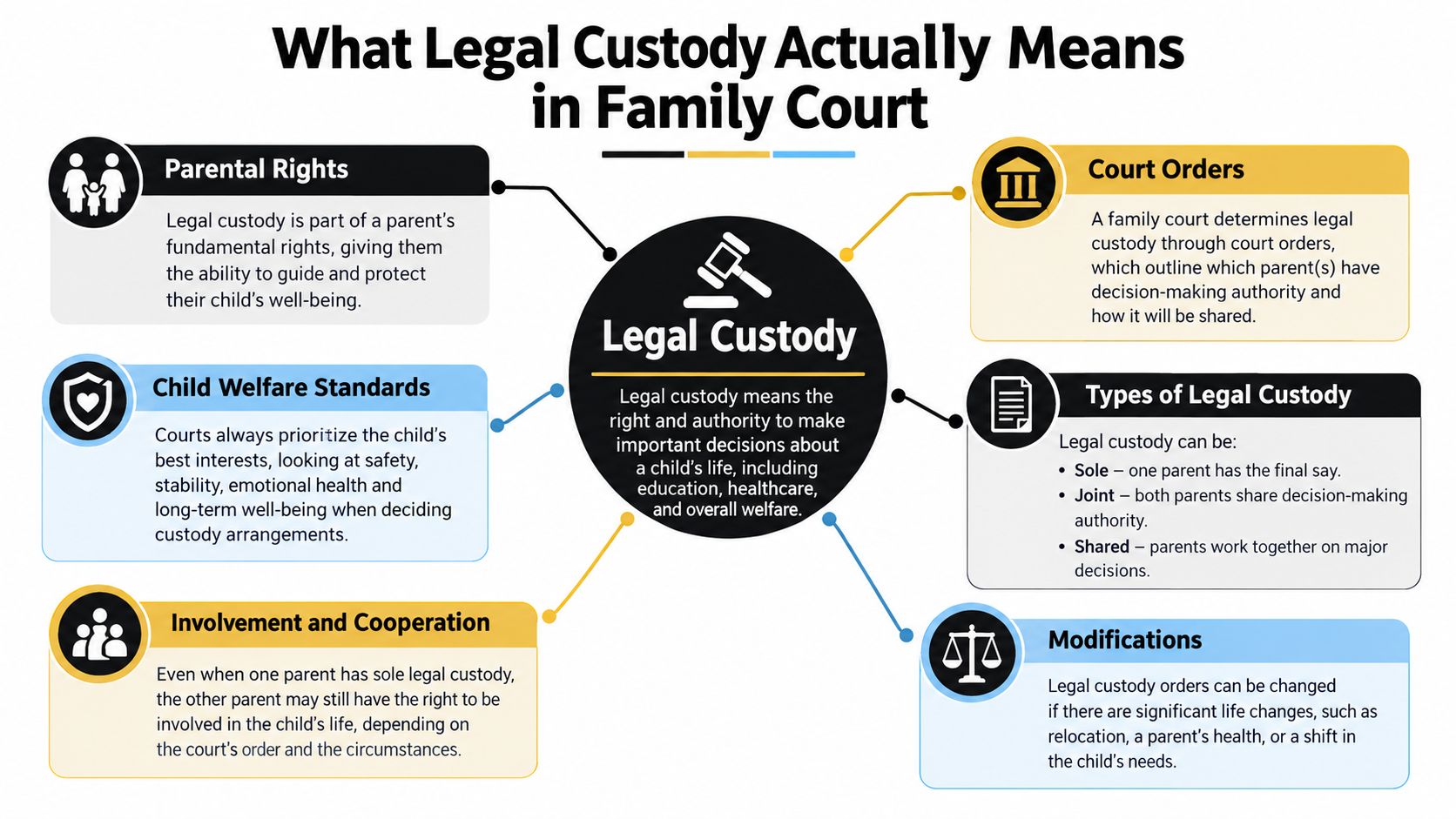
Authority is different from access
Consider a parent who learns that the child's school recommends a specialized program. The other parent may object, delay a response, or insist that both parents must agree. Whether that conduct affects legal custody depends on the order. The document may give one parent final authority, require consultation, or require a joint decision.
Legal custody commonly concerns:
- Education: Decisions about school placement or other significant educational arrangements.
- Healthcare: Major treatment, providers, or procedures, subject to emergency rules and the order's wording.
- Religious upbringing: Decisions about religious instruction or participation.
- General welfare: Significant choices affecting the child's safety, development, or long-term interests.
Daily care still matters. A custodian may have responsibilities for discipline, shelter, food, and supervision, but a professional reviewing a dispute must distinguish a routine parenting choice from a decision reserved to legal custody. Parents seeking broader family-law context can also review what family court handles, while keeping the operative custody order at the center of the analysis.
Legal Custody vs Physical Custody and Parenting Time
A child may spend most nights with one parent while both parents share time during the week. That schedule answers where the child stays and who provides daily care. It does not, by itself, answer who may make a major decision.
The three concepts describe different parts of the order:
- Legal custody concerns authority over significant decisions, such as education, healthcare, religious upbringing, and the child's general welfare.
- Physical custody concerns the child's living arrangements and day-to-day care.
- Parenting time identifies when a parent is scheduled to care for or spend time with the child.
The North Carolina Courts explanation of child custody makes the distinction between decision-making authority and the child's residence or schedule. A parent can have time with the child without holding authority over every major choice. A parent with decision-making authority may still need to follow a separate schedule for in-person care.
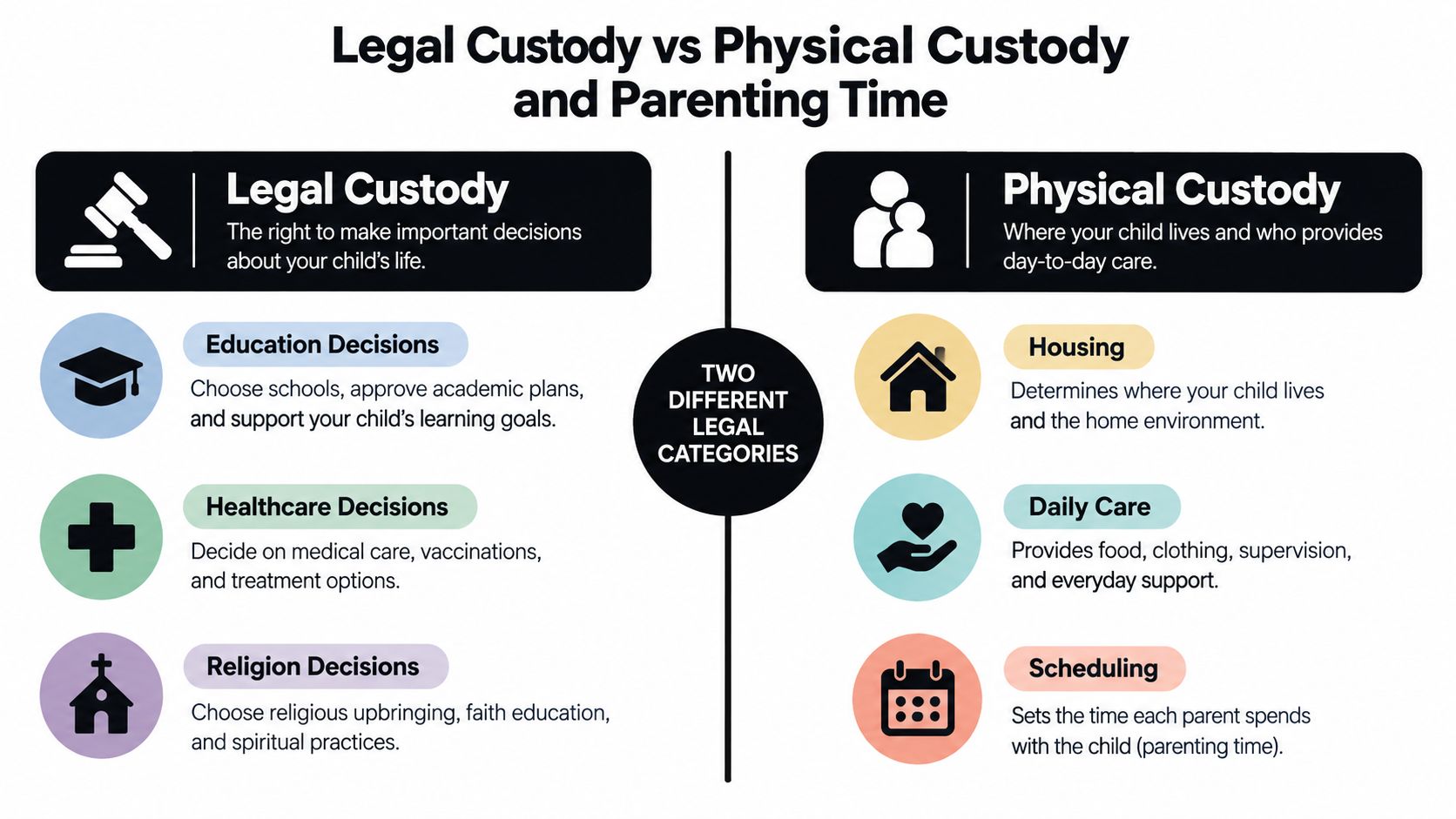
Consider a parent who schedules a routine appointment during scheduled parenting time. That is usually part of ordinary care. If the same parent consents to a major procedure, the issue may fall under legal custody, depending on the order, the treatment, notice or consultation duties, and any emergency exception.
For each disputed event, separate the questions:
- Where was the child supposed to be? This addresses physical custody or parenting time.
- What care was required then? This concerns supervision and routine decisions.
- Who could authorize the disputed choice? This identifies the legal-custody issue.
A record should connect the event to both the schedule and the decision involved. Keep the relevant messages, notices, appointment details, and order language together. That turns an abstract disagreement into evidence a court can evaluate.
For a plain-language explanation of living arrangements, see what physical custody means. Never use the number of overnights as proof of decision-making authority. Read the operative clauses, including any terms such as legal decision-making, decision-making responsibility, or authority over a specified issue.
Joint Legal Custody and Sole Legal Custody Explained
Sole legal custody generally allows one parent to make covered decisions independently, subject to the limits in the order and applicable law. The other parent may still have parenting time, access to information, or rights that remain expressly preserved. Sole legal custody doesn't necessarily erase every parental right.
Joint legal custody generally means both parents share authority and are expected to consult or decide together on covered matters. That sounds equal, but “joint” doesn't always mean that each parent has an identical veto over every question. The order may divide authority by subject, establish notice requirements, or assign a final decision-maker if the parents can't agree.
| Custody structure | What it may mean | What still needs review |
|---|---|---|
| Sole legal custody | One parent generally makes covered major decisions | Notice duties, access rights, emergency provisions, and any retained parental rights |
| Joint legal custody | Both parents share authority or consultation duties | Whether agreement is required, how notice works, and how an impasse is handled |
| Allocated authority | Each parent has authority over specified subjects, or one parent has final authority in selected areas | The exact subject, deadline, consultation process, and limits in the order |
The District of Columbia custody guidance illustrates the important point that a court can assign one parent authority over certain decisions while preserving equal rights and responsibilities in other areas. Arizona law similarly permits an order to specify decisions where one parent's rights or responsibilities differ.
Disagreement is not automatically noncompliance
A parent who acts without the other parent's agreement may have violated the order, or may have acted within the authority assigned by it. The conclusion depends on the decision's subject, the wording of the clause, whether consultation was required, whether notice was given, and whether an emergency exception applies.
Before describing an event as a violation, preserve the relevant clause and record what each parent did. The question isn't, “Did the other parent disagree?” It is, “What did the order require for this decision, and what conduct can be shown?”
For a broader explanation of shared authority and time arrangements, parents can consult what joint custody means, then compare that general explanation with their own judgment or parenting plan.
How Courts Determine Legal Custody Decisions
Courts don't apply one universal legal custody formula. State statutes, court rules, prior orders, jurisdictional requirements, and the child's best interests shape the analysis. Safety concerns can also affect whether shared decision-making is workable, particularly when the record raises concerns about abuse, domestic violence, coercion, or a parent's ability to communicate safely.
A practical review usually begins with four questions:
- Which court issued the order? Identify the court, jurisdiction, case number, and date.
- What law controls? Definitions and enforcement procedures vary by state.
- What does the order say? Locate provisions about legal custody, decision domains, notice, consultation, emergencies, and dispute resolution.
- What happened in sequence? Establish the proposal, response, deadline, decision, and effect on the child.
Jurisdiction matters especially when a child or parent moves across state lines. The Uniform Child-Custody Jurisdiction and Enforcement Act background document explains that modern custody rules developed partly to reduce conflicting orders across state lines. The Uniform Child Custody Jurisdiction Act was promulgated in 1968 and eventually became law across all 50 states, the District of Columbia, and the U.S. Virgin Islands. Congress added the Parental Kidnapping Prevention Act in 1980, and the replacement Uniform Child-Custody Jurisdiction and Enforcement Act was approved in 1997.
Why dates and locations matter
The interstate framework generally prioritizes the child's “home state” for initial custody jurisdiction and addresses continuing jurisdiction, enforcement, and recognition of custody determinations. A custody determination includes custody and visitation orders, while child support and other monetary obligations are treated separately in that framework.
That history has a direct practical consequence. If a parent moved, a child changed residences, or another court became involved, preserve dates and locations rather than relying on a general statement such as “the order is from our old state.” A lawyer or court may need to compare the exact order with the jurisdictional facts before assessing enforceability.
Real Decisions That Fall Under Legal Custody Authority
A parent may agree to a school change but dispute a counseling appointment, a religious ceremony, or an overnight trip. Each question concerns the child, yet the custody order may treat them differently. Legal custody works like a set of decision lanes: some choices stay with the parent handling daily care, while others require consultation, agreement, notice, or action by the parent with final authority.
Start with the subject of the decision, then read the order's wording.
A routine medical appointment may be ordinary care during a parent's parenting time. A major procedure may require legal decision-making authority. School enrollment, placement, or a substantial change in schooling can involve a major educational decision, while homework support usually remains part of daily care. Religious instruction, counseling, travel, and extracurricular activities may fall between those examples, depending on the order and local law.
The order controls the category
Use these questions to sort the event:
- Medical: Was it routine care, a professional recommendation, treatment, or a significant procedure?
- Educational: Did it concern everyday schoolwork, enrollment, placement, or a substantial change in schooling?
- Religious: Was the issue instruction, attendance at a service, a ceremony, or a long-term commitment?
- Welfare and development: Could counseling, an activity, or travel affect safety, health, or development?
- Parenting-time logistics: Did it involve exchanges, transportation, bedtime, or ordinary household rules?
The last category usually concerns daily care unless the order connects it to a reserved decision. A joint legal custody label does not necessarily give both parents equal power over every subject. One clause may require agreement, while another may permit one parent to decide after consultation.
The Oregon Courts family-law terminology guidance illustrates why labels alone can leave practical questions unanswered. A definition may identify major decisions without stating whether both signatures are required, whether one parent may act after consulting the other, or how an impasse should be handled.
For each event, identify the required process. Did the order call for agreement, consultation, notice, or only an opportunity to respond? Was there an emergency? Did either parent propose an alternative? Separating those questions from whether the conduct felt unfair helps show what happened under the order.
The following video offers another visual explanation of custody authority and related decision-making concepts:
The clause, subject, and sequence of events carry more weight than the custody label alone.
How to Document Legal Custody Interactions for Court
A school enrollment dispute can begin with one unanswered message and end with conflicting accounts about who had authority to act. A useful record makes the sequence visible. A lawyer, mediator, or judge can then compare the conduct with the custody order instead of reconstructing events from memory.
Begin with the controlling clause. Keep a copy of the order and mark the paragraph covering the disputed decision. Read for requirements about consultation, notice, deadlines, emergencies, and final authority. The label “joint legal custody” does not answer those practical questions by itself.
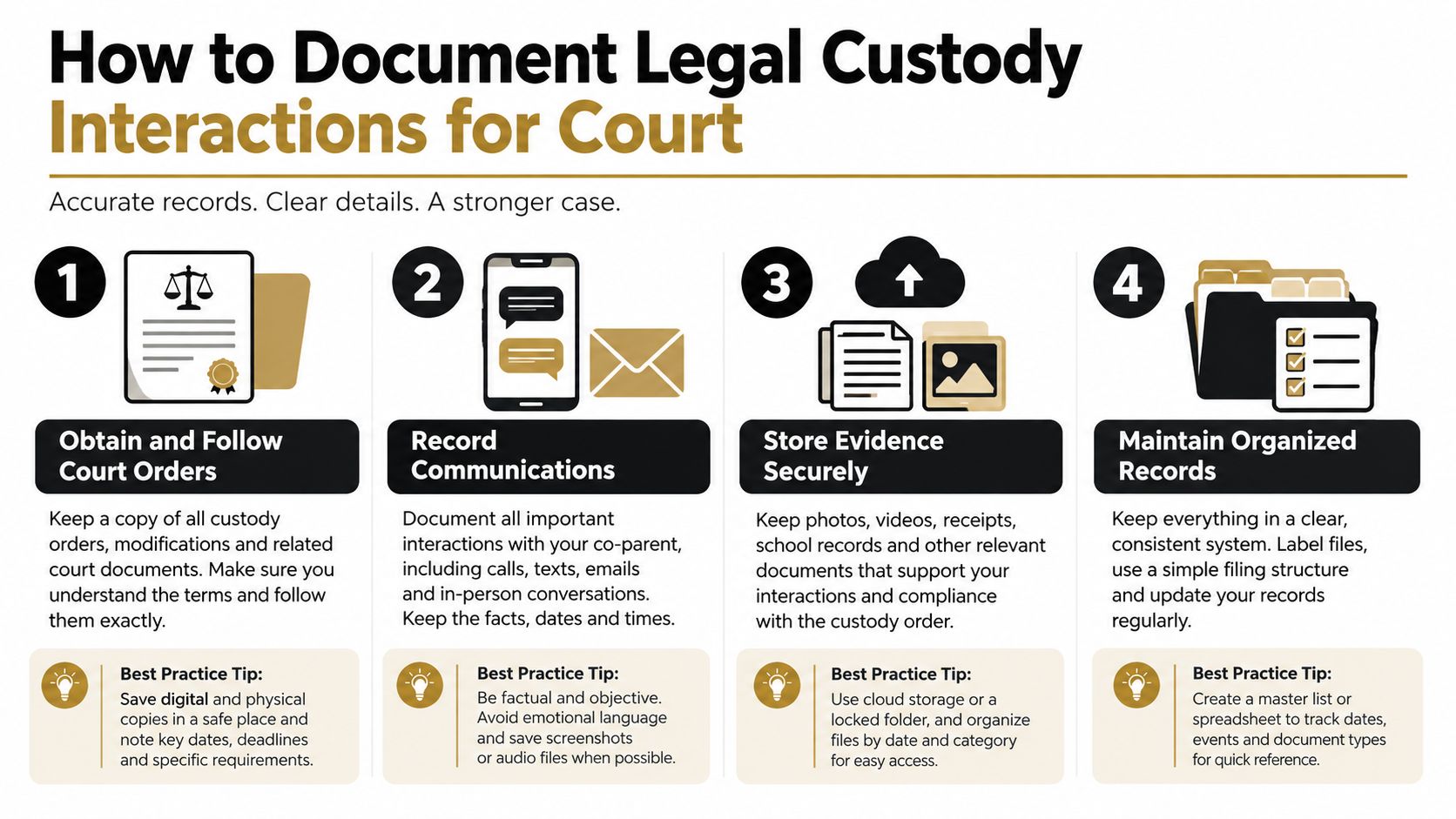
Build the record around one event at a time. A single dated entry should show what decision arose, which process the order required, and what happened next. Combining several disputes into an emotional summary makes it harder to separate observation from legal conclusion.
For each entry, identify the Order clause and copy the relevant language rather than relying on memory. Add the Decision category, such as medical, educational, religious, welfare-related, or parenting-time-related, followed by the Date and time of the proposal, message, appointment, or decision. Describe Notice and consultation by stating what you requested, how you sent it, and when you sought a response.
Then record the Response and deadline, including a reply, nonresponse, objection, or missed deadline. Under Action taken, describe conduct without assigning motive. Note the Child-related impact, such as a missed appointment or delayed enrollment, and list the Attachments, including the order excerpt, messages, letters, receipts, appointment information, or other supporting files.
Use wording that can be checked: “I sent the proposed school information on the recorded date and requested a response by the recorded deadline.” Avoid conclusions such as “The other parent intentionally sabotaged school planning” unless that conclusion belongs in separate legal analysis by a qualified professional.
A California Courts resource reports a 2025 study covering 35 superior courts and 1,239 mediation cases, including 688 sessions involving 1,260 children, 503 cases resulting in joint legal custody, and 183 in one parent retaining sole legal custody. The California Courts child-custody resource provides those figures, but they do not determine the proper result in an individual case.
Parents organizing dated entries, screenshots, agreements, receipts, and focused PDF reports can review the Casewell custody evidence checklist. Preserve original files, record later edits, and share only records relevant to the issue with a lawyer or mediator.
Legal Custody Definition and Documentation Checklist
A sound working definition has three parts. Legal custody identifies decision-making authority. Physical custody and parenting time identify care and residence arrangements. The custody order determines how those categories operate in the particular family.
Joint legal custody may require genuine consultation, but it doesn't necessarily create equal authority over every subject. Sole legal custody may give one parent independent authority over covered decisions, but the order may preserve notice, information, or other rights for the other parent. A disagreement alone isn't enough to establish noncompliance.
Before mediation or a court appointment, organize each disputed event around the order:
- Decision: What subject was involved?
- Authority: Which clause governs it?
- Notice: What proposal or information was provided?
- Response: What did each parent say or fail to say?
- Timing: When did each step occur?
- Urgency: Was immediate action required?
- Impact: What practical effect followed for the child?
- Proof: Which attachment supports each factual statement?
Keep facts separate from conclusions. A neutral timeline won't resolve every custody dispute, but it gives a professional a clearer basis for deciding whether the conduct matched the order.
If you're struggling to organize messages, agreements, appointments, or custody-related events, Casewell provides a private custody journal for dated records, supporting attachments, searchable timelines, and focused PDF reports for professional review. Visit Casewell to create a structured record that reflects your custody order requirements.