 Casewell

Divorce with an infant isn't rare, and it isn't new. U.S. Census historical data show the number of children involved in divorces rose from 361,000 in 1956 to 1,117,000 in 1976, according to the U.S. Census historical report on children and divorce. Those figures don't isolate babies, but they explain why custody, support, and caregiving schedules became routine family law issues, not exceptions.
What makes your case different isn't the filing itself. It's that your baby can't tell anyone how the week went. The plan has to be built from what can be seen: feeds, sleep, soothing, and how your infant recovers after each handover.
Why an Infant Changes the Divorce Plan
Nearly one-third of American children experience parental divorce before adulthood, according to a 2025 U.S. Census working paper linking tax and Census records for more than 5 million children. Its age-specific analysis reported that divorce occurring at ages 0 to 1 may have a larger negative effect on later employment prospects than divorce occurring at other ages, whose estimated effects were smaller and generally not statistically distinguishable from zero.
Read that carefully. It doesn't predict your baby's future, and it doesn't prove divorce alone causes the result. Income drops, conflict, parental mental health, housing changes, and problems that existed before the breakup also shape outcomes. When pre-breakup difficulties are counted, apparent effects on later behavior and achievement shrink.
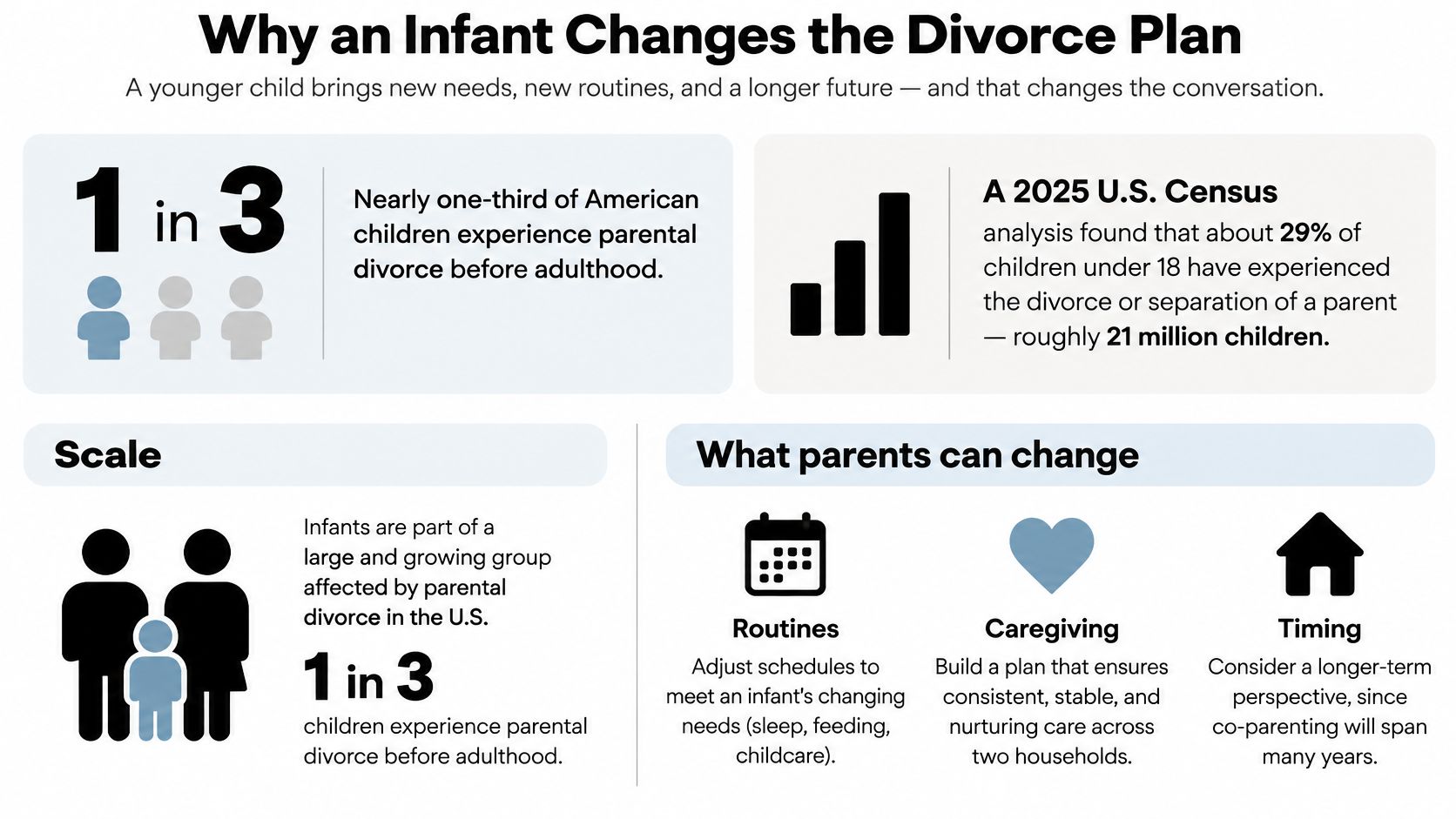
What you can actually control
You can't rewrite timing once separation is happening. You can control conditions around your baby: who provides hands-on care, how predictable that care is, how conflict is handled at exchanges, and whether each parent knows the current routine.
That's why a useful parenting plan in a divorce for an infant reads less like a school-age calendar and more like a caregiving record. It names who feeds, settles, bathes, and puts the baby to sleep now, not who hopes to do those things later. It also sets a review date, because a newborn's pattern will change quickly.
Planning rule: Choose the first schedule from current caregiving, not from guilt, pressure, or a generic toddler template.
Temporary arrangements matter because they can set the pattern while the case moves forward. If you're in Texas, understanding Texas temporary custody orders helps you see what a court may put in place before final orders. Wherever you live, bring facts about the baby's day to that first conversation, not only arguments about fairness between adults.
An infant also changes what counts as evidence. A parent can't interview the baby after a visit. A dated note that says the baby fed, napped, cried, then settled gives a lawyer, mediator, or judge something concrete to work with.
Routines That Keep Care Predictable
A shared routine isn't proof that one home is the home. It's a map both parents can follow so the baby doesn't have to relearn basic care at every exchange. Keep it short, factual, and updated as the baby changes.
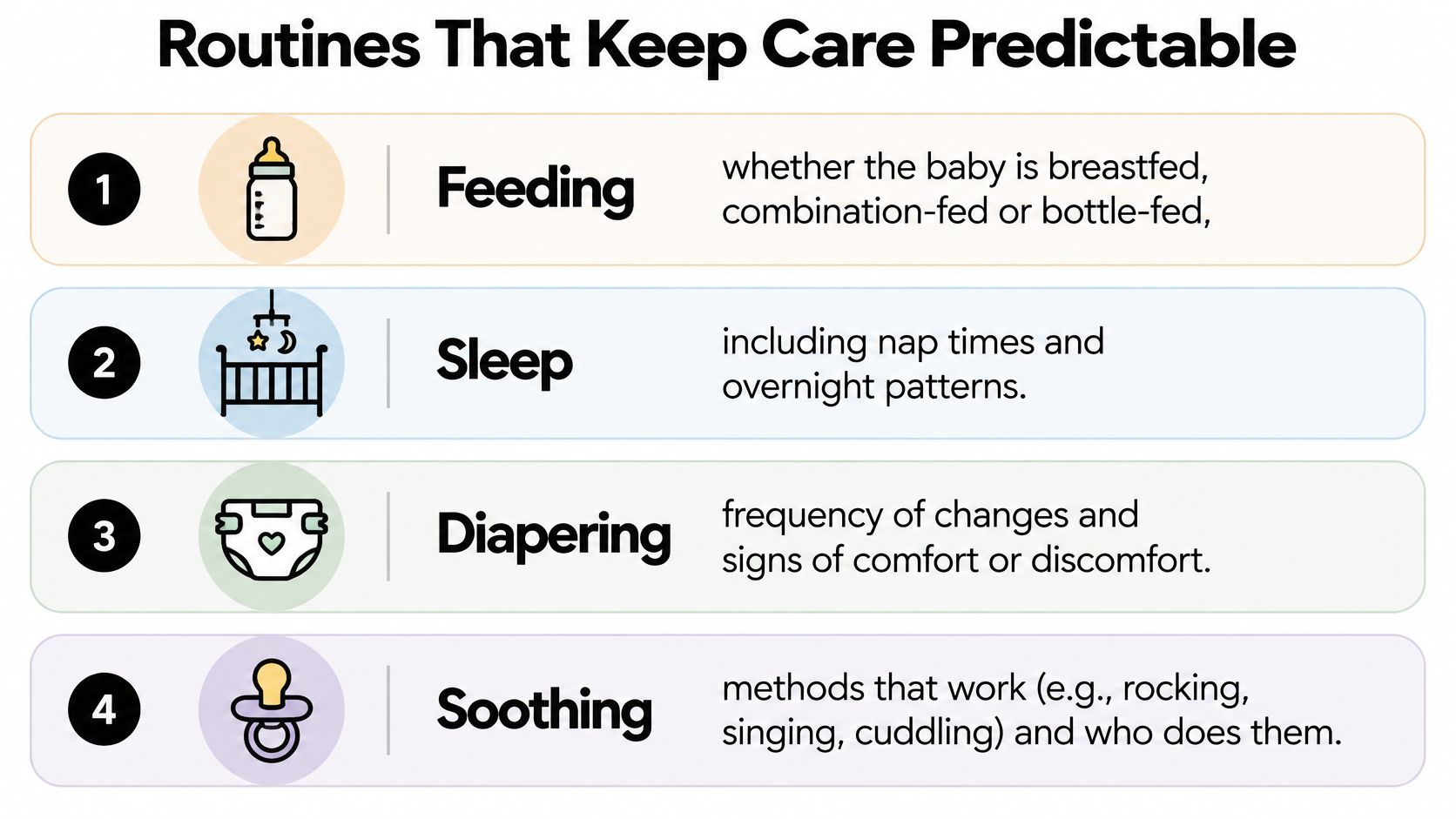
Feeding and sleep
- Feeding method: Write whether the baby is breastfed, combination-fed, or bottle-fed, the usual interval, and approximate bottle volumes if you bottle-feed.
- Bottle practice: Note any clinician or lactation advice before introducing or increasing bottles. A non-nursing parent can still do skin-to-skin time, baths, burping, and settling.
- Sleep pattern: Record typical naps, rough wake windows, where the baby sleeps, and what helps settling, such as a feed, a dark room, or being held.
- Night care: Note who usually responds overnight and how the baby resettles, since that history matters more than a label.
Soothing deserves its own lines. Write which hold, sound, motion, or comfort item usually works, and what doesn't. That keeps the other parent from guessing during a hard hour and reduces the chance that ordinary crying turns into an accusation.
Health notes belong beside the routine, not scattered in texts. Date pediatric visits, medicines, temperatures, rashes, and feeding concerns. If your baby was premature or has reflux or another medical issue, the clinician's feeding plan outranks any generic custody template.
This short video walkthrough helps you think through how daily care details fit into a parenting discussion.
The one page routine card
Expect disruption even when both parents do things right. A growth spurt, teething, illness, or a sleep regression can wreck a smooth week without anyone failing.
End with a one-page routine card that travels conceptually, if not physically, between homes. Include last feed time, next expected feed, nap just taken, medicine given, and anything the next caregiver needs in the first hour. Use plain words you'd be comfortable showing a mediator later.
Parenting Time Patterns for Infants
An infant's parenting schedule works best when it reflects the care the baby already knows and can adjust as caregiving becomes familiar. The Michigan parenting time guidelines recommend frequent, several-hour visits when a parent is unfamiliar or uncomfortable with basic infant care. They also emphasize consistency, minimal disruption, developmental needs, and contact with each parent every few days.
These guidelines are an example, not a rule for every state or family. Local courts may use different guidance, so a lawyer or mediator in your area can help assess how it applies.
Infant parenting time by current caregiving
| Current situation | Contact pattern | Overnights now | Review signal |
|---|---|---|---|
| Parent still learning basic infant care | Frequent visits of several hours, contact every few days | Generally deferred | Feeds completed, baby settles, shorter distress at handover |
| Parent already does regular hands-on care but not nights | Consistent daytime blocks, contact every few days | Usually not yet; revisit after a stable routine | Predictable feeds, naps, and soothing in that parent's care |
| Parent already provided regular overnights before separation | Keep a familiar pattern with minimal disruption | Often appropriate to continue | Baby settles on a similar timeline as before the split |
| Frequent breastfeeding or bottle feeds | Short visits timed around feeds, both parents can still do care tasks | Often deferred in the early months | Intake, weight checks from the clinician, settled feeds after return |
| Long travel or highly conflicted exchanges | Shorter visits, fewer transitions, neutral handover point | Deferred until exchanges are predictable | Recovery after reunion, illness, and whether conflict happens in front of the baby |
The table is a starting point, not an age chart. A parent who has already cared for the baby overnight may be able to continue a familiar pattern. A parent still learning infant care may begin with shorter, regular visits and build experience before longer stretches.
An overnight is not automatically harmful or appropriate because of the baby's age. The practical question is whether the parent can provide familiar care and whether the arrangement fits the baby's needs.
Ordinary crying is not misconduct. A pattern of failed feeds, missed handovers, or conflict at exchanges is different, and it should be documented as dated facts.
Choose review signals both parents can recognize, such as feeds completed, naps in the usual window, handover length, illness, and how the baby settles after returning. A co-parenting schedule guide can help you compare planned care with the time that took place. Texas parents preparing for court can also review what happens at temporary orders hearings to prepare relevant documents and questions.
Set a review after several weeks of observing the arrangement. Parenting time can grow in response to how the baby and caregivers manage each transition, rather than to a birthday or a disagreement.
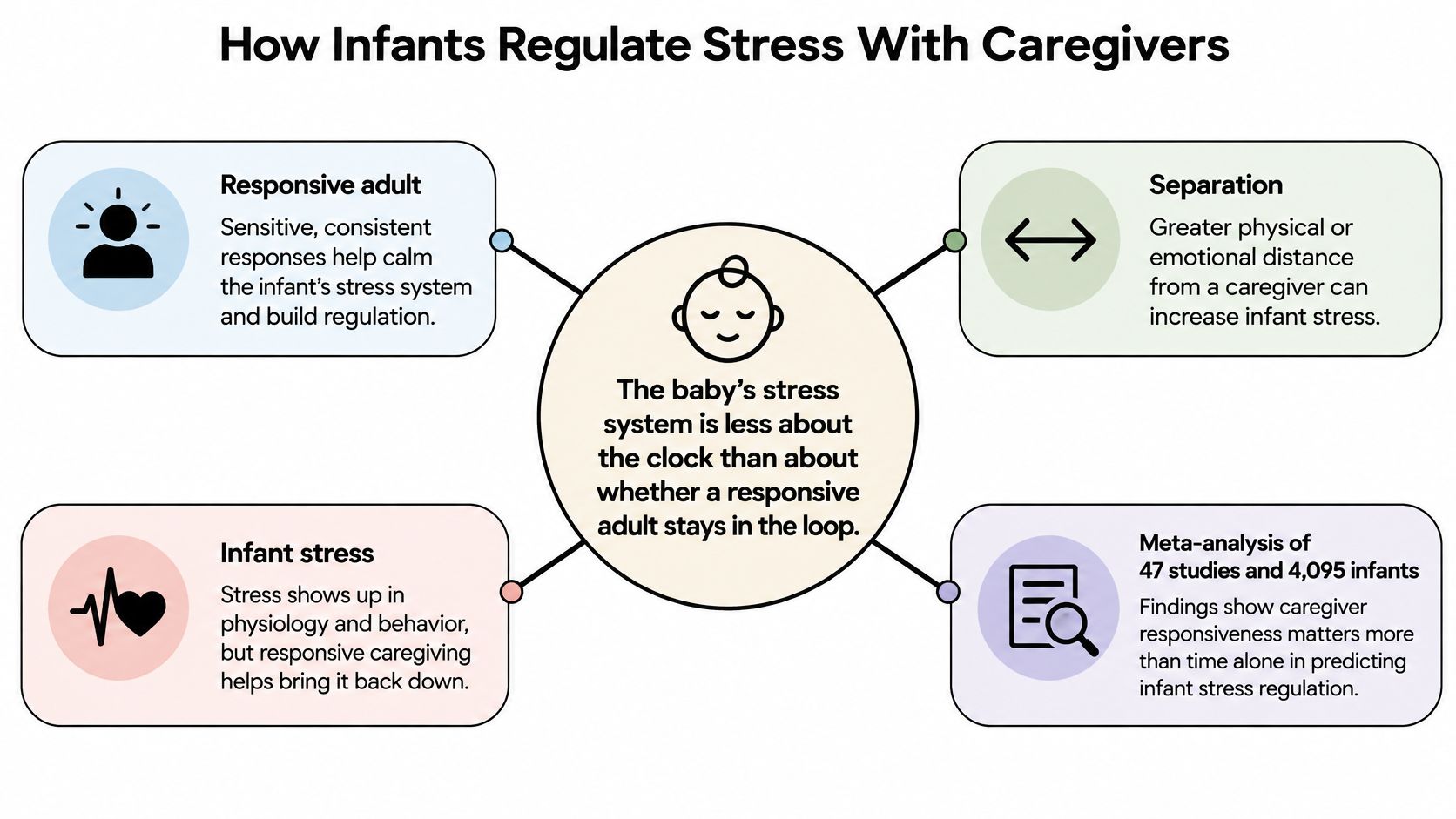
How Infants Regulate Stress With Caregivers
Your baby's stress system is less about the clock than about whether a responsive adult stays in the loop. Separation by itself doesn't tell the whole story. Who's present, how familiar that person is, and how quickly the baby is soothed change what separation means.
A meta-analysis of 47 studies involving 4,095 infants aged 3 to 18 months found psychological stressor procedures produced only a small overall salivary cortisol increase, with Hedges' g = 0.11, while separation procedures were the only stressor category showing a consistent cortisol response. A sensitive substitute caregiver can prevent the cortisol elevation normally observed during a 30-minute maternal separation, whereas an unresponsive caregiver doesn't provide the same buffering effect.
What to note at a handover
Don't infer distress from crying alone. Write what you can see:
- Before the exchange: Baby's age, last feed, and sleep status.
- During the exchange: Who was present and how long the handover took.
- Soothing tried: Holding, feeding, rocking, a pacifier, or another specific response.
- Recovery window: Whether the baby fed, settled, slept, or cried for a long stretch after reunion.
Use neutral behavioral words, not diagnostic labels. "Cried, then fed and slept" helps. "Traumatized" or "neglected" turns an observation into a conclusion you can't prove from that moment alone.
Attachment also doesn't produce a simple time formula. In a longitudinal laboratory study of 180 one-year-olds, infants securely attached to their mothers showed lower cortisol levels during the Strange Situation regardless of whether attachment to the father was secure or insecure. Another study in that review found parent and infant cortisol moving together across measurements, which points to physiological co-regulation, not a direct measure of legal time.
Laboratory tasks aren't court predictions. They support a practical standard you can apply at home: preserve continuity where it exists, help each parent learn to soothe reliably, keep timing predictable, and watch recovery after exchanges. Stable routines and prompt responsive care give the baby fewer surprises to manage.
If recovery is repeatedly long, don't jump straight to blame. Check the basics first: hunger, missed nap, illness, travel length, an unfamiliar caregiver, or adult tension during the exchange. Then decide whether the schedule, the handover, or the routine card needs to change.
Handovers and the Private Record
Run each exchange the same way, especially when communication is tense. Predictability helps the baby, and it also creates a clean record if the plan is later disputed.
A five step handover sequence
- Confirm the basics: Confirm time and place the day before through the channel your order or plan requires.
- Bring stated supplies: Pack milk, diapers, medications, spare clothes, and any agreed comfort item.
- Exchange calmly: Hand over the baby briefly and kindly, without discussing money, lawyers, or relationship complaints.
- Send one factual note: Afterward, send feed, nap, plain mood words, and any health issue the other parent needs to know.
- Record any miss: If the plan wasn't followed, write what was scheduled, what happened, and the reason given.
Keep handovers short and in a familiar place when you can. Agree whether the baby should arrive fed or ready for a feed, so hunger doesn't get mistaken for a failed visit. In high conflict situations, fewer words and a fixed script usually work better than trying to solve adult issues at the door.
Avoid two common failures. The first is ambushing the other parent with complaints while the baby is being passed over. The second is interpretive messaging, such as calling the other parent unstable when the fact is that the baby cried for ten minutes and then slept.
Write the sentence you'd want a neutral professional to read later. Dates, times, and observable details carry more weight than adjectives.
What belongs in your private record
A private record should hold date, time, child, feed, sleep, soothing, recovery length, and any difference from what was agreed. Keep photos, screenshots, and receipts beside the event they belong to. Give illness, a missed feed window, and a late arrival separate dated entries instead of blending them into one emotional summary.
A structured parenting journal makes those fields easier to complete the same day, while details are fresh. If a court order or parenting plan requires a specific communication platform, keep using it for messages. Your private journal sits beside that channel as your own documentation, and the other parent doesn't need an account for it.
Don't edit old entries if you remember something later. Add the correction with its own date and preserve the original sequence. That habit protects credibility if a lawyer or mediator reviews the timeline.
The goal isn't to build a case out of every fussy evening. It's to separate a real pattern, such as repeated late returns or consistently missed feeds, from normal infant variation. Clear notes let you raise the pattern once, with examples, instead of arguing from memory every week.
When Parenting Time Can Grow
Expansion should follow evidence from the baby's actual days. These three scenarios show how the same principle leads to different next steps.
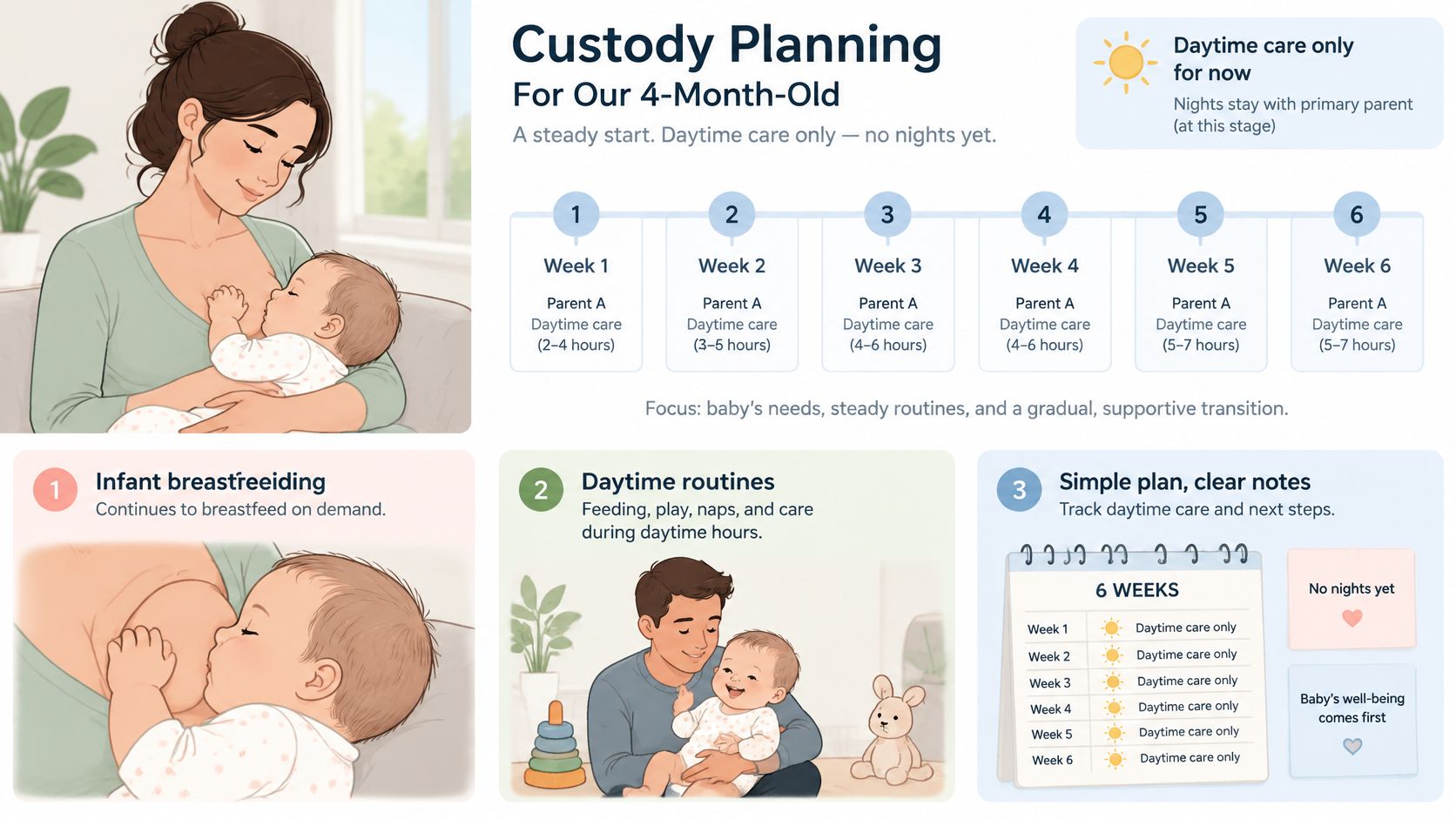
Three starting points
Say a four-month-old is breastfed, and one parent has done daytime care but not nights. Six weeks of notes show completed bottles or nursing top-ups, naps in the usual window, and crying that settles fairly quickly after exchanges. The next step is a slightly longer daytime block, reviewed again in a few weeks, not an immediate overnight.
Now say an eight-month-old already spent regular overnights with both parents before separation. Cutting one parent back to a weekly afternoon because of a general no-overnight belief removes a familiar caregiver. Continuity argues for keeping the known overnight if feeds and soothing still work, unless travel, exchange conflict, or clinician advice points the other way.
In a third case, a parent has rarely changed, fed, or settled the baby. Starting with several hours every few days, using the routine card, gives that parent a real on-ramp. Expansion waits for repeated successful feeds and settling, not for the next birthday.
Pause expansion for repeated missed handovers, feeds that consistently fail, unresolved illness concerns, or conflict during exchanges. Don't pause for one fussy evening, a growth spurt week, or dislike of the other parent. If a lasting change is needed later, the dated pattern also helps you assess the reasons to modify custody with a professional.
Safety overrides every step. Violence, an intoxicated caregiver, or unsafe sleep arrangements pause expansion at once. Contact a lawyer or your local child protection agency right away.
Your Next Seven Days
Start small enough that you'll finish. A week of clean, dated facts is more useful than a month of good intentions.
- Day 1: Write the current pattern in one sentence, including who does hands-on care now, whether overnights already happen, and your review date.
- Day 2: Write the routine card with last feed, next expected feed, recent nap, and first hour needs.
- Day 3: Agree the handover script and confirm it through the ordered channel, or confirm which channel you'll both use.
- Days 4 to 6: After each exchange, record date, time, feed, sleep, soothing, and recovery time in neutral words.
- Day 7: Review the log. Repeated smooth recovery supports discussion of a longer block. Missed care or hard transitions stay as dated entries, not a general complaint.
Casewell can serve as that private parent log for parents who live apart. We're built for iPhone and Android, our parenting time log records scheduled care, changes, overnights, and the time that took place, and we create PDF exports for a lawyer or mediator. Use it beside any court ordered messaging app, not in place of it. The other parent doesn't need to install, approve, or join it, and a local lawyer or mediator can confirm how an export fits your procedure.
Start your seven day record today with feeds, naps, handovers, and recovery noted in neutral, dated entries, then export only the relevant pattern when you need professional advice. Visit Casewell to set up your private log and turn this week's infant care notes into a clear record you control.