 Casewell

The most popular advice about a co parent schedule is to pick a familiar rotation and divide the calendar fairly. That's not enough. A schedule becomes usable when parents can identify which nights belong to whom, when each handoff happens, and what replaces the regular plan when life interrupts it.
Start with a counted baseline, then add a written exception rule. A custody label can describe an arrangement broadly, but it won't tell a parent whether to collect a child from school or wait outside the other home.
Shared Time Is Not One Pattern
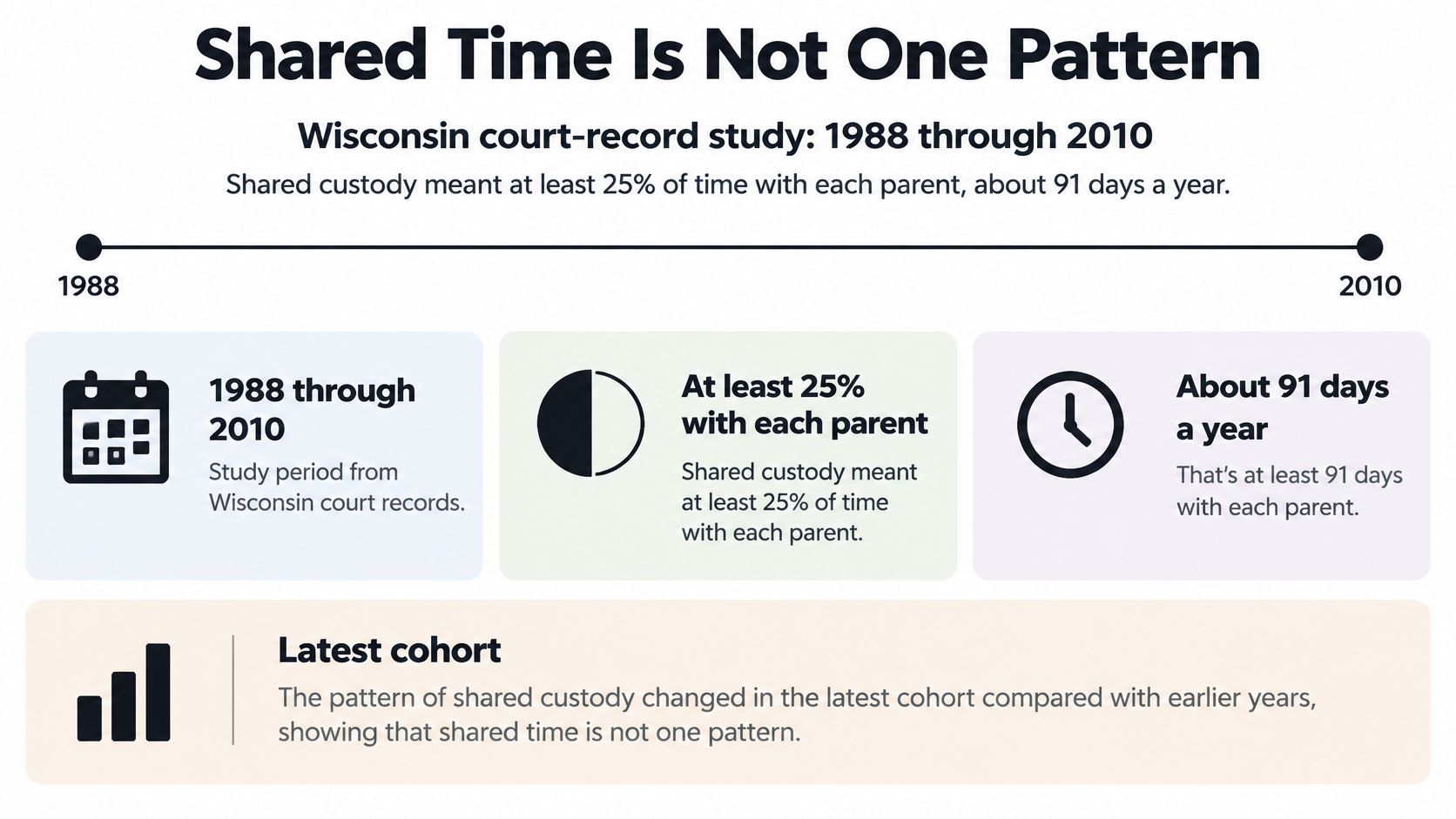
A Wisconsin court-record study published in Family Court Review, covering 1988 through 2010, defined shared custody as at least 25% of time with each parent, approximately 91 days annually; in its latest cohort, shared custody accounted for 50.3% of cases, exceeding sole-mother custody. Equal time wasn't required under that definition.
That distinction matters when you turn an agreement into a calendar. Substantial time in both homes can include a primary school-week home, recurring weekends elsewhere, midweek overnights, and extended school breaks. The combination matters more than the nickname.
The timeline illustrates that historical change in Wisconsin.
Translate the label into events
A phrase such as joint physical custody doesn't identify the porch, school entrance, or clock time for an exchange. Nor does it explain what happens when a parent's weekend overlaps a school holiday.
A usable schedule needs distinct records:
- The rotation: A sequence showing where the child sleeps.
- The handoff instructions: Start and end times, locations, and transportation duties.
- The exceptions: Dated holiday, vacation, or agreed replacement periods.
Keep legal custody terminology separate from these operational details. Decision-making authority and the child's physical whereabouts aren't interchangeable fields in a planner.
Practical rule: If another authorized caregiver couldn't complete the pickup from your written instructions, the schedule still needs detail.
Don't begin by asking whether the arrangement sounds equal. Ask whether both parents could independently mark the same nights and arrive at the same exchange point.
Co Parent Schedule Templates Side by Side
Common co parent schedule rotations
The counts below are worked calendar calculations, not research estimates. Exchange totals use a repeating four-week illustration, exclude holiday changes, and count a move between homes as an exchange.
| Schedule | Pattern | Overnights in 14 days (A / B) | Exchanges per month | Fits best when |
|---|---|---|---|---|
| 2-2-3 | A takes two nights, B two, A three, then reverse | 7 / 7 | 12 in the illustrated four-week cycle | A child already handles frequent moves; not an automatic infant choice |
| 2-2-5-5 | Fixed weekday pairs, with alternating weekends creating five-night stretches | 7 / 7 | 8 in the illustrated four-week cycle | Parents want predictable weekdays and longer weekend blocks |
| 3-4-4-3 | A takes three nights, B four, A four, B three | 7 / 7 | 8 in the illustrated four-week cycle | Equal time with longer stretches |
| Alternating weeks | Seven nights each, followed by a weekly exchange | 7 / 7 | 4 in the illustrated four-week cycle | A child manages longer separations and school travel is practical |
| Every other weekend | A has Friday evening through Sunday evening; B has the remaining nights | 2 / 12; adding a weekly Wednesday overnight makes 4 / 10 | 4 without the midweek overnight; 12 with it in the illustrated four-week cycle | A primary-home arrangement matches the child's assessed needs |
Count the actual sequence, not the schedule name. Friday-to-Sunday every other weekend contains Friday and Saturday nights on that weekend. It doesn't create an additional weekend inside the same fortnight.
Likewise, a rotation with longer blocks doesn't necessarily eliminate as many exchanges as its name suggests. Write the parent's initial in every overnight cell, then mark each change of initial. Include the boundary where the calendar repeats.
Equal nights can mean different routines
In the German joint-physical-custody sample described in PLOS ONE, using 2019 data for families with children aged 0–14, 55.5% used asymmetric arrangements and 44.5% used approximately equal arrangements; children averaged 9.5 transitions per month, with an observed range of 0 to 48.
That spread makes transition planning a separate question from overnight division. A school-based transfer may avoid direct parent contact, but the child still needs the correct books, medication, sports equipment, and clothing at the receiving home.
Test a proposed rotation against ordinary obligations:
- School travel: Can the responsible parent manage arrival and collection without relying on an unconfirmed helper?
- Belongings: Which items travel, and which stay duplicated in each home?
- Separation tolerance: How does this child manage time away from each caregiver?
- Parent availability: Who provides care during work shifts?
For a Texas-specific comparison, The Law Office of Bryan Fagan plans offer examples to discuss with local counsel. Don't assume a template from another jurisdiction changes an existing order.
Before agreeing to a rotation, extend it across a complete repeating cycle. Check school nights, weekends, and transitions separately. A balanced night count doesn't establish developmental suitability, particularly for an infant or a child with additional care needs.
How to Lock the Regular Week
Build the regular week as instructions someone can carry out, not a description of what parents generally intend. The Missouri parenting-plan form calls for exchange locations across ordinary and exceptional periods and gives holidays priority over the regular schedule and vacations.
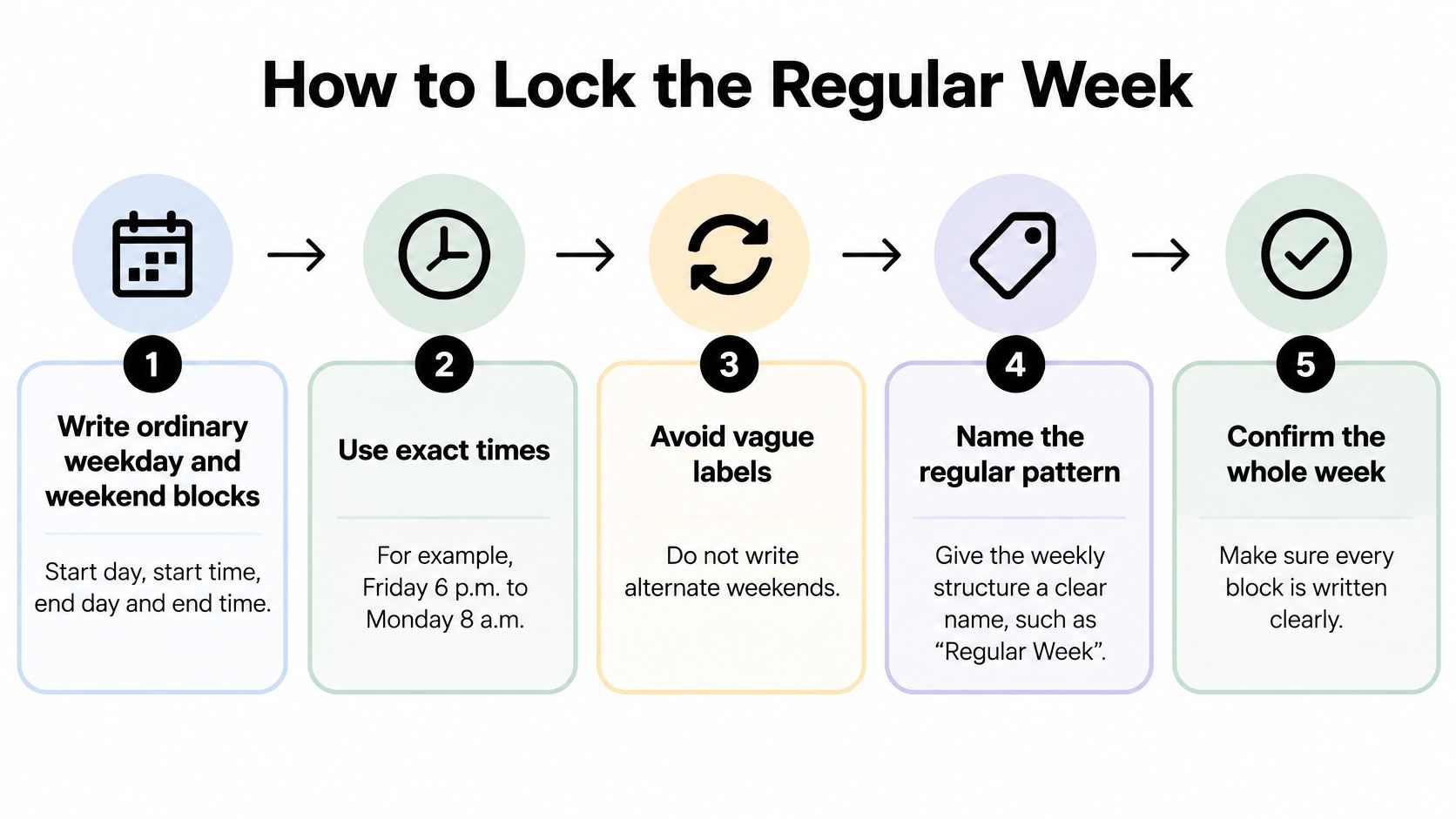
Use that structure as a drafting model, while following your own order and local requirements. The visual below emphasizes the precision needed for the ordinary routine.
Build the schedule in layers
Define ordinary periods. In a hypothetical plan, write Friday at 6 p.m. through Monday at 8 a.m., rather than alternate weekends. Identify the starting weekend by date, then state how the sequence repeats. Assign all remaining time so there aren't unexplained gaps.
Name the place and driver. For that example, Parent A collects the child at the main entrance of the public library on Friday and delivers the child to school on Monday. Specify a fallback location when school is closed. Don't leave pickup and drop-off as interchangeable phrases.
Add a holiday list. Keep holiday periods separate from the repeating week. Give each a beginning, ending, and transportation instruction rather than changing the underlying rotation manually.
Define vacation windows. State how a parent requests vacation, the permitted duration under the agreement or order, the notice deadline, and how competing requests are resolved. Include what happens if a request is incomplete or arrives late.
Write the precedence rule. If adopting the Missouri-style structure, state explicitly that listed holidays override both ordinary time and vacations. Don't treat that example as a universal rule when your order says otherwise.
The following video can accompany your written planning work.
Preserve the underlying rotation
An exception shouldn't erase the baseline event. Keep the ordinary calendar intact and attach a replacement entry naming the affected period, substitute period, notice, and transportation responsibility.
Check the weekends on either side of a holiday. Without a restart rule, parents may disagree about whether the holiday interrupts the alternating sequence or merely overlays it.
Write whether the ordinary rotation resumes unchanged after an exception. Don't make the next weekend depend on someone's memory.
Use a filled handoff entry as a drafting test:
| Field | Hypothetical Friday handoff |
|---|---|
| Scheduled period | Friday, 6 p.m., through Monday, 8 a.m. |
| Receiving parent | Parent A |
| Friday location | Public library main entrance |
| Friday transport | Parent A collects |
| Monday return | Parent A delivers to school |
| School-closure fallback | Same library entrance at the agreed return time |
| Exception status | Regular period unless a listed override applies |
Replace every example with the actual location and terms. A named building still needs an entrance if its parking areas are separate.
Holiday and Break Rules That Override the Week
Holiday and school-break splits
These are drafting options, not automatic legal entitlements. For every method, identify the exchange point and driver alongside the allocation.
| Method | How time is split | Example | Write this down |
|---|---|---|---|
| Odd and even years | Listed holidays alternate by calendar year | Christmas with Parent A in odd years and Parent B in even years | Holiday list, starting allocation, boundaries, location, and driver |
| Split the day | Each parent receives a defined clock block | An illustrative daytime block from 9 a.m. to 9 p.m., with the overnight elsewhere | Exact start and end, exchange point, and transport |
| Split the school break | First portion goes to one parent, remainder to the other | Winter break divided at an expressly dated noon | School calendar, dividing date, location, and driver |
| Whole-break alternation | A parent receives the complete break, then allocation reverses the following year | Alternating Thanksgiving or spring break | Full break boundaries and travel responsibilities |
| Birthday and Monday holidays | Separate rules address these events | A Monday remains attached to the weekend unless expressly reassigned | Birthday hours, school-day treatment, and extended-weekend return |
Treat this as a second calendar placed over the ordinary week. If your adopted precedence rule gives listed holidays priority over regular time and vacations, apply it only to the holiday's defined boundaries.
Resolve the collision, not the whole month
Say Parent A's ordinary weekend includes Christmas, but the applicable holiday allocation gives Christmas to Parent B. Parent B receives the defined holiday period. That doesn't automatically extend the holiday through the remaining weekend or give Parent A replacement time.
Write whether the child returns for the remainder of the ordinary block. Also state whether make-up time exists, rather than assuming it follows from every displaced overnight.
A broader parenting plan in a divorce should keep these scheduling rules consistent with travel, communication, and decision-making provisions.
Make flexibility a documented choice
Canadian Affairs' reporting on co-parenting schedules describes flexibility as a factor that can help shared parenting continue as children's circumstances change. That doesn't mean leaving changes unrecorded.
For a recital, illness, or child-requested adjustment, use a short written-change protocol:
- Request: Identify the affected event and who proposed the change.
- Agreement: Preserve the other parent's response through the permitted communication channel.
- Replacement: Specify the revised period and any agreed make-up time.
- Practical effect: Record transport changes and the child-related reason without assigning blame.
As a drafting safeguard, require written agreement for changes that move an overnight, subject to the order and emergency provisions. Don't present an unanswered request as approval.
Exception test: A dated accommodation is a change to an event. A recurring accommodation may mean the baseline needs formal review.
If parents repeatedly follow a different arrangement, seek advice about updating the plan through the proper process. A habit isn't a reliable substitute for an enforceable amendment.
Track Planned Time Against What Happened
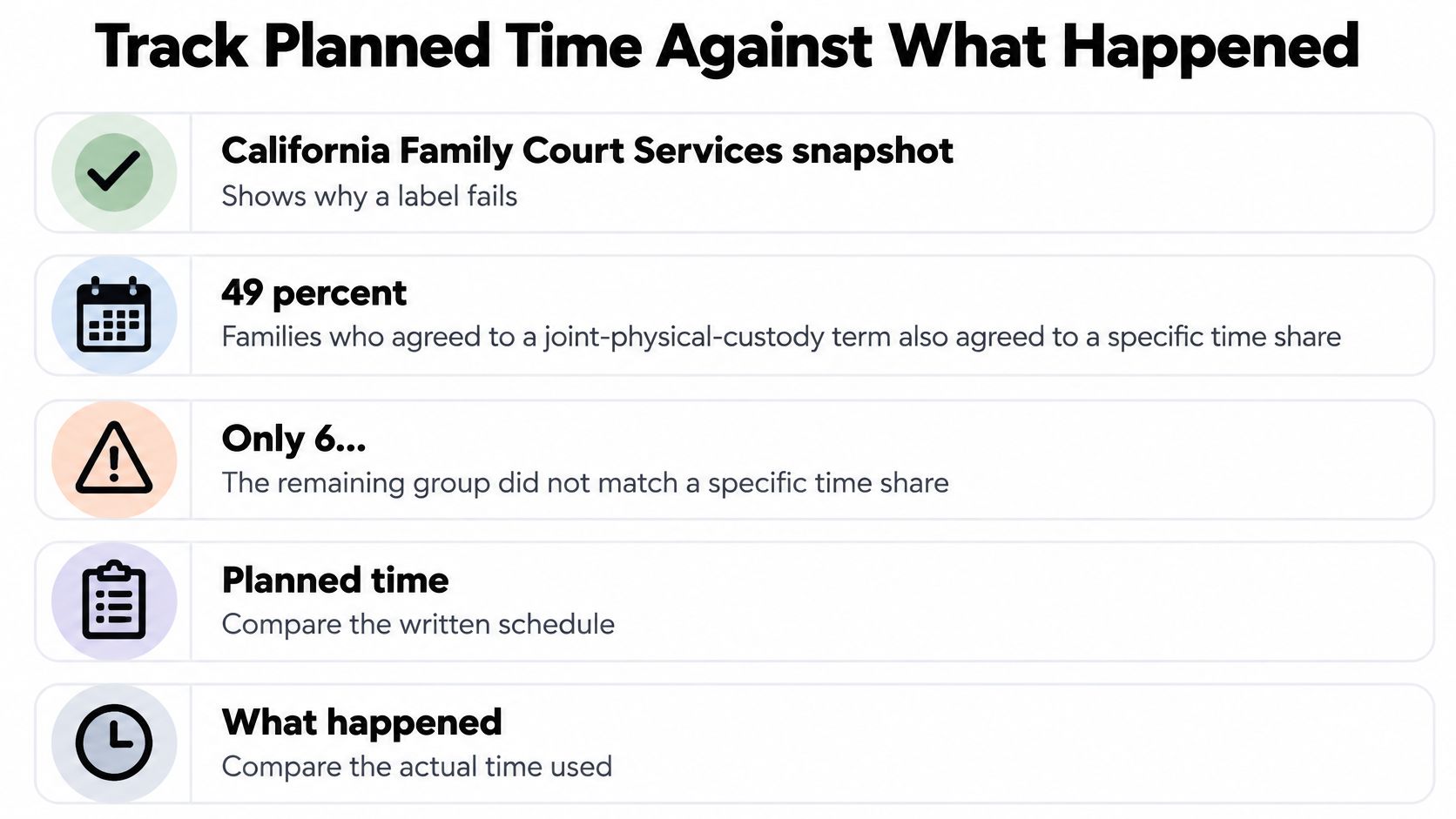
In a California Family Court Services snapshot, only 49% of families agreeing to a joint-physical-custody term also agreed to a specific time-sharing arrangement, and only 6% of all families reached a 50/50 split in mediation. A legal label and an executable calendar aren't the same deliverable.
Measure the schedule through completed care and actual exchanges. Keep deviations separate from the original allocation so a reviewer can reconstruct what changed.
This visual introduces the planned-versus-actual comparison.
Run an overnight audit
Count scheduled nights across a complete cycle. Use the baseline plus applicable holiday and vacation overrides. Keep ordinary allocations distinguishable from agreed substitutions.
Enter actual care. Record where the child slept and the actual pickup and return times. A late pickup and a missed overnight are different events.
Classify the difference. Use parent-requested change, child-related disruption, school or holiday conflict, transport failure, or undocumented. If the reason isn't known, don't fill the gap with an assumption.
Calculate completion consistently. Divide completed scheduled periods by scheduled periods. Decide in advance whether a shortened period counts as completed, partially completed, or missed, and show that definition beside the result.
Review repeating causes. Look for recurring transport problems, school-calendar mismatches, or requests linked to work. Bring the pattern to a mediator or lawyer rather than trying to prove intent from a total alone.
A parenting-time log gives the record a consistent structure. Track overnight totals and exchange punctuality separately so a delay doesn't disappear inside an otherwise completed stay.
Keep the entry factual
Consider this hypothetical entry: scheduled library collection was Friday at 6 p.m.; actual collection was at 6:25 p.m.; the collecting parent's message attributed the delay to traffic. Attach the relevant message and connect the note to the scheduled pickup.
Don't replace those facts with a character judgment such as unreliable or uninterested. Record what happened, what was communicated, and what remains unknown.
For a vacation-related discrepancy in Texas, Texas couples' vacation possession rules from Law Office of Bryan Fagan, PLLC can provide context for questions to take to counsel. The controlling order still needs to be checked before classifying an event as missed time.
Finish the review with a compact summary: scheduled nights, actual nights, agreed substitutions, incomplete periods, and unresolved explanations. A completion rate is an administrative measure, not a parenting-quality score. Illness, authorized travel, and agreed accommodations need context beside the count.
High Conflict and Safety Adjustments
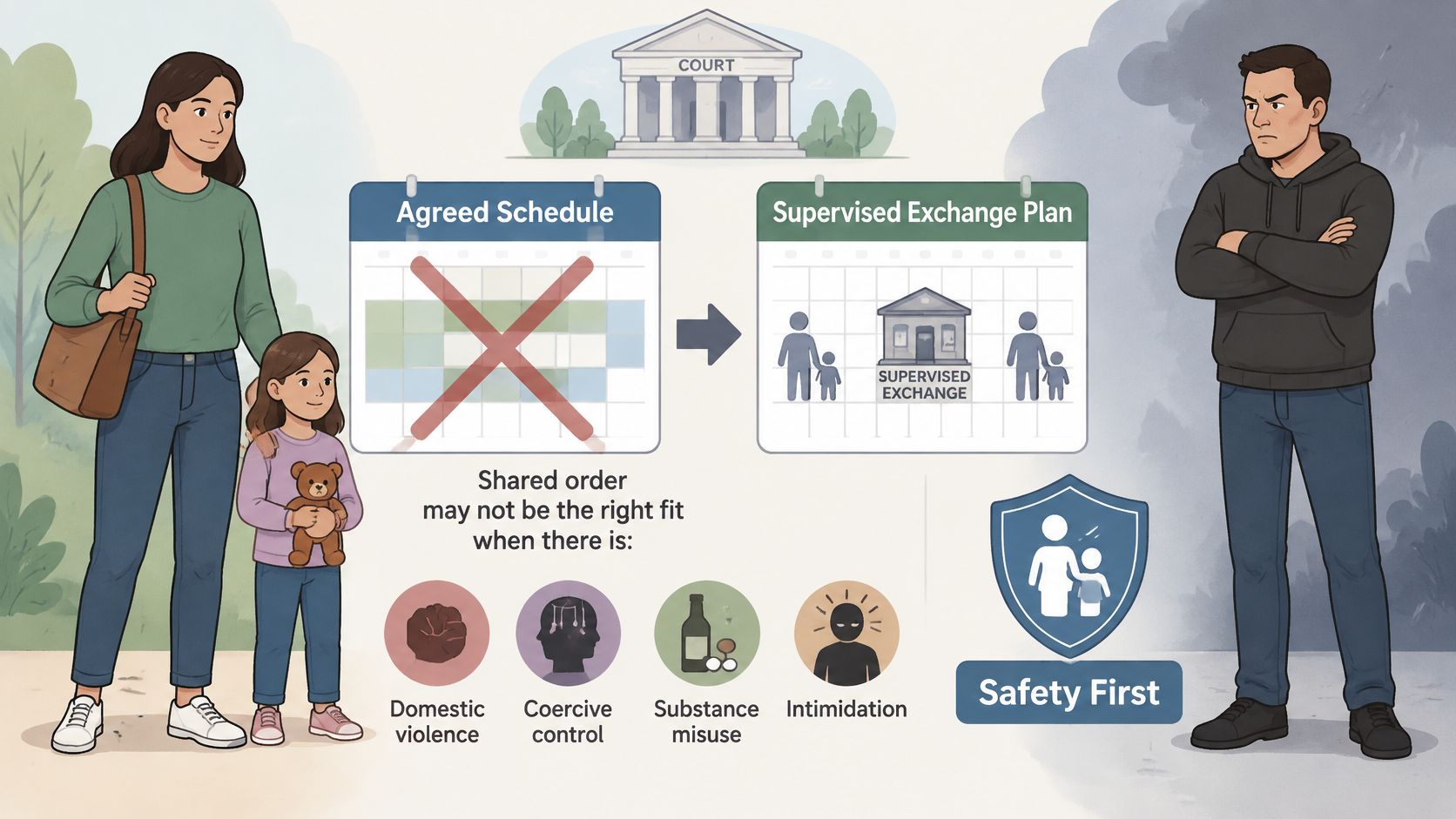
An agreed shared schedule may still be inappropriate when domestic violence, coercive control, substance misuse, or intimidation affects safety. The Alaska Court System's parenting-plan guidance identifies options including supervised parenting time, supervised or public exchanges, no-contact handoffs, staggered arrivals and departures, and limits on overnight visits.
These are changes to the safety design, not ordinary calendar conveniences. Don't preserve a template's overnight balance at the expense of a child's or adult survivor's safety.
The diagram illustrates how a handoff arrangement may need to change.
Separate conflict management from protection
Parallel parenting can reduce the need for direct coordination: each parent manages care during their allocated time, while communication stays limited and structured. It isn't a substitute for protective restrictions or professional safety planning.
For high-conflict co-parenting, define how necessary information moves without requiring face-to-face negotiation. Follow any ordered communication platform and don't negotiate contested changes in a parking lot.
Ask a qualified professional to distinguish among:
- Exchange supervision: Someone monitors the transfer between caregivers.
- Parenting-time supervision: Someone supervises the contact itself.
- No-contact arrangements: Parents don't meet during the handoff.
- Restricted communication: Messages follow the channel and limits established by the order.
A public location isn't automatically safe because other people are nearby. Likewise, a third-party driver doesn't resolve concerns about what happens during the visit.
Record observable safety facts
Document a moved or missed exchange, the location, whether an authorized third party attended, and any relevant protective-order restriction. Preserve threatening communications accurately and record observable effects on the child without diagnosing a cause.
For example, describe crying, refusal to leave a vehicle, or words the child used. Don't turn an observation into an unsupported claim about coaching, trauma, or a parent's motive.
Private documentation supports professional review. It doesn't replace emergency services, legal advice, or a formal safety plan.
Keep sensitive safety notes separate from routine scheduling messages. Don't automatically disclose the full journal to the other parent, particularly if it contains protected locations or details about safety arrangements.
If direct contact is unsafe, obtain advice about an authorized alternative rather than forcing the handoff assumed by a generic schedule. Changes to supervision, duration, or overnight contact may require court action. In immediate danger, prioritize emergency assistance and follow applicable protective orders.
A professional review can focus on selected events and supporting material. Include enough surrounding context to make the sequence understandable without exposing unrelated private information.
Write the Baseline and Start the Record
Use the coming week to produce a usable draft and begin documenting its operation. If an order already exists, work from its terms rather than replacing them with a preferred template.
The practical task is modest: translate the arrangement into calendar entries, identify unresolved language, and collect accurate observations. You don't need a perfect history before you can start a reliable record.
A checklist for the coming week
- Choose the rotation. Mark every overnight across the repeating cycle and total each parent's allocation.
- Complete the handoffs. Add the start and return times, exact location, responsible driver, and school-closure fallback.
- Enter upcoming exceptions. Put the approaching holidays and breaks on the calendar using the actual school calendar.
- Confirm when the terms begin. Record the effective date of the agreement so the old and new arrangements aren't mixed.
- Observe the initial exchanges. Compare planned and actual times, recording a brief factual explanation when they differ.
- Resolve drafting gaps. Take unclear precedence, transport, or replacement-time language to the appropriate professional.
Keep communication on any platform required by your order. A private record can sit beside it without becoming a second place to negotiate.
Casewell is a private custody journal for that single-user record. Its parenting time log records scheduled care, changes, overnights, and the time that took place; its handovers and pickups log records planned and actual times, delays, missed exchanges, locations, and outcomes. The co-parent doesn't need an account and can't approve, edit, or delay your entries.
When a lawyer or mediator needs a slice of the history, choose relevant dates and supporting records rather than sending an undifferentiated journal. Preserve the context needed to understand each event.
The decision isn't which custody slogan sounds fairest. It's whether the written nights, responsibilities, and exceptions describe a workable plan, and whether your record accurately captures what followed.
Keep your schedule and its real-world outcomes together with Casewell, a private custody journal for separated parents. Record planned care, actual handoffs, and supporting messages, then select the relevant records for a focused PDF report when your lawyer or mediator needs them.