
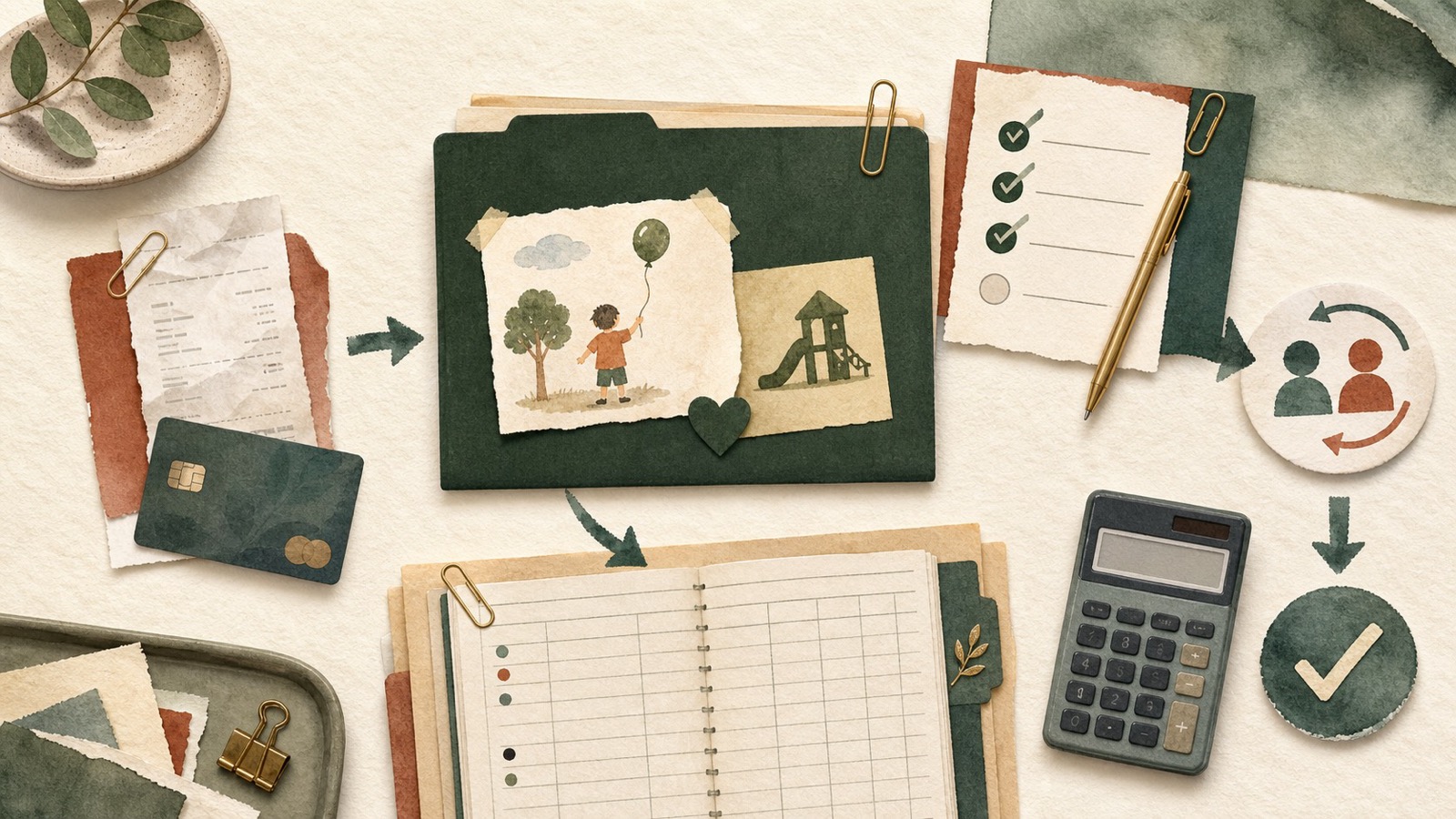
Build an expense and repayment ledger
Add child-related expenses, requests and payments. The totals and repayment chart update automatically, and you can download the complete ledger as CSV.
Your entries stay in this browser. Nothing is uploaded.
Total spent0.00
Requested0.00
Received0.00
Balance0.00
Child expense and reimbursement ledger
Swipe to view all columns
| Date | Expense | Spent | Requested | Received | Balance | Status | Actions |
|---|
No expenses yet.
Printable child-expense checklist
Check each field that applies. Leave inapplicable fields blank rather than inventing information.
Fictional example: EXP-026 · 12 July 2026 · Parent A paid $84.50 for Child A's school activity fee. Type: school. Context: school notice SCH-011 and both parents' message agreement AGR-006. Receipt REC-026 attached. A 50% repayment of $42.25 was requested on 13 July by message MSG-044. $20 received on 18 July as PAY-019. Balance shown as $22.25. Status: partially paid. The percentage comes from the recorded agreement, not a general rule.
What each part of the example establishes
The annotation prevents a receipt or percentage from being overstated.
- Event
An $84.50 activity fee was paid on 12 July.
- Agreement evidence
AGR-006 records the parents' agreed split for this expense. It is not treated as a legal area-wide rule.
- Purchase evidence
REC-026 supports provider, date, item and amount.
- Request evidence
MSG-044 supports when $42.25 was requested.
- Payment evidence
PAY-019 supports the $20 receipt and leaves $22.25 on the recorded arithmetic.
- Chronological position
SCH-011 → AGR-006 → EXP-026 → MSG-044 → PAY-019.
How to read this in the UK
Three things need to stay separate in a record. What the arrangement says, what actually happened, and the file that shows it. Blur them together and a reader has to take your word for it. Keep them apart and the record speaks for itself.
The UK is not one family-law system. England and Wales, Scotland and Northern Ireland each have their own rules, forms and vocabulary. Use the words that appear in your own order or agreement rather than a term borrowed from somewhere else.
Keep the complete source file, not a crop of it. Write events in the order they happened, and say plainly where something is missing or unclear. A family solicitor can work with a record like that. They cannot work with a reconstruction.
Locality checklist for a UK review
Name the UK nation and court. Copy the key words from the current order or plan. Add places only when they help explain the event. Remove home or school addresses if the reader does not need them. Check the right court rules before you use a private timeline as a formal record.
Separate the expense date from the record date
The purchase, service, repayment request, reply, and payment may happen on different days. Give each date a label and keep the original currency. This prevents a later summary from making a repayment look overdue before it was requested.
Identify who, what, and why
Record who paid, which child the expense concerns, the type, provider, item or service, and child-focused purpose. Use types consistently. Do not place adult personal spending into a child-expense type merely because it happened during parenting time.
Connect the entry to the governing context
Quote or link the relevant agreement, order, prior consent, school request, medical recommendation, or everyday-expense rule. Terms and allocation rules vary by legal area and person arrangement. Do not infer a universal repayment percentage.
Preserve the receipt and request trail
Keep the complete receipt with vendor, date, items, tax, discounts, total, and payment method where relevant. Record when and how repayment was requested and link the exact message. A receipt shows a purchase. It does not by itself show that repayment was agreed.
Maintain a running balance without erasing history
Add partial payments as separate events. Show original amount, requested share, each payment, adjustment reason, and remaining balance. If a request is disputed, keep the dispute status rather than labeling the other parent as refusing a valid debt.
Place the expense in the chronology
Link the expense to related events such as consent, appointment, school notice, repayment request, reply, and payment. Monthly totals should point back to record IDs. This lets a reviewer verify the arithmetic and see why the cost arose. It isn't useful to collapse those steps into one total.
A UK review note
Print a child-expense checklist and review an annotated record covering receipt, agreement context, repayment, payment and balance. Sharing any of it in the UK takes a few more steps.
Before you share any of this, work from a copy. Remove private details the reader does not need, and leave the original file untouched.
Check each key sentence. Can you link it to a date or source? If not, change the summary. Do not fill the gap with a guess.
Name the UK nation and court on the review copy. Keep the words used in the order. Ask a family solicitor about court rules and what you may need to share.
Which child expenses should I track?
Track expenses relevant to your agreement, order, repayment process, budget review, or child-focused timeline.
Does a receipt prove reimbursement is owed?
Not by itself. It supports the purchase. Allocation depends on the applicable agreement, order, consent, and local rules.
How should partial payments appear?
Keep the original request, add every payment as a dated event, and show the remaining arithmetic.
Can I print this checklist?
Yes. The print control isolates the checklist and fictional example for paper or PDF output.
Does this cover Scotland and Northern Ireland too?
No. England and Wales, Scotland and Northern Ireland have separate family-law systems, forms and terms. Use the page to organise a working record and get advice for the relevant legal system.
Sources
England and Wales, Scotland and Northern Ireland have separate family-law systems, forms and terms. The official source gives orientation only. This page is a records guide, not legal advice.