
How to read this in Australia
A record earns its weight by staying factual. Note what was planned, note what took place, and attach the file or message that supports the note.
Start from the parenting order, plan or written agreement now in force. Most family law here is federal, though Western Australia follows a different court path in some cases. Use the words that appear in your own papers.
Keep everyday days in the private record alongside the difficult ones. When a review is needed, select only the entries that answer the question in front of you. That is what lets an Australian family lawyer find the key facts quickly.
State, territory and pathway checklist
Name the state or territory and the court registry. Say if the plan is an order, parenting plan, or written deal. Use the words from that paper. Flag any Western Australian court path for legal review. Keep court papers, dispute help records, and daily notes in separate groups.
Identify the school record type
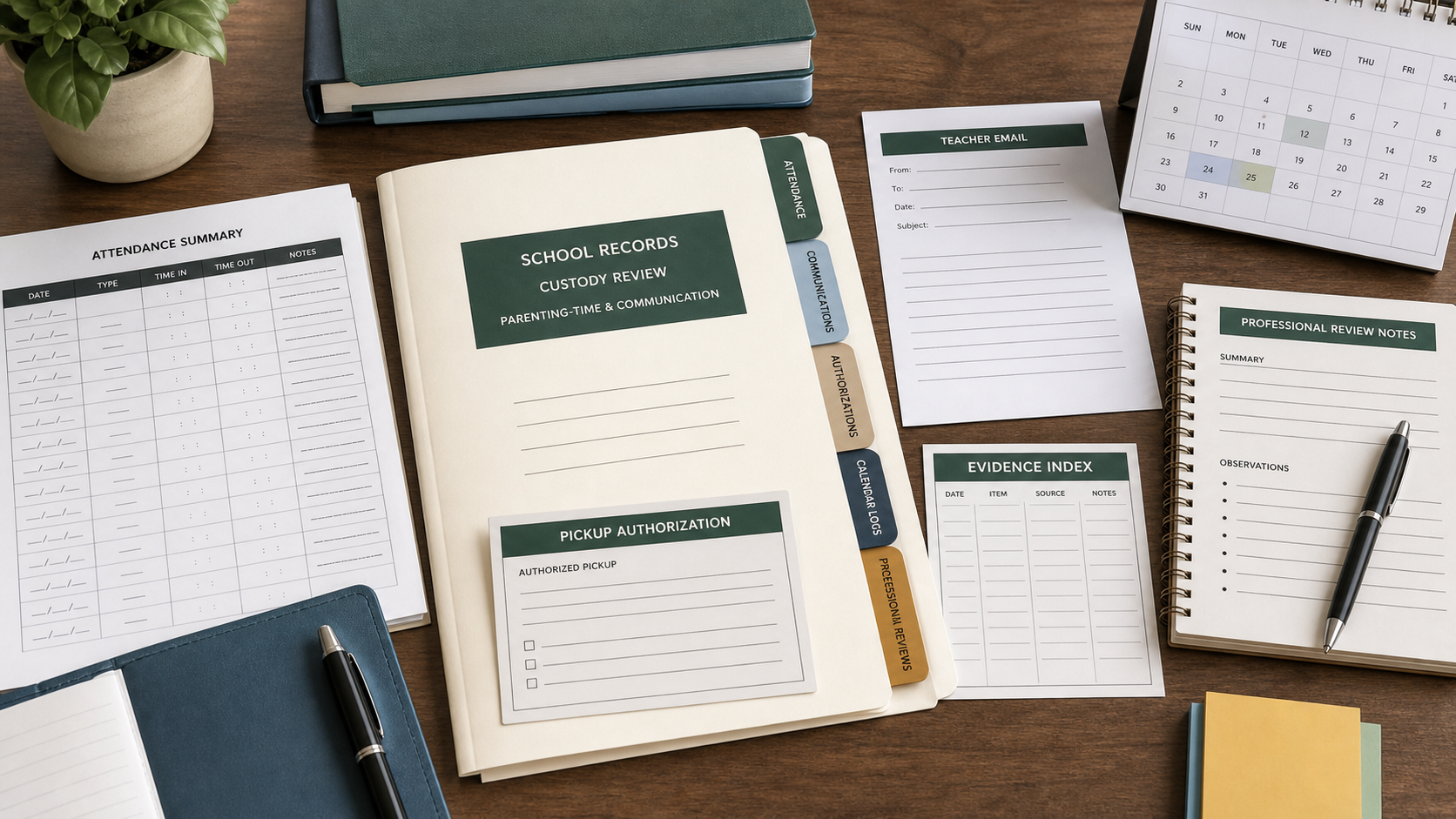
Separate attendance, lateness, pickup, teacher messages, activity, report and wellbeing records. Each type answers a different question. Do not mix them into one general school folder.
Link the record to the parenting issue
A late arrival may matter if it connects to exchange times, transport or schedule changes. It may also have another note. Record the related event and the limits of what the school document shows.
Preserve the complete communication
For teacher emails, keep the full email with date, sender, recipients and files. A pasted excerpt may lose context. If you create a summary, link it to the original.
Respect privacy and school boundaries
School records can include sensitive child information and third-party details. Keep access limited and ask what can be shared, redacted or filed in your legal area.
Prepare a focused school-record pack
For review, group records by issue: attendance pattern, pickup confusion, messages failure or medical/school coordination. Add a short timeline so the reader sees the sequence.
Check what the school record cannot show
Before drawing a conclusion, write down the limit of the source. Attendance may show when a child was marked late. But not automatically why. Keep that limitation beside the record so a reviewer can separate the school's observation from your interpretation.
An Australian review note
Organize school records for custody planning. Attendance, lateness, teacher emails, pickup records, activities, source context and review packs. Sharing any of it in Australia takes a few more steps.
Work from a copy when someone needs to review the record. Include the current order or plan, a short timeline and a small set of named source files.
Check current court orders and rules before you send the pack. An Australian family lawyer can say what belongs in an affidavit, annexure, or private file.
Name the state, territory, and court path. Take extra care in Western Australia. A national guide cannot set the right court step for every case.
School records checklist
Collect only records that connect to a real issue.
Copyable school record index row
Use this to connect school material to your timeline.
SCHOOL RECORD REF:
RECORD TYPE:
DATE OF RECORD:
DATE RECEIVED:
CHILD:
SOURCE OR SENDER:
WHAT IT SHOWS:
RELATED EVENT REF:
ACTION TAKEN:
LIMITS OR CONTEXT:
PRIVACY REVIEW STATUS:- Useful note
Attendance record shows late arrival on 4 Feb. Related exchange entry EX-014 records actual handover time. Cause not stated by school record.
- Weak note
This proves the other parent is causing school problems.
Example school-record bundle
A focused bundle is easier to review than a folder dump.
- Issue
Three late arrivals after weekday exchanges.
- Records
Attendance records SCH-004 to SCH-006 and exchange entries EX-014 to EX-016.
- Context
Two everyday on-time arrivals included for comparison.
- Question
Ask counsel whether the pattern is relevant to schedule review.
What a coherent Australian record looks like
Casewell keeps the dated entry, its source file and any later addition together in one private timeline. When a review is needed, select only the records that answer the question in front of you and share those with an Australian family lawyer.
Try for freeCan this type of record be used in custody preparation?
It can help organize facts and source material. A court or qualified expert decides relevance, court process, privacy and weight.
Should I keep the original source?
Yes. Keep the original where possible and use a separate working copy for notes, summaries or redactions.
How should I share these records?
Share a focused, filtered pack only after checking privacy, safety and local process with a qualified expert.
Is this a court form or affidavit?
No. It is a method for keeping a private factual record. Current court rules and expert advice decide how material is prepared or used in a proceeding.
Sources
Federal family law supplies the broad framework, while Western Australia and some related processes have distinct pathways. The official source gives orientation only. This page is a records guide, not legal advice.