 Casewell

Stable parenting evidence is a dated, factual record of how you meet your child’s everyday needs: who handled exchanges, school, medical care, meals, bedtime and money, and how consistently. Judges decide custody on the child’s best interests, so the strongest record ties each entry to a need of the child, not to a complaint about the other parent. A custody journal such as Casewell keeps that record in one place, timestamped as events happen, and turns it into a court-ready PDF when you need it.
TL;DR
- Courts look at the child’s needs and each parent’s ability to meet them, including continuity of home, school and routine. Your records should answer those questions.
- Keep four kinds of records: parenting time and exchanges, caregiving (school, medical, activities), communication, and expenses.
- Write entries the same day, with date, time, facts and no opinions. Neutral wording persuades more than anger does.
- A judge decides what evidence is allowed, and deadlines and exhibit rules vary by county, so organize early and check your court’s rules.
- Casewell logs exchanges, messages and expenses in one place and exports filterable, indexed PDFs, with records stored encrypted on your device.
Table of Contents
- What courts mean by stable parenting
- The records worth keeping
- How to write entries a judge will trust
- From journal to mediation or court
- When the other parent will not cooperate
- Start the record today
- FAQ
- Sources
What courts mean by stable parenting
There is no single national test. Each state sets its own best-interest factors, but the themes repeat. The Alaska Court System’s self-help guidance on parenting plans lists the child’s physical, emotional, mental, religious and social needs, each parent’s ability and desire to meet them, and continuity in a stable, satisfactory environment among the factors a court weighs.
Alaska’s best interests affidavit form asks a parent to explain the child’s needs, how the proposed plan meets them, each parent’s capacity, the living arrangements, continuity, and support for the child’s relationship with the other parent. That last item matters. Evidence that you encourage the child’s bond with the other parent counts as stability evidence too.
Michigan’s custody investigation manual is useful because it shows what a neutral investigator actually checks. It directs investigators to look at the child’s comfort, stability, supervision, routines, housing history, school continuity, and the effect of changes in household or caretaker. The same manual adds a point worth knowing: frequent relocation alone does not settle the question. Investigators are told to consider how long key relationships have lasted, how predictable the child’s life is, structured activities, and the effect on the child.
In practice, “stable” means a pattern, and a pattern can only be shown with many small, dated facts.
The records worth keeping
Massachusetts Legal Help, reviewed August 2025, says parents should offer evidence tied to the child’s needs. It names safe housing, medical care, food and clothing, supervision, educational support, daily care and emotional support as examples of what to document. Use that list as the skeleton of your record.
Parenting time and exchanges
This is the backbone. For every handover, record the planned time, the actual time, the location, who was present, and whether the child arrived with what they needed (school bag, medication, clothes). The gap between planned and actual time is often what a judge wants to see. Our parenting-time log is built around that comparison, and our guide to a parenting time timeline shows how a series of entries becomes a record that holds up.
Caregiving
Log the doctor and dentist visits you scheduled or attended, parent-teacher conferences, homework help, activities, meals, bedtime routines and illness days. One line each is enough: “Took Maya to pediatrician for ear infection, picked up prescription, gave first dose at 6 p.m.”
Communication
Keep messages about the child’s schedule, health, school and expenses. Note how you responded: promptly, politely, with a clear proposal. A calm tone across months of messages says more about stability than any single statement.
Expenses
Record what you paid for, the date, the amount and whether you asked for reimbursement. Keep receipts alongside the entry. Child-related costs are a recurring point of conflict, and a ledger that matches your receipts ends most arguments quickly.
Records held by others
Some of the best evidence is not yours. Massachusetts Legal Help lists medical, police, school, childcare-provider, supervised-visitation-center and Department of Children and Families records as possible custody evidence. It also says records held by organizations may require a subpoena, and that you should know what they contain before you request them. Your own journal helps here because it tells you which dates and providers to ask about.
In some states a parent without primary custody still has a right to these records. Nevada, for example, provides that a parent must not be denied access to a child’s medical, dental or school records solely because they are not the custodial parent. Check your own state’s statute.
How to write entries a judge will trust
A record is persuasive when it is boring. Here is the routine.
- Write the same day. Memory fades and details drift. Entries made at the time carry more weight than a summary assembled the night before a hearing. Casewell prompts you after each exchange or handover, so the entry gets written while the facts are fresh.
- Use date, time, place, people and what happened. “Dad arrived 6:22 p.m. for a 6:00 p.m. exchange at the library parking lot. Child handed over with backpack and inhaler.” Nothing more is needed.
- Separate fact from feeling. “She screamed at me” is a characterization. “She raised her voice and said she would not return the child on Sunday” is a fact. If you want to note how you felt, keep it out of the version you might export.
- Quote messages exactly. Do not paraphrase. Paraphrase invites an argument about what was really said.
- Attach what supports the entry. Receipts, screenshots, photos of a school notice. Casewell is designed to hold messages, expenses, agreements and evidence together with the entry they belong to.
- Re-read before you save. Anger leaks into wording. Casewell offers optional AI-assisted rewriting that restates an entry in neutral language, and you approve every change before it is kept. That keeps the facts yours and the tone calm.
- Build the timeline as you go. A calendar of custody and important events can help establish dates, according to Philadelphia Legal Assistance’s guide for self-represented parties. Real-time timeline tracking in Casewell means the sequence is already organized when you need it. For schedules, see our parenting time calendars guide.
Our article on the parenting journal for court goes deeper on entry wording.
A worked example
Suppose your exchange schedule says Friday at 5:00 p.m. over three months. Your log shows 11 on-time handovers, 2 late by under 15 minutes (both noted with the reason you were told), and 1 missed by the other parent with a message you saved. Alongside, your caregiving entries show you booked and attended every dental and pediatric visit. A mediator reading that sees reliability in numbers, not adjectives. Nothing in it attacks anyone.
From journal to mediation or court
Keeping records is half the job. The other half is getting them in front of the decision maker in a usable form.
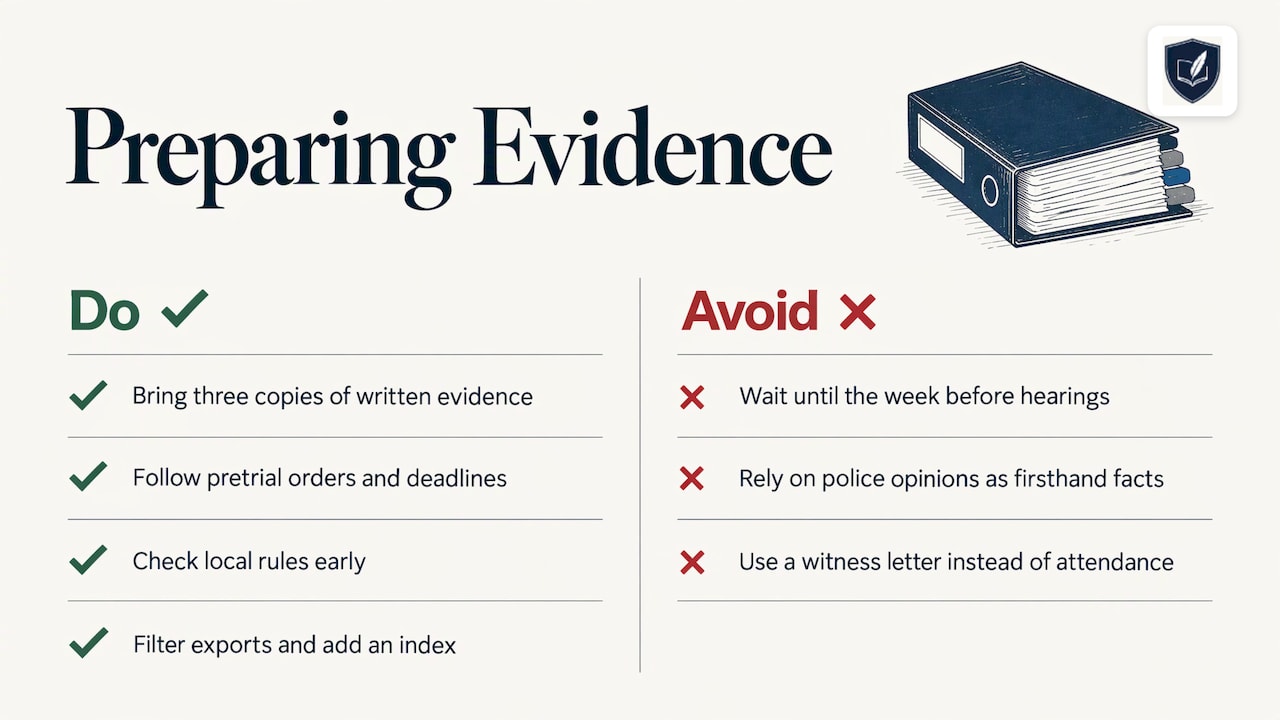
A judge decides what counts. Philadelphia Legal Assistance’s guide says parties may use documents, photos, voicemail, video, texts and social media posts as exhibits, but the judge decides what may be considered. It advises bringing three copies of written evidence: one for you, one for the court and one for the other party. A Superior Court of California handout from Merced County, dated April 28, 2025, similarly says evidence should be made available to both the judge and the other side, and the judge determines which documents may be included.
Deadlines are strict. A Pennsylvania county custody handbook advises self-represented parties to follow pretrial orders and deadlines, because noncompliance may prevent evidence or witnesses from being presented. Find your court’s local rules early, and do not wait until the week before a hearing to produce a clean set of records.
Evidence rules apply to what you bring. Massachusetts’ Guide to Evidence, section 1115, adopted February 1, 2026, explains that custody cases there apply common-law and statutory evidence rules. For example, school records generally qualify as official records, and police reports are admissible as business records only for officers’ firsthand observations, not for opinions. The lesson for you is simple: records built from firsthand facts travel better than records built from opinions. Other states have their own rules, so ask a family law attorney or your court’s self-help center how they apply where you live.
Witnesses need to speak for themselves. Massachusetts Legal Help names teachers, childcare workers, health professionals, social workers, police, family, neighbors and friends as possible firsthand witnesses, and says they should testify to what they personally know, not rumors. The Philadelphia guide adds that a witness’s letter is usually not a substitute for the witness appearing, and that a subpoena can require attendance. Your journal helps you recall who saw what and when.
Make the PDF easy to read. A judge or mediator has little time. Filter the export to the question at hand, for example only exchanges for one quarter or only expenses, and give it an index. Casewell’s court-ready reports are filterable and indexed for this reason.
When the other parent will not cooperate
A non-cooperative co-parent makes your record more important, not less. You cannot count on them to confirm times, agree on costs or answer messages, so your own dated notes become the shared reference point. Keep your messages short, factual and child-focused, and write the entry about the facts, not the fight.
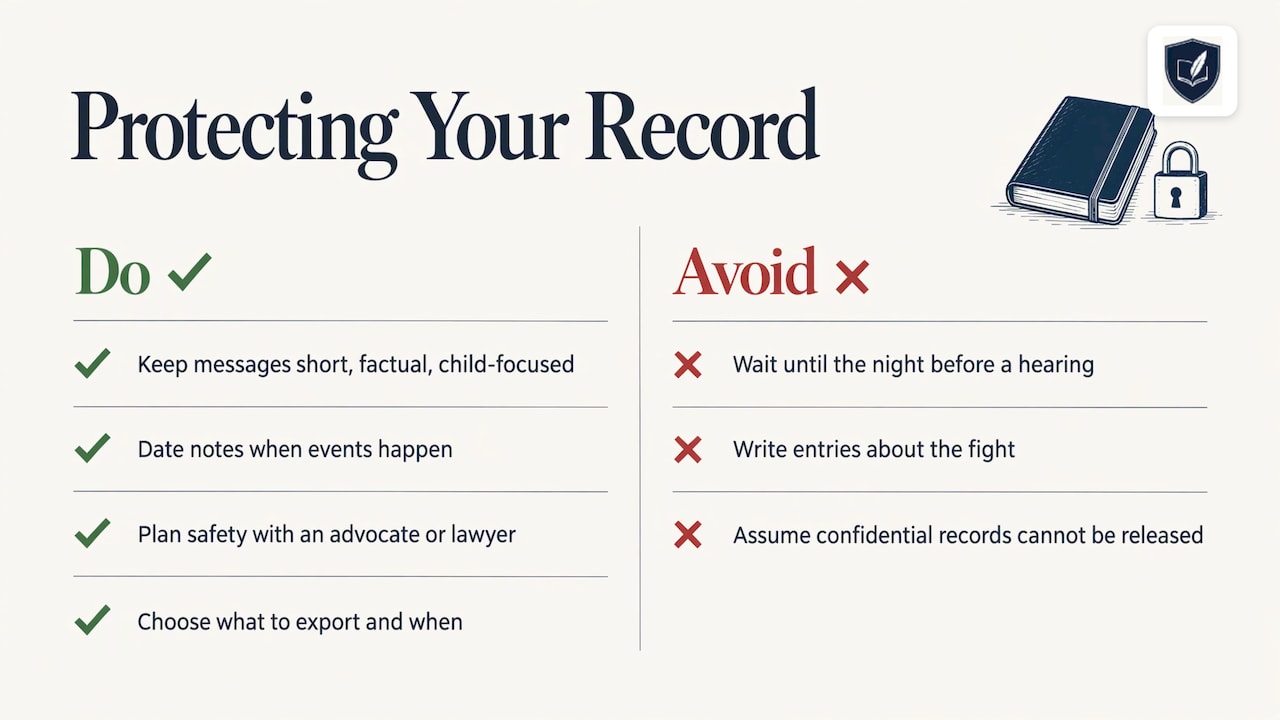
Privacy needs thought too. Where there has been abuse, the Philadelphia guide advises you to consider whether anything you tell court personnel or mediators may be shared with the former partner, and to plan safety precautions with an advocate or lawyer. The Ohio Domestic Violence Network’s self-help manual, updated April 2025, warns that confidential records may still be released by consent or court order, though courts can also review records privately or limit disclosure. It also cautions that contesting custody may put mental-health information at issue. If any of this applies to you, speak with a domestic violence advocate or family law attorney before deciding what goes into an exhibit.
This is why where your journal lives matters. Casewell stores records encrypted on your device and keeps no copies on company servers, so the other parent, and anyone else, has no account to reach. You decide what to export and when.
Our perspective
Most parents we think about start keeping records the night before a hearing. By then they are reconstructing months from texts and memory, and the result reads like a grievance. The parents with the clearest cases wrote down small, dull facts at the time they happened.
That is why we built Casewell around the moment right after an exchange. A prompt, a few lines, a timestamp. Over time that becomes a timeline of parenting time, messages and expenses that speaks for itself.
We also think the record should belong to the parent alone. Entries are stored encrypted on your device, with no copies on our servers, and the AI rewriting is optional and always approved by you. It exists to help you say what happened in neutral words, not to say anything for you.
When you do need to show someone, a filterable, indexed PDF lets you hand over the part that answers the question and nothing more.
Mielad
Start the record today
Casewell is a custody journal app for co-parents. You log exchanges, messages, expenses, agreements and evidence in one place, see them on a real-time timeline, and export court-ready PDFs. It starts with a free trial, and Casewell Premium is $2.99 per week or $49.99 per year. See Casewell Premium or the US features page for details.

If you already have months of messages and receipts and need them in order, our Court timeline service starts from £29 as a one-off.
FAQ
How long should I keep a parenting journal before it helps?
A few weeks of consistent entries already show a pattern, and several months show reliability. Start now rather than waiting for a dispute, because you cannot go back and record an exchange as it happened.
Should I include my opinions of the other parent?
Keep opinions out of anything you might export. Write who, what, when and where, and quote messages exactly. Entries about the child’s needs and your response to them are the ones that tie to best-interest factors.
Can a judge refuse my records?
Yes. The judge decides which documents are considered, and local deadlines and evidence rules apply. Organize your records early, follow your court’s pretrial orders, and ask a family law attorney or the court’s self-help center how admissibility works in your state.
Does frequent moving mean I will be seen as unstable?
Not automatically. Michigan’s investigator manual says relocation alone does not conclusively establish instability, and points to the length of key relationships, predictability and effects on the child. A record showing steady school attendance, routines and care across a move speaks directly to those points.
What if the other parent can see my records?
With Casewell, records are encrypted on your own device and not held on company servers, and you choose what to export. If safety is a concern, talk to an advocate or family law attorney before sharing anything with the court or a mediator.
Sources
- Alaska Court System: Parenting Plans self-help guidance
- Alaska Court System: Best Interests Affidavit, SHC-1125
- Michigan Courts: Custody and Parenting Time Investigation Manual
- Massachusetts Legal Help: How to show the judge it is in your child’s best interest
- Nevada Legislature: NRS Chapter 125C
- Philadelphia Legal Assistance: Guide for Self-Represented Survivors
- Superior Court of California, County of Merced: custody handout
- Adams County Court of Common Pleas: Custody Litigation Handbook
- Massachusetts Guide to Evidence, Section 1115
- Ohio Domestic Violence Network: Self Help Legal Manual