 Casewell

Your child sleeps at your home every school night, so you assume you have sole custody and can sign every form, choose every doctor, and decide on a school move alone. Then the other parent says you can't. That clash is where physical and sole custody confuse most parents, because one phrase describes where a child lives and the other, by itself, doesn't tell you who decides.
Physical Versus Sole Custody at a Glance
Custody orders answer two separate questions, and parents who blend them misread what their own order allows. One question is where the child lives night to night. The other is who makes major decisions. A child who sleeps at one home Monday through Friday and spends alternate weekends with the other parent raises the first question; an argument over who signs the school enrolment form raises the second.
Physical custody covers the child's day-to-day residence, physical care, and supervision. Legal custody covers major decisions about education, healthcare, and religion. The word sole is a qualifier that can attach to either one, so an order can pair sole physical with joint legal, joint physical with sole legal, or another combination.
Two answers, one order, different columns.
Two Definitions Parents Can Check
The New York Courts guidance on custody says sole physical custody generally means the child resides with one parent more than 50% of the time, while the other parent typically receives visitation. That threshold turns the label into a counting exercise, which is why the table below separates scope, time, and authority into three rows instead of treating a label as a decision-making rule.
Physical, sole physical and sole legal custody compared
| Question | Physical custody | Sole physical custody | Sole legal custody |
|---|---|---|---|
| What it covers | Where the child lives and who supervises daily care | The child lives mainly with one parent, who has exclusive or primary physical custody | One parent alone makes major decisions on education, healthcare and religion |
| Typical threshold | Time the child spends with each parent | More than 50% of overnights with one parent in New York guidance | Not measured in time, set by the order's wording |
| Who decides school, medical and religious issues | Not decided by physical custody alone | Set by the legal custody term in the same order | The sole legal custodian, without the other parent's consent |
Read the first row for scope, the second for the time test, and the third for authority. The third row is the one parents skip when they stop reading at the words sole and physical.
A Three Question Test for Any Order
Apply three questions before you act on an assumption. First, where does your child sleep most nights? Second, who signs the school and medical forms under the written order? Third, does the order say sole or joint separately for residence and for decision-making?
Practical rule: A disagreement about a medical form doesn't prove a parent missed parenting time, and a missed weekend doesn't prove who can choose a school.
Keep the three questions in separate columns of your notes. Overnights, exchanges, and the care that took place speak to the physical custody term. Requests, approvals, and refusals about school or healthcare speak to the legal custody term. When each event sits under the question it answers, your records line up with the words your order uses.
How Parenting Time Decides the Physical Custody Label
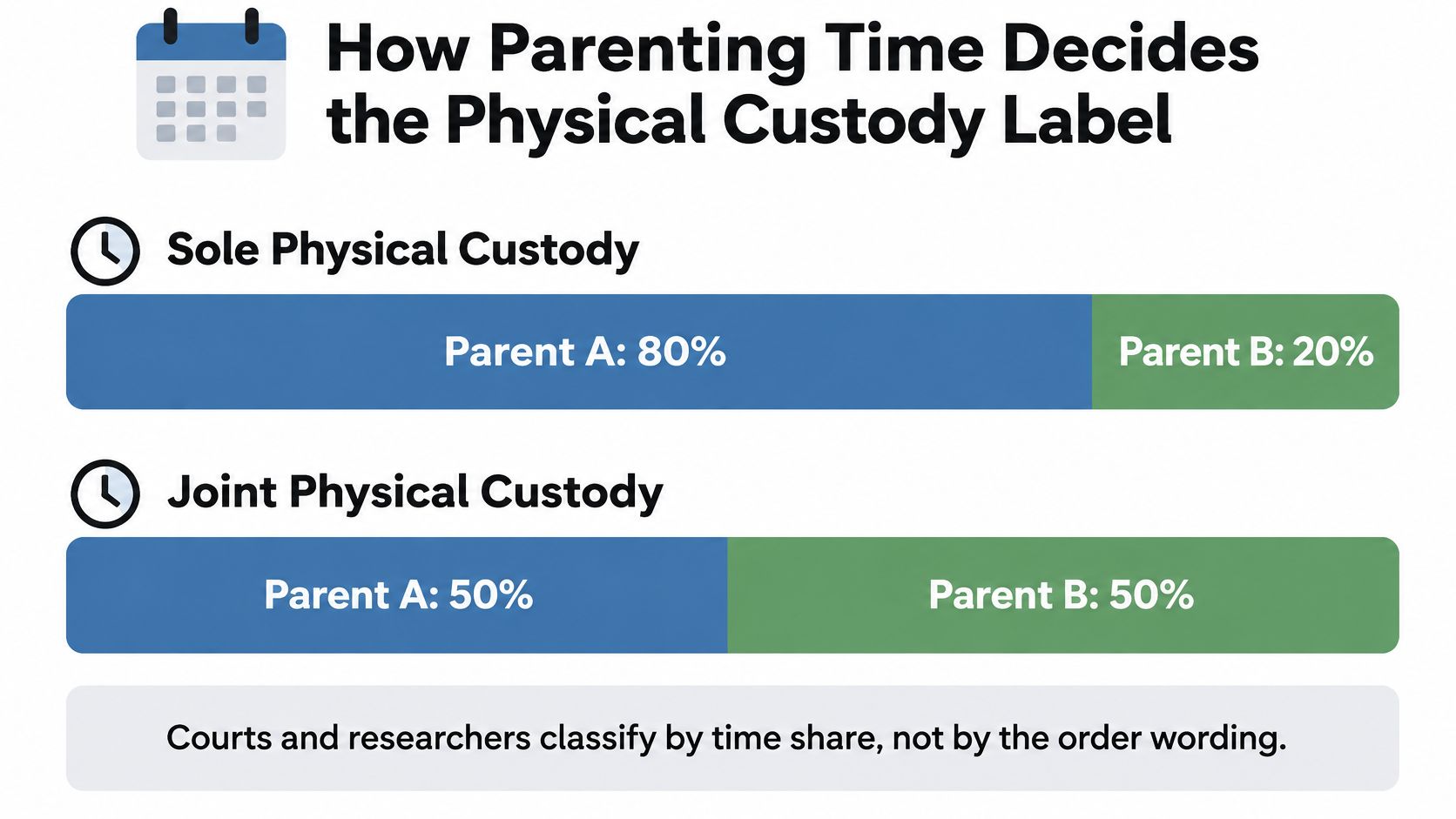
A label on paper doesn't always match the calendar your child lives. Parents often read joint physical custody and expect an exact half-and-half schedule, but time shares are usually the deciding measure. The 2019 literature review in Family Process defines joint physical custody as a child living with each parent for at least 25% to 50% of the time, depending on the threshold used.
That range matters. A parent who provides 30% to 49% of residential time may still fall within a joint definition, even though the other parent has the majority. Sole physical custody generally means the child resides primarily with one parent, even when the other parent has substantial visitation.
Count Overnights Not Intentions
Overnights are the usual yardstick because they're easier to count than hours at school, practice, or work. Say your child spends 4 of 14 overnights with one parent in a two-week cycle. That's 4 divided by 14, or about 28.6% of overnights.
That example sits just inside the lower joint band in the research definition, not in a token-visitation band. It doesn't settle what your court will call the arrangement, but it gives you a concrete number to compare with the order's wording. You can also check how the underlying schedule works in this explanation of what parenting time means in practice.
Parenting-time share and the usual custody label
| Share of overnights | Usual label | What the records should show |
|---|---|---|
| Under 25% | Visitation with the other, primarily residing parent | Scheduled weekend or midweek times and actual pick-up and return times |
| 25% to 49% | Joint physical in many definitions, with one parent holding the majority | Overnight counts, handover times and deviations from the agreed schedule |
| 50% | Equal shared physical custody | Calendar of each overnight, with both parents' entries |
| Over 50% | Sole physical custody in New York guidance, with primary residence | Overnight counts per month plus the other parent's scheduled and actual time |
Measure a Full Month First
Don't calculate from the planned schedule if swaps happen every week. Count actual overnights over a full month, including late returns, extra nights, and missed time, then note if the pattern changed mid-period.
If summer differs from the school term, measure each period separately. A yearly average can hide months where the lived schedule didn't resemble the order at all.
Why Physical and Legal Custody Are Separate Questions
Physical custody sets the address where your child sleeps on a given night. Legal custody sets who signs off on the major decisions. The same parent can hold both, or a court can split them, and that split is where most confusion starts.
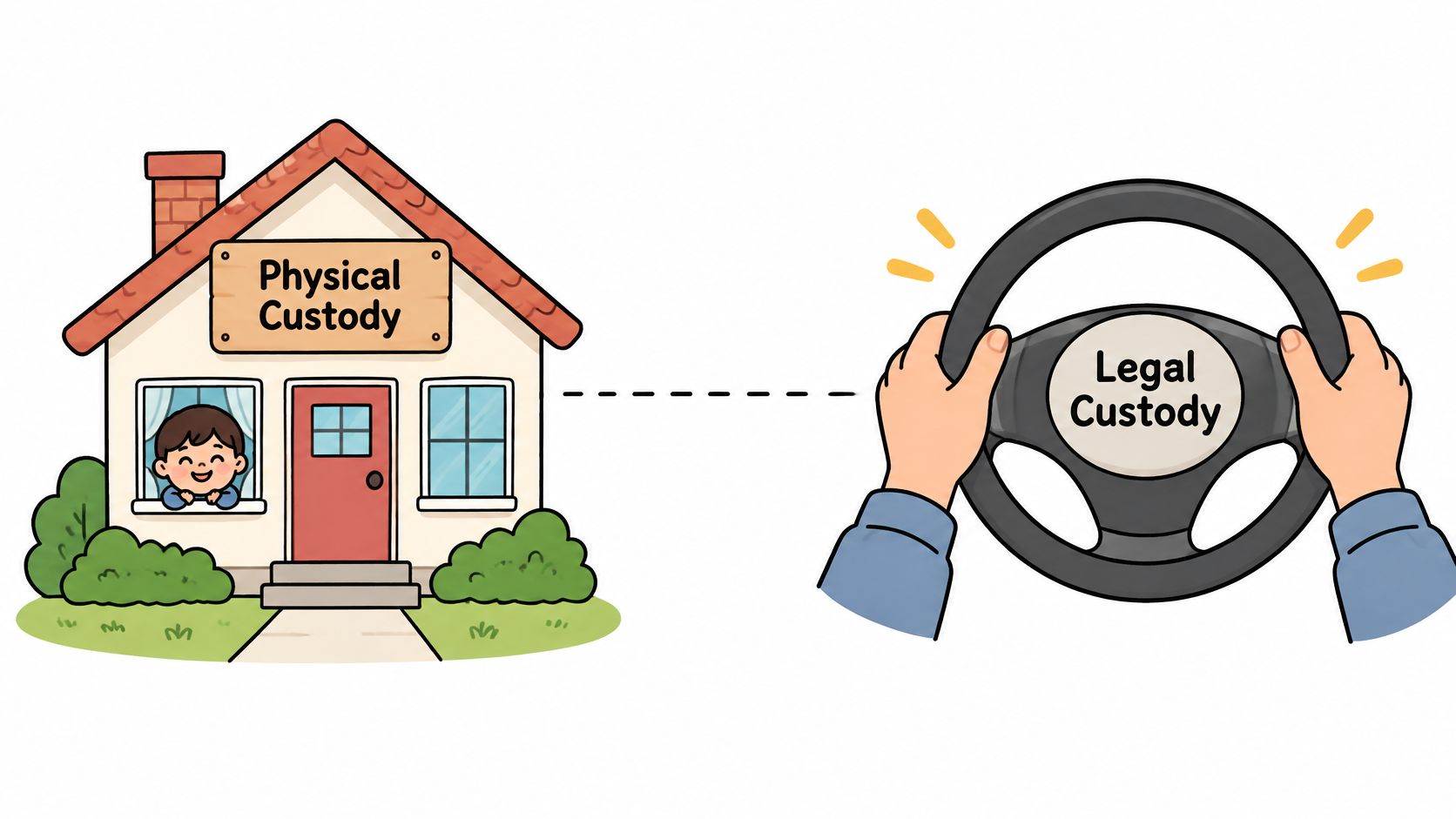
A parent with sole physical custody may still need the other parent's agreement on school or healthcare when legal custody is joint. Everyday phrases such as full custody blur that line, and a court can place the child's main home with one parent while still ordering parenting time for the other.
The San Diego Superior Court custody FAQ makes the same point: sole physical custody is not the same as sole decision-making authority, and it does not automatically eliminate the other parent's parenting time.
Common Combinations in Daily Life
Common custody combinations and who decides
| Combination | Where the child lives | Who decides major issues | Practical effect |
|---|---|---|---|
| Sole physical with joint legal | Mainly with one parent | Both parents together | The primary parent runs daily care, but the other must be consulted on school and medical choices |
| Sole physical with sole legal | Mainly with one parent | One parent alone | Strongest form of control, the other parent may still have visitation |
| Primary residence with joint physical | Mostly with one home base, with substantial time at the other | Both parents together | A shared arrangement with one official home address for school |
| Joint physical with joint legal | Substantial time with each parent | Both parents together | Shared parenting on both time and decisions |
| Joint physical with sole legal | Substantial time with each parent | One parent alone | Shared time, but one parent makes the major decisions |
Read each row from left to right. The residence column covers routines, school runs and bedtime care. The decision column tells you whose consent you need before enrolment, treatment, travel or a major activity change. Neither column predicts the other, which is why two parents can share overnights evenly while only one of them holds decision power.
For the baseline definition before you check your own order, this guide to the legal custody definition separates decision authority from residence.
The short video below states the distinction out loud if the table still feels abstract.
Keep in mind that the label on the order and the schedule on the kitchen calendar are different kinds of evidence. Overnight counts, pick-up times and missed handovers show where the child actually lived, while the legal custody clause shows who had to agree on the school form. Don't infer authority from who packs lunches or keeps the bedroom. Read the order's physical and legal terms separately, under your jurisdiction's wording.
What Each Type Means in Court and Daily Life
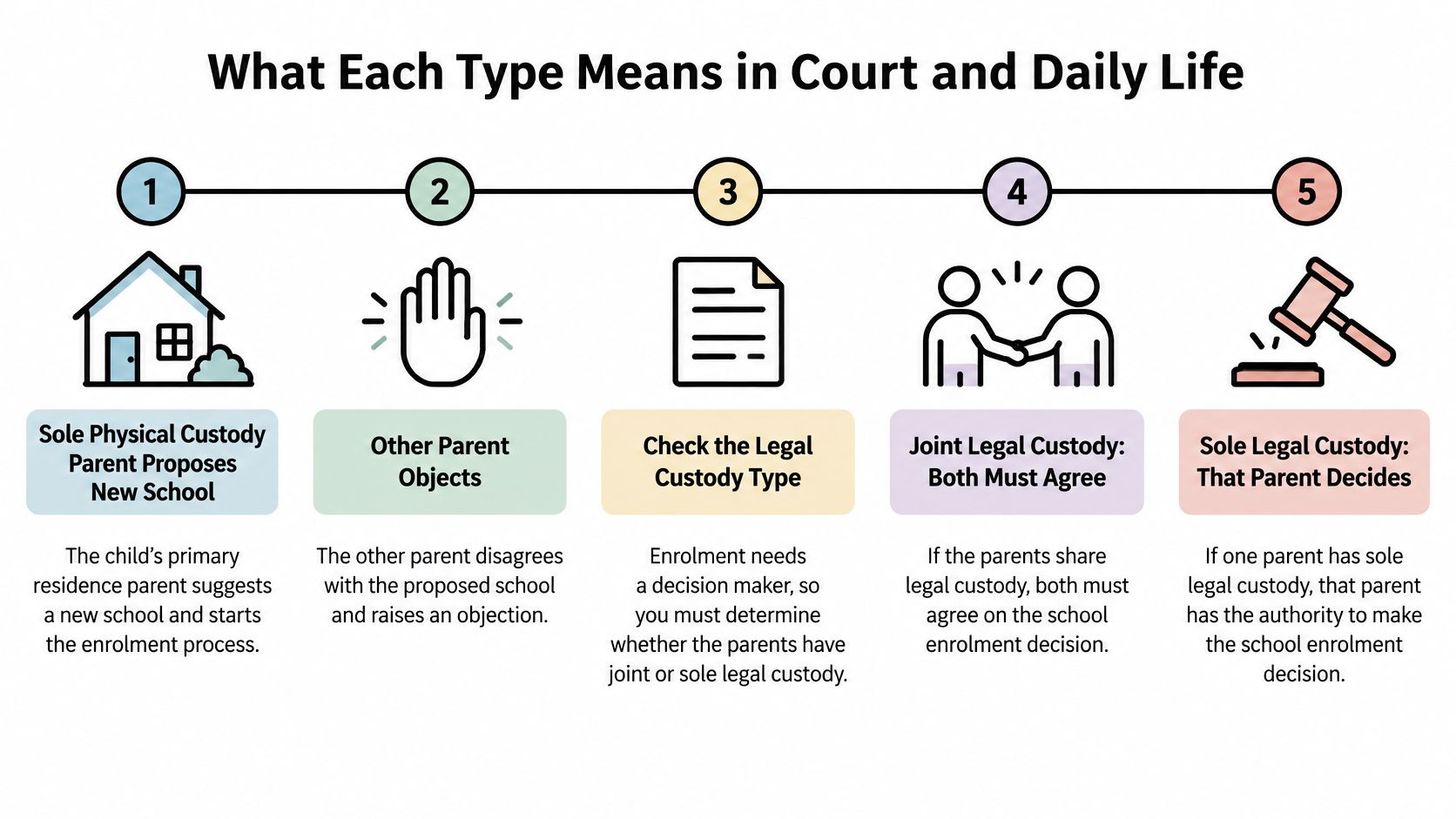
A parent with sole physical custody finds a better school near home and starts the enrolment paperwork. The other parent objects and says the move can't happen without agreement. Who's right turns on the legal custody term, not on where the child sleeps most nights.
If legal custody is joint, both parents normally must decide the school question together. If one parent has sole legal custody, that parent decides, subject to the order's limits and any notice rules. The timeline below maps that fork in the road.
Where the Distinction Shows Up
- School enrolment and address: Physical custody often supplies the home base, while legal custody controls the enrolment decision.
- Medical consent: Routine care during your parenting time differs from choosing a provider or authorizing major treatment.
- Travel abroad: A holiday during your scheduled time may still need written consent, a passport decision, or court permission.
- Relocation: Moving the child's main home can affect both the time share and the other parent's access, so orders often treat it separately.
- Extracurricular activities: Sign-ups that consume the other parent's time or create major costs can become decision-making disputes, not just scheduling choices.
Don't collapse these into one argument about fairness. Name the exact decision, find the term that governs it, and check whether notice, consent, or mediation is required first.
How Orders Usually Take Shape
- Temporary order: A short-term arrangement may govern residence and decisions while the case is pending.
- Petition or parenting plan: The filing names the physical and legal terms each parent requests.
- Mediation or hearing: Parents negotiate, or a judge hears evidence if they can't agree.
- Final order: The written terms set the schedule, decision authority, exchanges, and holidays.
- Later modification: A parent usually must show a change in circumstances before a court revisits the arrangement.
Court categories don't always capture the lived schedule. The Department of Justice Canada fact sheet on parenting arrangements cautions that court-file classifications do not always establish how children divided their time between households.
Keep the order wording and the actual calendar as two records, because a judge or mediator may need to compare them side by side.
That comparison only works if your entries carry dates, scheduled times, actual times, and attached proof. A family lawyer in the relevant province or territory can assess the legal use of a focused export, and whether a record is used is up to the court.
What to Document for Each Type of Custody
Start with observable events, not conclusions. Write what happened, when it happened, who was there, and what you kept as proof. If you later clarify wording, keep the original note so the sequence stays honest.
The 2025 research digest in the Journal of Child Psychotherapy frames the better question as whether an arrangement fits conflict levels and the child's relationships with each parent, not whether one label wins for every family. Your records should therefore show workability, including exchange reliability, exposure to conflict, school continuity, health needs, and your child's relationship with each parent, without diagnosing motives.
What to record for each custody element
| Custody element | Facts to capture | Proof to keep | Why it matters |
|---|---|---|---|
| Overnight residence (physical) | Scheduled and actual overnights, pick-up and return times, location | Calendar entries, messages confirming changes | Shows the lived schedule behind the physical custody label |
| Exchanges and handovers (physical) | Date, time, who handed over the child, any delay | Timestamped messages, photos where lawful | Shows reliability of the schedule and deviations from it |
| Missed or modified parenting time | Date, the agreed time, what happened, who requested the change | Written requests and replies | Separates missed time from disputed decisions |
| Major decisions (legal) | Decision needed, date raised, the other parent's response, the outcome | Emails, school or medical notices | Shows whether joint or sole legal authority was respected |
| Deviations from the written order | Order term, actual event, date written, any later edits | Original order, dated notes, attached proof | Lets a lawyer or mediator compare the order with what happened |
| Child-related facts | Attendance, sleep, health visits, school communications, the child's stated needs | School reports, appointment confirmations | Gives neutral, observable evidence instead of conclusions |
Keep Each Event in Its Own Lane
A dispute over a school form isn't a missed weekend. Log the decision request under legal custody, with the date you raised it and the reply you received. Log a late exchange under physical custody, with scheduled and actual times.
That separation protects you from overstating a claim. It also helps a mediator see patterns quickly, such as reliable handovers alongside repeated unanswered medical requests. For the practical side of building that record, see this walkthrough on how to prove parenting time with dated records.
Treat the log as neutral pattern evidence, not ammunition. Note cancelled time and cooperative swaps, extra nights you offered, and agreements that worked, so the file doesn't read as a one-sided complaint list.
A Monthly Routine That Stays Manageable
- Review overnights against the calendar: Count actual nights and mark every change from the written schedule.
- List open decisions and replies received: Close out school, health, travel, and activity requests with dates and outcomes.
- File proof within the same week: Attach messages, notices, and receipts while you still remember which event they support.
Myths About Sole Custody That Lead Parents Astray
The most damaging myth is simple to say and hard to undo in a conflict. A parent hears sole custody and assumes the other parent has been erased from the child's life. That assumption then shapes missed calls, withheld information, and arguments at the exchange.
Four Myths to Retire
- Sole custody means the other parent has no role: Sole physical custody describes primary residence, and the other parent may still have scheduled parenting time and a relationship the order protects.
- Sole physical custody means no say in decisions: Decision authority comes from the legal custody term, which can be joint even when residence is mainly with one parent.
- Full custody means full legal authority: Full custody is an everyday phrase, not a reliable statement of what your order grants, so don't use it to consent, refuse, or enrol.
- Sole custody harms children and joint custody always helps: Outcomes don't sort that cleanly, because conflict, stability, and each parent-child relationship shape daily experience.
What the Outcome Evidence Actually Supports
The review and evidence summary in the Journal of Divorce and Remarriage reports that a 2022 evidence review found available research insufficient to draw clear conclusions about differences in children's well-being across custody arrangements. A review of 60 studies found children in joint physical custody had better outcomes on all measured dimensions in 34 studies, but those findings are associations, not proof that changing custody alone causes better outcomes.
A newer study in that summary reported good mental health for 79.8% of children in shared care versus 67.9% in sole care, while physical-health percentages were nearly identical at 60.9% versus 62.3%. Those numbers don't tell an individual family which order to seek, because families who can sustain shared care may differ from families who can't.
High conflict can make a joint arrangement function like a difficult sole arrangement, so fit matters more than slogans.
Ask whether exchanges are safe and predictable, whether school and sleep stay stable, and whether your child can maintain a healthy relationship with each parent under the proposed schedule. Record those observable conditions, including attendance, appointments, transitions, and your child's stated needs, rather than writing that an arrangement is good or bad.
Confirm Your Custody Order Before You Act
Don't rely on memory, a text thread, or what someone called the arrangement at the kitchen table. Sit down with the actual order and check it term by term. Terms for residence and decision-making are named differently by country, so match each phrase to the exact wording of your local order.
Your Order Checklist
- Find the physical custody term: Write down the number of overnights it gives each parent and where exchanges happen.
- Find the legal custody term: List which decisions need joint agreement and which one parent can make alone.
- Check the written parenting schedule: Include school weeks, holidays, birthdays, travel notice, and exchange times.
- Note every later change: Record any temporary order, modification, or amendment with its date so you don't follow an outdated version.
- Start a dated log today: Keep the original note of each event, with proof attached, instead of reconstructing months later.
- Ask a lawyer or mediator to confirm: Have a family lawyer or mediator confirm how the terms apply and whether a focused export is suitable for review.
That checklist is easier to follow when your paperwork matches the current parenting time order, not an earlier draft. If you want those entries kept in one place, Casewell is a private custody journal for separated parents in Germany, the US, and Canada. The other parent does not need to install, approve or join Casewell.
Be clear about the limit. Casewell cannot determine whether a record is admissible, prove a disputed claim or replace legal advice, and the court decides what is relevant.
Start your dated log today by recording tonight's overnight, the next exchange, and any open school or medical decision as separate entries, with the order term each one concerns. Casewell keeps those private records organized by child and date, with proof beside each event, so you can prepare a focused export for a lawyer or mediator when you need one.