
A parenting time order is a court-approved schedule that spells out when and where a child spends time with each parent, how exchanges happen, and how disputes or expenses are handled. Courts enforce what's clearly written and clearly documented, not what one parent remembers being agreed.
That distinction becomes painfully clear on an ordinary custody week. A pickup runs late, the parents disagree about the exchange location, and a simple question about traffic turns into a long chain of angry messages. By bedtime, nobody can say exactly what happened, what the order required, or whether the missed time should be made up.
A well-written order acts as a practical safety net. It replaces assumptions with instructions that both parents can follow, even when communication has deteriorated. The challenge is that a schedule only works as well as its wording, and enforcement only works as well as the records supporting it.
What Happens When a Parenting Schedule Breaks Down
The problem often starts with a term that seemed harmless when everyone was cooperating. “Pickup after school” sounds clear until the child's school releases students at a different entrance, one parent expects the other to provide transportation, and neither person knows whether a delay of an hour requires a makeup visit.
Messages then become the unofficial record. One parent writes that the other is always late. The other responds that the first parent changed the location without permission. Each side saves the messages that support its own version, but neither has a clean timeline showing the scheduled time, actual events, reason for the change, and time lost.

A parenting time order is a court-backed schedule that sets those expectations in writing. It typically states where the child will be, when each parent's time begins and ends, who handles transportation, how holidays and school breaks work, and whether the parents must offer makeup time after a missed visit.
Why informal understandings fail
An informal arrangement can function while trust remains intact. Once conflict appears, however, phrases such as “we'll work it out,” “usual place,” or “whenever works” create openings for disagreement. Courts generally need to compare conduct against an actual order, not reconstruct an entire co-parenting history from competing memories.
The need for clarity extends beyond time with the child. Census data connects custody administration with financial arrangements. The United States had 12.9 million custodial parents, and in 2017 about 49.4% had a legal or informal child support agreement, according to the U.S. Census Bureau report on custodial parents. A written schedule helps separated families organize care, exchanges, and responsibilities alongside those financial orders.
The practical lesson is simple. If the schedule breaks down, stop treating each incident as an isolated argument. Identify what the order says, record what happened, preserve the original proof, and look for a pattern that a mediator, lawyer, or judge can understand.
What a Parenting Time Order Actually Covers
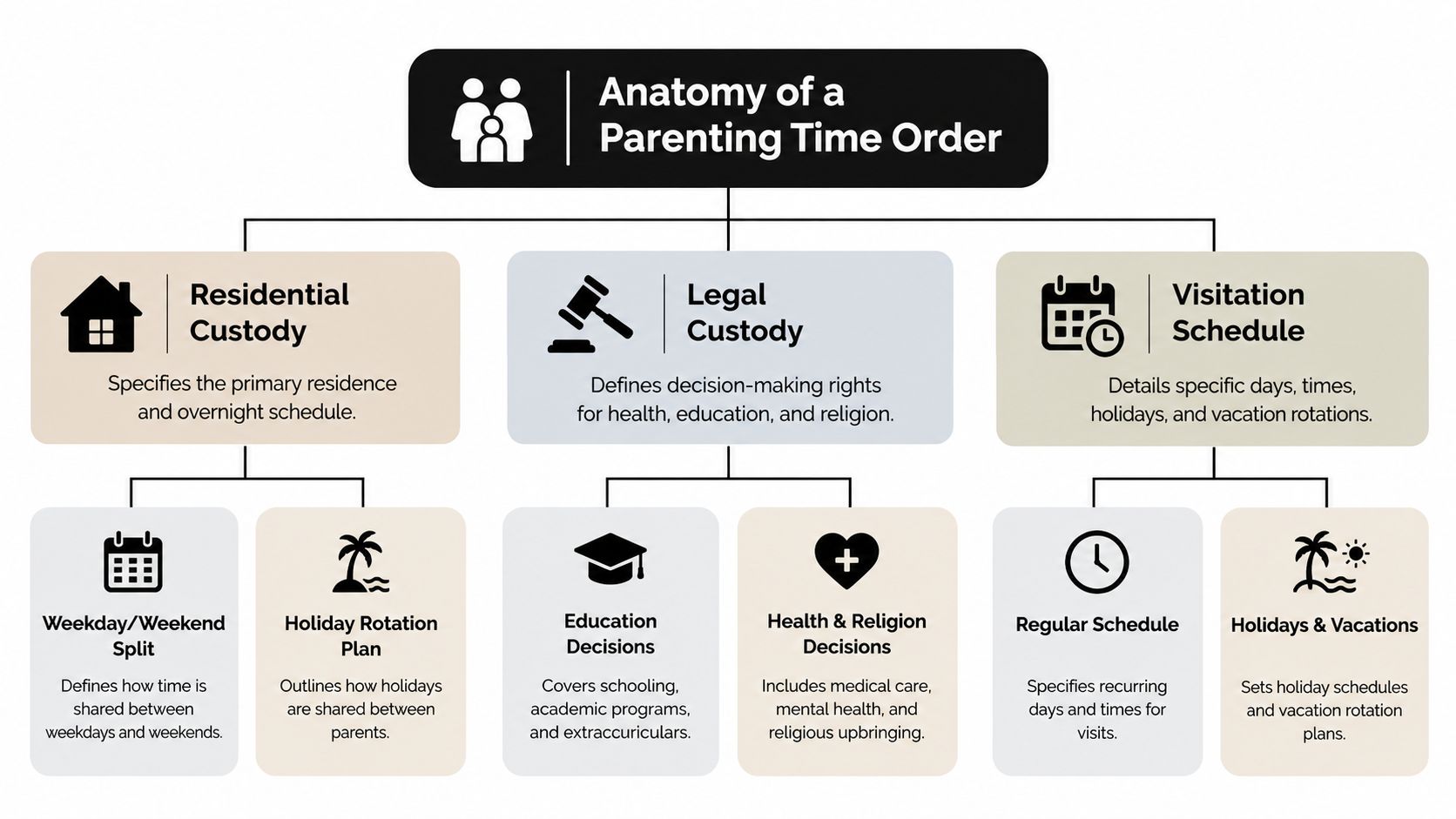
An informal agreement depends on cooperation in the moment. A parenting time order should work when cooperation is limited. Think of it as an operating manual for shared parenting. It can't predict every emergency, but it should answer the recurring questions that otherwise produce disputes.
A complete order usually addresses several connected areas:
- Residential arrangements: It identifies where the child lives and how overnights are divided.
- Decision-making authority: It explains who makes major decisions about health, education, and religion, or whether those decisions must be shared.
- Regular schedule: It states weekday, weekend, overnight, and transition times.
- Exchanges: It identifies the location, transportation responsibility, and any conditions for handoffs.
- Holidays and school breaks: It provides a rotation for holidays, birthdays, vacations, and breaks rather than relying on the regular weekly schedule.
- Communication: It can address calls, electronic contact, notice requirements, and reasonable boundaries around messages.
- Changes and makeup time: It should explain how parents request changes, how cancellations are handled, and whether comparable replacement time is available.
Public court guidance commonly emphasizes where the child lives, when each parent sees the child, exchange times, holidays, birthdays, school breaks, and communication rules. The parenting time guidance from the 55th Circuit Friend of the Court also highlights a recurring source of confusion, extracurricular activities don't automatically override parenting time.
The difference between a usable term and a vague term is often practical detail. “Parents will share holidays” leaves room for dispute. A workable provision identifies the holiday period, start and end times, exchange point, transportation, and what happens when the holiday overlaps with school.
For broader context on the questions a schedule should answer, see these parenting time guidelines. The order should be detailed enough that a neutral person can determine what was supposed to happen without calling either parent for an explanation.
How Parenting Time Orders Are Created, Modified, and Enforced
Most parenting time orders begin in one of three ways. Parents may reach a written agreement through mediation, develop terms through a collaborative process, or ask a court to decide after contested proceedings. The method matters less than the final document. Once the court approves the arrangement, the written order becomes the reference point for future compliance.
A verbal promise can still matter as background, but it usually doesn't replace the signed or entered order. If the parents informally change a weekend, record who proposed the change, what both parents accepted, the revised times, and whether makeup time was agreed. Otherwise, a later dispute may turn on whether the conversation changed the order or only created a one-time exception.
Modification requires a reason and usable proof
Schedules change because children's needs change. School timetables, work demands, relocation, medical needs, and sustained problems with exchanges can all prompt a request for modification. The parent seeking a change should connect the requested term to a specific practical problem, rather than presenting a general complaint that co-parenting has become difficult.
A strong modification request usually shows:
- The existing rule, quoted or identified precisely.
- The recurring problem, recorded by date and event.
- The effect on the child or schedule, stated factually.
- The proposed solution, including workable times and logistics.
- Supporting records, such as messages, school documents, receipts, or professional records.
Restricted or supervised parenting time requires careful attention to evidence. Family-violence guidance explains that supervised time is intended to preserve safe contact while reducing risk, and that the person seeking supervision must justify the restriction. The evidence guidance on parenting-time determinations identifies contemporaneous records, screenshots, medical or police records, business records, and school records as useful when they establish a connection between conduct, safety risk, and the requested change.
Enforcement follows the same logic
An enforcement request asks the court to compare the order with actual conduct. A dated timeline is more useful than a folder of unorganized screenshots because it shows sequence, frequency, and context. For practical examples of preparing an allegation, see this guide to custody order violations.
Don't retaliate by withholding the child, cancelling your own time, or stopping support. The Census Bureau reported that custodial parents were due $29.9 billion in child support and received $19.2 billion in 2022, illustrating how parenting arrangements often operate alongside continuing payment and enforcement records in the Census-based child support series. Parenting time and support should be addressed through the proper order and process, not traded as punishments.
The Key Details That Make an Order Work in Real Life
The strongest schedule can fail at the curbside if the order doesn't explain what happens there. Exchange language deserves the same care as the parenting-time calendar because transitions are where timing, transportation, communication, and emotion collide.
A practical exchange provision should identify the exact location, who collects and returns the child, and what happens if that location becomes unavailable. It should also address delays. “Promptly notify the other parent” is less useful than a clear method for giving notice and a defined process for offering replacement time, where local law and the order permit it.
Practical rule: Record the scheduled start and end time first. Then record the actual pickup and return, the person who transported the child, any shortened or cancelled time, and the reason given.
Transportation creates another common fault line. If a parent uses a relative, babysitter, or approved driver, the order should say whether that is allowed and whether notice is required. A parent who assumes personal transportation is mandatory may treat a lawful arrangement as interference, while a parent who sends an unknown driver without notice may create a legitimate safety concern.
Communication should reduce friction
Parents should decide which channel handles routine changes and which channel is reserved for emergencies. A narrow, factual message is more useful than a debate about motives:
- Useful: “The order lists the library entrance at the scheduled time. I'm here and will remain available until the stated end of the exchange window.”
- Unhelpful: “You're doing this again because you never respect my time.”
The same discipline applies to expenses. The order or written agreement should distinguish routine costs from medical, educational, childcare, and activity expenses. It should state how a parent gives notice, whether approval is required, what receipts must show, when reimbursement is requested, and how a disputed charge is handled.
One parent may pay an expense while the other disputes whether it was authorized. Without the receipt, date, child, purpose, payment record, and request for repayment, a small disagreement can become difficult to resolve. A separate expense log keeps financial questions from being mixed into every parenting-time exchange.
Precision prevents accidental violations
School events and extracurricular activities need special attention. An activity may be important to the child, but a parent shouldn't assume it automatically changes the other parent's scheduled time. The court FAQ on parenting time states that extracurricular activities don't trump parenting time, which is why parents should address attendance, transportation, notice, and conflicts directly in their written arrangement.
Why Structured Documentation Changes Enforcement Outcomes
Memory is a poor filing system. Parents remember the emotional intensity of an exchange, but court decisions usually require a more disciplined account: what the order required, what occurred, when it occurred, what proof exists, and what remedy would solve the problem.
Scattered records make that work harder. A text may contain the cancellation, a calendar may show the scheduled visit, a receipt may prove transportation, and a school record may establish where the child was. When those materials remain separate, the reviewer must reconstruct the timeline manually.
A structured custody journal changes the task. Each entry can begin with the same core fields:
- Event details: Child, category, date, time, and title.
- Schedule comparison: Planned start and end, actual start and end, and the difference.
- Exchange facts: Planned and actual location, transportation, and handoff result.
- Change history: Who requested the change, what was agreed, and whether makeup time was offered.
- Supporting material: Messages, screenshots, receipts, photos, school records, or files.
The value isn't the number of entries. The value is consistency. A parent who records every significant exchange in the same format creates a date-ordered account that can be reviewed without guessing which facts were added later or which details were omitted.
Neutral wording carries more weight
Emotional notes may reflect genuine pain, but they often blur fact and interpretation. “The other parent deliberately sabotaged the visit” states a conclusion. “The other parent arrived after the scheduled start, stated that traffic caused the delay, and the child was returned later than the order required” gives a professional something to assess.
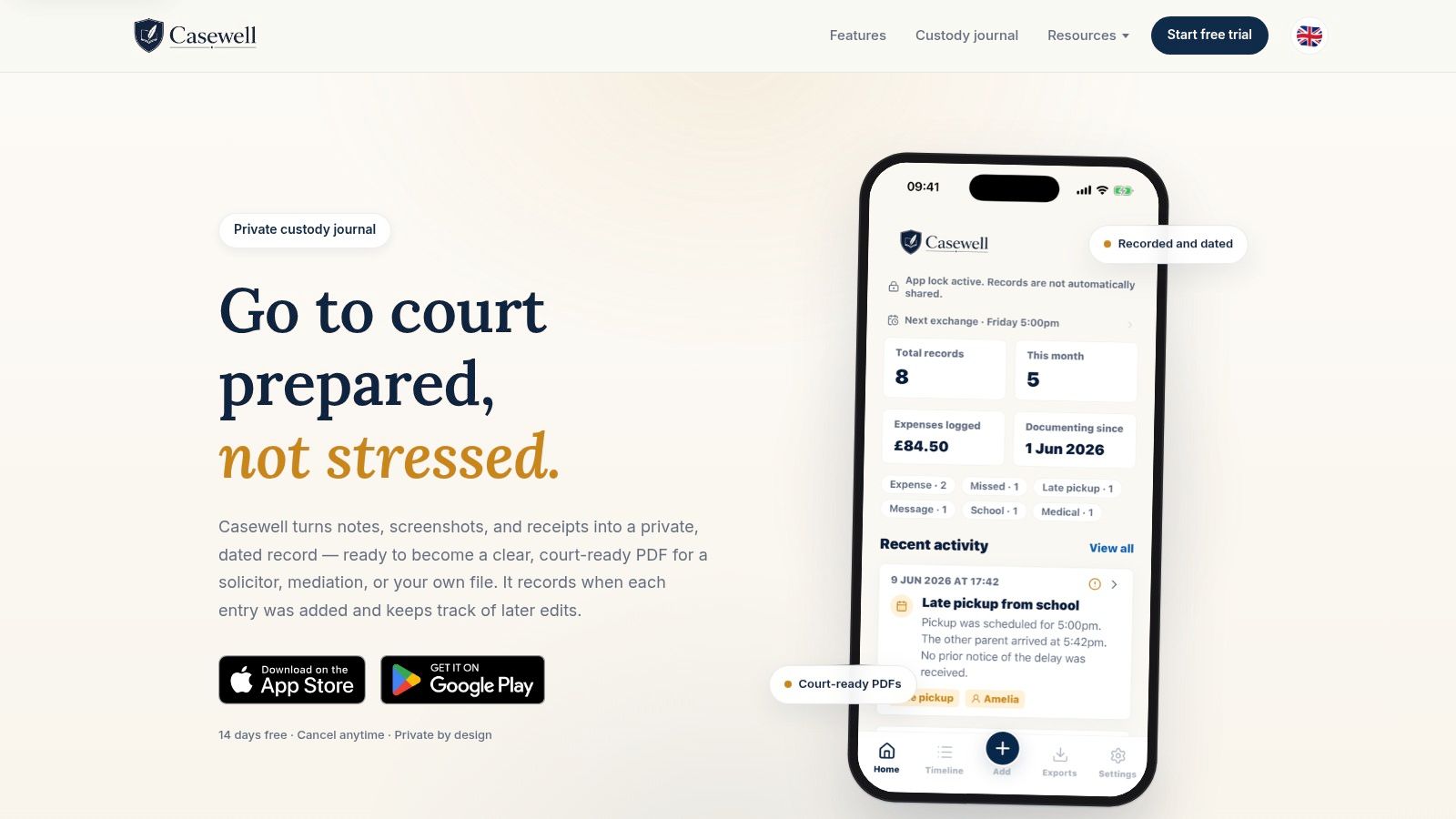
A tool that preserves the original entry, records later edits, and places attachments beside the event helps maintain that distinction. A focused court-ready report workflow can also reduce the time needed to prepare relevant materials for a lawyer or mediator.
Documentation doesn't guarantee a result. It does give the decision-maker a clearer basis for distinguishing a one-time misunderstanding from a repeated pattern, and a genuine safety issue from an unsupported accusation.
How Casewell Supports Private Custody Documentation
Parents can keep records in several ways. A paper notebook may suit someone who wants a simple private log. A spreadsheet can organize dates and expenses. A notes app can store messages and reflections. Those options become harder to manage when a parent needs linked attachments, edit history, child-specific filters, and a concise report for professional review.
Casewell is one private custody-journal option. It organizes records by child and category, with structured fields for the event type, title, date, time, and practical details. A parent can record an exchange, attach a screenshot or receipt to that event, and locate the entry later through a searchable timeline or activity calendar.
The workflow is most useful when it follows the order itself:
- Record what was scheduled.
- Record what happened.
- Identify any agreed change, cancellation, or missed time.
- Attach the source material.
- Note makeup time offered, accepted, or still unresolved.
The app also supports agreement records, exchange check-ins, and expense tracking. Expense entries can include who paid, repayment requests, amounts repaid, and the remaining balance. Those categories keep a reimbursement dispute separate from a parenting-time allegation, while still preserving the relationship between related events.
Private records versus shared communication
A shared co-parenting platform can help when both parents want one calendar, one message thread, and one jointly visible record. It may be less suitable when communication itself is high conflict or when one parent needs a private contemporaneous record before deciding what to share.
Casewell is designed for personal documentation rather than communication. It doesn't automatically share a parent's journal with the other parent. Its saved entry history preserves earlier versions, and optional AI factual rewriting can help produce neutral wording while leaving the original note available for review and approval.
That distinction matters. A private journal shouldn't become a place to manufacture a litigation narrative. Use it to preserve accurate facts, original documents, and the sequence of events. Before submitting anything, review the report with a qualified lawyer or mediator who understands the governing jurisdiction and the specific order.
When Structured Records Matter Most
Consider two versions of the same exchange dispute. In the first, a parent has a long message thread, several photographs with unclear dates, and a handwritten note saying the other parent “kept changing everything.” The concern may be real, but the reviewer must spend time sorting the material and deciding what happened first.
In the second, each scheduled exchange appears in date order. The record identifies the planned location, actual location, scheduled time, actual handoff, message that proposed the change, and any makeup time offered. The attached proof stays with the relevant entry, so a professional can assess the pattern without searching across unrelated conversations.
Structured records are particularly useful when:
- Supervised transitions require careful tracking of safety conditions and contact.
- Relocation disputes involve school schedules, travel, notice, and proposed replacement time.
- Repeated exchange problems make isolated explanations less persuasive than a consistent timeline.
- Expense disagreements require receipts, payment details, requests, and repayment history.
- Modification requests depend on showing how the existing schedule operates over time.
A parent preparing to enforce an order shouldn't wait until a hearing is scheduled. The guide to proving parenting time reflects the practical importance of dates, original communications, and records that connect the alleged violation to the order.
The before-and-after difference is straightforward. A scattered file asks the lawyer to investigate. A consolidated record lets the lawyer evaluate, advise, and act.
Frequently Asked Questions About Parenting Time Orders
Is parenting time connected to child support?
They often appear in the same family-law case, but they are generally separate obligations. A parent shouldn't withhold support because parenting time was denied, and a parent shouldn't block parenting time because support is late. Address each order through the appropriate enforcement or modification process. The Census Bureau's custody and support data shows how closely these systems operate in separated families, with 69.8% of custodial parents who were supposed to receive support receiving at least some payment in 2017, as reported in the Census child support publication.
Which terms are enforceable?
The clearest enforceable terms are the ones written as specific instructions, including dates, times, locations, transportation duties, notice requirements, and defined holiday periods. Statements such as “parents should cooperate” may express an important expectation, but they don't answer what either parent must do during a disputed exchange.
What happens if an extracurricular activity conflicts with parenting time?
Read the exact order first. Don't assume the activity cancels the scheduled period. The court guidance cited above states that extracurricular activities don't automatically trump parenting time, so parents should address notice, transportation, attendance, and replacement time in writing.
What records should be prepared for mediation or court?
Bring the order, a date-ordered timeline, original messages and emails, exchange records, school or childcare documents, receipts, and any relevant medical or official records. Keep entries factual, preserve the original files, and separate what you directly observed from what someone else reported.
What should happen after a missed exchange?
Record the scheduled and actual details, the reason given, the time missed, and any makeup time offered or agreed. Avoid turning the incident into a retaliatory cancellation. If violations continue, ask a family-law professional how the court that issued your order handles enforcement.
Casewell gives parents a private custody journal for dated exchange records, agreements, expenses, attachments, and focused court-ready PDF reports. Visit Casewell to organize the facts behind your parenting time order before the next dispute becomes harder to explain.