

What do co-parenting costs include?
Co-parenting costs are not one bill. They include everyday spending while a child is present, child maintenance paid between homes, agreed shared expenses and reimbursements. They can also include duplicated housing, clothing, equipment and travel.
Child maintenance is a regular transfer towards a child's living costs. A shared expense is usually a particular item, such as a school trip or prescription. A repayment is money requested after one parent has already paid. The applicable agreement or calculation may treat these types differently.
That distinction matters when reading statistics. A maintenance total does not reveal who bought a second bed. A poverty figure does not show whether a football fee was repaid. Adding unlike figures together would create a confident-looking answer that the evidence cannot support.
What do the headline UK figures show?
The Department for Work and Pensions estimates that 2.4 million separated families in Great Britain included 3.9 million children in the financial year ending 2025. About 65% had a child maintenance arrangement. Roughly two thirds of those arrangements were non-statutory, meaning they were made outside the statutory service.
Across the three financial years ending 2023 to 2025, parents with care received an estimated £2.9 billion each year. DWP estimates that the payments kept 120,000 children out of relative low income after housing costs. This describes income movement between homes, not the full cost of caring in both.
The measure also uses a “parent with care” and a “non-resident parent.” Those administrative labels do not describe every shared-care family neatly. They should not be read as a judgement about involvement, legal responsibility or the quality of either parent's care.
Source: Department for Work and Pensions, Separated families statistics — Great Britain; annual estimate based on the three financial years ending 2023 to 2025
Why can two homes cost more than one?
Some costs follow the child. Food, local travel and daily activities rise mainly when the child is present. Other costs must be available throughout the month. Rent, heating, internet and a suitable bedroom do not halve because the child spends nights elsewhere.
Many families also duplicate practical items. A child may need bedding, toiletries, chargers, basic clothing, medicine storage and school equipment in both homes. Duplication can reduce stressful packing and forgotten items. But it uses money that a one-home budget may not show.
Distance adds another layer. Fuel, public transport, accommodation and time away from work may support contact or handovers. The DWP survey found that only 10% of surveyed Child Maintenance Service users said contact costs such as travel or accommodation were included in their calculation.
Does 50/50 parenting mean expenses divide equally?
Equal parenting time describes time, not identical household finances. One parent may earn more, pay childcare directly or cover costs that serve both homes. A child may also spend equal nights in homes with very different housing and travel costs.
UK child maintenance calculations can reduce liability for overnight care. In the DWP survey, 44% of CMS users said overnight care was factored into their calculation. Twenty-one per cent did not know whether it was included, and the report warns that some respondents may have misunderstood the question.
A percentage of nights so cannot settle every expense. Parents still need to identify what the regular calculation covers. This costs need prior agreement and how later reimbursements will be handled. A solicitor or qualified adviser can explain the effect of an exact arrangement.
Which expenses are most likely to be disputed?
Disagreement often begins before the amount is discussed. The parents may differ about whether an item was needed, whether consent was needed or whether maintenance already covered it. A receipt proves that money was spent. But it does not prove that the other parent agreed to contribute.
School costs, childcare, healthcare, activities, clothing and travel create recurring questions. Was the cost expected? Was a cheaper option available? Does the child use it in both homes? Was the contribution meant to be equal or linked to income?
Timing creates another problem. A request may be sent weeks after payment, or a partial repayment may arrive without a reference. Keeping the original cost, requested share, amount received and balance as separate fields makes the history easier to understand.
Source: Department for Work and Pensions, Separated families statistics — Great Britain; association by arrangement type, not a causal estimate
What should a useful expense record contain?
Start with the date, child reference, provider, item and total paid. Add the type and the child-focused purpose. Attach the complete receipt or invoice rather than relying on a bank line that may not show what was purchased.
Next, record the agreement context. Link the relevant clause, email or message if one exists. State the amount requested, the date of the request and any response. If payment is partial, keep the original amount and calculate the balance separately.
Use factual status labels such as recorded, requested, part-paid, paid, disputed or no response by a stated date. Do not silently change a disputed cost into an unpaid debt. The underlying agreement and local law decide whether any contribution is due.
Worked fictional expense record
This example separates the purchase, agreement, request and later payment. It does not decide whether the contribution is legally due.
- Expense
12 September 2026 · Child A · school residential-trip deposit · £180 paid to Northfield School.
- Purpose and source
Deposit needed to reserve the child's place. Full school invoice attached as EXP-024-A.
- Agreement context
Parenting agreement says agreed school trips are shared equally. Message approving the trip on 4 September attached as EXP-024-B.
- Contribution requested
£90 requested on 12 September with the invoice and payment receipt.
- Response
Other parent confirmed £60 on 15 September and disputed the remaining £30. Complete message thread kept.
- Payment and balance
£60 received on 18 September. Recorded balance: £30 disputed, not described as an established debt.
How can parents track expenses manually?
A spreadsheet can work when entries are consistent. Give each cost one row and keep receipts in a matching folder. The free co-parenting expense checklist shows the fields, while the child-expense tracker gives a reusable structure.
Keep maintenance payments separate from itemised expenses unless your agreement or the applicable system combines them. This prevents a routine payment from being counted twice or a separate school cost from disappearing inside a general total.
Review open balances regularly. Add later payments as new dated events instead of replacing the original request. A record that shows both unresolved and resolved items is more useful than a folder containing only disputes.
How does Casewell organise expense records?
Casewell lets one parent keep a private timeline without requiring the other parent to join. Add the expense date, amount, type, notes and receipt to the event it explains. Related messages can remain beside the cost instead of being scattered across several apps.
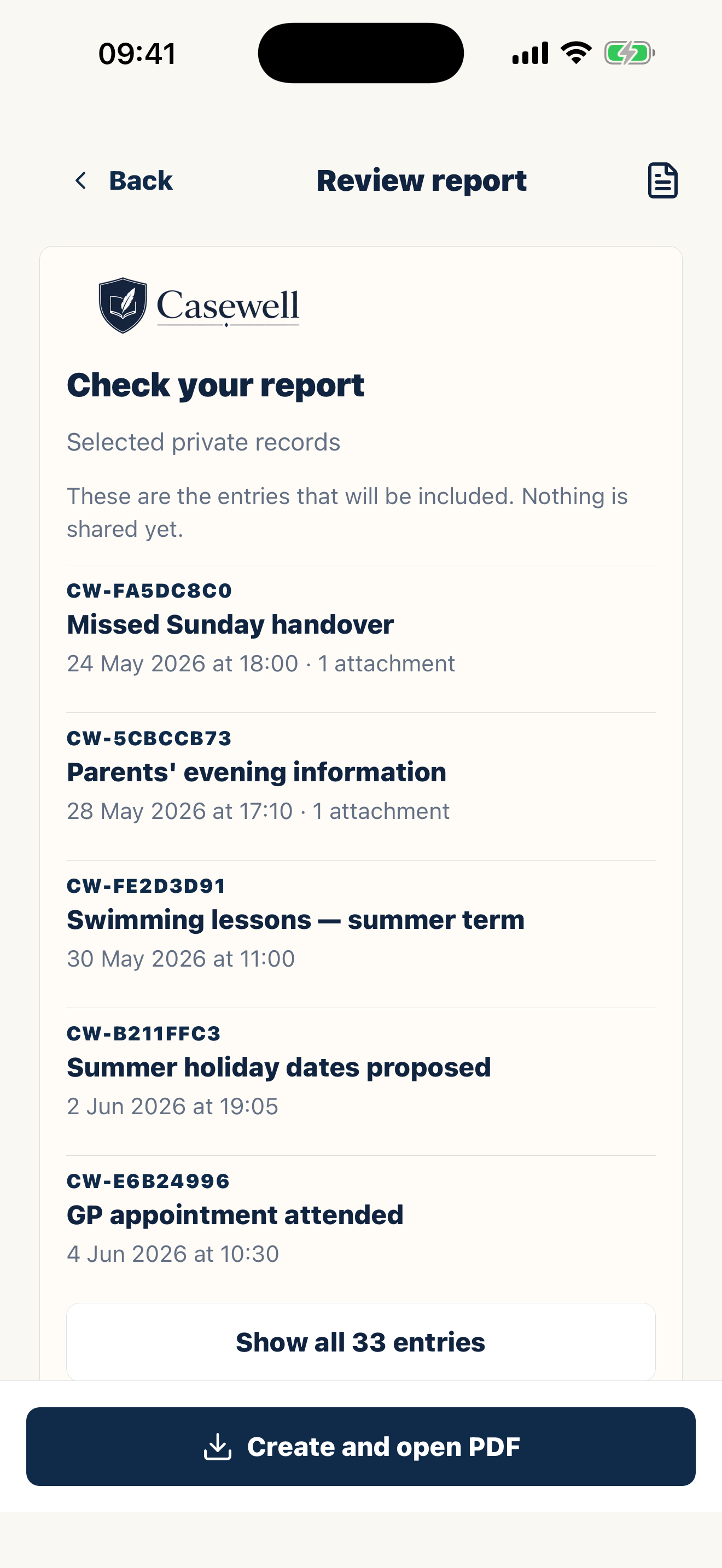
You can search and filter the timeline when a solicitor, mediator or adviser needs a defined period or type. Selected entries can be clear into a PDF report for expert or court-related review. The complete private record remains under your control.
“Court-ready” means clear, dated, factual and prepared for review. It does not decide whether a cost is recoverable or a document is admissible. An expert or court decides relevance, court process and admissibility.
What do these statistics say about family finances?
Public systems are better at counting transfers than duplicated household life. They can record a maintenance arrangement, payment or registered address. They rarely see two sets of bedding, repeated transport or the hours spent matching receipts to messages.
Resources shape which arrangements are practical. Two suitable homes near school need housing capacity. Flexible work can reduce childcare and handover pressure. Lower-income families may have less room to absorb an unexpected activity fee or delayed repayment.
That does not make one parenting arrangement financially or morally superior. It shows why time percentages alone are incomplete. A workable plan must consider income, fixed housing costs, distance and the child's actual needs.
How should you review an outstanding expense?
Start with the source that governs the cost. Check the agreement, order or written discussion before calculating a share. Then compare the original receipt with any refund, subsidy or later adjustment.
Keep the amount requested separate from the amount paid. If a payment does not clearly identify the expense, record the uncertainty instead of allocating it by guesswork. That small distinction can prevent a misleading balance.
Finally, add a dated outcome. Mark the item paid, part-paid, disputed or withdrawn using factual language. Recording everyday resolved costs alongside disputed ones gives a solicitor, mediator or adviser a more complete history.
What is the useful conclusion?
UK statistics show that maintenance moves substantial money between separated households and reduces child poverty. They do not produce a universal price for co-parenting. Much of the extra pressure sits in housing, travel, duplicated items and costs paid before agreement is clear.
The practical response is to define types and keep the history of each cost. Record what was purchased, why, what was requested and what was later paid. Keep everyday maintenance separate unless the relevant arrangement says otherwise.
Casewell gives that work a private timeline, receipt files and clear exports. Track co-parenting expenses in a private, court-ready timeline with Casewell.
Keep each expense connected to its evidence
Casewell keeps the amount, receipt, request, response and payment history in one private timeline. Filter selected records into clear PDF exports for expert or court-related review.


Does co-parenting always cost more?
Not in a fixed or measurable percentage. Some spending moves between homes, while housing, travel and everyday equipment may be duplicated. The result depends on care time, distance, income and the child's needs.
Does 50/50 parenting mean every expense is split equally?
No. Equal time does not create identical incomes or costs. The applicable maintenance calculation, agreement or order decides how regular and more expenses are treated.
Should maintenance and shared expenses be recorded together?
Usually they should remain distinct unless the applicable arrangement combines them. Separate records reduce double counting and make itemised requests easier to follow.
What can Casewell record about an expense?
A Casewell entry can keep the date, amount, type, notes, receipt, related messages and later payment history together in a private timeline.
What does court-ready mean for an expense record?
It means the record is clear, dated, factual and prepared for expert or court-related review. It does not decide recovery, admissibility or a particular outcome.
Sources
The sources measure different populations and financial questions. Maintenance received, household poverty, care time and itemised expenses are related. But they are not interchangeable. The figures show reported patterns and administrative outcomes rather than a universal extra cost caused by co-parenting.